Sunday, June 12, 2011

A look at A New Beginning, advertisement in manuals and upcoming games by Daedalic


Seems I'm a bit late to the party, as the English localization of the latest game by the makers of Edna & Harvey and The Whispered World has been finally released in the UK about a week ago or two. It's been sitting on my shelf shortly after it came out in Germany last year, but since it doesn't run on my Netbook (damn intel and their fake pixel shaders) I don't get to play it that much.

The premise to A New Beginning reminds of Twelve Monkeys, only here the world has been destroyed by global warming. So the few surviving humans send teams back into time to get their hands on the research of the aging biologist and ex-environmental activist Bent Svensson.


After a prologue with Svensson where he solves the seemingly trivial task to get his fogger running and meets the visitors from the future, the first portion of the game consists of a flashback. The future people have miscalculated the period for the global warming, and it turns out in 2050 the world is already destroyed. Almost all teams quickly die in horrible deaths, only fay and two of her colleagues survive, and she has to find a way to get to the correct time period.


Other than most modern adventure games, interaction with the environment doesn't just come down to "click on stuff or don't", as the game brings back the verbs of the good old days. It's all contextual, of course, but most of the time there are at least one or two "unneccessary" alternate actions that can be done with any object. The interface is a bit annoying, though. There's a delay to the popup-menu for the verbs, and I quit the game more than once just because I didn't want to put up with the slow interface. Could be my old computer's fault, though.

Since I'm playing the German version, I can't talk much about the voice overs, but even in the original, the writing and performane seem awkward at times, especially for Fay, who acts and talks like a little girl (that might be intentional since she's from the future and totally naive and all, but it's still unpleasant and makes the environmental message seem all the more "in your face"). The atmosphere is quite cool, though, mostly thanks to the gorgeous graphics, although every animation that isn't the standard walkign loop is very choppy.


The puzzles so far are standard fare, except for a confusing installation of a n antenna. Some are a bit too constructed — why is the key to Bent's cellar stuck behind a photo on the wall? (The answer: Because the game wants the player to notice the descriptions of the people on the photos) All that said, I do like the game, but I'm just a tiny bit disappointed after all the praise it got. Maybe I get really hooked later in the game, but I've progressed well further than an ordinary demo length so far, so the game takes at least it's pretty time to get into its gears, puzzle-wise.


I really wanted to talk about the manual, though: About a third of its space is reserved for ads. And it is awesome. Allmost all the ads are for other games by publisher Deep Silver, which are mostly adventures, so all stuff buyers of A New Beginning might actually be interested in. The whole manual is in glossy full color, with the cover designed like a vintage comic book. It even spends five pages to get players started with the solution to the first puzzle. When looking at games from other European publishers like the direct competitor dtp or EA Europe, whose games have b&w manuals even in the collector's editions, this one was really stunning. There's a definite "yay" from me for ads in game manuals, at least when done in this fashion. The game&mdahs;no "collector's edition", even—also comes with the game's soundrack on an extra CD and a folded poster. (It seems the UK version has the same package, at least judging by the product pictures on Amazon UK.)


One of the games advertised in A New Beginning's manual is Deponia, which on first glance almost looks like a parody of A New Beginning. The reason is, the whole game takes place on a giant landfill. Amazon UK lists the game for a release in October, but seeing how the game doesn't even seem to have a release date for Germany yet, that is probably just made up.


That's not all Daedalic have up their sleeves right now. Their most recent annnouncement, a tie-in with the The Dark Eye fantasy role playing world, looks even more gorgeous than everything they did before. In the role of a cursed trapper, players have to fight against their fate in front of the most brilliant hand-drawn backgrounds ever seen in an adventure game. The game titled Satinavs Ketten (Chains of Satinav) will probably still take quite a while before its finished, though.


Friday, June 10, 2011

Star Control fan sequel – Project 6014


I only discovered the demo yesterday, despite it coming out in November 2010, so am definitely late to the party. But if I missed it, then did others no doubt. The demo is only about 30 minutes long, but it has tremendous potential and is easily one of the best pieces of fan-work that I’ve seen.
.
.
.

Official page is here.

Official UQM forum topic is here.

Started because the guy behind it was tired of waiting for a true SC2 sequel, this is touted as Star Control 2.5 and – if the demo is any indication – is probably one of the best fan homages I’ve come across. Set not long after the end of SC2, it takes place in a mostly new map, shifted to the South West of the old galaxy. There’s detailed explanations for what happened to each of the other races, from both the Chmmru and Earth base guy, and a mystery to solve. The Chmmr picked up a faint distress signal from a Shofixti scout vessel exploring uncharted space, but they can’t quite tell where, giving you only a general area. Speaking with the Shofixti at the Gorno stars reveals three scouts are on patrol – putting these two pieces of info together takes you to an area of space with a couple of solar systems to explore. On the outer planet of one you’ll come across the sinister Lurg and a squadron of Prawn ships (genetically altered lower organisms which the Lurg control for space flight). Take them out (the Chmmr ships work best) and you’re rewarded with a cut-scene.


All pretty simple, but it’s the perfect execution in this demo which impresses.

The freshly drawn graphics for the Earth communications screen, plus the Lurg and their ships, is impeccably done, and absolutely fitting with the SC2 universe. It reminds me why I love old DOS graphics – they can be quite beautiful! And it saddens me to think that modern companies totally don’t get this, choosing to redo things in HD and making them look ugly (Half Minute Hero on XBLA is the perfect example of a beautiful low-res game made hideous in HD).

Apart from the Lurg none of the other races have voice acting yet, but damn – the Lurg are PERFECT. Really great acting and some top notch voice modulation. Right away they grab your attention as being sinister creatures – possibly moreso than the Ur-Quan. And, for some great fan-service, can you guess what they were based on? Awesome. Their ships aren’t as scary as they make, farting a wall of paralysing bubbles and shooting semi-homing shots, but the design is good and I can see them proving to be interesting enemies. A couple of Chmmr should be able to take down five Prawns easily though.

In addition to the voice acting the script needs special mention. For something done by fans, it fits so well with the SC2 universe. It’s not overbaked, but it doesn’t feel like it was restricted by being too obsessed with canon – you’ll have to judge for yourselves, but for me it perfectly treads the line between respecting the source and taking it in a new direction. And it’s funny! Wait until you bump into the Slylandro, having been brought space-bound through a prank of the Umgah’s, and read their dialogue. The original SC2 was hilarious in places, and there’s some choice sci-fi references going on in this fan sequel.

Finally, I am really digging the puzzle design. There was a puzzle in SC2 where the Syreen mention that their ships must be a specific number of space units away from their current location, on a planet with a specific type of sun. Following the clues yields only about 3 possible systems, and by following this cookie trail and exploring the planets you’ll soon come across them. it was extremely satisfying solving this puzzle, and they’ve employed a similar one here. The fact that the clues also show up on your space chart is a bonus, and makes the game very user friendly. It’s not elaborate and so far it’s just one example of design - but I love it, and it bodes well. I hope they really think outside the box and come up with some great stuff.

Of course being a demo it's still lacking several things. You can land on planets but can't pick up any minerals (biological data is fine though) since you don't have a cargo bay, plus you can't buy additional modules for your new ship. There are fighter craft you can build though, and you do start with a generous amount of RU.

As of now they say the project is ticking along nicely, they’ve finalised the general story arc (even if they’ve not written the script), and things are looking good. So many fan projects fade away, especially the more ambitious ones, but I sincerely hope this team has the resolve to carry it through, because it’s looking ace so far.

Try it for yourself!

Tuesday, June 7, 2011

Update - 6/7 - More Book Info, Super Monkey Daibouken


The book page has been redesigned so it's not quite so slapdash looking, and has a bit of extra info, if you're curious. It's also available at Amazon UK...sort of. You see, there are different royalty tiers with the publisher I'm using - unfortunately, the royalties only really apply if you buy it from Createspace or Amazon US, and the amount I get for copies sold through other outlets is a pittance (69 cents, to be precise...which for a $27 book is kind of absurd). So what I'm basically saying is, if it's not terribly inconvenient and you'd like to be awesome and support the site, please order from Createspace or Amazon US, if you can. It would be much appreciated. (The Kindle versions are unaffected by this, so buy from whichever region it allows you to.)

If that's unfeasiable...well, even though there's a listing on Amazon UK, it doesn't seem like they've stocked it (yet). So, in order to fix this, I've set myself up as a third party seller and shipping books directly from the printer. I've tried to keep it as close to retail price as possible, since it doesn't let me adjust shipping charges (trust me, it costs way more than three pounds to ship), taking into account the exchange rate and all.

Anyway, since we neglected to put up a Weekly Kusoge late last week, we're making up for it with a look at Ganso Saiyuuki: Super Monkey Daibouken, one of those incredibly tragic Famicom titles that fails hilariously on pretty much every level. We'd also like to call your attention to the Dezaemon article from a month or so back. It had the unfortunate timing of being posted around the time when the PSN went down, and you can get the PSOne version import from the online store for a pittance. It's definitely worth checking out.

Sunday, June 5, 2011

THQ is really late to the party.

I mean really really really really really really late to the party with it's advertising for Devil's Third.

Friday, June 3, 2011

Update 6/2 - The Games of Donald Duck, Psycho Dream, Neural Gear, Strikers 1945


The headline article this update is the games of Donald Duck, which covers over twenty title starring Disney's easily irritable water fowl. It's an expansive article, seven pages in length, with some absolutely fantastic material. It includes a look at Sierra's classic computer title, as well as an interview with Al Lowe, its designer from way back when. It also desperately makes me want to replay Quackshot - I don't think I've touched it since I rented it over at a friend's house in sixth grade. It also accentuates how popular Donald Duck still is in Europe, something I was never aware of. It also includes an interview with Darlene Lacey, a producer at Disney who was at the head of a handful of games, including the NES version of Duck Tales.


On the extremely obscure side, we have looks at Psycho Dream, a Super Famicom sidescroller from Telnet, and Neural Gear, a rather cool 3D Space Harrier-style shooter for the Sharp X68000. Continuing with more shooter coverage is Strikers 1945, arguably Psikyo's flagship series. (If you don't count Gunbird or Sengoku Ace...it could go either way.) We also updated the Trouble Witches article to detail some of the additions to the recent XBLA port...which as it turns out, isn't a whole lot, other than some new graphics and several additional characters. And if you haven't already, please check out the Brief History of Western Action RPGs from a few days back, which chronicles dozens of computer games ranging from 1978 to 2000. Just please don't explode the comments regarding an off-the-cuff remark regarding the quality of Mass Effect 2, as what happened in the Kotaku article. I know Bioware are the guys to hate nowadays, but c'mon, really.

Friday, May 27, 2011

A Brief History of Western Action RPGs


The action RPG is a genre that could thrive first and foremost in Japan, where influences of personal computer games often resulted in new interpretations on game consoles, thus benefiting a healthy melange of genre traditions. Mixtures like that were initially fewer in the West, due to the consoles and arcade games being marked mindless quick entertainment by an elitist home computer crowd for real deal hardcore simulations and RPGs, which were the domain of computers with lots of memory (for the time) to store all those stats. Yet early on there were a few attempts to adapt what was originally inherited from tabletop war games to a more responsive and involving model, and with the slow demise of slow-paced turn-based gameplay eventually ARPGs would catch on as a main stream genre also among Western developers.

The rise in popularity of the genre in modern times may deceive from the fact that it has truly ancient roots, and there is much confusion and oblivion about the actual early innovations. So, following up on our Brief History of 2D Fighting Games, we'll have a look at what was going on with the ARPG genre in the US and Europe over the decades. (I know a lot of you will be yearning for a parallel feature on Japanese games. Such a thing is bound to follow some day, but don't hold your breath just yet.)

Of course I am likely to be eaten by a grue for all the omissions and games I simply didn't know about. Everyone's got their own definition of what belongs in the genre, too, so please be nice when you point out to me all the games I've idiotically left out/falsely included. Please also note that I originally put this post together late in 2010, but ended up not posting it for a number of reasons. I haven't really followed the genre since then, so this is a history for the time until 2010.

Adventure (Atari 2600)


1980-1982:
  • Adventure is released for the Atari VCS in 1980. Yeah, it doesn't have The RPG Elementz(TM), but that doesn't mean it was not an important antecede for the Action-RPG genre. For the first time in an action game, players got to do adventurey stuff, exploring dungeons, finding keys and weapons. Probably exerted more influence on Zelda and the Japanese ARPG tradition than the western one, though, directly or indirectly.
  • Most of the very early computer RPGs have their roots in Dungeons&Dragons applications for big university mainframe computers, so it's hard to work out a timeline for them, but from 1980 to 1982 a lot of them have been ported to home computers, as well as some new, original games. Automated Simulations' (later Epyx) Dunjonquest series and The Sword of Fargoal, as well as Daniel Lawrence's Telengard still played out pretty much like "normal" RPGs with a time limit to your moves.
  • Dungeons of Daggorath did similar for the 1st person crawl (although it had a really interesting feature of a heartbeat sound indicating your level of fatigue and damage and at the same time giving a greater sense of urgency).
  • Also from Automated Simulations, Dragon's Eye combines boardgamey exploration with what can only be described as a fighting game with an ATB battle system, as little sense as that seems to make on paper.
  • The first batch of official Dungeons & Dragons games is released for the Intellivision, but only Treasure of Tarmin vaguely resembles an RPG/Adventure experience.
Dragon's Eye (Apple II)

1983:
  • Gateway to Apshai, an offshoot of the Dunjonquest: Temple of Apshai RPG series, is the first ARPG proper world-wide, predating even the Japanese genre forebears Dragon Slayer and Hydlide. Combat takes place in real-time with reliance on player skill, although there are also stats to be leveled up (which happens mostly automatically without offering any choices for the player), and there is a lot of loot to find in the dungeons. This being a pure dungeon crawler, only NPC interaction is missing from the modern standard formula.
  • Dandy by John Palevich is the progenitor to Gauntlet. It gets later remade as Dark Chambers in 1988.
Gateway to Apshai (C64)

1984:
  • Gemstone Warrior, SSI's first dabbling with the genre, is more of an action adventure by today's standards. The player once again explores dungeons and kills monsters in real-time and searches for treasures which amount to the score. There's item management and a limited supply of ammunition, but no experience system.
  • Icon: Quest for the Ring by the small and unknown developer Macrocom plays like a simplified Gateway to Apshai, but surprises with astonishing CGA techniques that avoid the typical ugly 4-color scheme and make for one of the best looking IBM-PC games of its time. According to a developer interview at MobyGames, the game was popular as a demo for graphic cards in Japan. Could it have been a direct inspiration for Zelda?
  • Also into adventure territory falls Knight Lore, which explores the isometric perspective (and later influences the use of the perspective in Adventures/RPGs in general, as well as Solstice and its successors in particular, which in turn inspires Landstalker and its sequels).

1985:
  • Origin Systems creates Autoduel, the first racing RPG. Eat that, Squaresoft's Racing Lagoon.
  • Also published by Origin Systems is Moebius: The Orb of Celestial Harmony. The game takes place in a vaguely far eastern fantasy setting, with a focus on martial arts training and a fighting game style combat system. The characters awkwardly walk around as profile pictures and the combat controls are horrendous, but the concept is nonetheless unique and interesting.
  • Gauntlet is released the same year. Though also not quite an ARPG in itself, it is save to assume that without Gauntlet, there would be no Diablo (and in consequence neither most other WARPGs we know today).
Auto Duel (C64)

1986:
  • Gemstone Healer, sequel to Gemstone Warrior.

1987:
  • Conceived as an RPG for dummies, David Joyner's Fairy Tale Adventure might be the first western game that fits all modern ARPG definitions without fail, finally causing some steam for the (nowadays) classical top-down ARPG in the west.
  • Dungeon Master brings 1st person real-time RPGs en vogue. With a fighting system based on intervals slightly resembling the later Final Fantasy ATB, it is also no "true" ARPG, though. Aside from a sequel, tons of games follow its formula for combat, among them Bloodwych (1989), Eye of the Beholder (1991), Black Crypt (1992), Lands of Lore (1993).
  • Macrocom delivers a follow-up to Icon with 7 Spirits of Ra. The game takes place in ancient egypt.
Faery Tale Adventure (Amiga)

1988:
  • Times of Lore (Origin Systems). The NPC interaction is as complex as you'd expect from an Origins game at that time, there's no character generation but a selection of three pre-built heroes, and the combat is fully realtime action. Might or might not be the first game with jiggle animation for the female protagonist.

1989:
  • Hero's Quest: So you want to be a Hero (later renamed to Quest for Glory because of legal issues with Milton Bradley's board game) at one hand was a typical Sierra adventure, but also featured different stats and classes for the characters, which have a huge influence on how the game is played, as well as action based combat.
  • Hillsfar is more like an RPG/Mini Game compilation. Arcade style combat takes place only in the Arena.
  • Windwalker is the sequel to Moebius and fares much better thanks to icon-based mouse controls.
  • Also: Gauntlet II.
Quest for Glory (DOS)

1990:
  • Darkspyre by Event Horizon Software could be seen as another antecede for Diablo, albeit with fixed dungeon layouts.
  • Origin's Bad Blood is similar to Times of Lore, but shifts gameplay even more towards action-adventure and is set in a postapocalyptic future where one of three mutant spies is sent out to investigate and avert human war plans.
  • In The Keys to Maramon, a spin-off of the The Magic Candle series, the player gets to chose between four characters and then has to protect the town of Maramon against invading monster hordes. The game features a day/night circle: At night all shops are closed and the fiends start storming in.
  • Quest for Glory continues with its first sequel, the main character can be imported in good, old-school RPG fashion.
Bad Blood (DOS)

1991:
  • Two games based on Norse mythology are released that year. In Dusk of the Gods, Event Horizon builds upon their groundwork laid with Darkspyre, while the Britains at Core Design put themselves on the genre map with Heimdall.
  • Conan the Cimmerian hails as the first licensed ARPG not based on a pen&paper or tabletop game. For combat the game switches to a fighting game-style 1-on-1 sideview.
  • Another licensed title, Robin Hood: Prince of Thieves, was adjusted to tie in with the Costner movie just in time, leaving an unfinished feel about the game. Released for Game Boy and NES, it is the first console exclusive western ARPG.
  • Gauntlet III: The Final Quest (Won't be mentioning any more episodes of Gauntlet beyond this. With the genre as developed and defined as it is by now, the series just doesn't cut it anymore.)
Dusk of the Gods (DOS)

1992:
  • Ultima VII makes first (very slight) concessions towards a more action-oriented combat by introducing realtime.
  • The big attraction of the year is Ultima Underworld, though, with its real-time rendered 3D world, predating even Wolfenstein 3D.
  • Event Horizon bring a direct sequel to their 1990 debut, called The Summoning, so in this year one of the last great 2D dungeon crawl ARPGs (for a while) meets the first great realtime-3D dungeon crawl ARPG.
  • Sierra releases Quest for Glory III.
Ultima Underworld (DOS)

1993:
  • Ultima Underworld II is released, but doesn't stray much from the paths laid out by the first game.
  • Event Horizon in the meantime explore more adventure-esque paths with Veil of Darkness (which in a way anticipates their much later game Sanitarium). This is their last game before closing and reforming as DreamForge Intertainment.
  • In Hired Guns by DMA Design a team of 4 cyber agents infiltrate futuristic complexes in real time over 4-splitscreen, similar to the Dungeon Master formula. Quite a stressful task for a single player, so the game also supports multiple players simultaneously. (For comparison, the first big Japanese multiplayer ARPG, Secret of Mana, was released the same year).
  • Only one year after the third part comes Quest for Glory IV.
Hired Guns

1994:
  • Warren Spector, formerly of Origin System, changes the world with System Shock and its genius mixture of RPG and FPS elements.
  • Probably through influences from Japan, western developers by now also seem to discover the console-style ARPG for themselves. SSI's Al Qadim: The Genie's Curse would have worked just as well on the Genesis or SNES
Al Qadim
  • Interplay for once releases an ARPG that isn't a straight port of a computer game, but adjusted to what they deemed suitable for the platform - J.R.R. Tolkien's Lord of the Rings Volume One for the NES has (other than shared source, art and music) little in common with its PC counterpart, which is a traditional turn-based RPG. With a party of up to five, each of which can be controlled by a human player, it has the highest simultaneous player count in an offline ARPG ever.
  • Blue Sky software delivers a console title as well, Shadowrun for the Genesis (while the SNES game is more like a traditional RPG in that, though realtime, player effort has little influence over the combat vs character stats).
  • King Arthur & the Knights of Justice shares many features with an ARPG, however it lacks a levelup system.
  • Heimdall 2 is also much more console-like than its predecessor and becomes an important title for Commodores Amiga CD32 console.
  • The main Ultima series now makes is full jump to a point&click based action RPG with platforming sequences, much to the dismay of old time series fans.
  • The Elder Scrolls: Arena in turn manages to build a bridge between the concepts of Ultima Underworld and classical fantasy world exploration.
System Shock (DOS)

1995:
  • As great a year 1994 was, the more dreary appears the slump in 1995. The only western PC title that comes to mind is Entomorph, which features an interesting setting but proves quite insignificant, gameplay-wise as well as on the market.
  • Things look a bit better on the console side. Squaresoft America sets up a development team to create Secret of Evermore, inspired by Japanese game mechanics (namely a combat system taken from Secret of Mana; but on the other hand also an ingredient-based magic system that resembles that of more recent Ultima episodes) but with an audiovisual design meant to cater to American gamers specifically.
  • Lucasarts creates Big Sky Trooper. The unique Sci-Fi action RPG falls under most people's radar for combining overly cutesy graphics with complex mechanics.
  • Ocean's Addams Family Values follows closely in the footsteps of The Legend of Zelda.
Big Sky Trooper

1996:
  • The Elder Scrolls: Daggerfall is likely the biggest RPG ever, in terms of sheer world size. YMMV once again whether it is an action- or a "true" RPG. My mileage says I won't mention any more main series entries, as now the demise of the turn based RPG in the west has begun to set in, and real-time combat loses its role as a distinguishing factor between the subgenres.
  • Most of all, 1996 is Diablo year (though some sources claim it was released in January 1997. We Europeans got it a bit later, anyway, so I wouldn't know), marking the end of the big RPG draught. The vast majority of western ARPGs to come will be influenced by Blizzard's megahit in one way or another. Love it or hate it, deny its RPG status, whatever: Diablo is the most influential game for the genre of the whole decade.
Diablo (Windows)

1997:
  • Lands of Lore II is released, other than the first game a pure ARPG with lots of FMV sequences and digitized graphics, filling 4 CDs.
  • Faery Tale Adventure also makes its comeback with part 2: Halls of the Dead.
  • The Elder Scrolls: Battlespire ditches the huge overworld and NPC interaction of its predecessors, so it almost plays like a straight action game.

1998:
  • Now the era of "Diablo clones" begins: Ancient Evil, Dink Smallwood, Hexplore (the latter featuring a voxel-based 3D engine and a party of four exchangeable characters).
  • Tomb Raider's mark on the industry also becomes clear: Bethesda Lara-fies their Elder Scrolls series with Redguard, the French RPG sovereigns at Silmarils bring Asghan: The Dragon Slayer (the Action-Adventure genre should start to return the favor the next year with Drakan: Order of the Flame).
  • After a long pause, the Quest for Glory series is concluded with its fifth and final installment.
  • Interplay releases Descent to Undermountain. Using the successful Descent engine and the even more successful AD&D license, the game is a huge disaster, often quoted as the most bug-infested retail game ever and/or the worst RPG ever.
Hexplore (Windows)

1999:
  • Ultima's main series turns 3D with Ascension, but after endless revisions from the groundup isn't the game fans wanted, they call it pejoratively an "action adventure". It also ships with lots of bugs, and receives many fan mods to fix its several flaws.
  • Lands of Lore III is released and considered the weakest title in the series as well.
  • More Diablo clones: Revenant, Darkstone, Clans.
  • The year is saved by System Shock II, once again the best thing since sliced bread.
  • Another mention deserves Silver, which combines Japanese-style inspired RPG flair with beat 'em up fights and mouse gesture special moves.
Ultima IX: Ascension (Windows)

2000:
  • Diablo II is released, and it would have completely rejuvenated the hype around its predecessor, hadn't it been going strong consistently over all the years, anyway.
  • Warren Spector continues to explore new grounds with his cyberpunk thriller Deus Ex, which gives more meaningful plot decisions into the hands of the player than any game before.
  • Also: Summoner for PC and consoles, Nox.

2001:
  • Piranha Bytes apparently takes any concepts that are salvageable out of the trainwreck that is Ultima IX (figuratively speaking), patch it all up with what they carried over from their pen&paper passion, and somehow make a great game out of that. The new German RPG prodigy is called Gothic.
  • No end to Diablo-inspiration in sight: Vampire The Masquerade: Redemption and Throne of Darkness (in a samurai setting).
  • But 2001 marks also the beginning of console hack&slay shovelware with Baldur's Gate: Dark Alliance, an attempt to cash in with the biggest name in non-action RPGing at the time.
  • Also: The obscure Euro-only title Technomage that dreams of being Japanese; Dragon Riders: Chronicles of Pern, based on the fantasy novels by Anne McCaffrey.
Gothic (Windows)

2002:
  • With Divine Divinity by the Belgian Larian Studios and Dungeon Siege by Gas Powered Games, the Diablo worshippers start to create something more meaningful with their time.
  • Gothic gets a sequel, which manages to excel the expectations set up by the first game.
  • The Lord of the Rings: The Fellowship of the Rings, oddly enough not based on the recent movie, but the book
  • Only one month later EA brings The Lord of the Rings: The Two Towers. This one is based on the movie, and other than the aforementioned one a straightforward hack&slash game.
  • With Arx Fatalis appears a spiritual successor to Ultima Underworld.
  • Also: Summoner 2, now only on consoles.
Lord of the Rings: The Fellowship of the Ring

2003:
  • With the current console generation, "RPG Elements" (meaning: stats that grow over the course of the game) start to crawl in into all genres, distinguishing between "proper" Action RPGs and action games with RPG elements becomes more and more difficult. For example, Deus Ex: Invisible War is more linear than its predecessor and relies even more on player skill rather than stats, causing many to file it as an FPS.
  • More Hach&Slay with Dungeons & Dragons: Heroes, The Lord of the Rings: The Return of the King.

2004:
  • Even more Hack&Slay: Baldur's Gate: Dark Alliance II, Fallout is selling out with Brotherhood of Steel, Everquest gets a console hack&slay spin-off with Champions of Norrath, The core RPG cult classic Bard's Tale gets a remake that in no way pleases old fans, either, but can at least win a new niche audience with sarcasm and snide. And not to forget Forgotten Realms: Demon Stone, Knights of the Temple: Infernal Crusade and X-Men Legends (some of which also got sequels I'm not tracking any further).
  • More stuff to shove down the throats of point&click ARPG fans on the PC comes with Sacred and Beyond Divinity.
  • With Sudeki tries another game to emulate Japanese aesthetics, with mixed results.
  • The most significant entry of this year is Peter Molyneux' latest baby Fable with its good&evil mechanics and a visibly developing main character, despite keeping about 5% of the promises previously made by its creator.
  • The underdog gem Vampire: The Masquerade - Bloodlines, by the troubled Troika Games, is one of the most RPG-ey games (in the classical sense) games to date. Unfortunately the developer shall soon go bankrupt, leaving the game unpatched with loads of bugs. Maybe the most extensively fan-patched game.
Sudeki (Xbox)

2005:
  • Bioware, by now known as the saviour of the WRPG, tries their hand at the slightly pretentious Asia-Fantasy story Jade Empire, fittingly with a martial arts beat 'em up fighting system, most likely their least loved game ever (maybe with the exception of the Sonic handheld RPG), although that of course still isn't too bad in Bioware terms.
  • Sequels to Dungeon Siege and Champions of Norrath (dubbed Champions: Return to Arms). In a similar mold fits Fate by Wild Tangent.
  • Sigma Star Saga (WayForward Technologies) for GBA mixes an RPG with Shmup stages.
  • D.W. Bradley, of Wizardry fame, makes a short and unfortunate comeback with Dungeon Lords.

Jade Empire

2006:
  • Gothic 3 ships as the most bug-ridden game since Ultima IX and completely forfeits the series' reputation. Publisher and developer part ways to set in motion their individual follow-ups.
  • Dark Messiah of Might and Magic revives another of the big ancient PC RPG series in a new subgenre. Console version/remake follows in 2008.
  • Also: Titan Quest.

2007:
  • CD Projekt from Poland land a surprise hit with The Witcher, based on the most popular Polish fantasy novel.
  • Less surprising but even more hit is Bioware's Mass Effect.
  • Hellgate: London tries to combine Diablo's collecting mentality with the FPS genre, but can't even dream to repeat its role model's success.
  • Been awfully long since the last norse setting. Cyanide Studios from France try to rectify this with Loki: Heroes of Mythology. Another French title, Silverfall, is a typical fantasy hack&slay for PC and PSP.
The Witcher (Windows)

2008:
  • Fable II is released and fulfills about half the expectations people had for its predecessor.
  • Fallout 3 brings an old core RPG fan favourite back in form of an FPS/RPG hybrid.
  • Also: Two Worlds by Reality Pump from Poland; Sacred 2.

2009:
  • Borderlands is also borderline FPS/ARPG.
  • Piranha Bytes rises again with Risen, only not quite as high as they stood before Gothic 3.
  • Venetica embraces The Legend of Zelda, though not without a solid shift towards stat-based RPG, and pairs it with the gorgeous views of fantasy Venice.
  • Sidescrolling ARPGs never really caught on with western developers, but now there's Aztaka, which by virtue of being unique(?) in this therefore is the only indie game included in here.
  • Also: Divinity II, Torchlight.
Venetica

2010:
  • Mass Effect 2, though sacrificing many of its predecessor's "RPG elements", becomes the most engaging RPG yet.
  • Arcania: Gothic 4 is likely to doom the series to mediocracy forever.
  • Fable III comes out by the end of the year.
  • The espionage RPG Alpha Protocol and Fallout: New Vegas stand in good old Obsidian (and Troika, as some of that company's former employees are involved) game tradition in that they waste a lot of potential with lackluster QA (more fateful with Alpha Protocol, less with Fallout).
Alpha Protocol

Thursday, May 26, 2011

GamesTM issue 109

Another issue; another blog entry. Actually, I’ve now decided to subscribe, since I don’t want to rely on my freelancing to guarantee me a copy every month. If you read EDGE or EGM every month, you’re doing something wrong. Those magazines suck, especially EDGE for not crediting its authors. GamesTM doesn’t either, but I will criticise them for it every issue as a result. After the last issue, which was written by porn stars, I’ve been told by the magazine’s editor (who isn’t Rick Porter, that’s just a pseudonym, it’s actually Ricky Gervais), that this month’s articles were written by sentient inanimate objects bought from Tesco!. And you can’t prove me wrong, because it’s not like the articles have credits anyway!
.
.
.


Contents. Click the pick to see it enlarged.
Written by: Tesco’s budget range toilet paper


Region locking feature. Now online, CLICK HERE.
Written by: a bottle of Southern Comfort (the mini sized bottles).
The online version doesn’t include the Nintendo boxout where James Honeywell is acting like a total and utter **** (there’s no way that C&T word’s being printed uncensored). So here it is, typed up by me:

“Handhelds, traditionally, have always been region-free, and with good reason. If you take your DS abroad then you should be able to do so safe in the knowledge that you can buy a game in that country and play it while on holiday. 3DS is the first system that takes this common sense luxury away from the consumer, and Nintendo’s justification is once again unconvincing. “People can still take their Nintendo 3DS and software to enjoy on holiday with them, this hasn’t and won’t change”, says James Honeywell. “We will communicate this to purchasers in interviews like this, on hardware packaging and in-box information in Nintendo 3DS hardware and software. This model has existed for DVDs for a number of years now so we’re confident consumers do and will understand how it works.” Now, how many people do you know that take a DVD player on holiday.”


Like I said. Nintendo = absolute *****. I hope everyone who thought of region locking the 3DS gets trapped in an office fire. If I ran a multiformat mag, I would have every 3DS game that was region locked receive 1 out of 10. Man, screw that bullshit.


Dragon’s Dogma. Made a nice cover but in-game looks horribly generic. I can’t even be bothered to read the feature. I’m bored of hi-fantasy, I want more sci-fi in games.
Written by: a wilted lettuce from the vegetable aisle


Minipreview. Love this page. Wish it had more pages.
Written by: a packet of Durex condoms (extra small).


Angels and demons, a look at morality in games.
Written by: rolls of flypaper – by 2 get 1 free!

Was looking forward to this feature, but was sadly disappointed. It says most of the criticism against Bioshock was due to its morality system. No, my criticism was that the mechanics were simple / the mechanics were dumbed down / the mechanics were for stupid people with short attention spans / the mechanics were geared towards casual console play. I hated Bioshock because it was a lacklustre, simplified trod through ineptly designed levels with insipid functionality. For hell’s sake, it didn’t even have an inventory! System Shock 2 on the other hand was laden with complexity and intelligence. Bioshock was like System Shock 2 after being lobotomised and having its testicles removed. No critic – EXCEPT ME – ever seems to make this point. I don’t care about its morality system, I care about the fact that it’s a game designed for simple-minded people with simple minds. Bioshock is loathsomely awful – I despise its mere existence.

The rest of the article is so-so. It doesn’t mention either the Zettai Zetsumei Toshi series, which featured the best morality system I have yet seen in the gaming medium, BAR NONE, nor does it mention Pathologic, which GTM reviewed and gave an 8 to. Pathologic has an excellent morality system – trapped in a town where people distrust you, it’s not about simply black or white choices. You can kill innocent people to help your own survival, but you must be prepared for the townspeople’s reaction. Ultimately though, whatever you choose, it’s for the greater good of stopping a plague which threatens an entire country. Sacrificing one man for his organs to research the virus is surely worth the price, right?

Instead the article talks about Bioshock, The Witcher, Fallout 3, Heavy Rain, KOTOR and a few other games. Maybe the author didn’t play Zettai Zetsumei Toshi or Pathologic?


Fez article. LOVE THE DESIGN.
Written by: a pair of men’s Y-fronts from the clothing section


Indie game review. This is why I love the mag. Not many other publications will give 2 whole pages to this kind of game.
Written by: a tin of dog food


Another indie review, from XBLA. Love the opening paragraph. Genius.
Written by: a bottle of Fairy washing up liquid


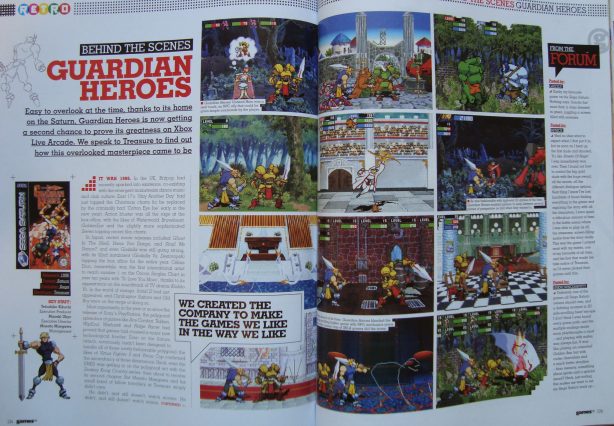
Guardian Heroes. Six pages, with input from Treasure. Sadly the amount of interview answers could have filled only half a page. It’s passionate, but a little lacking in insider information. Shame.
Written by: reduced price pork sausages (sage and onion)


Gala Networks Europe
Written by: a copy of Marquis from the magazine aisle.
I’ve only included this here because of the artwork used. Who doesn’t like a bit of elf-girl on elf-girl action, eh readers?


BONUS:
artwork from the Guardian Heroes article. Click for full size.