First off, the HG101 Digest Vol. 1: Strider and Bionic Commando, is now available! It retails for $15 at Amazon, $4 for the Kindle and $3 for the PDF from Sellfy. It's more than just Capcom's series, it covers some similar games and includes a few other really fun, nerdy feature articles.
Coming up this month, we have a bunch of articles on some older computer games, all from Electronic Arts: Murder on the Zindernauf. a mystery on a blimp; 7 Cities of Gold and its pseudo-sequel, Heart of Africa, which focus on exploration and can be seen as the precursor to Sid Meier's Pirates!; and Alter Ego, an extremely forward thinking "life simulator". We'll also be featuring all of Sunsoft's Batman games, including the two NES and two Game Boy games, in time for the release of the new Arkham Knight game, as well as some Namco titles like Phelios and Marvel Land, and the addictive perpetually-a-work-in-progress strategy game Dwarf Fortress.
I'll also be at Too Many Games on June 26-28, at the Greater Philadelphia Expo Center in Oaks, PA. I'll be manning a table selling our books, as well as assorted video games and whatever else I can dig out of my closet and fit on display. Feel free to stop by and chat! As a side note, Robert Belgrade, the voice actor of Alucard from Castlevania: Symphony of the Night, is going to be there. Just saying, maybe our Castlevania book would be a good thing to have signed!
For a summary of last month's articles, we started an extensive feature on arcade games within video games (which will be completed this month); a long look at the many, many Lemmings games, which will also be evolving as we fill in some of the small gaps left in coverage; the weirdo cult classic Goat Simulator; the two GI NES games by Taxan; the two Mad Max games to tie in with the awesome new movie (even though Outlander isn't officially a Mad Max game, even though it really is); two fun indie games, the Zelda inspired Ittle Dew and the time-bending run-and-gun Super Time Force; and the early PS1 3D platformer series Jumping Flash.
Now that some of our major projects are completed, it's time to start talking about some new ones.
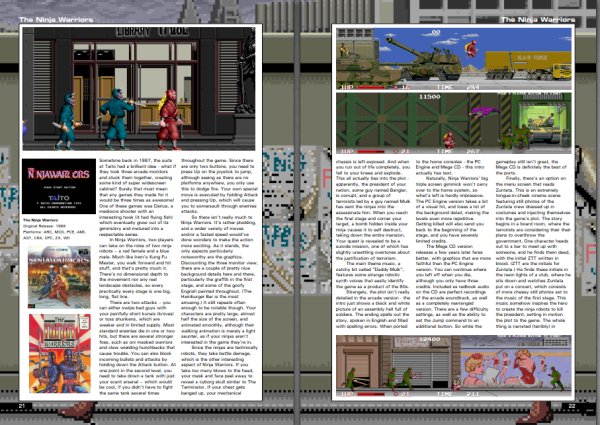
As a follow-up to our Bionic Commando and Strider digest, we are currently planning two more similar volumes. Vol. 2 will focus on Taito arcade games. While nowadays Taito is mostly known for Bubble Bobble and Space Invaders, they were a huge, huge publisher in the 80s and 90s, as the many arcade compilations can attest. Most of them are not well known outside of Japan, unfortunately, though many are excellent. We're still keeping the whole volume within the 75 page limit so obviously this will only scratch the surface of the company's output. We haven't finalized all of the covered titles yet, but planned articles include an overhaul of the ancient Darius article, as well as Ninja Warriors, The New Zealand Story, Gun Frontier, Metal Black, Growl, and many others. Like the first volume, it will also contain 10 pages devoted to 80 interesting Super Famicom titles. We're also planning some other interesting "Inventory" articles to feature.
A subsequent volume will focus on Data East. The major game people seem to remember from them is probably Bad Dudes, but again, they had quite a bit of output, and even though they aren't always fantastic, there are still a lot of interesting titles. Again, nothing is set in stone, but we plan on covering the Data East Commando games (Heavy Barrell, Bloody Wolf, Midnight Resistance, Desert Storm), Joe & Mac, Bad Dudes, Karnov, Burger Time, Trio the Punch, Edward Randy, and whatever else we can squeeze again. Again, there will be another piece focusing on 80 import titles, though we haven't decided the platform yet (I'm still working on completing the Super Famicon one!)
Of course, we are still working on Sega Arcade Classics Vol. 2! This one has taken awhile (and will continue to take awhile) as we build up all of the games that need to be featured. Basically, the game will cover all sorts of early 80s stuff, from the Sega/Gremlin days, all the way up through the System-32 era. The current list of featured titles are:
119 / Megumi Rescue / Flying Hero, A.B. Cop, Action Fighter, Aerial Assault / Sonic Boom, Air Rescue, Alien 3, Arabian Fight, Aurail, Bank Panic, Bayroute, Bonanza Bros., Borderline, Buck Rogers: Planet of Zoom / Zoom 909, Bullet, Burning Rival, Car Hunt / Head On, Carnival / Razamatazz, Choplifter, Columns, Congo Bongo, Cool Riders, D.D. Crew, Dark Edge, Desert Breaker, Enduro Racer, Flicky, Gale Racer / Rad Mobile / Rad Rally, Hang-On, Holosseum, Jurassic Park, Laser Ghost, Last Survivor, Line of Fire, Monaco GP / Super Monaco GP / F1 Exhaust Note / F1 Super Lap, My Hero, Ninja Princess / The Ninja, Pengo, Rail Chase 1 & 2, Riot City, Samurai, Scramble Spirits, SDI / Global Defense, , Sindbad Mystery, Spatter, Spiderman: The Arcade Game, Subroc / Poseidon Wars, Super Locomotive, Tant-R, Teddy Boy Blues, Tetris, Tough Turf, Tranquilizer Gun / Safari Hunting, Turbo, Up'n Down, Zaxxon
We'll also be having smaller reviews of the (many, many) other obscure titles published during this era, like 005, Gardia, Combat Hawk, 4-D Warriors, Tac/Scan, Pulsar, Monster Bash, I'm Sorry, Flashgal, UFO Senshi Yohko, Time Scanner, and others.
One project we've been working on for a few months is a little different from the norm. It's a "best games of all" time book, that highlights favorite titles from the staff. Looking through old magazines, these were always the issues I enjoyed the most (and have the most worth in keeping around) since it gave a good snapshot into the tastes of the magazine, and the attitude towards certain titles of the time, so I wanted to do something similar for HG101.
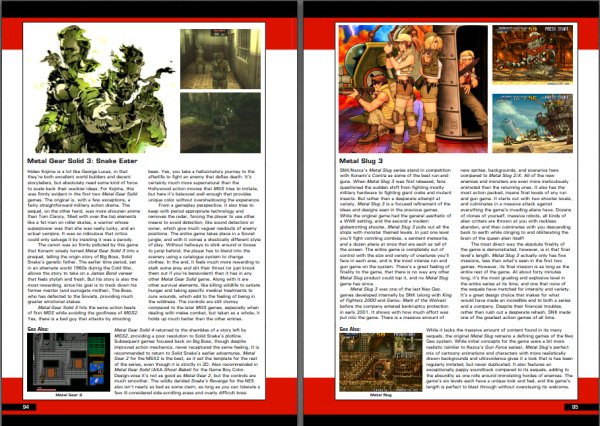
The main issue with these types of articles is that the actual written content is very shallow, since they're typically just a cover article as part of a larger magazine. Even when other video game sites do "top X" lists, there's not much actual writing, maybe a paragraph or so. We're doing things a little differently, as each piece will have about 450 words devoted to it, describing its history, why it's important, and why we love it so much. We're also doing smaller pieces to accompany each game that we've chosen that recommends similar titles, either other games in the series or just another game that's related in some way. The main reason is that we don't want to feature too many similar games, but at the same time want to talk about as many awesome games as possible. We also tried to balance the selection out so there are a whole bunch of different games from various genres, to give a wide variety of titles to read about.
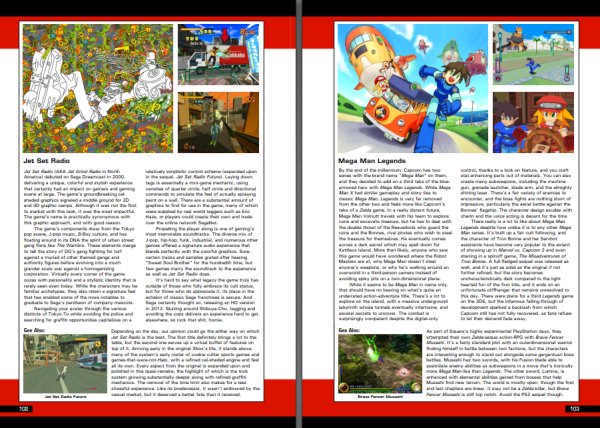
Although I'm sure many readers will be familiar with a good chunk of our selections, the content will be significantly different from most other magazines or websites. Since we focus primarily on retro content, most of our selections aim towards older games, or modern games that either channel the spirit of older games, or do something really unique beyond the typically bland AAA cinematic stuff that encompasses a majority of today's marketplace. I hope that it will encourage people to check out some new and different titles. It's still very much a work in progress and I haven't quite nailed down how many games we'll be featuring, but it will be at least 175, so it will be a pretty meaty book. Given the size, we will probably be publishing both a full color and a cheaper black and white edition.
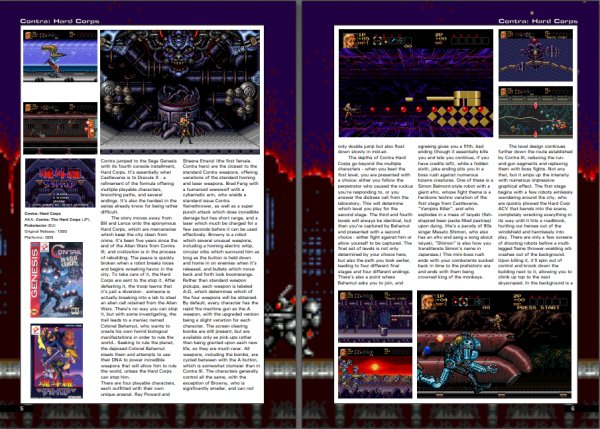
Further into the future, we also have two (maybe three?) more books planned. The first one is a Konami special, that will feature two big series - Contra and Ganbare Goemon - along with a good chunk of their 8/16-bit output. I was initially trepidatious about this after Konami grumbled about our Castlevania book, but we haven't had any issues with them since, and they haven't bothered us about the Konami Shooters book, so I think we're in the clear! Other games featured will include their run-and-guns (Sunset Riders, Mystic Warriors, etc) and their many FDS/FC/NES games, like Almana no Kiseki, Bio Miracle Bokutte Upa, Ai Senshi Nicol, Getsu Fuumaden, and so forth.
Additionally, since I've received many requests for a book on beat-em-ups, we've decided to start putting one in order. We have a good number of significant titles already featured on the site, but we're missing a big one - Double Dragon - so we have to complete that first! And in order to chronicle all of the beat-scrollers, we will probably have to publish two volumes, and figure out to do with some of the redundant content that will already be featured in the Sega book. (The Konami beat-em-ups articles will probably be placed here, rather than in the Konami specific volume mentioned above.)
All of these plans are admittedly pretty ambitious! I'm hoping to have the Taito digest, Top X Video Games and Sega Arcade Classics Vol. 2 completed by the end of 2015. Everything else will definitely be planned for 2016.
If you like what we're doing and like what you see, please consider donating to our Patreon, even as little as $5 a month will get you access to digital copies of all books published, past and future, and $10 a month will get your name in print in subsequent volumes. Thank you for your support!