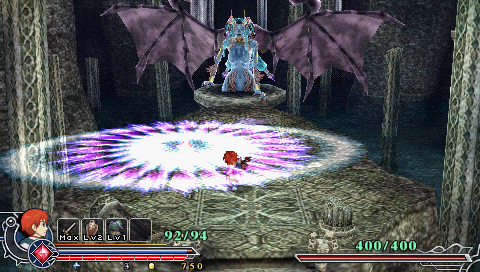
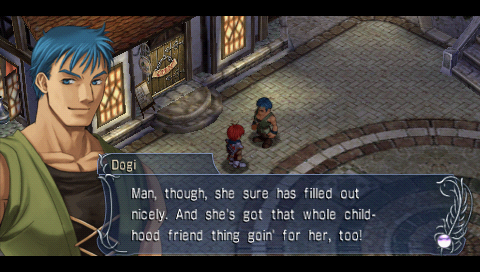
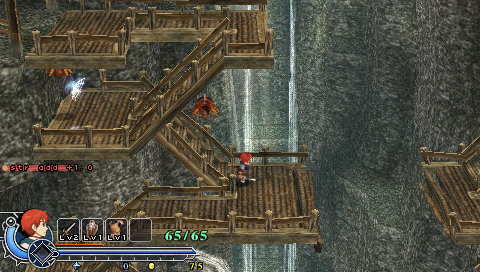
Issue 111 (one-hundred-and-eleven) of GamesTM features an 8 page History of Ys feature by me, John Szczepaniak. As usual they didn’t credit the author, and they also spotted my attempt to hide my name in screenshots, so sadly no one will know I wrote it. But, since there were a lot of unused interview answers, I’m going to post them here for your reading pleasure. Includes interview answers from Toshihiro Kondo (president of Falcom), Hiromasa Iwasaki (creative director on PCE), John Greiner (localiser on PCE), Ken Berry (director of publishing at XSEED), and Jeff Nussbaum (official localiser and fan translator). If you like these snippets of unused interview answers, consider reading the actual issue of GamesTM in your nearest newsagent/shop, and while you’re at it, email the editor demanding writer credits! – (blog entry written by J Szczepaniak II) . . .
Since I was over my word limit, there’s every chance that interview answers were cut from the final version (I’ve not seen it, I’m still waiting for my freelancer copy to arrive!), so I may add more here later.
TOSHIHIRO KONDO
JS: What was the inspiration for the red-haired hero Adol Christin, and the world of Ys he lives in? TK: He’s a young adventurer and even though in his profile it states that he later writes over 100 adventure journals, in-game he never speaks and you can never tell what type of person he is. This is because we wanted Adol to portray the player within the world. Now Adol is beloved in the same way as a popular historical figure. He is a very mysterious character who never speaks, but fans still have their own interpretations of, “This is like Adol,” and, “this is not like him.” Throughout the series players have been imagining who he is through his actions and adventure journals, and now that common thought has become part of who Adol is. In that sense he is a character that has been fostered and molded by the players.
JS: Is Falcom shifting more to consoles than PC development? TK: Recently, we have been concentrating on the console side too and getting a lot more fans that may not have played any of our PC games.
JS: What was the reason for outsourcing development of Ys IV to both Tonkin House and Hudson? How much influence did Falcom have on each game? TK: I’m sorry but I do not have any details about what happened then and cannot comment on this question.
JS: English speaking fans are so passionate they’ve made unofficial translations of Ys – what does Falcom think of this? TK: We’re really honored that people are interested in the Ys world so much. However, at the same time we always felt guilty for not being able to bring an official product to their hands. We’re very pleased that after a long time we were finally able to bring over an official English version for this audience.
JS: The popularity of the Ys series has endured for 24 years. Why do you feel this is? Are you planning a surprise for its 25th anniversary? TK: In Ys lore Adol is said to have left hundreds of adventure journals. The latest adventure we released was the 7th adventure so there are a lot more adventures to cover. It might be the excitement of wondering what adventure Adol tackled at what age that makes this series possible.
JS: What happens next for Falcom, the Ys series, and your partnership with XSEED?? TK: We were able to release the first chapter of the “Trails” series in the States. The European version is schedule to come out later so please keep an eye out for it. We announced that we will be releasing the latest iteration in the Trails series, “Ao no Kiseki” (direct translation: “Trails of Blue”), for the PSP in Japan.
JS: Do you want to say anything else to your English fans? TK: For a long time we have been getting requests from the English speaking fans to publish an English version but we couldn’t fulfil their wishes in a consistent manner. This time we were able to develop a partnership with XSEED Games which provides us with a pathway to release our titles in English territories. For the Ys series we were able to publish Ys SEVEN, I & II Chronicles, and Oath in Felghana so please give them a try if you haven’t done so already. We would love for more people to play our titles and get familiar with our work, and in the meantime we’ll strive to create more titles.
Answered by Ken Berry, Director of Publishing at XSEED Games: As we were getting ready to start on the translations for these projects, our newly hired Falcom fanboy, Tom, stated that there were already some great English translations created by another Falcom fan that went by the name “Deuce” on message boards. Since Tom knew Deuce he reached out to him about us using his translations and Deuce was immediately onboard. A lot of companies, including us when there’s too many projects for our in-house staff, outsource their translation so we figured why not outsource it to someone that’s intimately familiar with the material while also saving us the time of taking a couple months to do it since it’s already done? We always have our internal team proof and edit any translated scripts, but this saved us some time in our localization process to be able to allocate any time usually reserved for the translation process to the editing side for a more polished final product.
JS: What are XSEED’s future plans with Falcom? Ken from XSEED: We have a very strong partnership with Falcom where we’re always discussing potential projects, both new and from their great back catalogue of games, for English localization. Though we haven’t finalized the terms yet for either of these titles that Kondo-san mentioned, we will continue to have discussions with them about these and other titles to determine together which ones make the most sense to bring over.
JOHN GREINER – head of MonkeyPaw Games and localiser on the original PCE-CD/Turbo Duo version of Ys I&II.
I remember Ys of course. In fact, it was one of the first games I ever worked on. I helped Iwasaki-san with the English version. The game producer was a guy name Iwasaki, a freelance to Hudson. Although I don't know how the title came to Hudson, he just might. Well, Hudson's CD ROM-ROM add on to the PC Engine was the first time that a CD drive had been attached to a dedicated videogame console. Its hard to imagine games before large format media but CDs offered the chance to do real voice and deep cinematics. Ys was the first game to really use the space and the effects were dramatic. Iwasaki-san was the Hudson producer. He was a near-genius and was very talented. When the game came out, it opened a new era in the industry as now the bar was set much higher and the way to make games was changed forever. So in some ways, Ys was a precursor to what games have become today.
HIROMASA IWASAKI – freelance programmer for Hudson and creative director on the PCE port of Ys I&II (image taken from Facebook)
In Ys book I&II, one of the original artists “Tomoo Yamane” had joined and created with us. But for some reason, his name was tilted as “Hideyuki Amagi”. This is true story. I had written all the story of Ys development in my Japanese BLOG
(JS: apologies for the brevity of this section, but I used almost all of Iwasaki-san’s answers ion the print article)
JEFF “DEUCE” NUSSBAUM – official XSEED translator on several Ys games, freelance fan-translator on older Ys games.
JS: Briefly describe yourself and current occupation. You’re an official translator, correct? JN: I'm a generally disagreeable and highly opinionated sort of fellow who is very fond of inflicting his tastes on others (sadly, I’m not joking... just ask my wife). My current daytime job is as data analyst for a multinational corporation. A boring title which has no bearing on my passion, which is, of course, games. Officially, I’ve translated two Ys releases for XSEED (Ys: The Oath in Felghana and Ys I & II Chronicles), and about 1/3 of the text in Legend of Heroes: Trails in the Sky. Unofficially, the only Ys title I haven't translated at least 90% of is Ys Seven, and that’s just because XSEED's deal with Falcom was announced before an Ys Seven fan translation project could get off the ground, beyond a 30-second proof of concept video that was never publicly released.
JS: How did you first get involved in translating the Ys games? JN: Very much by accident. Back in 2001, I was poking around the internet and found place called RIGG, dedicated to preserving old PC Engine and TurboGrafx CD games. It was run by a fellow by the screen name of Nightwolve (which, to this day, makes me think of “Nightwolf” from Mortal Kombat). I found out that he was doing some tinkering around with Ys I Complete for PC, which I had recently purchased. He had put up the Japanese script file for anyone to mess with, and so I downloaded it and decided to see if I could translate it. I did, though it took a while. This was my very first serious translation work of any kind, so it was a pretty sloppy first draft, by my standards, though more for translation errors than anything else. I’d made no announcements regarding my intention to translate the script, and the fact that I literally popped up out of nowhere with a translated script was a little jarring to NW.
JS: From here you partnered with Nightwolve, correct? JN: [We eventually worked] on several other Ys titles, most of which saw an English patch release. We actually were about 95% done on Ys VI: The Ark of Napishtim before there was a lawsuit between a Falcom licensee and a Korean translator/hacker, which resulted in us halting the project entirely. Soon after, Konami announced their licensing deal to bring the game to the United States on PS2 and PSP, so our PC patch got shelved indefinitely.
It’s worth noting that Nightwolve and I could not have been more different without making a concerted effort to do so. He was (and is) an extremely conservative Republican... your prototypical Bush-supporting, flag-waving, God-fearing, go-get-‘em sort of fellow. I, on the other hand, have more liberal-leaning, radically-atheistic views. It’s no stretch to say that our only common ground was our mutual love of the Ys series.
The turning point came with the release of Ys: The Oath in Felghana for PC. I was incredibly excited for the game, bought my limited edition copy, and pestered Nightwolve (henceforth called NW) for a script dump from day one. Once I had it, I burned through the script and had a 100% completed rough draft in seven days... a record for me.
So, NW took the script and built a beta-test version. Given his then-current financial state, he had been partially relying on donations from his web site to defray some of his basic costs. So, he had the idea of making the Oath in Felghana beta available exclusively to those who donated, then publicly available once the donation period was completed. This idea did not sit well with much of the fanbase. He was called every name in the book, and then some. But everything didn't truly go south until someone donated to receive the beta patch, and then immediately distributed it online.
NW kind of lost it at that point. He felt his trust had been betrayed, and he obsessed over finding the source of the leak for years. He schemed to find ways to punish those responsible, spoke openly of hacking the pirates, planned out ways to mess with people who were using pirated copies of games with his patches, etc. He could never let it go and move on.
In the end, it was that, more than anything else, which proved to be the dissolution of our partnership. He simply became more interested in obtaining revenge than in translating the games, which was always the point for me. At the time of this writing, I believe it's been a little over a year since I last spoke with him. I hope he's doing better.
Outside of that whole matter, I've also [worked with Gideon Zhi of Aeon Genesis http://agtp.romhack.net.
JS: You’re very much connected with the fate of the Ys series in the west due to unofficially and officially translating several games – how did you discover the series? JN: I first discovered the series like many of its long-term fans did: the TurboGrafx-CD. Back around 1991 or so, there was a local store named “Power Up” where they actually rented out game systems and games, including imports. They did this well in advance of Blockbuster catching on to the idea. This store was, incidentally, how I first discovered the Super Famicom (ahh, import ActRaiser) and the Neo*Geo (thus creating another expensive obsession).
I actually heard the music for Ys Book I & II well before I ever had a chance to play the games, and I was blown away. When my finances allowed one Friday, I rented a TurboGrafx-16 and the CD attachment, a copy of Ys Book I & II, then took it home to play. I then spent the entire weekend glued to my television, completely riveted by what I was seeing and hearing. It was official: I was in love. I did eventually purchase that same system from the store, as well as a copy of the game, and I still have them, to this day.
At that time, I was utterly charmed by the music, and the way the story unfolded really kept me going. I was particularly enamoured of the fact that Ys II let you turn into a monster and talk to other monsters for original dialogue, and to villagers for alternate dialogue (some of which was quite funny). Of course, there’s also the voiceovers, which were mostly well-done: a revelation in the early 1990s, and (sadly) still pretty impressive, even now.
My favourite entry is kind of a toss-up. I was extremely impressed by how well Falcom handled the new party-based combat system in Ys Seven, and I loved the new skill system. I liked the story better than most of the reviewers (who have apparently been playing games with the plots of Amadeus and Schindler's List combined, to judge by their comparisons and criticisms), though I'll concede that it could have been more in-depth than it was. If not that, then it would have to be Ys: The Oath in Felghana. Ys III was always a game I never really liked much (at all), and I was more than a little amazed that Falcom was able to take the worst game in the series and turn it into one of the best.
JS: Most of the canonical series is now available in English. Falcom have mentioned they feel honoured that the fan-translation community has handled their games. Apart from Ys V, are there any other Ys games you hope have a translation released? JN: Well, there's really not much left. Ys Online was available in Europe for a while, but obviously, it never showed up in the States. Ys Strategy was only in English in Europe. I have a copy of that, and I can say that U.S. fans really aren't missing out with that one. I'd like to see Falcom-made and officially-localized versions of Ys IV and V, as well as Ys Origin. Perhaps PSP versions of all three? But that's just wishful thinking on my part.
JS: In the course of fan-translating, have you ever come across content which wasn’t normally accessible in-game? JN: Indeed, I have. The PC-based Ys games have been full of debug menus that one cannot access via normal play, which would allow one to skip through the game to specific places in the story, set the amount of experience and gold possessed, as well as inventory. I've never encountered a means of actually accessing these menus, however.
JS: Is there anything you personally want to comment on? JN: I’d like for gamers to know and understand just how much goes into translating/localizing a game. If you're lucky, you get someone like me and the Ys games: I do it because I genuinely adore the series, and I want non-Japanese speakers to be able to enjoy the games as much as I do.
With a fan translation, one has the benefit of time and an extensive beta period. If glitches, context errors or just plain old bad grammar are found, one can go back and correct them, generally without a deadline hanging over one's head. This is where most of my experience lies, but after Trails in the Sky, I know how the other half lives. There’s constant deadline pressure, a daunting amount of text to be dealt with in a startlingly small amount of time, and depending on how long the project goes, it can really start to wear on a person. And then there are the other people on the project who have to lose sleep over it (poor Jess). It’s not always done by people who care about the source material, but in my limited professional experience, it has been.
I try to maintain a pretty neutral stance on the whole piracy debate, but it really does hurt a small company like XSEED. Then you have the phenomenon of the “undub”, where enterprising fans remove any English-dubbed audio and replace it with the original Japanese voices. This, I feel, is just adding insult to injury, given that these “undubs” can’t be played on an unmodified system. A lot of work went into that audio, and personally, I consider it to be rather callous to remove it on a whim. I went through my phase of thinking everything from Japan was automatically better than anything from America, but I’m 37 years old, and that phase was almost two decades ago.
I know, from personal experience, that it’s frustrating when a company does a lousy job with translating a game you like and you get a botched mess. On the other hand, I also know how it feels when you put in the effort and some folks just can't appreciate that it’s just “not Japanese enough”. Some of us do our utmost to respect the original work... so it’s always appreciated when the consumers respect ours, too.
JS: I recently played through Ys IV on the Super Famicom with your translation patch and found both the translation and game to be excellent, despite fans criticising it slightly. Can you tell us about the translation? JN: It is still what I consider to be my finest work. The nature of the script enabled me to manually rearrange the text at my leisure, so I could put everything in chronological order. This basically eliminated context errors, and resulted in a final product that I could cheerfully stand behind. I think part of my motivation was that, since MotS really isn’t as good of a game as Dawn of Ys, I needed to really pump up the story and make the translation sing, so it would feel more worthwhile to the player.
In what is likely NEVER to become a regular column, I document an interesting glitch I found in Ys IV on the Super Famicom, and reveal a little of my warped logic in the process. . . .
Whenever I play a game I have an inherent distrust of the designers, believing them to be in many instances trying to bamboozle me with their fiendish trickeries. A good example was in the original Yakuza. I came across a sobbing man who called out a woman’s name, lamenting how he lost everything because of her. Five minutes later a mission triggered, where a woman ran up to me being chased by a thug – she told me her name, the same exact same one the old man had mumbled, and begged me to save her. I thought aha! The game is trying to trick me, and if I save her I’ll lose everything too. I had assumed that the NPC was giving a warning for wary players, so I let her get dragged off. As it turns out you were supposed to save her and then lose everything, and in avoiding this fate I would never gain access to one of the game’s secret casinos. So in disgust I stopped playing and never completed the original Yakuza. It had clearly given me a warning which I had followed, and instead of being rewarded for my astute vigilance, I was punished.
Anyway, this highlights how an obsessively astute nature can disrupt game flow. As it did in Ys IV on the SFC.
At the start of Ys IV Dr Flair joins you, stating he intends to find a rare flower to create a special panacea. He lodges at the first inn you come across and stays there while you go off on your adventure. Most players would forget about this, but for me this mentioning of the flower took precedence over all other things – if it wasn’t to become a pivotal point of the game, it wouldn’t have been mentioned. Most writers avoid creating a “dues ex machina” situation by casually dropping something significant at the start of books, films and games. So when someone mentions being double-jointed, a place of interest, a bottle of milk or packet of prophylactics they’re picking up, right at the start of any narrative, my assumption is that the final act of this narrative will somehow hinge upon this seemingly innocuous item/skill/location/etc, otherwise it would never have been mentioned. In fact 90% of all films are ruined for people who watch with me, precisely because I pin-point every key aspect which most of the time ends up correct thereby totally spoiling it ahead of time (except Morgan Freeman and his knife throwing in Seven – that never went anywhere, making it something of a red herring).
So anyway, when I finally find this flower late into the game, at an exorbitant price, from a merchant who only has one of them, and then I’m asked to give this flower to an old man whose wife needs it, my SPIDY NERD SENSES kick in, and I realise: Tonkin House is trying to **** with my mind, man. Of course they’d set up this situation where I need to take the game’s ONLY flower to a dying old woman, thereby denying Dr Flair the game’s ONLY flower, and thereby denying myself some kind of outlandish reward – like having the power of GOD, or something equally outlandish.
So in order to fulfil my Messiah Complex and best the game’s trickeries, the only logical thing is to abandon the old woman and trek it aaaaaaaaalllllll the way back to Dr Flair, across about 137 different map screens, in order to instead give HIM the ONLY flower, in the original inn he’s staying at, and get the super secret reward.
Right? Eh, readers?
I could have looked up a FAQ to check this, but I trusted my gut instinct.
My belief was that only the most astute (or paranoid) of players would make such a journey. And therefore only such gifted individuals would receive an unimaginably amazing reward. Because if I made commercial games, they would all be made like this, forcing players to constantly double guess me and break the design flow – because if I made commercial games, I would absolutely 100% of the time be ****ing with your mind. My games would literally be non-stop mind ****ing.
So I trek it back to Dr Flair, who is still inside the inn. After talking to him he starts spouting strange gibberish about coming here to find me, after finding the flower himself, and that he’d take me to the elder if I follow him. At which point he freezes in place and Adol starts walking around the scenery, only to end up stuck inside the background, as in the starting image. It even incorrectly says: Elder's House.
As it turns out, you’re not supposed to go back to Dr Flair. Giving the flower to the old woman sets a trigger which places Flair in the seaside village, whereupon he’ll take you to the elder. Failure to bring her the flower causes him to remain at the inn. The curious thing is though, at some point a different trigger must have been activated, whereupon instead of his usual “best wishes” dialogue he initiates the conversation about taking you to the elder. So there must be two triggers at work: (1) to alter his dialogue response and (2) to actually make him appear in the seaside town. By triggering (1) and skipping out (2), I was able to initiate the wrong conversation while still inside the inn, which of course resulted in Adol getting stuck.
The worrying thing is you can still save the game after this, so it is quite a fatal glitch.
I reloaded and did things properly, whereupon I discovered that Flair ended up getting the flower on his own, so Tonkin House wasn’t really messing with my mind and I could have just gone with the flow. Making it all a great waste of time...
Is it too early to talk about "Best of 20XX" stuff yet? Probably. But we're going to discuss the best soundtracks anyway, under the assumption that there's not going to be much better. The rest of the 2010 release seems to include mostly Western games, who are largely focused on bombastic Hollywood-style film soundtracks than legitimate game music, and I don't think there's too many big Japanese releases left. If something comes out and surprises is - it definitely could! - we'll append it down the road. So, without further ado, here are the Ten Best Game Soundtracks of 2010 (So Far):
VVVVVV (Featured song: Potential for Anything)
There are only maybe half a dozen proper songs in this soundtrack - fitting, since the game is only about two hours - but each of these tracks is pure SID-inspired chiptune bliss. You can grab MP3s of it the composer's website for a few bucks - unquestionably worth it.
Scott Pilgrim vs the World: The Game (Featured song: Another Winter)
Anamanaguchi was band I had only half paid attention to, because while their unique of guitar and NES chiptunes were kinda cool, their songs always felt long and meandering. When concentrated into the context of a 1-2 minute video game song, though, their talent for composition really shows through, resulting in a retro soundtrack that still has a distinctly modern edge.
Castlevania Harmony of Despair (Featured song: Invitation of the Crazed Moon)
My own big complaint about remixed music in Castlevania games is that they always drew from the 8 and 16-bit games, ignoring practically everything from Symphony of the Night and afterward. Harmony of Despair changes that, and features numerous songs from the portable Metroidvanias, all rearranged. They're all fantastic too, many being done by the same folks who redid the songs for Judgment. The DLC pack adds even more, and the handful of new tracks - including one of my favorites, Invitation of the Crazed Moon from Portrait of Ruin - are outstanding too.
NIER (Featured song: The Lost Forest)
This game kind of came out of nowhere to be really damn cool, and part of that appeal lied on its music, which took the took a tired musical trope - foreign-sounding chanting - and gave it new life. The dramatic strings and percussion pieces are even more outstanding, breezy and melodic, constrasting to the comparatively dull orchestrations that permeate stuff like Castlevania Lords of Shadows and God of War.
Ys The Oath in Felghana (Featured song: A Searing Struggle)
Is it fair to include this game? This was released in the US in 2010, but released in 2009 in Japan, which in turn was based on a 2005 release (again) in Japan only, which was a remake of Ys III, a game from fifteen years earlier. So, the music in The Oath of Felghana is hardly "new". But that's okay, because Ys III had one of the best soundtracks in existence, and remixes in The Oath of Felghana only improves them with live instrumentation. Props to the PSP version for including alternate versions from the old computer releases.
Ys Seven (Featured song: Mother Earth Altago)
The music in Ys Seven isn't QUITE as good as Felghana, but it's also the best original soundtrack in the series since Ys IV. Parts of it sounds remarkably like an upgraded PC Engine redbook track, which has always been part of the Ys appeal (at least, to the English speaking audience.)
Dodonpachi Daifukkatsu Black Label (Featured song: Vertex)
The soundtrack to DDP Daifukkatsu was kinda lousy, but the Black Label version doesn't rearrange it, it created a whole new soundtrack from scratch. It's much better, with some damn catchy electronica, and while it's not quite as trance-y as Espgaluda, it further establishes the parallel that Cave-brand danmaku shooters are the video game equivalent of an ecstasy fueled rave.
Dark Void (Featured song: Main Theme)
Usually we rag on Western game soundtracks for totally missing what we love about video game music. But we'll overlook that when it comes to Bear McCreary, the incredibly talented composer behind the reimagined Battlestar Galatica and its (now cancelled) spin-off Caprica. As a result, the soundtrack to this under-appreciated action game sounds much like his other work - which is to say, filled with fantastic orchestrations and lots of percussion. Bonus points for the Dark Void Zero soundtrack, which takes these turns and turns them into Mega Man-style NES music.
Final Fantasy XIII (Featured song: Blinded By Light)
On the Final Fantasy/Dragon Quest divide, I am usually staunchly on the side of Final Fantasy. FFXIII screwed up so much though, from the storytelling to the dialogue to the character development to the level design that it really did come up short. The only two areas where it excelled was its utterly fantastic battle system and its magnificent soundtrack. Styistcally Masashi Hamauzu is quite a bit different from series mainstray composer Nobuo Uematsu, as well as FFXII composer Hitoshi Sakimoto, but the man can use the violin like no other game musician out there.
Etrian Odyssey III (Featured song: Unrest - The End of the Raging Waves)
Even if you don't like grindy masochistic first person dungeon crawlers, everyone should appreciate these games for continuing to employ Yuzo Koshiro, one of the few prominent musicians from the 80s music scene that's still got it. This PC88 FM inspired sountrack is the best of the series, offering a wider variety of dungeon themes that alter between serene and foreboding, and numerous outstanding battle themes. The arranged album also borrows some instrumentation styles from Falcom, also making it essential for Ys fans.
Runners-up
Death Smiles (Featured song: Burning Halloween Town)
Not one of Cave's better soundtracks (better than Daifakkutsu though), at least the first level theme is pretty excellent, as are the boss and level select themes.
Super Mario Galaxy 2 (Featured song: Throwback Galaxy)
Catchy and eminently likable, with a handful of arranged songs from previous Mario and Yoshi games. Not enough of it really stands out to make the Top 10 though.
No More Heroes Desperate Struggle (Featured song: Philistine)
The "A Goddamned Philistine Since 2004" header on the main HG101 page is a reference to Margaret's song, a darkly silly little bit sung by the boss in question about how our hero, Travis Touchdown, is a goddamned pussy. Like the first game, the music selection is eclectic and ultimately not as consistently strong, some of the boss tracks are still outstanding.
Yeah, yeah, I know, about three months ago we made a plea for you all to buy Ys Seven. Well, we're making a similar plea again for the next Ys game coming out, Oath in Felghana. It is similarly amazing, although for slightly different reasons. (Check out the Ys article if you're unfamiliar with the whole bit, although it is slightly outdated.)
Some background: while Oath in Felghana has been released in North America after Ys Seven, it is actually quite a bit older. The original game was released on the PC in Japan back in 2005. After Falcom found some success with the PSP, they ported in 2009, which is the version we're getting. In turn, Oath in Felghana is a remake of Ys III, which was originally released sometime back in 1989 for Japanese home computers.
Ys III was considered the black sheep of the series, because it's side-scrolling versus the overhead viewpoint of all of the other games. It's unbalanced and awkward, but also tremendously fun - I like to call it The Best Worst Game Ever Made. (Conversely, the Worst Best Game Ever Made is Vagrant Story, but that's a diatribe for another day.) None of this matters because Oath in Felghana only takes the setting, story and music from Ys III - the gameplay system is based on Ark of Napishtim, which is the sixth Ys game. You may remember the PS2 port from awhile back - which was pretty decent - as well as the PSP port, which was plagued with numerous problems. Please note that these ports were done by Konami, whereas the Felghana port was handled in house by Falcom, and is thankfully absent of any technical issues.
So now with that cleared up, let's talk about the differences between Seven and Felghana. This interview with Falcom scholar Tom Lipshultz (who can be seen with me doing a panel on Falcom at Otakon 2008) makes a pretty good analogy, that if Ys Seven is Castlevania: Symphony of the Night, then Oath in Felghana is Super Metroid. Ys Seven has tons of equipment, multiple playable characters, a gigantic overworld, and an expansive story that encompasses 25-30 hours of play. Oath in Felghana is much more compact, with straightforward equipment selection, an extremely (EXTREMELY) combat overworld, and an average game time of 10 hours or so. That might sound like it's worse, but it really isn't - Ys Seven biggest sin is that it was simply too padded, the areas were too long, there was too much pointless story, and much the extra equipment and skills were a bit extraneous. Felghana is much more concentrated as a result.
Which overall is better? The fanbase seems to prefer Felghana slightly. I'm not sure if I can pick, though. Felghana is unquestionably better paced, but Ys Seven does have an awesome counter system, which every action game from now until the end of time should have, and I rather like the multiple playable characters, even though some of them are redundant. Playing Felghana again, I also miss the dash function of Ys Seven, because it's just a totally rad feeling to duck and roll across huge sprawling landscapes. (I also still love Castlevania Harmony of Dissonance for this reason alone, despite its other many failings.)
Felghana, in general is quite a bit harder, mostly because it eschews stockable healing items completely, ensuring you can only win boss fights by skill (and leveling up) instead of just stocking up on curatives. Enemies do drop lots of items of stuff, including regenerative items, but they also build up combo multipliers that will increase your offense, defense and even experience gain, as long as you continue to smash stuff. The magic system is also pretty cool, in that you can drain it pretty quickly by tossing fireballs, but it recharges fast, as long as you ease up on it.
Ys Seven did have a rad soundtrack, but Ys III also has some of the best music ever composed for a video game. My personal favorite track is the Tigre Mine theme, Be Careful, which I have set as my ringtone (and you can grab it here.) The remixes of these songs featured in Felghana are fantastic, of course, but the PSP version also includes the X68000 and PC88 versions, for those (like me) with a fetish for FM synthesis and tinny drum samples. The PC88 version sounds most like the Genesis version, which is the one I'm most familiar with (and the version I grabbed the ringtone from.) The only one missing is the amazing Turbografx-16 CD audio version (which is the one embedded above, followed by the Felghana version), which is absent due to rights issues, seeing how that port was done by Hudson and Alfa Systems, rather than Falcom.
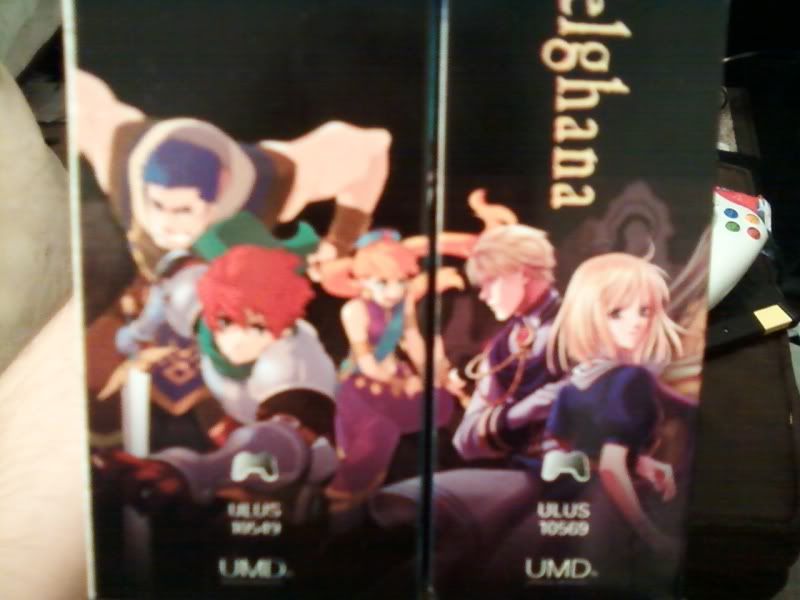
Plus, the limited edition boxes fit together to form one image! (Thanks to Ike from the HG101 forums for the image.) As usual, you'll be supporting an awesome company who's taking quite a risk of bringing this titles to a (purportedly) dying platform, again making these essential purchases. Please, go for it!
Ys Seven came out in the US yesterday, and it's absolutely imperative that you buy it. I could write paragraphs and paragraphs on how awesome it is, but in the interest of keeping it brief, I'll point to the Official Sony US blog, which should do an excellent job of hyping you up, and I can confirm that it's not the usual PR speak either. The game hasn't been covered in the Ys article proper, just because I hadn't gotten enough time that I was happy to fully review it. I got about eight hours in and got distracted, but don't let my video game ADD put you off - those were eight damn good hours. Plus after I'd heard it was being released in English, I held off playing any further so I could actually enjoy the story.
I love Ys, because I truly believe the Action-RPG is The Best Genre. Despite their proliferation and popularity in the 16-bit era - Secret of Mana, Illusion of Gaia, Terranigma, Beyond Oasis, Landstalker, Crusader of Centy, and even Zelda, if you want to argue that way (I would) - it's sorted of dried up over the past decade. Well....maybe not dried up, so much as torn apart and evolved. Outside of Zelda and its very particular type, you've got stuff like Bayonetta and God of War which weighs heavily on the action side and Champions of Norrath and Shining Force EX/Neo whatever leaning on the RPG side. Most of these don't really hit the sweet spot I'm looking for, although NIER is probably one of the best recent ones. You could probably stick in stuff like Odin Sphere and Muramasa, which are decent, although in different ways.
Ys though? Man. Ys was a series I really liked when I was introduced to it - Ys III is the best worst game ever made - but it really became super awesome with Ys VI: The Ark of Napishtim, which replaced its fun-by-wonky battle system with something far more gratifying. Then it got ridiculously mega awesome with Oath in Felghana, a little less awesome with Ys Origin, and graduated in some of doctorate in awesomise-tisity by the time Ys Seven rolled around last year.
In many ways, Ys is sort of a sister series to Castlevania, at least of the Symphony of the Night variety. I know that claim might put off some people, but hear me out! They are both focused on exploration, world-building, and level-building. Their controls are beautifully smooth, doubly impressive with the Ys games, since they're 3D games that play like 2D games. And they also all have amazing soundtracks.
In fact, Ys arguably does a lot of this better. It's got a beautiful tempo, as the very act of running around, hacking everything to bits, feels like a constant series of miniature rewards. It's better balanced, too. The day-to-day hacking and slashing is hardly taxing, difficulty-wise, but the bosses will test every single old-school arcade skill you've got. (And while grinding will help you out, they won't completely solve the matters either.) Admittedly, over the course of the series, the action actually started to get a little bit rusty by the time Ys Origin rolled around, but they revamped everything by adding a speedy dash button in Ys Seven, and substantially improved the battle system by adding tons of secondary skills. Altogther, Falcom impressed themselves enough with it that they took the engine and turned it into an arena-based fighting game, Ys vs Sora no Kiseki. (Which, to be honest, didn't turn out so well. It might be fun in multi-player, but single player is another story, and one for another time.)
So yeah, you shouldn't just buy this game to support XSeed and the PSP. Well, I mean, they're a brilliant company for licensing these and absolutely deserve your money, but this isn't a charity case or anything. This is one of the best games of 2010 (and of 2009 too, in fact.) I even say this as someone who doesn't particularly care for playing games on portables - I am slightly sad that Falcom abandoned a PC version, because I'd much rather play it on a 21 inch monitor with a proper controller - but it's just rad enough to overcome that inherent obstacle.
(This post has been updated regarding the availability to Nightwolve's translation patches, which can be found at Ys Utopia. Nightwolve has officially endorsed the dubbing project. We apologize for the error.)
That’s right, those loveable chaps at the Voice Acting Alliance are going to be dubbing Ys IV on the Turbo Duo, and they want YOU to audition!
The Ys series is a long running one, with many awesome remakes and offshoots, the majority of which never left Japan. Most have been fan-translated (the text for Ys V on the SFC has been translated last time I checked, but the patch hasn’t been coded yet).
Ys IV is one of the best games in the series, with solid and extremely fun battle mechanics, lots of cool anime cinemas, a neat self-contained story, and a lot of polish. It’s probably the best of the older console titles before they upped the quality with the PC installments.
For more information on the Ys IV dub, visit the Voice Acting Alliance topic on the subject. They’re requesting audition samples to be sent via email, and the deadline for the next batch is NOVEMBER 21st. So get ‘em sent and good luck.
The full download a bit over 400 MB encoded in xVID, and 52 minutes or so long.
This stars me, Wyrdwad, OMGFloofy from the Ancient Land of Ys forums, and a guy named Will who I don't think posts at either place. We spent a huge chunk of the time talking about the basic history of Falcom then about Ys, but we ran out of time before we delved deeper into their other series. The same thing happened at this year's panel, too, which we unfortunately couldn't record due to logistic reasons. (We had too much luggage and the camera didn't fit in our trunk.) Anyway, enjoy! (Thanks to Vysethebold for recording this for us!)
I'm a few weeks late on this, but apparently a group of people are translating Falcom's Brandish 4, also known as Brandish VT. (Check out the full HG101 Brandish article) They're also doing the fan world one better by remixing the entire soundtrack. The (as of current) final installment of the series ditched screen rotation in favor of an isometric perspective, which is far less headache inducing. I'm not a gigantic fan of the series, although I do think it's kinda cool how they took the mechanics of a standard first person dungeon crawler, made it third person, and introduced real time combat. It's always been a bit weird and futzy, except for the recent PSP remake, which fixes pretty much every problem the series ever had (and should be an excellent candidate for localization, but chances of it being picked up seem slim.) With this, Ys Origin and Xanadu Next coming up soon, English speaking Falcom fans can finally play through games without skipping through all of the text with apathy and frustration.
Also, Ancient Land of Ys member OMGFloofy has started up a Falcom blog called Endless History (the domain name is a reference to the continent which Ys takes place on, while the title is named after the vocal version of the song "Morning Grow (Glow)", the ending song to the first Ys.) So far it's keeping on top of the upcoming release of Eiyuu Densetsu (Legend of Heroes) VII, as well as Ys 7 for the PSP, which is coming out in a few weeks. It's also updating on Falcom's weekly special, which bundles together various games and goods at a discount. Falcom games are notoriously difficult to obtain for us non-Japanese, and about the only way to get them is by ordering straight from the company. The shipping is extremely pricey, but you're still getting a decent price overall - the only way you'll get better is either by trawling Japanese used game soft stores or hanging out at the Falcom boards and hopes someone decides to part with some of their stuff.