
Is it too early to talk about "Best of 20XX" stuff yet? Probably. But we're going to discuss the best soundtracks anyway, under the assumption that there's not going to be much better. The rest of the 2010 release seems to include mostly Western games, who are largely focused on bombastic Hollywood-style film soundtracks than legitimate game music, and I don't think there's too many big Japanese releases left. If something comes out and surprises is - it definitely could! - we'll append it down the road. So, without further ado, here are the Ten Best Game Soundtracks of 2010 (So Far):
VVVVVV (Featured song: Potential for Anything)
There are only maybe half a dozen proper songs in this soundtrack - fitting, since the game is only about two hours - but each of these tracks is pure SID-inspired chiptune bliss. You can grab MP3s of it the composer's website for a few bucks - unquestionably worth it.
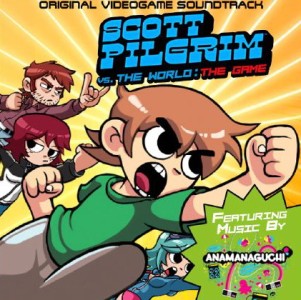
Scott Pilgrim vs the World: The Game (Featured song: Another Winter)
Anamanaguchi was band I had only half paid attention to, because while their unique of guitar and NES chiptunes were kinda cool, their songs always felt long and meandering. When concentrated into the context of a 1-2 minute video game song, though, their talent for composition really shows through, resulting in a retro soundtrack that still has a distinctly modern edge.
Castlevania Harmony of Despair (Featured song: Invitation of the Crazed Moon)
My own big complaint about remixed music in Castlevania games is that they always drew from the 8 and 16-bit games, ignoring practically everything from Symphony of the Night and afterward. Harmony of Despair changes that, and features numerous songs from the portable Metroidvanias, all rearranged. They're all fantastic too, many being done by the same folks who redid the songs for Judgment. The DLC pack adds even more, and the handful of new tracks - including one of my favorites, Invitation of the Crazed Moon from Portrait of Ruin - are outstanding too.
NIER (Featured song: The Lost Forest)
This game kind of came out of nowhere to be really damn cool, and part of that appeal lied on its music, which took the took a tired musical trope - foreign-sounding chanting - and gave it new life. The dramatic strings and percussion pieces are even more outstanding, breezy and melodic, constrasting to the comparatively dull orchestrations that permeate stuff like Castlevania Lords of Shadows and God of War.
Ys The Oath in Felghana (Featured song: A Searing Struggle)
Is it fair to include this game? This was released in the US in 2010, but released in 2009 in Japan, which in turn was based on a 2005 release (again) in Japan only, which was a remake of Ys III, a game from fifteen years earlier. So, the music in The Oath of Felghana is hardly "new". But that's okay, because Ys III had one of the best soundtracks in existence, and remixes in The Oath of Felghana only improves them with live instrumentation. Props to the PSP version for including alternate versions from the old computer releases.
Ys Seven (Featured song: Mother Earth Altago)
The music in Ys Seven isn't QUITE as good as Felghana, but it's also the best original soundtrack in the series since Ys IV. Parts of it sounds remarkably like an upgraded PC Engine redbook track, which has always been part of the Ys appeal (at least, to the English speaking audience.)
Dodonpachi Daifukkatsu Black Label (Featured song: Vertex)
The soundtrack to DDP Daifukkatsu was kinda lousy, but the Black Label version doesn't rearrange it, it created a whole new soundtrack from scratch. It's much better, with some damn catchy electronica, and while it's not quite as trance-y as Espgaluda, it further establishes the parallel that Cave-brand danmaku shooters are the video game equivalent of an ecstasy fueled rave.
Dark Void (Featured song: Main Theme)
Usually we rag on Western game soundtracks for totally missing what we love about video game music. But we'll overlook that when it comes to Bear McCreary, the incredibly talented composer behind the reimagined Battlestar Galatica and its (now cancelled) spin-off Caprica. As a result, the soundtrack to this under-appreciated action game sounds much like his other work - which is to say, filled with fantastic orchestrations and lots of percussion. Bonus points for the Dark Void Zero soundtrack, which takes these turns and turns them into Mega Man-style NES music.
Final Fantasy XIII (Featured song: Blinded By Light)
On the Final Fantasy/Dragon Quest divide, I am usually staunchly on the side of Final Fantasy. FFXIII screwed up so much though, from the storytelling to the dialogue to the character development to the level design that it really did come up short. The only two areas where it excelled was its utterly fantastic battle system and its magnificent soundtrack. Styistcally Masashi Hamauzu is quite a bit different from series mainstray composer Nobuo Uematsu, as well as FFXII composer Hitoshi Sakimoto, but the man can use the violin like no other game musician out there.
Etrian Odyssey III (Featured song: Unrest - The End of the Raging Waves)
Even if you don't like grindy masochistic first person dungeon crawlers, everyone should appreciate these games for continuing to employ Yuzo Koshiro, one of the few prominent musicians from the 80s music scene that's still got it. This PC88 FM inspired sountrack is the best of the series, offering a wider variety of dungeon themes that alter between serene and foreboding, and numerous outstanding battle themes. The arranged album also borrows some instrumentation styles from Falcom, also making it essential for Ys fans.
Runners-up
Death Smiles (Featured song: Burning Halloween Town)
Not one of Cave's better soundtracks (better than Daifakkutsu though), at least the first level theme is pretty excellent, as are the boss and level select themes.
Super Mario Galaxy 2 (Featured song: Throwback Galaxy)
Catchy and eminently likable, with a handful of arranged songs from previous Mario and Yoshi games. Not enough of it really stands out to make the Top 10 though.
No More Heroes Desperate Struggle (Featured song: Philistine)
The "A Goddamned Philistine Since 2004" header on the main HG101 page is a reference to Margaret's song, a darkly silly little bit sung by the boss in question about how our hero, Travis Touchdown, is a goddamned pussy. Like the first game, the music selection is eclectic and ultimately not as consistently strong, some of the boss tracks are still outstanding.
Showing posts with label scott pilgrim. Show all posts
Showing posts with label scott pilgrim. Show all posts
Thursday, November 4, 2010

Monday, September 6, 2010
Scott Pilgrim vs. RPG Elements
The whole Scott Pilgrim multimedia blitzkrieg worked far better than it really should have. Yes, the movie flopped, but quality-wise it was completely fantastic, because the people that made it had an understanding of why people loved the comic. The same goes for UbiSoft's downloadable video game, which makes no excuses for being an updated version of River City Ransom. It's appropriate, given that Scott's universe is largely inspired by this particular game, and also welcome, because not even the original Kunio-kun developers have ever done it properly, instead compelled to remake the numerous sports related games that no one seems to care about (except the dodgeball ones, but those new ones haven't turned out all that well.) Other than the technical glitches, most people seem to like it, with the major criticism being against the RPG mechanics. I've even read some people say the game would be better off without them. Nonsense, I say -- for the type of game this is trying to be, they are essential.
This is because, from a design standpoint, the sidescrolling beat-em-up -- or the belt-scroller, if we're gonna be all hip -- just isn't very good.
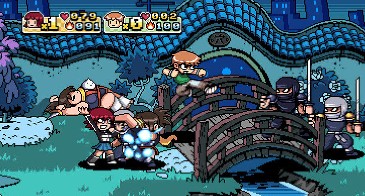
That's not to totally write off a huge part of gaming history, or say that we were all fooling ourselves when we put quarters into TMNT: The Arcade Game. No, they're still FUN, because smashing stuff in Final Fight is pretty gratifying even twenty years later. But they're very, very hard to balance if you're going to play to win and not just put quarters into them. The 3D nature of the movement makes it hard to line up attacks. The size of the characters, combined with their sluggish movement and the nature of close quarters combat, makes defense maneuvers difficult. And the chaotic nature of the enemy attacks make it hard to predict their movement anyway. There is some technique required for crowd control, but even that grows nearly useless in a typical boss fight, wherein your opponent is clearly overpowered. And none of that takes into account that they're just really repetitive -- without any platforming or any other activities, it's literally the same action repeated thousands of times, which is usually not helped by the limited movesets. Even the most advanced games grow weary by the time the finale rolls around. It's widely acknowledged that these games tend to live or die in co-op multi-player, not only because it's more fun to bash heads with friends, but because the multiple characters allow you to tip the scales of balance through flat-out attrition.
Knowing that it's hard to be "good" at beat-em-ups -- and you can't make them too easy without being boring, or too hard without being frustrated -- the designers of Scott Pilgrim used RPG elements in an attempt to balance everything out by minimizing the need for player skill. In that way, the difficulty of the game is inversely proportionate to how long you've spent playing it. I know that sentiment sends terror down the spine of the "play games to 1 cc them" crowd, but if you're playing Scott Pilgrim that way, you're playing it wrong.
That might sound like it's meant to waste the player's time, but think of it like this. If you're making a old school style beat-em-up, you can (A) make it an hour long game with infinite credits, like many recent arcade ports, and have people claim that it's too easy and disposable, (B) make it like an NES game and give limited continues, forcing people to replay earlier stages over and over in hopes they get better and don't just give it up, or (C) implement a barrier that artificially slows down progress but gives the opportunity for the player to improve their stats and play over levels at their leisure. I'm not a huge fan of forced grinding, but the way it's presented in Scott Pilgrim mostly works, in large parts because the graphics and music is brilliant, and the core action is fun enough that it feels gratifying without getting too repetitive. I don't think I played a single level more than twice before I beat it, other than occasionally visiting some old stages for fun.
It's still got issues, though. When you stick RPG elements into an action game, you get a conundrum with your "starting point" at level 1 - do you stick your character in neutral state, that is, with skills on the level to a game without RPG elements, or do you nerf the character and weaken them, forcing them to climb the ranks to get skills you would otherwise commonly start with? Scott Pilgrim picks the latter route, and I'm not a fan of that. The first stage or so is really slow, because you're slow, and you don't have many skills, and it's not a lot of fun. It gets astronomically more enjoyable once you level up, but that's an awful way to start a game, especially when you're depending on sales from a demo.
Scott Pilgrim's other mistake is that leveling up is so haphazard that it's easy to turn the game into a complete cakewalk and become completely overpowered. This also happened to be the same exact issue with River City Ransom, so the developers must not have felt it was a concern, but it feels weird to beat a boss you've encountered for the first time in a handful of seconds.
It's not quite as well done as Castle Crashers, a game which Scott Pilgrim owes its very existence to due to its extraordinary success, but while it could've used some adjustment, it's still another fantastic example of how you can take an old-school arcade-style game and update it to a modern console mentality, and have it appeal to more than just a handful of people.
Subscribe to:
Posts (Atom)