Showing posts with label falcom. Show all posts

Sunday, June 2, 2013

Dark Age of JRPGs (7): Panorama Toh ぱのらま島 - PC-88 (1983)

If you thought Dragon Slayer was Falcom's first RPG, you guessed wrong. Well, admittedly it's a bit of a stretch to call Panorama Toh an RPG in the traditional sense, cause there are no stats or level-ups, but Falcom did, so who are we to judge? According to Japanese sites, the game was programmed by Yoshio Kiya, the creator of Dragonslayer and Brandish.
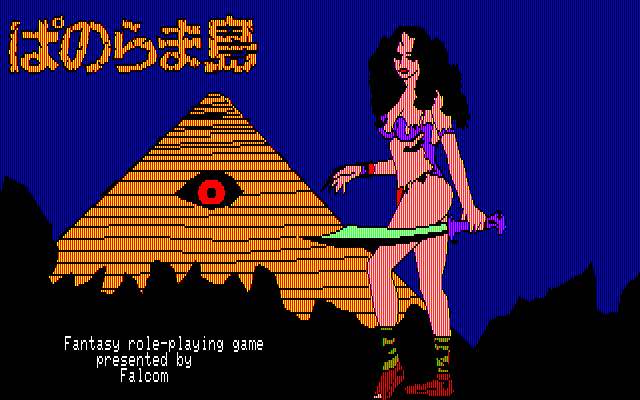
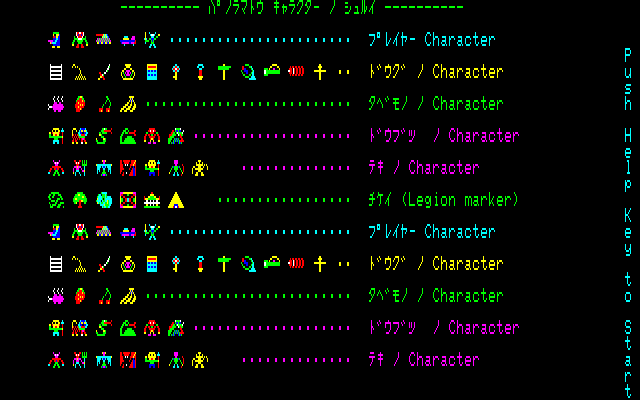
After the title screen, the game opens with a Pac-Man-like scroll, where all the characters, items and locations are introduced. Only here they're much more. You're supposed to press the Help Key on the PC-88 keyboard to start the game, which was mapped to "End" in the Emulator I used.
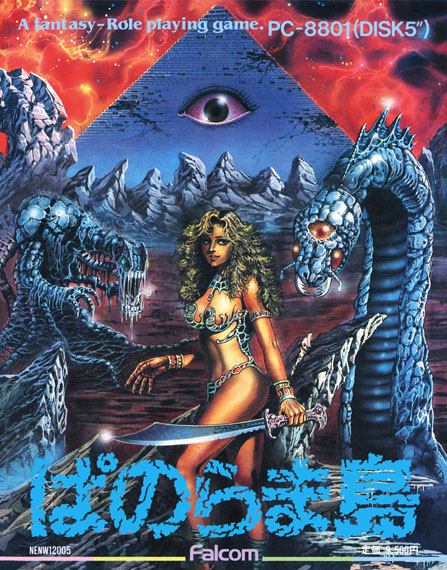
Maybe by virtue of being a Falcom game, there are surprisingly decent scans around for this game, not only of the box cover, but also the map below that came with it, found on this site. Players were probably supposed to mark enemies and traps on it, as their locations are always the same.
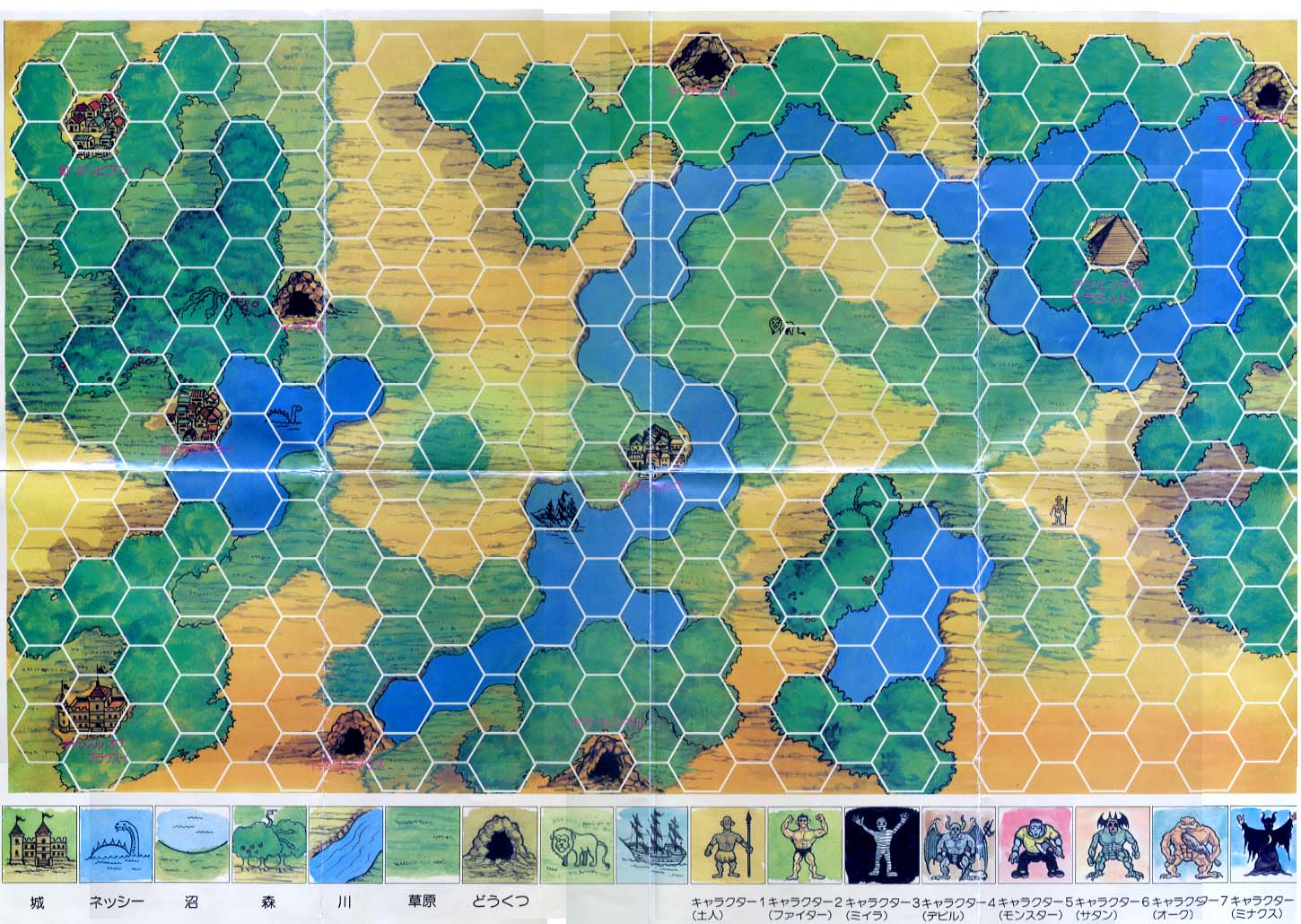
It also shows that the overworld takes place on a hex grid, which isn't immediately apparent when looking at the black background in the game. Therefore, you can only walk left or right in the diagonal directions, which feels a bit weird at first. At the beginning, the game kindly ask you to toggle your Caps Lock, cause coding a routine that deals with lower case characters was apparently just too much to ask for.
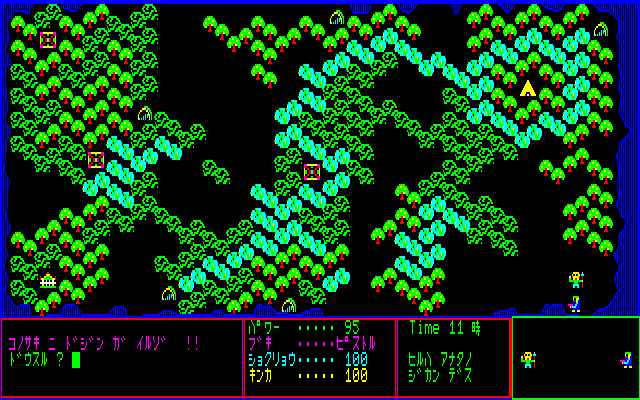
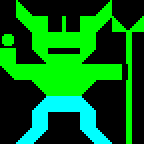
All around the map, you meet these spear-wielding aboriginals. At first I thought they were enemies and pressed (A)ttack, which triggers a little animation at the bottom right and shoot them - that's right, you have a gun at your disposal. It's not easy to tell what kind of setting this is, as it takes place mostly in forest areas where you meet bushmen, snakes or nessie(!), in the dungeons you meet ghosts, demons and other monsters and you can enter a pyramid, but you can also get a tank an power armor.

Turns out the aboriginals are not necessarily hostile, though, and you're not actually supposed to fight them. (T)alking makes them drop a line of exposition or two, like in most Japanese RPGs that followed since. You can also (G)ive them money for items, but you have to guess a number between 1 and 9, and the price of their item is determined randomly, as is the type of item you get afterwards. Whether or not you meet their demands, they always take your money. Sometimes they also just run away with it, no matter how much you gave them. Actually it's never worth buying from them, at least in this version (more on that later).
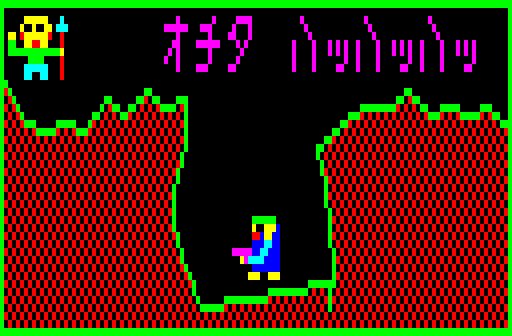
On some fields you end up in a trap like this, whereupon an aboriginal appears and laughs at you. You can try to (J)ump out of it on your own, but every failed attempt (it's random again) costs a not insignificant amount of health. It's usually much less dangerous to (C)all for help, until another aboriginal appears and pulls you up. At some places on the map there are also snakes that bite you. As a result you get paralyzed, and cannot carry on without a medicine. If you don't have any, you can again (C)all an aboriginal for help.
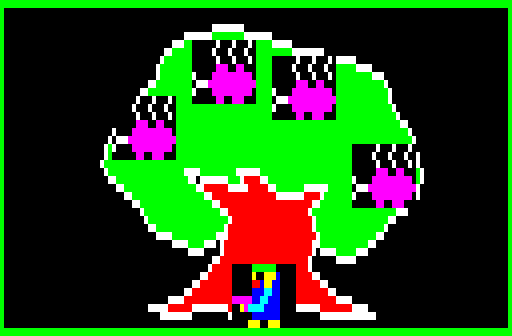
Pretty much any normal action substracts one or two health points as well, but you start the game with 100 rations of (F)ood you can consume at any time to heal yourself. Sometimes you can find a tree with cherries, bananas(!), strawberries(!!) or steaming pork knuckles(!!!), which I suppose refill your rations, but I never got any of them. It seems you need to position yourself with the "4" and "6" keys on the numeral pad, and then (U)se a rope, but I never happend to have one with me when I found a tree.
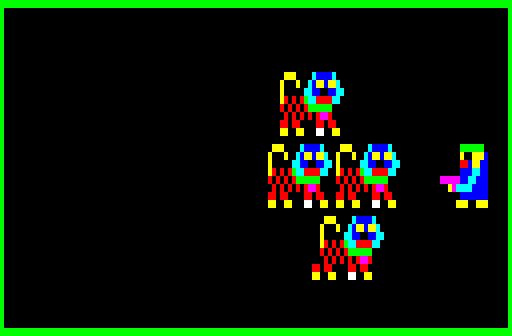
Combat in this game is really weird, as it's more or less real time. Calling it an action RPG would be a bit much, but it is clearly visible that Falcom was getting there eventually. If you meet a lion (or a whole bunch of them, as seen above), it starts to rush at you, and you need to (A)ttack it in time (you might still lose by random determination). If you manage to slaughter a whole pack of lions, you get 30 rations of food. There are also some fights that can be dodged with "8" and "2".
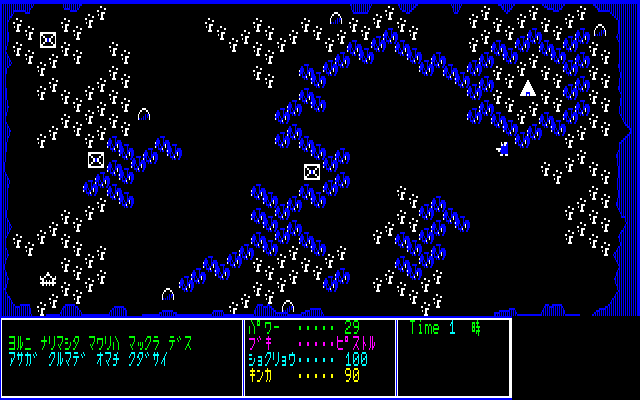
Panorama Toh even has a day-and-night cycle, although at night all you can do is wait for dawn. You cannot move and nothing ever happens at night.
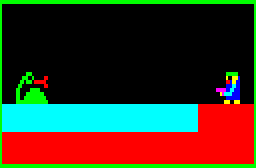
This is Nessie, but you can't actually attack her. The guy just tries to storm at her and then sinks to the ground of the lake.
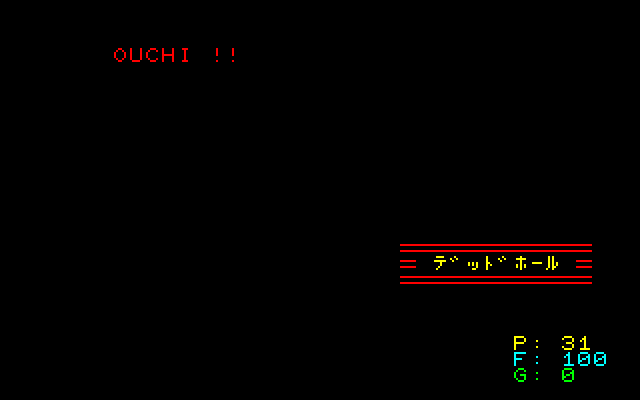
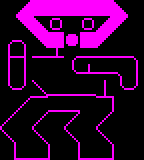
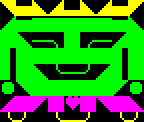
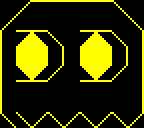
This is one of the caves from the inside. It is pitch dark, and the only means of orientation is the exclamation "Ouchi !!" whenever you hit a wall. Add to that a somewhat unresponsive input and randomly attacking monsters. (A)ttacking them only yields a message that they cannot be hurt without certain artifacts, which of course I don't have, so all I can do is (E)scape. That fortunately always works, but you have to do it quickly, cause the battles here are semi-realtime, too. The monsters are all made of text characters and look kinda cute:
The spelunking didn't go too well, so I guess I should stock up my gear at one of the towns. But they're all at the other side of the river, so I have to find a way across.
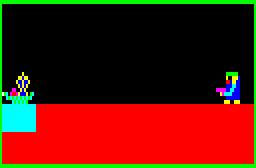
At some points there is actually a ferryman. You can try (A)ttacking him, but it always fails. Trying to (C)all him for help may get his attention - or maybe a bushman runs up to you and stabs you in the face with his spear instead. But even if you manage to employ the boatsman, he doesn't simply drop you off across the river - the one I could convince to take me on his boat for 10 gold pieces just took me down the river for a few fields before leaving me on the same shore I came from. Swimming over is actually more promising: The game makes you keep pressing "4" to the other shore, but you sink down to the ground with random speed, and if you hit the ground before reaching the end, you lose health and have to start again. For some reason this procedure has to be done twice with each crossing, but failing the second one still lets you get across.
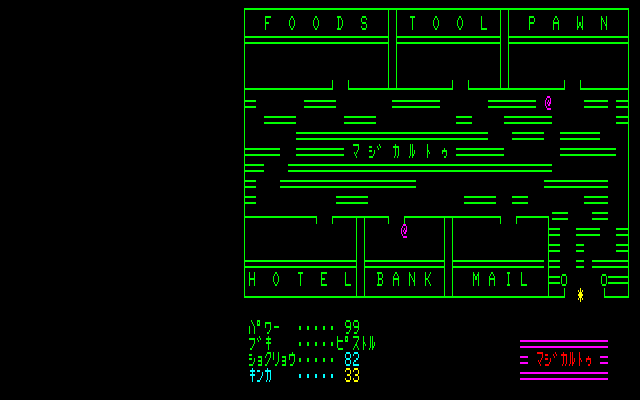
The towns are fun - you are the yellow asteristk, but the purple @-characters are thieves that steal your money. Doesn't matter at all, though, as you'll see shortly
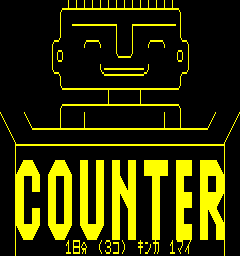
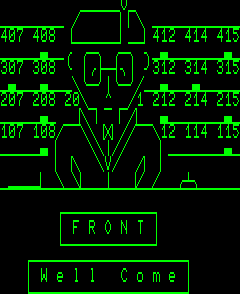
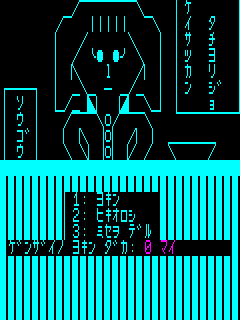
Entering the stores brings up close-up portraits of the shopowners, a feature that carried on to later games like Ys. From left to right: The Foodstuff Store, the Inn and the Bank. The Inn even exists as a 3D space where you can walk up to your room:
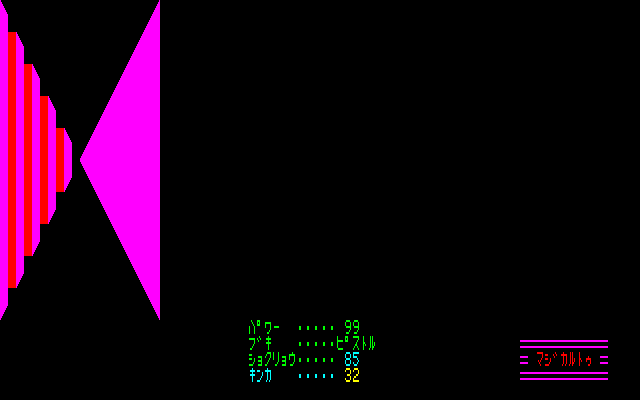
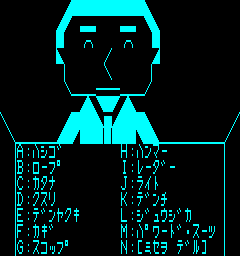
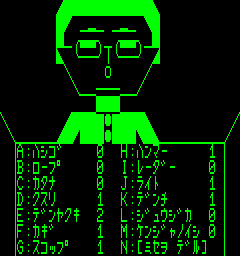
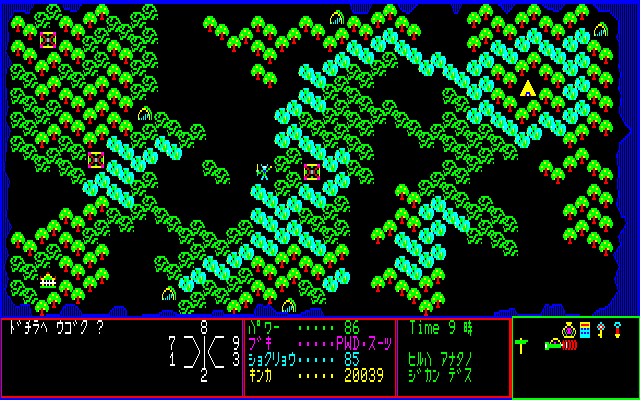
Most important is the tool shop, however, where you can get anything that the aboriginals sell, and then some. The best part of the deal: Almost every item only costs 1 gold coin, and for buying you actually get the money instead of losing it. I have no idea whether this is a bug, or the disk image that's around is hacked. There's also a pawnshop to sell items (above to the right), but given the state the game is in, that is hardly necessary. I bought a flashlight and some batteries, also a radar and a "PWD Suit" (which other than the rest of the items cost 20,000, but once again the shop owner gave me money instead of taking it). The latter is even reflected in the appearance on the overworld (also notice the filled (I)nventory screen to the right):
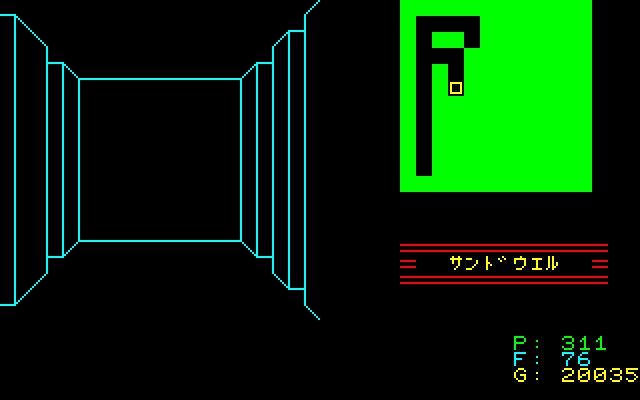
After (U)sing the flashlight, dungeons look like this, in best Wizardry - or rather early Ultima - fashion. Sometimes it's really hard to tell how far away a corridor to the left or right is, resulting in many useless, time-wasting turns. Batteries also die faster than in a Game Gear so I had to get back and stock up more (you can only buy one per menu selection - ugh). Each time a battery runs out, the color of the dungeon walls changes for some reason. Even if the light runs out, though, it isn't too bad with the radar, which draws an automap as you go along. All you have to do is bump into every wall to test the way, while the radar tracks your position. I never found anything of value in the caves, although they do connect one cave entry to another, so I guess that would be an alternative way across the river - after you've been at the city once to get your gear.
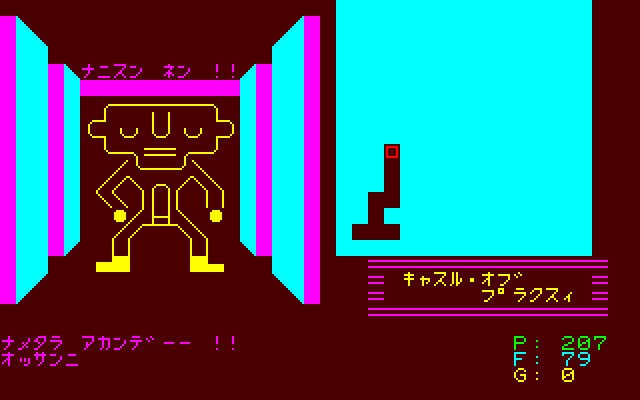
There's also the castle to the southwest, of course. Other than the caves, it is perfectly lit, represented by the solid walls instead of wireframes. It is full of these guys, which I can only interpret as perverts who show off their huge erections. (A)ttacking them makes them go away, but you can also give them all your money if you want. Nothing of this does anything for you. The castle is huge and you get disturbed by them every few steps, so I just gave up on it.
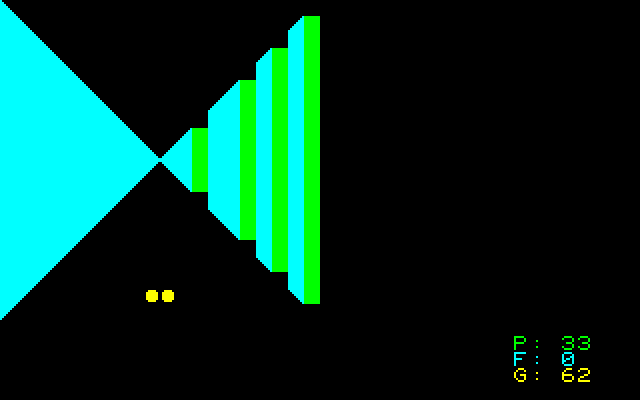
That leaves the pyramid, which houses the only dungeon enemies that can actually be (A)ttacked without magic weapons. There are also two yellow circles lying around everywhere, but I couldn't do anything with them.
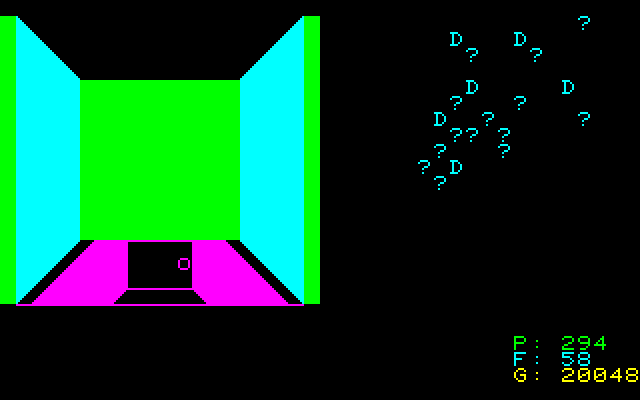
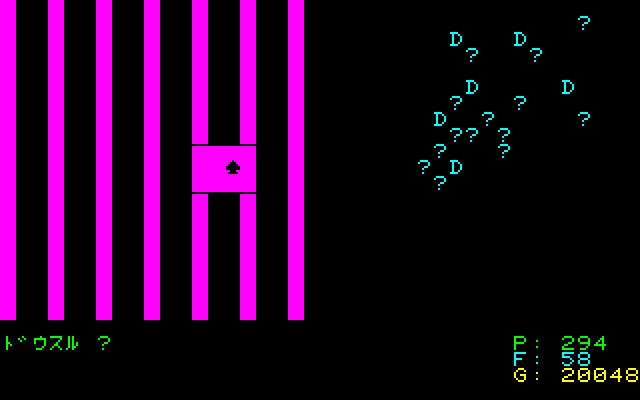
There are several locked doors around the hallways, but (U)sing a key here only gives me the message that it's to be opened and I shall return to the first floor? But I've never been on any other floors other than this? Very strange.
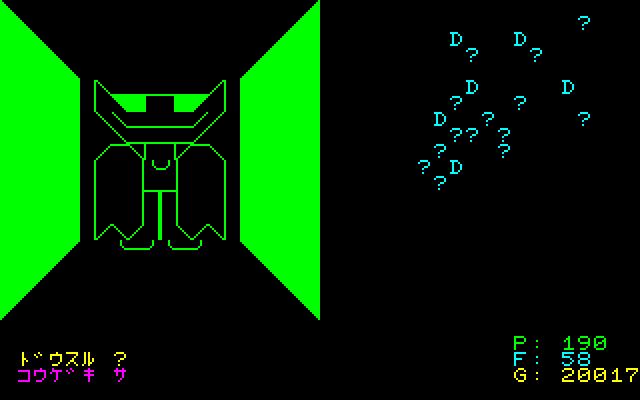
Eventually ASCII Darth Vader here blocks the way, and apparently I need a holy sword to defeat him. But I played Legend of the Holy Sword last week! I give up!


Wednesday, May 15, 2013

The Nintendo Power Retrospectives - Part 12

This week I've come to the end of Nintendo Power's first year, and boy is this issue weak on games to review, with only four titles. On the bright side, one of those is a classic from Capcom. We also have the results of the first annual Nintendo Power Awards.
The official HG101 write-up of Xanadu (and with it Faxanadu) can be found here.

Monday, March 19, 2012

Ys: The Oath in Felghana is on Steam right now.

You should go buy it!

http://store.steampowered.com/app/207320/


But seriously, folks. This isn't just one of the finest games in the Ys franchise, it's one of the best action RPGs you'll ever play.

Also, if this does well(which it seems to already be doing!), it will smash the gates for future Japanese and doujin games on Steam.

That's relevant to all our interests.

Here's some screens!


Sunday, March 18, 2012

In defense of the Japanese gaming industry

It's a sad state of affairs when an article warrants a title like this.

Unfortunately, as evidenced by controversial statements by everyone from Fez's Phil Fish to Megaman creator Keiji Inafune to Metal Gear's Hideo Kojima, the Japanese industry is rapidly becoming an easy target for ridicule and extensive criticism; as if it wasn't enough of one already.

Phil Fish

"your games just suck"


Sunday, September 18, 2011

Falcom JDK Band Performs Live at TGS 2011

My brother who lives in Japan attended the 2011 Tokyo Game Show. He was not very impressed with the show overall, but he enjoyed the live Legend of Heroes music performed by Kotera Kanako and the Falcom JDK Band. I'm told Falcom did a live stream of the entire performance, so there might be better recordings floating around out there than these clips recorded on a cell phone, but I don't see any others on Youtube yet and I figured there were enough Legend of Heroes fans here to justify posting them.


"Cry for Me, Cry for You", the theme song from Legend of Heroes Trails in the Sky the 3rd


"Aoi Kiseki", the theme song from Legend of Heroes Ao no Kiseki


"Sora o Miagete," the ending theme from Legend of Heroes Trails in the Sky the 3rd


"Way of Life," the Theme song from Legend of Heroes Zero no Kiseki


"Gin no Ishi Kin no Tsubasa", the theme song from Legend of Heroes Trails in the Sky SC

Wednesday, August 18, 2010

Ys Seven is Out and You Should Buy It Now

Ys Seven came out in the US yesterday, and it's absolutely imperative that you buy it. I could write paragraphs and paragraphs on how awesome it is, but in the interest of keeping it brief, I'll point to the Official Sony US blog, which should do an excellent job of hyping you up, and I can confirm that it's not the usual PR speak either. The game hasn't been covered in the Ys article proper, just because I hadn't gotten enough time that I was happy to fully review it. I got about eight hours in and got distracted, but don't let my video game ADD put you off - those were eight damn good hours. Plus after I'd heard it was being released in English, I held off playing any further so I could actually enjoy the story.


I love Ys, because I truly believe the Action-RPG is The Best Genre. Despite their proliferation and popularity in the 16-bit era - Secret of Mana, Illusion of Gaia, Terranigma, Beyond Oasis, Landstalker, Crusader of Centy, and even Zelda, if you want to argue that way (I would) - it's sorted of dried up over the past decade. Well....maybe not dried up, so much as torn apart and evolved. Outside of Zelda and its very particular type, you've got stuff like Bayonetta and God of War which weighs heavily on the action side and Champions of Norrath and Shining Force EX/Neo whatever leaning on the RPG side. Most of these don't really hit the sweet spot I'm looking for, although NIER is probably one of the best recent ones. You could probably stick in stuff like Odin Sphere and Muramasa, which are decent, although in different ways.

Ys though? Man. Ys was a series I really liked when I was introduced to it - Ys III is the best worst game ever made - but it really became super awesome with Ys VI: The Ark of Napishtim, which replaced its fun-by-wonky battle system with something far more gratifying. Then it got ridiculously mega awesome with Oath in Felghana, a little less awesome with Ys Origin, and graduated in some of doctorate in awesomise-tisity by the time Ys Seven rolled around last year.


In many ways, Ys is sort of a sister series to Castlevania, at least of the Symphony of the Night variety. I know that claim might put off some people, but hear me out! They are both focused on exploration, world-building, and level-building. Their controls are beautifully smooth, doubly impressive with the Ys games, since they're 3D games that play like 2D games. And they also all have amazing soundtracks.

In fact, Ys arguably does a lot of this better. It's got a beautiful tempo, as the very act of running around, hacking everything to bits, feels like a constant series of miniature rewards. It's better balanced, too. The day-to-day hacking and slashing is hardly taxing, difficulty-wise, but the bosses will test every single old-school arcade skill you've got. (And while grinding will help you out, they won't completely solve the matters either.) Admittedly, over the course of the series, the action actually started to get a little bit rusty by the time Ys Origin rolled around, but they revamped everything by adding a speedy dash button in Ys Seven, and substantially improved the battle system by adding tons of secondary skills. Altogther, Falcom impressed themselves enough with it that they took the engine and turned it into an arena-based fighting game, Ys vs Sora no Kiseki. (Which, to be honest, didn't turn out so well. It might be fun in multi-player, but single player is another story, and one for another time.)


So yeah, you shouldn't just buy this game to support XSeed and the PSP. Well, I mean, they're a brilliant company for licensing these and absolutely deserve your money, but this isn't a charity case or anything. This is one of the best games of 2010 (and of 2009 too, in fact.) I even say this as someone who doesn't particularly care for playing games on portables - I am slightly sad that Falcom abandoned a PC version, because I'd much rather play it on a 21 inch monitor with a proper controller - but it's just rad enough to overcome that inherent obstacle.

Friday, January 29, 2010

An unpublished Gurumin review


For the first time ever, my previously unpublished review of Falcom’s Gurumin on PSP, originally written for The Gamer’s Qaurter. In an attempt to mimic the surreal style of Digitiser’s Mr Biffo, I wrote it as a stream-of-consciousness piece. Written in 2007, and looking back on it, it’s either excruciatingly awful and maybe a little offensive, or possibly the greatest thing I’ve ever written. I can’t help but feel that, under all the nonsense, there is a sentiment which rings true for nearly everything today.

I mainly ramble a lot, so scroll way down if you want the review.
.
.
.


This was originally written for the unpublished Gamer’s Quarter Issue 9, but since it never materialised, this never went beyond the draft stage. For the record, I think TGQ was incredibly ahead of its time, perhaps a little too much so. It was, in my eyes, an attempt to replicate Reader’s Digest for the videogame world, where instead of the usual print format of news, previews and reviews, it was all features. If you want news, you go to a website. For reviews you visit Metacritic. But features aren’t easy to come by. They also pioneered footnotes in games publications. The UK’s NGamer later copied this idea, and when I suggested it be used on Retro Gamer during my tenure there, I was shot down: We can’t do that, you idiot! Everyone will think we’re copying NGamer!

Well what about every university paper that’s been written for the past few decades? The games magazine world is a strange place, full of misguided and blinkered people, and so good ideas will often die in the gutter. Footnotes was one of them. The opportunity to incorporate them was missed, and now I think only TGQ and NGamer will have the legacy of having used them.

But anyway, Gurumin. I’d actually previewed it for PSPGo, a short-lived PSP magazine in the UK, where I’d requested a switch-around: instead of one page on the godawful Xyanide, and half-a-page on Gurumin, how about we move them around? It made no difference to my commission, and I relished the chance to talk about Falcom which, as I pointed out, used to be one of Japan’s tripartite RPG developers. Sure Climax, Sega and Nintendo dabbled in RPGs to varying degrees, at various times, not to mention the plethora of undocumented Japanese computer developers, but for sheer quantity, quality and breakthrough into the console market, Falcom stands alongside Square and Enix. Over the years their relevance has diminished, but from what I’ve heard they seem like a decent company run by good people – they’ve even freely released some of their older games!

The preview is below.


Sadly my comparison to Zelda was a little overzealous, and the final game was mostly boring. Still, as an unrepentant Falcom fanboy, I did and will continue to buy their games regardless.

All images taken from GamesPress and IGN (who actually took them from GamesPress most likely).


ORIGINAL TGQ DRAFT – unedited, uncut and faaaar too long:

----
Apr 2007


Murdering Piggies

A nostalgic dissection of Falcom’s Gurumin on PSP


I was out in a Wrothendelshire farmer’s field with my Spanish friend, Pablo Gonzales, and we were murdering pigs by asphyxiating them on custard-cream cakes; which, I must add, were purchased, not stolen, from Tesco – while we might be porcine killers, we are not thieves. As was tradition, we chatted about everything and nothing on these excursions - mostly videogames - and on this occasion, the topic was the PSP and Falcom’s Gurumin.

“So Pablo, no love for Falcom’s Gurumin?” said I, with a cheeky glare in my eye.

“Sí señor,” said he, with a moustache that made women blush and men envious.

“But why not Pablo?”

“Una palabra, señor. It ís $40. It ís muchos expensive.”

“But it’s by Falcom, Pablo. Remember all the fun we had playing Falcom games over the years? Remember Legacy of the Wizard? Popful Mail? Ys? Faxanadu… No, wait, forget Faxanadu, that was terrible, and it was actually done by Hudson, or some jazz.”

“This is true, señor. It was terrible. But the others? We loved them. We were so carefree back then, señor.”

“But a Falcom game should be fun, and worth the price of admission, right? I mean, there’s not been a console-based Falcom we’ve ever not played, right?”

“Silence señor, I am hunting thee pigs,” he blustered, wrestling one of the said pink roley poleys to the ground and smothering a custard cake over its face until the muscle spasms stopped.


The origin of our strange hobby dates back to a birthday party we were invited to as small children. During its course, one of us, and we cannot remember whom, threw a custard cake at a Piñata pig (Viva!), after which we promptly burst into hysterical laughter. The other children backed away, many in tears, fearing for their lives. But we only continued to guffaw. Realising the joy in such behaviour, we decided to repeat it each year. Over the years though, we needed to increase the intensity of the act in order to get that same original high; this is why at two in the morning we were standing in a maize field, naked, with those same custard cakes, and a fresh set of momentarily living pigs.

But I was determined to pursue the issue of Gurumin, revealing to my European friend, “I picked it up because I try to support Falcom whenever I can. You should too Pablo… It has awesome things in it!”

“But señor, you don’t really like it. Do you see?” he crowed, as the sky behind him exploded into a spasmodic kaleidoscope of undulating winos and hard rock music.

His question and this vulgar display flummoxed me. Looking in the mirror I would say that I liked it, but did I really? It’s true that while holding the package, having spent closer to $60 on it due to importing, I was initially pleased with the cover art. It looked authentically Japanese, meaning Mastiff must have done a good localisation. Obviously a good sign, seeing as we only had to wait two decades, from the NES era, for companies to follow the example set by Working Designs and actually do things well. Still tasting the bitter tears of Working Designs’ unfair collapse, my mind was filled with thoughts of Popful Mail, Lunar, Dragon Force, and other games of such ilk. Gurumin had to be excellent. It was Falcom for goodness’ sake!

I had loaded it up, feeling re-assured by the accompanying Japanese cry. So far, so good. It then did some stuff games do, which I forget right now, and then at some point there was an awesome animated intro with Japanese theme song. Damn, I can still remember the era when I first heard Japanese theme songs. It was during the Turbo Duo days, warm-happy-safe-warm days.

Finally I was about to play… But wait, let’s reload and hear that song again. With feeling this time! Wait for it. Ahh, there. Good, wasn’t it?

Playing it felt intuitive since, after all, third-person 3D action games are not new. But I kept telling myself this was good, since it meant Falcom didn’t need to cut its teeth on a new concept. Refine and polish I hummed, refine and polish.

The main character, Parin, wandered about an idyllic town before making friends with some Mr-Men styled monsters – oh those wacky Japanese, copying the Yorkshireman Roger Hargreaves like that. This had to be a classic. Then there were the superfluous details as she ran around, which showed that true effort must have gone into the game. When Parin jumped she would perform a short unbalanced animation. Then, when she ran past NPCs, their heads would turn to follow her.
But there other things which made take pause, to think about. NPCs would say words like “Cool” and “Sedgewick” and “Gin-soaked-balls!” when you performed special moves near them. Well, maybe not the last two, but you get the gist. They talk to themselves. Enemies also talk. There are these dancing puppy-cubes, which look like little cubes with legs, except they behave like puppies and have small hearts floating above their heads, and they talk to each other. Until you attack them, at which point they get upset and their icon-based language changes from hearts to… some other symbols. Then they attack, leaving you with only one option: murdering puppies. Murdering lots of puppies. There are other enemies too, which talk amongst themselves, and you will witness lover’s spats, double-dealings and friendly arguments. Until they attack. But, these enemies aren’t just any enemies, they have a slightly Hayao Miyazaki influence to them, making for some genuinely (visually) impressive fights. The boss fights in particular are great fun. Surely any game which reminds me of Hayao Miyazaki has to be awesome, right?

So, I’ve killed some jive-talking puppies, bought some cookies, befriended some monsters, and then I’m going through some dungeons. Legacy of the Wizard had some astoundingly cool dungeon designs – at least that’s what my memory tells me – and so the hopes, they were high. Metaphorically. Except, actually playing the bulk of the game proved hideously repetitive. It was an exercise in pure tedium, with the sole object being to run through a linear stage while smashing every encountered pot (basically a box by another name) and defeating every enemy (basically a box by another name, except a bit more dangerous). Smashing every box in a stage results in a medal, and several medals can be exchanged for masks, which in turn improves your chances of smashing all boxes and also enables you to do it faster.
So, looking at the facts, Gurumin is basically a game where you just break loads of boxes, and it encourages you to do this task faster and more efficiently, in order to be able to break more boxes. Still, the level layouts are cool, right, because this is by Falcom. Right? Well, the levels are stiflingly linear – which makes every journalist who compared this to Zelda a crazy fool (oh wait, I did that, in a preview for another mag… damn). And while being linear, they also repeat. After a couple of hours of playing, the levels are reversed and the box locations remixed to create entirely new levels. Except, they’re not new levels, if you think about it. Take five minutes to do so. Back? Good. But I can forgive Falcom, because maybe they were busy, or doing cool things that Japanese people do, like eat ramen, smoke cigarettes and play Dance Dance Revolution. Maybe they HAD to cut corners with the level design. If you ignore this, it’s not that bad. It’s ok. Well, there’s this whole crappy MacGuffin section where you have to find a mole, to open a gate, to get at more boxes, but after this it’s cool. Actually, I really have no idea, since the clock rang 9 and I knew it was time to meet up with Pablo for our annual pig hunting. The game could wait until afterwards. But even so, my reality was slowly disintegrating.

As I went to the rendezvous point I had to remind myself: just keep thinking of the jumping, and moving heads and the enemies who talk. It’s not that bad, it’s fine. The moving heads makes up for the repeating linear levels and boring-as-hell mole hunting. See? Twenty more minutes and it’ll be over, and I’ll be back in the village, watching those wonderful turning heads which Falcom programmed. I had that. I had to stick to that. It’s a Falcom game, you owe it to them to stick with it, remember how good it was before, playing Falcom games? Remember Popful Mail? Remember Ys?


Now… Where could that daft mole be hiding? Hunting moles is a lot like hunting pigs I thought, and then suddenly I remembered that I had forgotten about Pablo, in the field! Except, I was still there, simply enjoying a flashback of the game, and yet, at the same time I am typing these things down. Strange, isn’t it readers?

I tried explaining all these thoughts to Pablo, but I could feel my enthusiasm waning. So in a disturbing moment of self-realisation, I asked him, “It’s not much fun, is it Pablo?”

“No, señor. Asphyxiating pigs is not much fun anymore. I do not know why we keep doing it. Perhaps we are trying to relive that same moment from our youth; chasing a near-forgotten memory of bliss in this bitterly miserable world. We keep going through the same motions, trying to tell ourselves it was as good or even better than before, but… But señor, these days it feels so empty, and I feel so alone.” He then began weeping into a silk shoe he had stolen from a nearby motel.

I looked at him. “Pablo, I was asking about Gurumin.”

Fin…

Tuesday, December 15, 2009

HG101 Digital Archive Project - Dragon Slayer


There's a labyrinthine history behind the Dragon Slayer games - you can read up on all of the site's Falcom articles for more information - but the gist goes something like this. Dragon Slayer was originally a very (VERY) early dungeon crawly RPG, but Falcom later turned it into a "brand", releasing several successors that, while technically very different games, sort of drew upon various elements of each other. While most of these games were action-RPG hybrids, this all stopped at the sixth Dragon Slayer game, Legend of Heroes (or Eiyuu Densetsu), which was a pretty standard Dragon Quest clone. (I have an unfinished article for a bit about that.) It was fairly popular and ported every which way, but the only version to make it Stateside was the Turbografx-16 CD version, which was probably the best of them anyway. It later spawned three other sequels known as the Gagharv Trilogy, which were the games released on the PSP a few years back (the PSP ports/English translations are baaaaad) as well as the sixth chapter, Sora no Kiseki, which in turn had three separate games, and there's a seventh Legend of Heroes coming soon.


Back to the point! The first Legend of Heroes game was the basis for an anime called (obviously) Dragon Slayer, which was released in Japan in 1992, and localized by Urban Vision in 1997. Other than a few scant mentions of Falcom in credits, this North American release wasn't tied in with the game, because it was based on an obscure something released five years earlier on a system nobody owned anyway. But hey, it was probably cheap to license, and it fulfilled their fantasy anime quota for a bit.


I won't lie - I've only watched a bit of this when it was recording. It's pretty bad. It's an OVA, which means there's not enough time for reasonable character development nor anything resembling an interesting plot. It's wholly generic fantasy fare and it barely has anything in common with the game it's purportedly based on. Sure, some of the characters names are the same, but they look totally different, and it doesn't feel the same, at all, even though it uses some music from it.

That's not really a positive, though, because Legend of Heroes' soundtrack was only interesting when arranged by Ryo Yonemitsu for the TG-16 port (who also did all of the TG-16 Ys games). In its standard form, it attempts to be rousing but is completely held back by the cheap orchestral synth (they called them "electric orchestra" back in the day). It was released separately with the name Symphonic Poem Dragon Slayer ~ The Legend of Heroes Vol. 2. I own this CD, and it is quite dull.


This isn't the first time this happened to a Falcom anime. There was also an OVA based off Xanadu, which originally had the look and feel of an action version of Wizardry and somehow got turned into a show about mecha and tentacle thingies. As much as I love Falcom, they have a tendency to farm out their properties and do as little as possible to make sure they aren't screwed up. (Those Ys DS ports, for instance.) I might post this Xanadu anime later, although it's still in raw Japanese.

The only thing I can't figure out is if this contains both episodes of the OVA or only one. I didn't notice any particular chapter breaks, but it is a bit over 40 mins total, which seems to suggest they combined both onto one tape.

Download here

Saturday, September 5, 2009

Falcom Panel - Otakon 2008 - Video for Download

Coming a year late, but here we go!


Full download:
Megaupload
Fileplanet

Youtube links:
Part 1
Part 2
Part 3
Part 4
Part 5
(embedded after the jump)

The full download a bit over 400 MB encoded in xVID, and 52 minutes or so long.

This stars me, Wyrdwad, OMGFloofy from the Ancient Land of Ys forums, and a guy named Will who I don't think posts at either place. We spent a huge chunk of the time talking about the basic history of Falcom then about Ys, but we ran out of time before we delved deeper into their other series. The same thing happened at this year's panel, too, which we unfortunately couldn't record due to logistic reasons. (We had too much luggage and the camera didn't fit in our trunk.) Anyway, enjoy! (Thanks to Vysethebold for recording this for us!)


Friday, September 4, 2009

Falcom Translation News - Brandish 4


I'm a few weeks late on this, but apparently a group of people are translating Falcom's Brandish 4, also known as Brandish VT. (Check out the full HG101 Brandish article) They're also doing the fan world one better by remixing the entire soundtrack. The (as of current) final installment of the series ditched screen rotation in favor of an isometric perspective, which is far less headache inducing. I'm not a gigantic fan of the series, although I do think it's kinda cool how they took the mechanics of a standard first person dungeon crawler, made it third person, and introduced real time combat. It's always been a bit weird and futzy, except for the recent PSP remake, which fixes pretty much every problem the series ever had (and should be an excellent candidate for localization, but chances of it being picked up seem slim.) With this, Ys Origin and Xanadu Next coming up soon, English speaking Falcom fans can finally play through games without skipping through all of the text with apathy and frustration.

Also, Ancient Land of Ys member OMGFloofy has started up a Falcom blog called Endless History (the domain name is a reference to the continent which Ys takes place on, while the title is named after the vocal version of the song "Morning Grow (Glow)", the ending song to the first Ys.) So far it's keeping on top of the upcoming release of Eiyuu Densetsu (Legend of Heroes) VII, as well as Ys 7 for the PSP, which is coming out in a few weeks. It's also updating on Falcom's weekly special, which bundles together various games and goods at a discount. Falcom games are notoriously difficult to obtain for us non-Japanese, and about the only way to get them is by ordering straight from the company. The shipping is extremely pricey, but you're still getting a decent price overall - the only way you'll get better is either by trawling Japanese used game soft stores or hanging out at the Falcom boards and hopes someone decides to part with some of their stuff.