
Please support my Patreon at http://www.patreon.com/countzeroor
Showing posts with label final fantasy. Show all posts
Showing posts with label final fantasy. Show all posts
Wednesday, April 23, 2014
Nintendo Power Retrospectives - Part 27
This week I'm taking a look at Nintendo Power #17, for November of 1990, covering Final Fantasy.
Please support my Patreon at http://www.patreon.com/countzeroor
Please support my Patreon at http://www.patreon.com/countzeroor

Friday, August 10, 2012
Final Symphony: Music from Final Fantasy VI, VII and X Announced.

The event will be held at the Stadthalle Wuppertal in Germany on the May 11th. Tickets will go on sale on August 24th at WestTicket.de, and be priced at €22 ($27). The concert is officially produced in cooperation with Square Enix and Nobuo Uematsu. Check out more info at ffsymphony.com as it becomes available.
Thursday, November 4, 2010
Ten Best Game Soundtracks of 2010 (So Far)
Is it too early to talk about "Best of 20XX" stuff yet? Probably. But we're going to discuss the best soundtracks anyway, under the assumption that there's not going to be much better. The rest of the 2010 release seems to include mostly Western games, who are largely focused on bombastic Hollywood-style film soundtracks than legitimate game music, and I don't think there's too many big Japanese releases left. If something comes out and surprises is - it definitely could! - we'll append it down the road. So, without further ado, here are the Ten Best Game Soundtracks of 2010 (So Far):
VVVVVV (Featured song: Potential for Anything)
There are only maybe half a dozen proper songs in this soundtrack - fitting, since the game is only about two hours - but each of these tracks is pure SID-inspired chiptune bliss. You can grab MP3s of it the composer's website for a few bucks - unquestionably worth it.
Scott Pilgrim vs the World: The Game (Featured song: Another Winter)
Anamanaguchi was band I had only half paid attention to, because while their unique of guitar and NES chiptunes were kinda cool, their songs always felt long and meandering. When concentrated into the context of a 1-2 minute video game song, though, their talent for composition really shows through, resulting in a retro soundtrack that still has a distinctly modern edge.
Castlevania Harmony of Despair (Featured song: Invitation of the Crazed Moon)
My own big complaint about remixed music in Castlevania games is that they always drew from the 8 and 16-bit games, ignoring practically everything from Symphony of the Night and afterward. Harmony of Despair changes that, and features numerous songs from the portable Metroidvanias, all rearranged. They're all fantastic too, many being done by the same folks who redid the songs for Judgment. The DLC pack adds even more, and the handful of new tracks - including one of my favorites, Invitation of the Crazed Moon from Portrait of Ruin - are outstanding too.
NIER (Featured song: The Lost Forest)
This game kind of came out of nowhere to be really damn cool, and part of that appeal lied on its music, which took the took a tired musical trope - foreign-sounding chanting - and gave it new life. The dramatic strings and percussion pieces are even more outstanding, breezy and melodic, constrasting to the comparatively dull orchestrations that permeate stuff like Castlevania Lords of Shadows and God of War.
Ys The Oath in Felghana (Featured song: A Searing Struggle)
Is it fair to include this game? This was released in the US in 2010, but released in 2009 in Japan, which in turn was based on a 2005 release (again) in Japan only, which was a remake of Ys III, a game from fifteen years earlier. So, the music in The Oath of Felghana is hardly "new". But that's okay, because Ys III had one of the best soundtracks in existence, and remixes in The Oath of Felghana only improves them with live instrumentation. Props to the PSP version for including alternate versions from the old computer releases.
Ys Seven (Featured song: Mother Earth Altago)
The music in Ys Seven isn't QUITE as good as Felghana, but it's also the best original soundtrack in the series since Ys IV. Parts of it sounds remarkably like an upgraded PC Engine redbook track, which has always been part of the Ys appeal (at least, to the English speaking audience.)
Dodonpachi Daifukkatsu Black Label (Featured song: Vertex)
The soundtrack to DDP Daifukkatsu was kinda lousy, but the Black Label version doesn't rearrange it, it created a whole new soundtrack from scratch. It's much better, with some damn catchy electronica, and while it's not quite as trance-y as Espgaluda, it further establishes the parallel that Cave-brand danmaku shooters are the video game equivalent of an ecstasy fueled rave.
Dark Void (Featured song: Main Theme)
Usually we rag on Western game soundtracks for totally missing what we love about video game music. But we'll overlook that when it comes to Bear McCreary, the incredibly talented composer behind the reimagined Battlestar Galatica and its (now cancelled) spin-off Caprica. As a result, the soundtrack to this under-appreciated action game sounds much like his other work - which is to say, filled with fantastic orchestrations and lots of percussion. Bonus points for the Dark Void Zero soundtrack, which takes these turns and turns them into Mega Man-style NES music.
Final Fantasy XIII (Featured song: Blinded By Light)
On the Final Fantasy/Dragon Quest divide, I am usually staunchly on the side of Final Fantasy. FFXIII screwed up so much though, from the storytelling to the dialogue to the character development to the level design that it really did come up short. The only two areas where it excelled was its utterly fantastic battle system and its magnificent soundtrack. Styistcally Masashi Hamauzu is quite a bit different from series mainstray composer Nobuo Uematsu, as well as FFXII composer Hitoshi Sakimoto, but the man can use the violin like no other game musician out there.
Etrian Odyssey III (Featured song: Unrest - The End of the Raging Waves)
Even if you don't like grindy masochistic first person dungeon crawlers, everyone should appreciate these games for continuing to employ Yuzo Koshiro, one of the few prominent musicians from the 80s music scene that's still got it. This PC88 FM inspired sountrack is the best of the series, offering a wider variety of dungeon themes that alter between serene and foreboding, and numerous outstanding battle themes. The arranged album also borrows some instrumentation styles from Falcom, also making it essential for Ys fans.
Runners-up
Death Smiles (Featured song: Burning Halloween Town)
Not one of Cave's better soundtracks (better than Daifakkutsu though), at least the first level theme is pretty excellent, as are the boss and level select themes.
Super Mario Galaxy 2 (Featured song: Throwback Galaxy)
Catchy and eminently likable, with a handful of arranged songs from previous Mario and Yoshi games. Not enough of it really stands out to make the Top 10 though.
No More Heroes Desperate Struggle (Featured song: Philistine)
The "A Goddamned Philistine Since 2004" header on the main HG101 page is a reference to Margaret's song, a darkly silly little bit sung by the boss in question about how our hero, Travis Touchdown, is a goddamned pussy. Like the first game, the music selection is eclectic and ultimately not as consistently strong, some of the boss tracks are still outstanding.
VVVVVV (Featured song: Potential for Anything)
There are only maybe half a dozen proper songs in this soundtrack - fitting, since the game is only about two hours - but each of these tracks is pure SID-inspired chiptune bliss. You can grab MP3s of it the composer's website for a few bucks - unquestionably worth it.
Scott Pilgrim vs the World: The Game (Featured song: Another Winter)
Anamanaguchi was band I had only half paid attention to, because while their unique of guitar and NES chiptunes were kinda cool, their songs always felt long and meandering. When concentrated into the context of a 1-2 minute video game song, though, their talent for composition really shows through, resulting in a retro soundtrack that still has a distinctly modern edge.
Castlevania Harmony of Despair (Featured song: Invitation of the Crazed Moon)
My own big complaint about remixed music in Castlevania games is that they always drew from the 8 and 16-bit games, ignoring practically everything from Symphony of the Night and afterward. Harmony of Despair changes that, and features numerous songs from the portable Metroidvanias, all rearranged. They're all fantastic too, many being done by the same folks who redid the songs for Judgment. The DLC pack adds even more, and the handful of new tracks - including one of my favorites, Invitation of the Crazed Moon from Portrait of Ruin - are outstanding too.
NIER (Featured song: The Lost Forest)
This game kind of came out of nowhere to be really damn cool, and part of that appeal lied on its music, which took the took a tired musical trope - foreign-sounding chanting - and gave it new life. The dramatic strings and percussion pieces are even more outstanding, breezy and melodic, constrasting to the comparatively dull orchestrations that permeate stuff like Castlevania Lords of Shadows and God of War.
Ys The Oath in Felghana (Featured song: A Searing Struggle)
Is it fair to include this game? This was released in the US in 2010, but released in 2009 in Japan, which in turn was based on a 2005 release (again) in Japan only, which was a remake of Ys III, a game from fifteen years earlier. So, the music in The Oath of Felghana is hardly "new". But that's okay, because Ys III had one of the best soundtracks in existence, and remixes in The Oath of Felghana only improves them with live instrumentation. Props to the PSP version for including alternate versions from the old computer releases.
Ys Seven (Featured song: Mother Earth Altago)
The music in Ys Seven isn't QUITE as good as Felghana, but it's also the best original soundtrack in the series since Ys IV. Parts of it sounds remarkably like an upgraded PC Engine redbook track, which has always been part of the Ys appeal (at least, to the English speaking audience.)
Dodonpachi Daifukkatsu Black Label (Featured song: Vertex)
The soundtrack to DDP Daifukkatsu was kinda lousy, but the Black Label version doesn't rearrange it, it created a whole new soundtrack from scratch. It's much better, with some damn catchy electronica, and while it's not quite as trance-y as Espgaluda, it further establishes the parallel that Cave-brand danmaku shooters are the video game equivalent of an ecstasy fueled rave.
Dark Void (Featured song: Main Theme)
Usually we rag on Western game soundtracks for totally missing what we love about video game music. But we'll overlook that when it comes to Bear McCreary, the incredibly talented composer behind the reimagined Battlestar Galatica and its (now cancelled) spin-off Caprica. As a result, the soundtrack to this under-appreciated action game sounds much like his other work - which is to say, filled with fantastic orchestrations and lots of percussion. Bonus points for the Dark Void Zero soundtrack, which takes these turns and turns them into Mega Man-style NES music.
Final Fantasy XIII (Featured song: Blinded By Light)
On the Final Fantasy/Dragon Quest divide, I am usually staunchly on the side of Final Fantasy. FFXIII screwed up so much though, from the storytelling to the dialogue to the character development to the level design that it really did come up short. The only two areas where it excelled was its utterly fantastic battle system and its magnificent soundtrack. Styistcally Masashi Hamauzu is quite a bit different from series mainstray composer Nobuo Uematsu, as well as FFXII composer Hitoshi Sakimoto, but the man can use the violin like no other game musician out there.
Etrian Odyssey III (Featured song: Unrest - The End of the Raging Waves)
Even if you don't like grindy masochistic first person dungeon crawlers, everyone should appreciate these games for continuing to employ Yuzo Koshiro, one of the few prominent musicians from the 80s music scene that's still got it. This PC88 FM inspired sountrack is the best of the series, offering a wider variety of dungeon themes that alter between serene and foreboding, and numerous outstanding battle themes. The arranged album also borrows some instrumentation styles from Falcom, also making it essential for Ys fans.
Runners-up
Death Smiles (Featured song: Burning Halloween Town)
Not one of Cave's better soundtracks (better than Daifakkutsu though), at least the first level theme is pretty excellent, as are the boss and level select themes.
Super Mario Galaxy 2 (Featured song: Throwback Galaxy)
Catchy and eminently likable, with a handful of arranged songs from previous Mario and Yoshi games. Not enough of it really stands out to make the Top 10 though.
No More Heroes Desperate Struggle (Featured song: Philistine)
The "A Goddamned Philistine Since 2004" header on the main HG101 page is a reference to Margaret's song, a darkly silly little bit sung by the boss in question about how our hero, Travis Touchdown, is a goddamned pussy. Like the first game, the music selection is eclectic and ultimately not as consistently strong, some of the boss tracks are still outstanding.
Saturday, April 3, 2010
Final Fantasy XIII - Game design and linearity
Judging by the message boards I tend to lurk around, I think I'm more liberal in my tastes for RPGs. I'd much rather play a game that does something new and interesting, rather than same-old-same-old. That's why I've always held a stronger affinity to Final Fantasy over Dragon Quest, which lowers my nerd street cred quite a bit, but that's the way I roll. Keeping in that, I really like Final Fantasy XIII, despite its boneheaded storytelling. Most of that stems from the awesome battle system, which mixes the best parts of Grandia with little bits of the Active Time Battle stuff from the older Final Fantasies, along with the general high level action management found in FFXII.

Yet as fantastic as this, I do wish they hadn't abandoned so much of the traditional stuff - it's not ALL bad, after all. To combat this, I've been playing the Japanese DS game 7th Dragon, which recently got a budget re-release in Japan. It's a year old by this point and no mention has been made of any localizations, which is a shame - it is a very traditional, 8-bit style RPG, but there's a lot of stuff I dig about it, and it's far better than most of the C-level dreck like Sands of Destruction, and quite a bit more interesting than playing Final Fantasy IV or Chrono Trigger for the fourth time. With 7th Dragon and Final Fantasy XIII taken together, in an alternating fashion, it creates a completely fulfilling experience, moreso than either game by itself.
The biggest issue with FFXIII, as noted billions of times over, is its linearity. Not only in its level designs, which I don't mind so much, but on the characters you play as and how they're customized. In all of the other Final Fantasy games, I'd kick the characters I didn't like to the sidelines, but here, you're playing as Vanille, whether you like it or not. (I do not.) In 7th Dragon...heck, there are seven different character classes with four designs each, and none have any obnoxious personality to get in the way. Below, see at my mage looks pissed off because I gave her such a retarded name.

One of FFXIII's directors claimed that linearity is necessary to tell a structured story. In a way that's true, but it also has a great advantage in creating a meticulously structured experience from a gameplay standpoint. With all of the characters having different roles (to start out) and with each chapter changing up the roster, you're forced to acknowledge their strengths and weaknesses and use them accordingly.
To explain why this is so cool, let's look back on the Final Fantasy series as a whole. There have always been elemental spells to take advantage of enemy weaknesses, there have always been sleep and stun and insta-kill spells. But did you ever really NEED any of them? Most of the games from IV onward can be beaten without paying attention to any of these, which conditioned a lot of RPGs players to think the games lacked depth. Then Shin Megami Tensei and Dragon Quest started becoming more popular, and all of sudden, hey, you really DO need to exploit enemy weaknesses and use sleep spells unless you want to get trampled over!
Keeping in that, with the introduction of the Job system there have been dozens upon dozens of weird and unique special skills. But the game never actually teaches you the usefulness of these skills - they just toss all kinds of stuff at you and expect you to figure it out. While this fairly freeform approach to design allows for a lot of experimentation, and much more replay value, it's somewhat undone by the lack of balance - what was the point of using a Geomancer or a Beastmaster in FFV when any of the other classes seemed more immediately useful? Surely there are uses for them, but the game lays that burden on the player.

To bring things back to 7th Dragon, I got about five hours into the game before I realized that I needed a Knight, to use her skills to counteract the poison of the thousands of flowers strewn throughout the game world. (Above, named after nerd queen Zooey Deschanel.) The Knight has strong defensive powers, which is handy for protecting the rest of your party. In theory, anyway - functionally I haven't found a real use for it. I keep my attackers in the front row and my mage/healer in the back, per usual structure, but the Knight skills can only be used on a specific row. So, I can have her defend the back row...but it gobbles up a significant amount of magic points, and if no one in the back row is attacked, I just wasted my precious resources. That, and by defending, I've lost an attack for the turn. Which is important when, again, you need to beat battles quickly and conserve those resources! Despite leveling her up quite a bit, I ditched the Knight and brought my Princess back. The Knight is probably useful, but hell if I know when and where.
Final Fantasy XIII though? I think I'm on the 7th chapter, and after being (thankfully) absent for a good chunk of the game, Snow has rejoined the party. He's the first time where you really get to use the Sentinel role, which as a defender. Similar classes have existed in previous Final Fantasy games, also as a Knight, with Cover skills that would let that character take damage in the stead of another, if they were in mortal danger, but keeping a character in that dedicated role never made much sense. But the way FFXIII is structured, Snow is paired with Hope, who is incredibly weak, and can be killed very easily. You absolutely NEED to know when you use those Sentinel skills to protect him, or he'll die, and then you'll die.
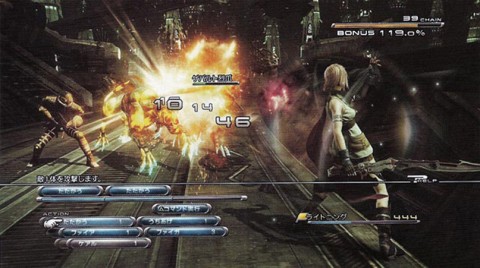
What's more is that the feedback is immediate, and you can quickly jump back in action if you screw up. Since leveling isn't terribly important, the onus lies on your strategy and not your numbers. The Shin Megami Tensei games occasionally have checkpoints, where it tests to see not only if you understand the systems, but whether you've built a well rounded demon squadron - if you come across legions of Jack Frosts, you'd better make sure you have some Agi spells. If you don't have the right skills...well, back to spending some time to get them. FFXIII cuts out that, quite frankly, tedious step, by forcing you to learn the rawest sense of mechanics, rather than looking at your party build. Consider your party build has been one of the defining factors of any JRPG for the last twenty years, to toss that aside, is pretty forward thinking.
No, wait, now that I think about it, that's really amazing! For such a long time, RPGs have just slung powers at you, and sent you off into the unknown to sift through them and figure it out. (Or buy a strategy guide. Or talk to other people. Promoting community isn't a bad thing but neither of these should be a necessity.) In FFXIII, the way the encounters are engineered, you slowly learn better ways to use the roles, until you become a master at it. Without random battles, you'll first fight a couple of popcorn soldiers, then some popcorn soldiers and their stronger compatriots, then finally a whole squadron of the stronger guys, each acting as increasing tests of your understanding of Paradigm Shifting. It's far tighter experience, and from a certain perspective, makes the last few decades look comparatively sloppy.
People have been complaining that the opening twenty hours or so of FFXIII feel like a tutorial. While it's a bit silly that they pop up for things that should be self-explanatory, is there anything really wrong with that? Look at any real great action game for the past twenty years. For one of the best, let's take the original Ninja Gaiden. You're first taught to handle the timing of your sword swings to take out the dogs, and properly wall jump. In the second stage, you need to be able to time your jumps against the enemies so you aren't knocked into pits. In the third stage and onward, you need to be able to jump and swing your sword in perfect precision, until you've mastered everything to beat the final stages. The directors of FFXIII have repeated said that the game is meant to be closer to cinematic action games like Call of Duty or Uncharted, which are similarly designed to teach you skills as the story progresses, so why is it so awful that FFXII takes that route?
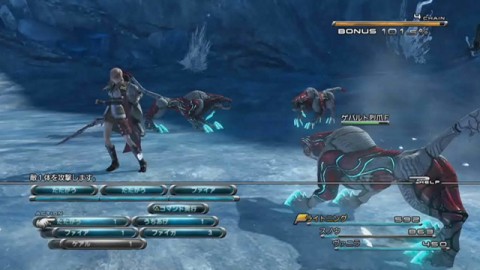
Well, the biggest slam against FFXII is its pacing. By the time I got Snow back and his Sentinel role, the clock hit the 11 hour mark. I've ditched other RPGs long before point, and have really only kept at it on the promise that the battles get awesome. They do, but that's really just too long to get into everything, and I really don't blame people for throwing their arms up in disgust in favor of something that properly quenches the thirst for some kind of traditional RPGing. In this aspect, the introduction of the mechanics are conflicting with the storytelling, which is definitely one of FFXIII's greatest flaws.
Still, don't dismiss it so quickly! As much as it's easy to think that the people behind it must be total morons, that everyone wants Fallout 3 or Oblivion or whatever, but once you examine how everything is laid out, perhaps you can become more appreciable of what it does right, rather than what it does wrong. Not every RPG needs to be designed like this - hence why 7th Dragon still has a very appreciable place, and there's still a lot of advantages to the exploration of character development mechanics - but the ones that do should be applauded rather than derided.
Yet as fantastic as this, I do wish they hadn't abandoned so much of the traditional stuff - it's not ALL bad, after all. To combat this, I've been playing the Japanese DS game 7th Dragon, which recently got a budget re-release in Japan. It's a year old by this point and no mention has been made of any localizations, which is a shame - it is a very traditional, 8-bit style RPG, but there's a lot of stuff I dig about it, and it's far better than most of the C-level dreck like Sands of Destruction, and quite a bit more interesting than playing Final Fantasy IV or Chrono Trigger for the fourth time. With 7th Dragon and Final Fantasy XIII taken together, in an alternating fashion, it creates a completely fulfilling experience, moreso than either game by itself.
The biggest issue with FFXIII, as noted billions of times over, is its linearity. Not only in its level designs, which I don't mind so much, but on the characters you play as and how they're customized. In all of the other Final Fantasy games, I'd kick the characters I didn't like to the sidelines, but here, you're playing as Vanille, whether you like it or not. (I do not.) In 7th Dragon...heck, there are seven different character classes with four designs each, and none have any obnoxious personality to get in the way. Below, see at my mage looks pissed off because I gave her such a retarded name.
One of FFXIII's directors claimed that linearity is necessary to tell a structured story. In a way that's true, but it also has a great advantage in creating a meticulously structured experience from a gameplay standpoint. With all of the characters having different roles (to start out) and with each chapter changing up the roster, you're forced to acknowledge their strengths and weaknesses and use them accordingly.
To explain why this is so cool, let's look back on the Final Fantasy series as a whole. There have always been elemental spells to take advantage of enemy weaknesses, there have always been sleep and stun and insta-kill spells. But did you ever really NEED any of them? Most of the games from IV onward can be beaten without paying attention to any of these, which conditioned a lot of RPGs players to think the games lacked depth. Then Shin Megami Tensei and Dragon Quest started becoming more popular, and all of sudden, hey, you really DO need to exploit enemy weaknesses and use sleep spells unless you want to get trampled over!
Keeping in that, with the introduction of the Job system there have been dozens upon dozens of weird and unique special skills. But the game never actually teaches you the usefulness of these skills - they just toss all kinds of stuff at you and expect you to figure it out. While this fairly freeform approach to design allows for a lot of experimentation, and much more replay value, it's somewhat undone by the lack of balance - what was the point of using a Geomancer or a Beastmaster in FFV when any of the other classes seemed more immediately useful? Surely there are uses for them, but the game lays that burden on the player.
To bring things back to 7th Dragon, I got about five hours into the game before I realized that I needed a Knight, to use her skills to counteract the poison of the thousands of flowers strewn throughout the game world. (Above, named after nerd queen Zooey Deschanel.) The Knight has strong defensive powers, which is handy for protecting the rest of your party. In theory, anyway - functionally I haven't found a real use for it. I keep my attackers in the front row and my mage/healer in the back, per usual structure, but the Knight skills can only be used on a specific row. So, I can have her defend the back row...but it gobbles up a significant amount of magic points, and if no one in the back row is attacked, I just wasted my precious resources. That, and by defending, I've lost an attack for the turn. Which is important when, again, you need to beat battles quickly and conserve those resources! Despite leveling her up quite a bit, I ditched the Knight and brought my Princess back. The Knight is probably useful, but hell if I know when and where.
Final Fantasy XIII though? I think I'm on the 7th chapter, and after being (thankfully) absent for a good chunk of the game, Snow has rejoined the party. He's the first time where you really get to use the Sentinel role, which as a defender. Similar classes have existed in previous Final Fantasy games, also as a Knight, with Cover skills that would let that character take damage in the stead of another, if they were in mortal danger, but keeping a character in that dedicated role never made much sense. But the way FFXIII is structured, Snow is paired with Hope, who is incredibly weak, and can be killed very easily. You absolutely NEED to know when you use those Sentinel skills to protect him, or he'll die, and then you'll die.
What's more is that the feedback is immediate, and you can quickly jump back in action if you screw up. Since leveling isn't terribly important, the onus lies on your strategy and not your numbers. The Shin Megami Tensei games occasionally have checkpoints, where it tests to see not only if you understand the systems, but whether you've built a well rounded demon squadron - if you come across legions of Jack Frosts, you'd better make sure you have some Agi spells. If you don't have the right skills...well, back to spending some time to get them. FFXIII cuts out that, quite frankly, tedious step, by forcing you to learn the rawest sense of mechanics, rather than looking at your party build. Consider your party build has been one of the defining factors of any JRPG for the last twenty years, to toss that aside, is pretty forward thinking.
No, wait, now that I think about it, that's really amazing! For such a long time, RPGs have just slung powers at you, and sent you off into the unknown to sift through them and figure it out. (Or buy a strategy guide. Or talk to other people. Promoting community isn't a bad thing but neither of these should be a necessity.) In FFXIII, the way the encounters are engineered, you slowly learn better ways to use the roles, until you become a master at it. Without random battles, you'll first fight a couple of popcorn soldiers, then some popcorn soldiers and their stronger compatriots, then finally a whole squadron of the stronger guys, each acting as increasing tests of your understanding of Paradigm Shifting. It's far tighter experience, and from a certain perspective, makes the last few decades look comparatively sloppy.
People have been complaining that the opening twenty hours or so of FFXIII feel like a tutorial. While it's a bit silly that they pop up for things that should be self-explanatory, is there anything really wrong with that? Look at any real great action game for the past twenty years. For one of the best, let's take the original Ninja Gaiden. You're first taught to handle the timing of your sword swings to take out the dogs, and properly wall jump. In the second stage, you need to be able to time your jumps against the enemies so you aren't knocked into pits. In the third stage and onward, you need to be able to jump and swing your sword in perfect precision, until you've mastered everything to beat the final stages. The directors of FFXIII have repeated said that the game is meant to be closer to cinematic action games like Call of Duty or Uncharted, which are similarly designed to teach you skills as the story progresses, so why is it so awful that FFXII takes that route?
Well, the biggest slam against FFXII is its pacing. By the time I got Snow back and his Sentinel role, the clock hit the 11 hour mark. I've ditched other RPGs long before point, and have really only kept at it on the promise that the battles get awesome. They do, but that's really just too long to get into everything, and I really don't blame people for throwing their arms up in disgust in favor of something that properly quenches the thirst for some kind of traditional RPGing. In this aspect, the introduction of the mechanics are conflicting with the storytelling, which is definitely one of FFXIII's greatest flaws.
Still, don't dismiss it so quickly! As much as it's easy to think that the people behind it must be total morons, that everyone wants Fallout 3 or Oblivion or whatever, but once you examine how everything is laid out, perhaps you can become more appreciable of what it does right, rather than what it does wrong. Not every RPG needs to be designed like this - hence why 7th Dragon still has a very appreciable place, and there's still a lot of advantages to the exploration of character development mechanics - but the ones that do should be applauded rather than derided.
Wednesday, March 10, 2010
The Uncanny Valley and Storytelling
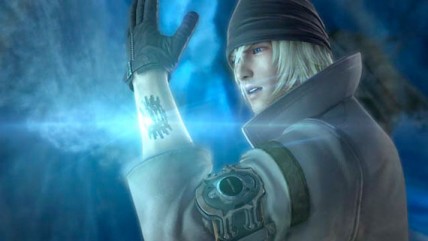
Every time I play a modern Final Fantasy and watch a cutscene, I have a tendency to reimagine what the game would look like if it were done as a 16-bit game, FFIV-style. It's probably the nostalgic in me, but it also helps rationalize some of the completely ridiculous things that happen in this game. (Ditto FFX.)
When people talk about the Uncanny Valley, they're usually referring to visuals, but the same thing applies to narrative too. When you have squat 16x16 sprites doing ridiculous things, it's OK, because they're 16x16 sprites - there's a huge layer of abstraction between the player and the game. That's why they can address the player, per below, and not seem extremely stupid.
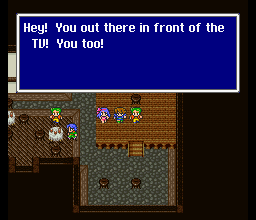
Think of the one scenes in the beginning when Snow and his jailbait (??) fiancee are stupidly flying around the fireworks, then get all surprised when they almost get killed. Couldn't you imagine that scene being kinda funny if it were done in a 16-bit game? Here, it's just kinda facepalmy. On the opposing side, think of that one scene in Final Fantasy V where Bartz and Galuf sneak up on Faris sleeping and then notice how attracted they are to her. The way it's portrayed - the funny little hoppy expressions, the little heart emoticons - pretty humorous! But imagine how it would be played out FFXIII-style, with full motion computer generated cutscenes, complete with unnecessarily extraneous dialogue and hyperbolic body language. Ugh.
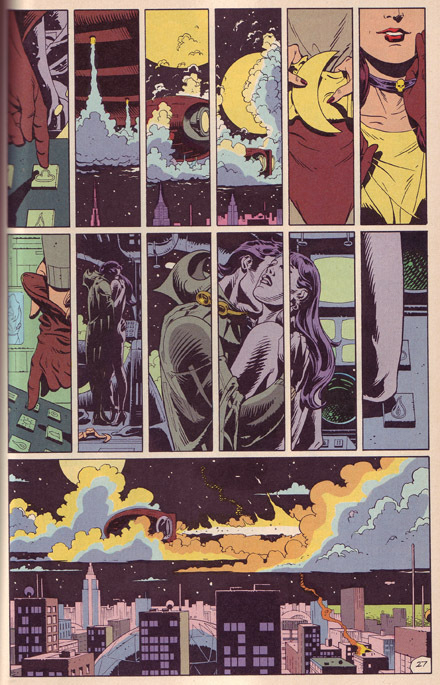
To put it in another, less theoretical context, and in another medium - think of the sex scene from Watchmen. In the comic, it was maybe a page or two, with the final part where they lean on a button and set off a flamethrower in a ridiculous visual metaphor, confined to a single panel. Even at worst, you can shrug it off. When you have actual real life naked actors doing this, complete with music, and actual special effects relished on this moment...yeah, wow, does it not work.
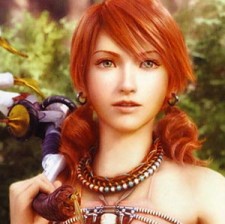
There's a special instance with Vanille. Here we have a girl so genki (I'm sorry for using Japanese, but there is literally no single English word that describes this kind of chirpy, upbeat obnoxiousness) that, despite all of the death and destruction going on mere feet from here, she's giggling and skipping and is all like, hey, Hope, let's go follow that guy that didn't really kill your mother for some reason so you can tell him off! (Which I think is why they're both involved in the plot at this point? I'm not entirely sure.) My roommate insists that Vanille must have some kind of Terrible Secret, or at least brain damage, that will eventually explain her mannerisms. I don't quite share that optimism.
JRPGs have always required some level of suspension of disbelief - in FFXIII's case, you just have to accept that this is a world where blue-haired J-rock stars and the world's most fashionable hobo are qualified to lead a resistance movement. But where do you draw the line? As much as the game's opening segments are intentionally obscured by inexplicable jargon whose meaning isn't explained for a few hours, it's this kind of technicality, this kind of flair, that gives the JRPG its unique voice, however ridiculous it may be. Like mentioned previously when I was talking about No More Heroes 2, it's a fine line to walk, and with other Western games being able to come across far less embarrassingly, it's something that the developers need to be consciously aware of.
And it's not like the developers are completely absent-minded, either! According to this interview, director Motomu Toriyama acknowledges that, when you have a fully 3D world and realistic characters, it looks pretty ridiculous to have combatants line in a row and take turns swatting at each other, which is why the system in FFXIII is more actiony. And he's right! Now they need to apply that logic to the narrative, and we should be good to go. It's not like they haven't before - Final Fantasy XII was downright classy in comparison - but that's one of the sad things that went out the door in the name of reinvention.
Wednesday, February 17, 2010
Final Fantasy VI
 Today, a guest article written by Sergei Servianov, on what Final Fantasy VI meant for the youth of the time, and the fantastic musical scores that accompanied it.
.
.
There’s a lot of argument regarding the nature of games writing, with some readers craving something deeper than arbitrary scores and pseudo-objectiveness, and others decrying any attempts at floral prose. Some like hard-hitting investigative features such as those by EDGE and GamesTM, and others want something deeply personal.
Well, whatever. I’m not about to argue with where writing should go.
This article was recently posted by my good friend Sergei Servianov on The Gamer’s Quarter forums, and I felt it needed greater exposure. I’m sure different people will appreciate it for different reasons, or possibly not all, but several points made it really resonate with me.
Sergei talks about how videogames of this calibre occupied a unique time, before the internet and improved means of distribution enabled greater choice with regards to various entertainment and artistic mediums. Speaking with generations prior to mine, it was only in adulthood when they came to appreciate more artistic things – their youth was occupied by sports, cheap comics, simplified children’s books and lousy TV. For the generation who grew up with games such as Final Fantasy VI though, it granted access to artistic worlds of thought and melancholy storylines which, for the time being, had no equivalent for teenagers. (though I fully expect a whole wave of rebuttals to this statement)
 I also relish any piece of writing which is brave enough to criticise Final Fantasy VII, which for me was a bloated and overrated mistake which influenced far too many developers, ruining a lot of potentially good future games in the process.
While the fabled last issue of The Gamer’s Quarter exists only in the minds of its writers, even if you never followed the publication this eulogy is well worth reading for anyone who appreciates the 16-bit era.
---
Preaching the Truth from the Edge of Kefka's Tower: A Hymn to Final Fantasy VI
By Sergei Servianov
Whenever I think back to my wasted youth, I can't help feeling a tang of bitterness at not having had my fair share of sex and adventure. There wasn't much of that going on in my teenage years; nothing at all, actually, if we're talking about sex. There was a lot of shame in those days and that makes me want to curse the RPGs.
I want to curse them, but I can't quite bring myself to do so. I'm listening to the Final Fantasy VI soundtrack right now and realize that you can't quite argue with something this good. Sex is one of the few things that makes life worth living, I love fucking... Even so, you can't refute Final Fantasy VI , because the argument that it presents is unimpeachable. Yes, of course, the cool guy faction in my crania sniggers at this, they're mocking me as I write. But they are wrong. They know all too well about what can satisfy the body and the steps that need to be taken to make it so. But they are the enemy and will always be the enemy. Cool is the enemy of all that is good in this world. Cool will never understand the beautiful and runs from the truths of this cold, dark universe like a cockroach running from light. I'll ally with the cool to get laid, but that's as far as my allegiance will ever go.
 Final Fantasy VI is pure refutation, an argument in 32-meg form against the vileness of this world. There are few artifacts of our generation that have withstood the test of time as well as Square's Super Famicom masterpiece. I can't imagine a single twelve-year-old of my generation with any soul at all smirking at it. It's way too serious a work for that to happen. It was something that millions of people would play and declare allegiance to. And it deserved all of it. One of the few videogames that did or does.
Where else could we have found such art? Movies? Well, the Americans of my day didn't have Miyazaki's stuff on file, so that was out. The Disney films seemed pretty profound in those years, but they haven't aged well. I have a hard time justifying my obsession for the Lion King back then. Music? There was no proper music for those who hungered for more. Classical music, you say? Well, classical music was boring and didn't talk about anything that we wanted. There was something cheesy about it, too. It didn't seem serious at all. Comics? We didn't have manga back then and the stuff that we did have was beneath contempt.
No, it was in videogames and in videogames alone that we could've found our arguments.
 You just couldn't help but love those characters. They were better than most of the people you went to school with. They probably still are. They had honor and meant what they said. And their wonderful personal themes, composed by Nobuo Uemastsu at the height of his power, were something that you hoped you would have for yourself one day. I know now that that's impossible, but how great it is to imagine walking into a bar and hearing Shadow's reedy music playing in your head, drowning out the shitty rap that's trying it's best to make the bar seem like the “decadent club scene” from a bad American action movie.
 Yes, THAT music, it's hard to write about it now because so many horrible people have expressed their appreciation of it. Yet, that's its strength and the strength of Final Fantasy VI as a whole. It is impervious to either praise or criticism. It merely sets up its argument, presents you with the greatest graphics, music, and story that you'd seen, heard, or read up to that time and asks you if you still want to continue on in the real world; a reverse Matrix.
 Many a twelve-year-old heard that call, but few followed it wholeheartedly, boarded that Phantom Forrest train. Many more than was to be expected, though. I'm pretty sure that if you were to gather all the true believers in a single place then you could easily get a Tienanmen Square crowd scene going. I can imagine it now. Hordes of plump and skinny losers of all races, howling like mad, whacking the chained unbelievers on their way to the Gulag of the Cool with their FF VI cartridges, while a grinning “ice teeth” Hironobu Sakaguchi – Mao Suit, liberation cap – waves to them from the castle walls.
 Though daydreams don't get you far in this world, so let's recall the characters, for our sake and theirs.
Make no mistake about it. They are still beyond you and will always be. If one can imagine a life as blissful and attractive as Setzer's, I'd like to hear it, lounging around a floating casino, taking his share of sex and drugs without a hint of nagging puritanism. As lame as it may look right now, that man was our libertine, our Byron. Then there's Shadow, a ninja loner, the idealized self-image of every boy that went through high school uncool, whose touching story of woe was presented with a minimalism that was ignored by RPG creators then and now. And like all good things, he was doomed to perish. You could never quite save Shadow, no matter how you may have wanted to. Or what about Edgar, who dresses like like a mix of a decadent 19th prince and a modern CEO, part chainsaw murderer, part ladies man. Kefka, while somewhat overrated as a villain, has many moments of delight as well, having the most fun of any JPRG character in history. Gleefully committing mass murder; an angel/ clown / punk rocker hybrid firing lasers from his trash tower. Yes, Square really sent in the clowns there and the clowns were scary. In fact, Kefka, despite being the villain, steals so many scenes, gets so many great lines – recall him laughing at your party during the final battle, calling them a bunch of walking self-help cliches – that you can tell that the creators' hearts were in the right place. It's no coincidence that Kefka's Tower is greatest piece of music on a soundtrack famed for great work. I don't know if it's scary or not that the appeal of Kefka is much more real to me now than as a child.
 And then there were the set pieces. There are so many to recall that you can open up any random save from a copy of the game bought from a Japanese “recycle shop” and be assured of stumbling upon something wonderful. The big Moogle battle, the type of thing you kept in your head while playing Magic: the Gathering as a teenager, stuffed animals whacking werewolves on the head with maces. The struggle on the Floating Continent, with that great scene of Kefka kicking the Old Man of the Empire offstage like a bag of rancid garbage, followed by Shadow playing a lethal game of WMD goddess statue chess with our favorite clown.
 Sadly, the same things cannot be said for many of the RPGs that came after it. Genius though it may be, Final Fantasy VI has given rise to many a false prophet ( though the critics rightly place the blame on the massive success of the game's Playstation sequel). The most offensive example of this is Xenogears: the pitiful banner of the most pathetic nerds of this Earth. It's so puerile that talking about it feels dirty and unsporting, like making fun of a cripple. It's just depressing to think about and that's that. It's not so much a game as the sad story of Hitler's Germany branded onto a CD: so much talent, so much great music and art wasted in the service of a laughable ideology, an insipid narrative.
Many other works have faired better. Persona 4 comes to mind, even though it's FF VI's direct opposite. It celebrates the cool, sneers at the nerds, and goes out of its way to glorify those loathsome high school days. As a counter-argument it works much better than I could have expected. Its music is poppy tunefulness compared to Final Fantasy's neo-romantic nobility, its story a big Yay !! for this world and its people. It's the closest that we've come in the Japanese RPG genre to “maturity.”
 Make no mistake, I'm not mocking it. I love the game dearly, it's the only modern game that I can stomach playing these days. Though its worldview will most probably never inch out the one that Final Fantasy has instilled in me. I also have the utmost contempt for the perfunctoriness of its villain. It's a sad state of affairs that the game makers of today don't even bother making a halfway decent counter-argument against our world, won't even make the villain fun. The heroes' argument in Persona 4 boils down to the same thing that the popular kids prove wordlessly every day at school, “We're cooler and totally have more friends than you, loser.” A very bad way to cap off a game that had a lot of good in it.
The saddest thing is that we still don't have the vocabulary – nay, the poetry – to celebrate Final Fantasy VI properly. Most of the praise that this profound little anti-Earth has gotten is as clumsy as its criticism. The words aren't here yet, but we're coming close... they're somewhere, to be sure, stashed away in the brain of some basement-inhabiting uber-dweeb romantic, waiting for the right moment to emerge. Final Fantasy VI is like Lovecraft's Old Ones, bidding its time, influencing the aesthetics of the world in ways we can't – perhaps, won't live to – ever see.
 The War of the Magi has never really stopped and Final Fantasy VI will no doubt continue its unseen jihad, unnoticed and unheard until our blessed day of reckoning. When the silly works of today will be nothing more than a footnote in the Final Fantasy-era of art history.
Tuesday, February 2, 2010
Pitchfork's Final Fantasy X-2 Review
This summary is not available. Please
click here to view the post.
Tuesday, August 4, 2009
Interesting magazine quotes...

Japanese RPG makers being coerced by Sega of America, a man who doesn’t want his games play more than once, Final Fantasy being influenced by Scotland’s Grand Theft Auto, and is Infinite Space a homage to Star Control 2?
Something I’ve always wanted to do is run my own games magazine, and if I did this, one thing I’d do is list the review scores from every other magazine (like Metacritic, except I came up with this idea LONG before Metacritic even existed), and I’d also reprint excerpts from said rival magazines, up to the maximum limit that I am legally allowed (I’ve heard that fair use is about 400 words?). In short, I would crib off their hard work, feature interview quotes and interesting paragraphs, and then add my own commentary. I don’t have a magazine, so I’m using this blog. This is what Dave Halverson’s wonderful PLAY magazine had to say: August 2009, issue 92.
---
As someone living in the UK, I love America’s PLAY magazine, because it’s better than that rag Edge, and for various political reasons I don’t read GamesTM. Also, PLAY always has a ton of cool interviews, and this month there were four key quotes which shook my world. I’ll try not to take them out of context.
Interview with Takayuki Suguro, director, and Mitsuhiro Shimano, producer, Ends of Eternity, by tri-Ace.

Suguro: We altered the characters’ faces a bit based on Sega of America’s input, didn’t we?
Shimano: We did. We had discussions with SoA during early development, and incorporated their opinions into changing some of the character’s appearances.
Now, I’ve known about Ends of Eternity (aka: Resonance of Fate) on PS3 months ago, mainly since the Japanese PSN had videos up. If you own a PS3 but do not a Japanese PSN account, stop reading this blog and set one up RIGHT NOW. Using it only for your domestic account is like having a pe... [EDIT] Having a mouth, and only using it to eat food. Anyway, once you’ve seen both PSN vids you’ll agree the game looks like an interesting RPG, with flamboyant battle system and ugly art direction.
The characters don’t look exactly western, when I first saw them I thought they looked like cheap Final Fantasy knock-offs. And this made me think, what the hell did SoA suggest? That it look like a Square-Enix title? SoA don’t exactly have a good track record when it comes to decision making, in fact I recollect they only ever seem to make stupid decisions (or maybe I’m just a jaded Saturn fan).
The interview also has them speaking about they didn’t want it to be a traditional JRPG, but neither could they make a western/PC-style RPG, since that’s not what’s expected of tri-Ace. Hmm, again, nervous when devs say they’re not allowed to do things because of expectation. I never like it when a publisher makes a developer change their style, or direction, when making a game. Not for structural/mechanical design, not for aesthetics, not to incorporate online components. The design team should have full control.
Anyway, regardless of all that, I am VERY interested by this game, and after watching the PSN vids, so should you. But I’ll forever be wondering, what exactly was Sega of America telling tri-Ace of Japan to do during development?
Interview with David Cage, of Heavy Rain

Cage spoke about his epic-sounding Heavy Rain thriller, and the auto-saving which is designed to stop people reloading after they make mistakes (Demon’s Souls has auto-saving, and let me tell you, I love it – takes me back to my Famicom days). The best thing though was Cage’s quote at the end of PLAY’s feature: “I know it sounds weird, but I’d prefer people play through [Heavy Rain] once, and then maybe never replay it again. But”, he adds with a laugh, “keep it, don’t sell it.”
That could be the most wonderful thing I’ve heard in the industry in a long time. Someone who desires each person to have their own, singular experience of a game. A unique experience. And never replay it again. Wow. I’m not sure what else to say, but I really like that.
Kawazu Akitoshi on Final Fantasy Chronicles: The Crystal Bearers

Heather-Anne Campbell asks about what influenced Akitoshi.
Akitoshi: As for this particular game, I was inspired by Grand Theft Auto.
H-AC: Because of its open-world experience...?
Akitoshi: You’re right on about that. I wanted to experience that freedom in the game world.
Talk about megaton bombshell drop. Japan’s darling series, Final Fantasy, taking cues from Scotland’s Grand Theft Auto? Wow. And just to emphasise that, Rockstar North, the developers of the GTA series, hail from the land of haggis, neaps and tatties. Aye, they do, young boyo, from ALBA as it’s known in Gaelic. Not America as many think.
Anyway, I have little interest in either the GTA or FF series, but I find Japan’s shift to a more western style both interesting and worrying (there is a fantastic column by Steve Haske at the back of the same issue of PLAY, which sums things up nicely). It’s interesting because the GTA games were released in Japan much later than the west, and their localisation originally consisted of little more than subtitles. So when games like GTAIV ends up on Famitsu, and the series is looked at by the FF guys (even if it is just an offshoot of the main series), that signifies some big changes happening in Japan’s view of the world.
Admittedly, he was referring mainly to an “open world”, which isn’t something Japan has done a lot of, but still. There is enough in those few interview sentences to flame internet debate for a hundred pages. Personally, I’m curious (and maybe even a little bit excited) to see what happens. What the Japanese do best is see what others are doing, and then copy and personalise it themselves. They did it with cars, motorbikes, and even the RPG genre to the point where console RPGs were eclipsed by Japan’s output. It’d be interesting to see them do the same thing with the GTA/Bethesda open-world model of design. So long as they don’t end up desperately pandering to the west and making a botched job of it – be influenced by, certainly, but make the games you WANT to make, not the ones you feel you should be making.
A conversation with Nude Maker’s Hifumi Kouno, director, and Platinum Games Atsushi Inaba, producer, regarding Infinite Space

(for those who don’t know, Nude Maker were behind Steel Battalion)
PLAY: Infinite Space seems to have a strong influence from classic western PC games, like Sid Meier’s Pirates!
Kouno: Definitely... I can’t name specific titles, but back in the PC-98 days, I loved the American games I played. Infinite Space is a little different than those space sims – characterisation is stronger for instance – but in the sense that you have freedom to explore and make discoveries, it is similar.
Another example of a Japanese developer saying how they were influenced by western games – and a very interesting example at that...
Now, the PC-98 heyday of gaming was late 1980s to mid-1990s, which ties in with American space-sim Star Control 2, my all time favourite game, ever. You don’t suppose he was talking about that, do you? I’m sure there were other space games released in this time frame (like Starflight – Elite was probably a little too early), and I could probably Google translations of Japanese reviews, or even westerners playing it on import, to see if my theory is correct. But frankly, this fantasy is just too delicious to tamper with. Until I get the game, which based on all I’ve read sounds ABSOLUTELY AMAZING, I’m going to sit here and pretend that Hifumi Kouno is indeed, a huge Star Control 2 fan.
And that’s that. If you’ve not done so, go out and buy this issue of PLAY, it’s a particularly strong issue, on several fronts. For the record, I am in no way affiliated with PLAY, I’m just a fan who subscribes.
(images stolen from the internet because I’m too lazy to screengrab this **** myself)
Subscribe to:
Posts (Atom)