

Showing posts with label unreleased. Show all posts
Showing posts with label unreleased. Show all posts
Wednesday, May 8, 2013
Steve Wozniak interview, history of Apple

Thursday, September 13, 2012
Akira - SNES - Jim Gregory

As promised, my interview with Jim Gregory, on Akira for the SNES. Further interview responses expected in the coming months (hopefully). Spread it around! There has never been this level of detail on the unreleased games published before.
Friday, April 1, 2011
Location of unreleased Akira prototypes
 I know where they might be! Well, technically it’s more that I know who might have them, even if I don’t quite know where these people are – but that’s where you, the readership, comes in. By making this information public, perhaps someone will succeed at tracking down those involved and report on it for the world to see. Read on for details!
.
.
.
I had been trying to get hold of the December 1993 issue of Game Zone magazine (issue 14) for what seems like forever. The reason being that its cover story was a feature on the Akira games for the SNES and GameBoy, both of which went unreleased. I was eager to see what this feature said, and if it had any screens.
 Eventually I tried contacting everyone listed in the staff page of the issue directly prior to that issue (which I had). I got hold of quite a few, though none still had any issues. Until I tracked down Rupert Sliwa, who you may remember from HG101’s Catrap article (pictured here). He kindly went to a great deal of trouble scanning the feature, which wasn’t easy considering the type of binding they used on the spine. But at last I had it, and if you click on the images below, you’ll see it reveals just enough concrete details to prove extremely valuable.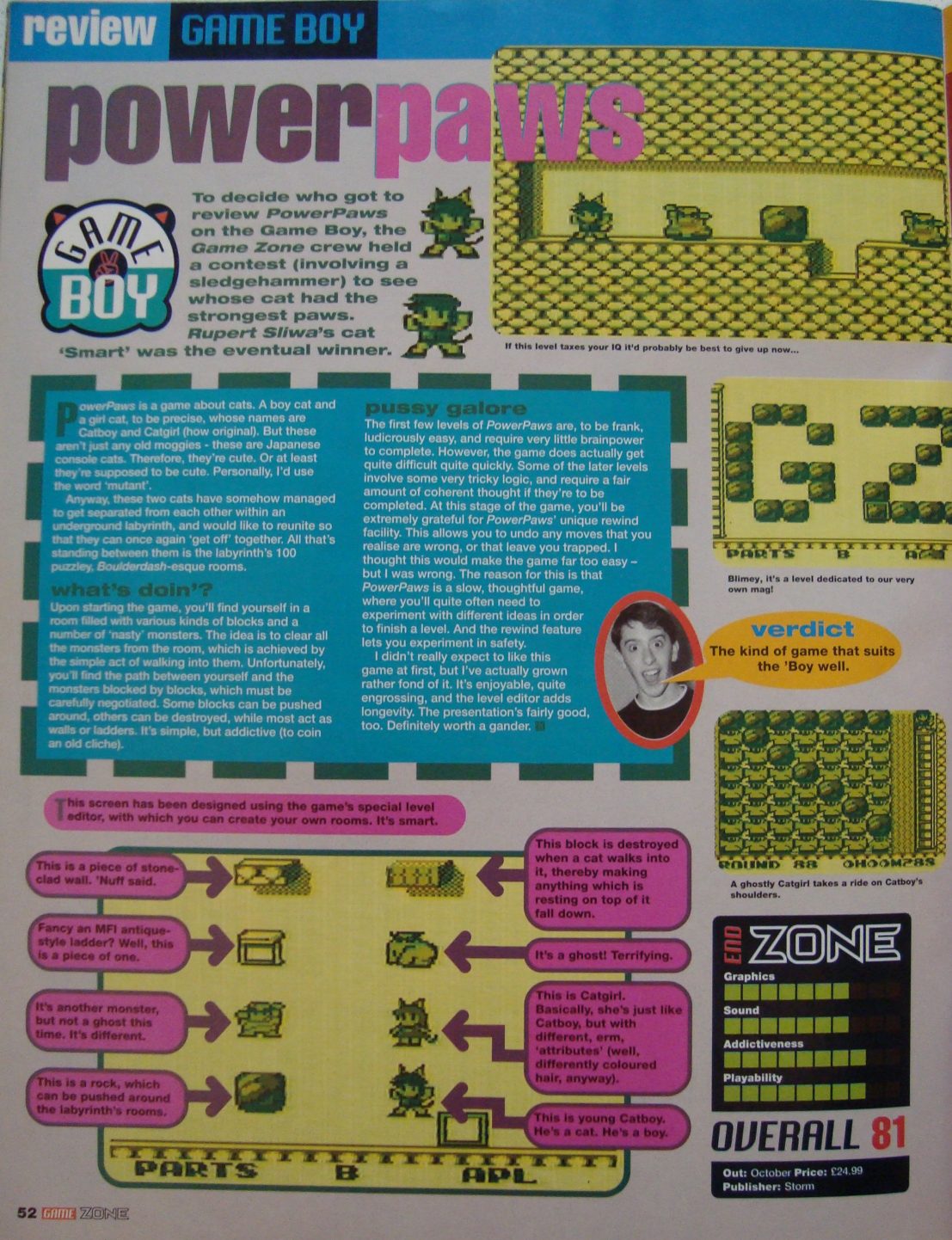
 The key information is that the man in charge was LARRY SIEGEL. He was head of Black Pearl Software (which most people know was involved with the Akira licence thanks to this interview), which was absorbed into THQ. What I’ve never seen mentioned before is info on the SNES and GB versions specifically.
 The SNES version was handed over to Handmade Software in Swindon, UK. It was formerly known as Mr Micro, and was headed by Jim Gregory, who also worked on Kasumi Ninja and other Atari games.
 The GameBoy version of Akira was handed to Ice Software in Slough, UK, on which I could find no further information. Are they connected to International Computer Entertainment (ICE) which worked on the Amiga Akira game? I have no idea, but all the staff on that specific project said they’d had no involvement with any other version other than the Amiga release. On the other hand, a few spotty records online say that was ICE was based on Slough. It's all very difficult to find solid info on.
 The unreleased Akira games, based on reports of those who played them (see below in green), sound awesome. And unlike a lot of other unreleased console games, which are hidden in Japan and near impossible to find, if any prototypes exist for these they’ll be in England or America. They’re so close I can almost touch them. Larry Siegel even has a LinkedIn profile, stating he resides in New York. If anyone can shed light on all the planned versions (SNES, Genesis, Sega CD, Game Gear, Game Boy), it’ll be Larry. All we need to do is find Larry.
 My hope had been to track these guys down, get concrete info, interviews, photos, maybe screens, maybe working prototypes, and then have all this information dumped onto the internet via Hardcore Gaming 101, because how awesome would that have been? Site traffic would be up, infamy would be assured, and we’d all coast along on a delirious wave of cocaine, strippers and fan adulation. But tracking Larry and Jim down proved pretty tricky. I trawled Mobygames, LinkedIn and Directory Inquiries, sent no fewer than 20 emails, and made over a dozen phone calls. Hell, I even got people I knew to use their Facebook accounts to contact other Facebook users who may have had a connection, and the same for Twitter. I thought I’d come close several times, managing to get hold of many of Larry and Jim’s former colleagues, but in all cases they’d lost contact with the gentleman in question. I even tried asking on our blog, with no luck.
 So, here are the Game Zone scans, plus scans from Unseen 64 (if you write for Unseen 64 feel free to re-use my GZ scans), and the rest I leave up to you – the wider world. If you know Larry or Jim, I advocate kidnapping and truth-inducing drugs.
The world is keen for this information!
 And if you’re unconvinced on the quality of the games, read this post by Whimsical Phil on NeoGAF. They sound like the greatest games ever (not) released.
 ---
---Whimsical Phil
And I was actually able to play THQ's Genesis Akira game back at a CES show ages ago (this, of course, pre-dated E3). Somewhere at my parent's house, I still have a sales flyer for the game with info and screens on it. I'll have to try to dig it up next time I'm there and get that puppy scanned.
If I remember correctly, it was announced for Genesis, SNES, Sega CD, Game Boy, and Game Gear, although I believe that the Genesis version was the only one on display on the show floor. The main gimmick of the game was that each stage played differently. Lemme see how many I can recall...
 - A motorcycle racing stage that was a lot like Super Hang-On. As you would imagine, you were Kaneda racing against the Clowns.
 - A FPS stage where you were Tetsuo wandering though the lab where he was being experimented on. Instead of a gun at the bottom of the screen, you just saw Tetsuo's hand, and when you fired at guards, he shot out a blast of psychic energy. This stage was about as impressive looking as a FPS could look on the Genesis.
 - A side scrolling stage where you were Kaneda and Kei piloting that hover vehicle through the sewers. These stages weren't strictly side scrolling, though, as they were quite large and maze-like. You could fly quite a ways up and down as well as left and right. You used the gun on the vehicle to shoot down the guards' crafts.
 - An isometric stage (think Viewpoint) where you were Tetsuo walking across the bridge (the one he would eventually destroy). Pressing the attack button caused him to swing his arm out in front of him, sending a wave of psychic energy out in front on him. The main enemy that I recall in this stage were rows of soldiers armed with the laser cannons from the movie. I remember being really impressed with the look of the Tetsuo sprite on this stage (complete with his tattered red cape).
 - The last stage that I remember was a 2D beat-em-up (or was it a one-on-one fight?). Either way, you were a surprisingly large mutated Tetsuo attacking, well, whoever it was attacking you (Kaneda? Soldiers? I don't remember).
 Seeing as how I was a big fan of the movie at the time, I talked to one of the head PR people at length about the game. She even gave me an animation cel from the movie (of the giant teddy bear and rabbit that attacked Tetsuo), which they were probably giving out to the press. Even though I was just a scrub working at Babbage's at the time (yes, I was one of those retail kids who snuck into the show), she gave me her business card and I kept in contact with her for a while getting updates on the game. Until, of course, she gave me the sad news one day that they had cancelled it.
 Man, I really gotta find that sales sheet now.
EDIT:
Many thanks to Rod_Wod on Assembergames forum for taking many of the magazine scans originally.
Saturday, March 5, 2011
Unreleased Game: Werner Asphaltbrenner

This is the kind of entry I'd usually submit to Unseen64.net, but that site continues to be available only spontaneously at best, so I fleshed it out a bit and I'd like you to be my audience today.
Werner: Asphaltbrenner (Werner: Asphalt Burner) was a motor bike racing game based on one of Germany's most popular comic book series, about a good-for-nothing biker, hobby mechanic and (when not unemployed) plumber, always feuding with the police and roadster drivers. The character also spawned four feature length animated films and a number of casual games, starting with the (illegitimate, I believe?) C64 Boulder Dash clone "FlaschBier" in 1985.
Werner "Game"ography:
FlaschBier
WernerSoft, 1985 (unofficial?!)

Werner: Mach hin (Werner: Get on with it!)
Ariolasoft, 1986

Werner: 100% Schwarzarbeit (Werner: 100% Illegal Employment)
Paraworld, 2001 (free download)

Werner: Flitzekacke Alarm!!! (Werner: Diarrhea Alert!!!)
Tivola, 2006

Originally announced by United Software as "Werner: Fun Racer in early 2000 for PC and PSX, Asphaltbrenner was meant to become the first modern full-priced game with the license. The game was developed by Exortus (Tunguska: Legend of Faith) and Phenomedia (Crazy Chicken series), and would have featured six (plus 2 bonus) courses where the titular hero or his brother Andi could fight it out with other bikers and cops. Players would have chosen from several crazy bikes the brothers built in the comics - and the author of the comics also built for real and conducted real races with (check out the official franchise homepage), including the famous-infamous Satte Liter Schüssel (full liter bowl), which in the real life implementation actually had 1440 ccm capacity.

The game's most advertised feature were 25 special tasks that had to be completed during the races, like messing with the police or spraying dirt over hated characters from the comics with your bike.

Werner: Asphaltbrenner was originally planned for a November 2000 release with 120.000 copies, to be released simultaneously with a guide book, which was already listed for preorder and remains listed on several online book stores even today (source).

The unfinished game was demoed publically in 8 cities in Germany (source) and presented to several gaming magazines (see snippets below). At least five of the six tracks were playable, although many of the special tasks were missing and the game was reported to seem unfinished (the lack of shadows and motor sounds was mentioned in particular, as well as analog controls).

However, the release was delayed, first to early 2001 (the announced PSX version had already disappeared by then) and then further. But in May the same year Achterbahn AG, the puplisher of the comic books, took the license away from United Software, because they "weren't capable to deliver an appropriate game quality needed for Werner," and declared furthermore that the game would be developed at Paraworld AG, who already made the casual mini game Werner: 100% Schwarzarbeit. (source) The game never resurfaced.
Scanned magazine articles:


Monday, September 13, 2010
Ghostlop: Unreleased Prototype
Ghostlop is an excellent unreleased puzzle game for the Neo-Geo developed by Data East. It appears to be completely finished. Unlike a lot of unreleased games, there are no complications about who owns the rights to publish the game and although no plans to release Ghostlop have been announced, G-Mode, the owner, has actually put a modest amount of effort into promoting it.
Ghostlop is a head-to-head arcade style puzzle game featuring a unique mix of elements from Puzzle Bobble and Breakout, with a color-switching mechanic reminiscent of Silhouette Mirage and Ikaruga. (Although it predates them both, with an intended release year of 1996.)
As you can see in the video above, you aim shots the same way as in Puzzle Bobble, but there are only two main colors of bubbles to destroy--or in this case ghosts. The A and B buttons determine whether your shot is red or blue. If your shot is the same color as the ghosts it hits, it will cut through them like in a bonus level of Alleyway. If it's the opposite color, it will bounce off without doing damage. You can switch as often as you like (even while the ball is bouncing around) so if there are a lot of red ghosts surrounded by a layer of blue ghosts, you could detach all of them from the top of the screen by throwing a blue shot to pass through the outer layer, switching to red to move through the middle, and then switching back to blue to pass out the other side, dropping the majority of the ghosts and putting a lot of garbage on your opponent's screen. As your ball bounces around you're free to move your character back and forth along the bottom of the screen, and you need to catch the ball when it comes back or suffer the penalty of having the pieces lower one notch.
The action is fast-paced and smooth. The lighthearted characters and rockabilly music add a lot of charm that is missing from newer puzzle games like Lumines and Planet Puzzle League. I've shown Ghostlop to a number of friends with a variety of puzzle-gaming skills, and they have all gotten addicted. It's a real shame that such a high-quality and unique game was never released, while the market is flooded with sequels and clones of virtually every puzzle game that was even remotely successful.
Only a couple of collectors have confirmed ownership of prototype cartridges, but the game's code was (like most things) leaked onto the internet and bootleg cartridges are even available if you really want to play it on your Neo-Geo.
I don't have anything especially new or novel to say about Ghostlop, but it's a really great game that deserves a wider audience, and it stands a better chance of eventually getting released than you might think. Data East filed for bankruptcy in 2003, and G-Mode acquired their back catalog in 2004. G-Mode registered DataEastGames.com at the end of 2007 and has steadily used it to promote ports of Data East games for consoles, mobile phones, and PC. The site lists all of the Data East games they own, including Japan-only games like Magical Drop F and the unreleased Ghostlop. Even more surprisingly, they've taken the time to record an official video of the game and post it on YouTube. Hopefully these efforts indicate that G-Mode is seriously considering allowing Ghostlop to finally see the light of day.
Thursday, May 27, 2010
Korean Week: Korean games that weren't

Looks like a week of awesome timing. Unseen64 has just posted screens from an unreleased Mega Drive game I submitted there a while ago, which gives me the opportunity to introduce some more games that even Korean gamers never got to play while advertising the post over there ;)
I'm concentrating mostly on games that would fit into the second part of my article, not only because I want to keep the first one interesting when it is finished next month, but also because I can't wait to show these. If you want to see more screens of Softmax' Halloween Capsule, head over to Unseen64. For other awesome things that don't exist, check out the full text.
Atrocity

Some people might have heard of Byteshock, the developer of a beat 'em up game with "RPG elements" called Electronic Popple, which was released in the West by Capcom. This would have been their second game, an action adventure with prerendered graphics, taking place in a Blade Runner-esque dystopian future.
Box Ranger Returns


The sequel to a horizontally scrolling shmup by Soft Action, Box Ranger Returns looks like a nice Zaxxon clone. For some reason this was later included in the products section on Soft Action's homepage (now offline), despite the game not being released.
Power Ball


The Mega Drive was somewhat of a tragic console in Korea. Not because of a lack of success (I think it did reasonably well in Korea), but because of the ill fate for most of the Korean games. The only one ever seeing a release was Uju Geobukseon (often refered to as Uzu Keobukseon on the web) but there were at least seven more that were cancelled at varying stages of their development. One of them was Power Ball, supposedly a sports/action game. I can't realy imagine how that would have played out from the side view seen on the screenshots ...
Demolition


A screenshot of this game was shown in 1996, and it got my attention for looking like 2D GTA with mechas. The game resurfaced in 1998, but I've only seen an ad showing cutscene images of some dudes on flying motorbikes. Given that another game by the same people change from an overhead-view RPG to a sidescroller, it's impossible to guess how the actual game would have turned out by then.
Woman Power


The order I post these things in makes no sense. Woman Power was actually the earliest game from this page, people following the Korean Game Marathon thread on the forums might remember "Super Cop", a game very similar to old Apogee sidescrollers. Woman Power by the same company looks like goes in the same direction, actually it almost seems like a counterstatement to Duke Nukem (but that was before he became the super macho he is depicted as in Duke Nukem 3D and the following games).
Rhapsodian Occulteller


Did someone order RPG with gorgeous 2D pixel art on top? The game seems to have two battle screens, the one with the five headed party above, and a more zoomed in one showing only one character dueling with a single monster. This was done by Mantra, the guys responsible for the Korean YS 2 Special, but they had to cancel it due to financial difficulties (the company also disappeared not long after).
Tragon


Speaking of RPGs with gorgeous graphics, here's another one (by Namil Soft).
Friday, May 21, 2010
Scans of old game magazines
 Games magazines, with only a few exceptions, do not sell for much on eBay. Often postage is more than the final item value. So during a recent clear-out, I decided to scan (photograph) articles of interest in a bunch of mags which I was going to throw out. Some of these are quite interesting, so here they are for your reading pleasure.
.
In truth, a lot of the magazines which I photographed I decided to keep, and those which I decided to throw out didn’t have anything work photographing. Launch issues are notoriously awful. All those initial Dreamcast and N64 magazines might still be fun to read, but they all only covered Sonic and Mario, Toy Commander and Star Wars. Only later issues started featuring the really interesting or obscure games. PS2 launch magazines are the worst, seeing as the PS2 had one of the worst launch line-ups ever. PS2M had to resort to covering imported copies of Shogi (two reviews in one issue), plus those perverted cameraman games where you photograph women in bikinis. My brother gave me his collection of Official Nintendo magazines which, being official, are also absolutely worthless.
It also occurs to me, there was no single-format PS1 magazine that catered to the "Japan crowd", or was fun and serious, in the same way Sega Saturn Magazine, Super Play, or N64 Mag were. Most PS1 mags in the UK positioned themselves as halfway lads mags, with photos of scantily clad women, laddish talk, and photos of clubbing and alcohol, with coverage of shmups and Japanese games being very limited, and often criticised. PlayStation Power was sort-of decent, sometimes, with features on disc-swapping and Japan, but it still had a rather loathsome attitude a lot of the time. The only choice for keen PS1 importers it would seem, was Dave Halverson's GameFAN or EGM.
But a lot of old magazines are still interesting. Old issues of Arcade had some amazing features in them, including one where they gave their staff between £1 and £1000, and asked them to buy as much gaming stuff with them as they could. All interesting (one guy nabbed a Saturn for £50 with a second-hand copy of Panzer Dragoon Saga before it shot up in price – he promptly dropped the Saturn on the way to the office, breaking it). Other mags have coverage of unreleased games, or forgotten features with behind the scenes info. All the scans take up about 10mb, and I’ve put them on Megaupload for you. The scans are as small as I could make them while keeping the text legible.
Featured in the ZIP file is the following:
 Akira scans – a cover of Game Zone magazine which I was never able to buy claimed to have screenshots of the Game Boy version of Akira. While a copy of Super Gamer, which I did own, had a screenshot of the SNES game.
EGM does 32-bit importing – a detailed feature for importing during the PS1/Saturn era.
 Game Zone Japan – a feature on Japan circa 1993, from Game Zone magazine, complete with casual racism.
 N64 magazine Japan – a beautiful article from N64 magazine, with a lot of amazing info on the 64DD, plus how to sneak into a Japanese press convention.
PlayStation Power Japan – feature by PlayStation Power, also on Japan. The text isn’t great, but the design is nice.
PS Power MGS – behind the scenes look at Metal Gear Solid.
 Rise of the Robots – behind the scenes article from Super Gamer, on Rise of the Robots. Fascinating, if only because of how much they praise it. Sean Hoden looks like a frightened rabbit in this photo.
 GameFAN – random scans from GameFAN. Including of Snatcher and Policenauts. These two features are to me, how I would want every single article in a magazine designed. I know people will complain it looks cluttered. But this is, to me, the pinnacle of magazine design. This is why I so badly wanted to play Policenauts. They made an average adventure game look like the greatest game on earth. Just looks at these pages, truly they are a thing of beauty. I want to frame them and put them on my wall. Also included is a 4 page preview of Blue Seed, a Saturn RPG no one remembers.
PS1 expo, 1997 – some interesting info, including photos of the From Software booth.
Glitches in games – article on games testing in the UK, including a history of bugs.
MISC – an interview with David Sheff, obscure Dreamcast games, EGm reviews, Satalaview system, and lots of other random gumph.
 Montreaux the clever sheep – between August and February 1994/1995 I stopped buying Super Gamer, and then suddenly in their A-Z of reviews they had a listing for Montreaux the Clever Sheep, on the Game Boy, scoring 99%. Searching the internet reveals nothing. Was this game a hoax, or does it really exist? Apparently by Titus.
 Anyway, that’s that, and this lot now has a date with the dustbin. I’d normally donate unwanted items to a charity store, but living in France they won’t accept English magazines. Posting to the UK meanwhile is impossible, since even if I give them away no one wants to cover the postage.
MEGAUPLOAD LINK
Subscribe to:
Posts (Atom)