Showing posts with label play. Show all posts

Monday, September 20, 2010

GameFAN issue 3 – print’s not dead

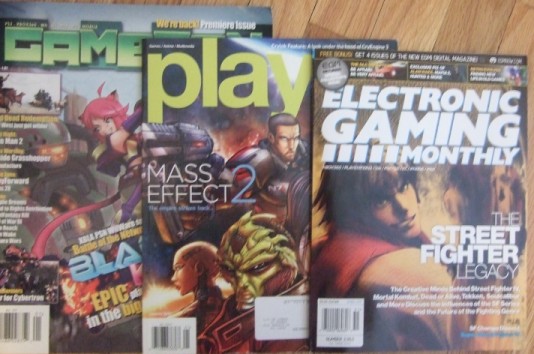
It’s taken me a little while to get issue 3, but here are my thoughts. Also, an interesting revelation about EGM.
.
.
.


Actually, it’s not hugely interesting, but I was told that EGM only made one summer issue, with the next due in October – presumably with the new start-up mag they wanted to take their time cementing in those first few issues. I speak from experience when I say that completing an issue of a monthly games magazine is a punishing exercise. I guess this just means my 6 issue sub is going to last that little bit longer.

I do have the 3rd issue of GameFAN though, and while they’ve clearly been working overtime to get it finished and printed, I think they’re finding their feet. For a start the rear MovieFAN cover is no longer – which is great. But I’m also extremely pleased to say they haven’t scrapped non-game coverage altogether. I know a lot of people have commented on wanting a games only publication, but for me, I’m not only interested in games. I love movies, anime, manga, comics, books, artbooks, OSTs, music, model figures, yacht sailing and all manner of other stuuf, and all of these things have cross-over potential with games. Well, maybe not yacht sailing, but over the years it’s always been a pleasure to read about what my geeknocratic comrades were enjoying in the world of videos et cetera. How awesome would it be if in a later issue of GameFAN they covered Valkyria Chronicles 2 and 3 for review and preview, and in the back of the mag examined the anime and manga which were based on the first game, and how these came to influence the second game (since the game sequel was mainly greenlighted based on the success of the anime, not VC1). Whatever they do, the non-game coverage isn’t intrusive and has great potential – so I’m pleased it’s still there.


Another big change is the removal of the Viewpoint section with dual reviews, replaced instead by a more standard reviews section. I actually really liked the dual review structure, since it’s always valuable to have counter points to someone’s positive or negative views. Many times the two agreed though, and as Halverson said in issue 2, they’ll axe Viewpoint in the future but will run counter-points if staff disagree on a game to a large degree. It’d be great to see two highly opposing opinions clashing over a contentious title – diversity of opinion is a healthy sign, especially when PR people hassle you about reviews (and believe me they will, since their salary is augmented by the Metacritic scores you help shape).

As always the design is top notch, as you can see from these photos. Take Deathspank for example, I have no interest in the game personally, but the design drew me in and I took the time to read about it – in other mags, such as EDGE, the design is so brittle and unrewarding to the reader’s eyes, I don’t even want to read about the things I like. Every non-advertising page should enthral me, not put me off.

In today’s world it’s impossible to avoid art assets provided by PR companies – just sign up to GamesPress.com and you will find every PR provided image and piece of artwork made available in both the USA and Europe. It’s easier to use PR assets than create your own screenshots. Inevitably you will find some of the same screens here as in other mags, but at least GameFAN tries to distance itself from the identical crowds. It’s refreshing to see an actual attempt being made at in-house creation of imagery. The rows of sequential screenshots are a sign of this, and their demise in magazines I believe could be more to do with the increased reliance on PR imagery rather than designers not liking them. The fact they even exist in GameFAN shows that someone took the time to actually grab images, in order, and make use of them.

I loved the sequential row of images for the purple dragon fight running along the bottom of the Metroid M page, and the entire thing came together with the text to give a genuine feeling of how the game plays. I’m not entirely convinced by the increase from the second issue in the number of 45 degree angled features, since as you can see in the Dragon Quest review you lose some of the imagery – but even so, I can only think of one other magazine, Retro Gamer, which has as appealing a design as here. When did everyone else stop enjoying colour?

The issue focuses on E3 with a series of editor profiles (man, don’t you love how in American mags everyone is an editor, as if to show you they’re considered valuable to the project? In the UK most of us are branded simply as “the staff” and treated like so much processed meat. Except for deputy editors, who take on the role of full-time editors except with less pay).

It’s a bit disconcerting to read up on E3 with the Tokyo Game Show featuring on the net right now, and my only criticism with the magazine is I seem to come to the party late and they’re still playing catch-up with their breakneck-speed relaunch. When coverage on a game, such as Vanquish, is only a page, is it due to the developer not providing content, or because of the hectic time frame? PLAY had some of the most impressive coverage of Platinum Games’ Bayonetta, long before it was released, which really psyched me up for launch day. Here’s hoping for something similar with Platinum’s Vanquish.

As for the issue relaunch, they seem to have lost 2 members of staff since last issue (Matt Cabral and Steve Haske who aren’t in the credits), and replaced them with Frank Schneider, and now officially Valerie D who I spoke about last month. Most curious to find a shift so soon – though I’m not sure if they’re all based in the same office.


THE GOOD:

* While the Vanquish preview was a little short they had a big write up on Quantum Theory (also a cover-based shooter, it’ll be interesting to see these 2 games go head to head), and more significantly an interview with the game’s director, Makoto Shibata, which pretty much epitomises the whole problem we have right now with Japan’s declining confidence. While the director spoke with pride about his creation, he was adamant that he didn’t want the world to think it was a Japanese game or by Japanese people.

“Don’t look at Quantum Theory as a Japanese game, or a game with Japanese design sense.”

That’s a direct printed quote, and I find it both astounding and disturbing that a Japanese director would so desperately make a plea for people not to consider the game’s origin. Why? Although I realise it could have been edited, and might be out of context, we’re seeing the same thing all over the industry. For no good reason, the Japanese appear to be ashamed of themselves, even outsourcing key franchises to the west in order to attain that intangible “western feeling”. Sandlot are handing over development of the latest Earth Defence Force to the guys behind Matt Hazard – with catastrophic results. I mean, one shovelware company which struck it lucky with a fantastic low-budget series (and my love for the EDF games is both sincere and epic – they were one of the highlights of the previous decade), are farming it out to another shovelware company for god knows what reason. And the Matt Hazard guys, as could be expected, have failed epically in understanding what made EDF great. There’s no local co-op, there’s all manner of unnecessary graphical improvements, they’ve toned down the “global Earth” aspect of previous titles, but hey, they are implementing fancy rendering and an online mode at the expense of everything else. Whoopee.

Regardless of what you think of the quality of Quantum Theory, it’s worrying that the developer seems so pre-occupied with the game appearing “non-Japanese”. I would say any faults raised with the game itself might be a symptom of this myopic attitude and unnecessary self-loathing.

* Pixel art at the correct ratios – look at the Scott Pilgrim artwork. Not a distorted pixel on it. The relaunched Retro Gamer is another mag which did justice to pixel art, but I’ve seen countless other magazines resize it disproportionately, resulting in a creepy wave-like effect.

* The Kane and Lynch 2 preview. Something I liked with PLAY, and something I try to do with these blog posts, is that you go in expecting what you see, but what you get is something entirely different (PLAY’s review of Folklore was actually an examination of the games industry and Japan being ignored by the west). While K&L2’s preview does include previewy bits, it’s also a fascinating examination of visual fidelity in games, and the inevitable peak we’ve reached in terms of graphics, which will now hopefully be followed by artistically interesting experiments, such as K&L2’s camera filters. The best thing for me about the demo was how much atmosphere these filters created. It actually elevated the game above photo-realism in terms of how tangible everything felt. I won’t buy the game due how the original title resulted in someone getting fired for giving it a low score, and I find it bizarre that while I can take a cop hostage and execute him, and while I can shoot and kill civilians, I am not allowed to take a civilian hostage even though you can let hostages go free (what ridiculous hypocrisy), but I agree fully with the assessment that this is a great example of where the industry can go in terms of graphics.

* It was interesting to read Halverson’s follow-up Splatterhouse feature, now that it’s been moved in-house at Bandai-Namco, especially after he covered the Bottlerocket developed version so extensively in PLAY.

* Increased indie developer coverage.

* Kyle Stiff’s prediction for a current gen RPG Maker where you can share creations online ala Little Big Planet – hell yeah, I’ve been having that dream myself for a while now (Chef Island will be finished some day). Either that, or I hope the DS version of RPG Maker gets localised/fan translated. Technically I could put my PS1 RPG Maker saves online, but man, where the hell do I buy a cheap Dexdrive?

* Dave Halverson telling people to try a week off the grid. I concur. Switch off your internet ready mobile phones which are permanently on Facebook, and go sailing or hunting or picnicking or something. Quick, before Autumn is upon us.


THE NOT-SO-GOOD:

* Frank S’ dislike of Resident Evil 3 (it was a perfectly good game I thought, and along with Code Veronica one which I preferred over Resident Evil 4 – but that’s a debate for another blog entry), and his dislike of Goldeneye, which I think still has some structurally clever level designs. Still, he had the funniest editorial of the lot, and I fully agree with his lack of belief in motion sensing technology being the future (E3 page), so I can’t criticise too harshly. I’m glad a few others are having doubts over Move and Kinect.

* E3 preview and full review of Dragon Quest IX in same issue (pages 53 and 92). In their defence, this is so easy to do and can be expected when you’re rushing, and I’ve been on publications myself which have done this and we didn’t notice until after printing. For readers who don’t know, magazines are actually created in chunks (normally 5-6 sections laid out on a flat plan), with news being done last to ensure relevance, and features done long in advance. Months blur into each other and it’s easy to forget what was written in week 1 when you’re rushing to finishing the mag in week 4.

* Only 2 sentences on Valkyria Chronicles 2. Hopefully it gets championed in future issues. It’s been released, I’ve been playing it, and it’s ace. With Ys 7’s release, the PSP is on RPG FIRE right now.

----


Being the E3 issue there’s a lot of coverage on a lot of different things, and some of it will already be known if you’re the kind of gamer who frequents HG101, but it’s nice to be reminded of things like El Shaddai, the new Rayman game (which proves 2D will never die), and the next Parasite Eve instalment. There’s also a healthy selection of interviews (one of which was extremely eye opening, as I mentioned above), plus increased indie coverage (which is always a good sign).

I’ve only read about half the issue, but I’m really enjoying the crazy ride on this magazine, much as I did with PLAY. I’ve seen criticism on other forums, but despite any of the faults others raise I’m still having fun reading it, and in turn I’m enjoying my hobby that little bit more. It’s unpredictable and I don’t know how long it will last, but I’m hoping once they settle into a groove they end up being the same irrepressible force that PLAY was and continue for a long while.

As they say: “Print’s not dead yet.”

Wednesday, July 21, 2010

GameFAN #2 vs EGM #2

I now have both the second issue of GameFAN and the second issue of EGM. And personally, I prefer GameFAN. By a long way I’m afraid. Which is rather annoying since I’d subscribed to EGM. Blast! (Thanks to ‘The Glider’ on ntsc-uk for the GameFAN photo) Most photos here are of GameFAN, click for a bigger image - though I've obscured the text.
.
.


When EGM arrived a few days ago I was rather disappointed. The features were good, but absolutely none of the game coverage interested me at all. Which isn't to say there aren't interesting games out there, just that EGM has chosen to focus on what's nauseatingly mainstream and, to me, boring as hell.

Out of roughly 86 editorial pages (ignoring covers, adverts and junk like the contents - but including art pages for each DPS), at least 40 of them I have no interest in, don't want to have an interest in, and won't be reading. I haven’t liked Mortal Kombat since 1995, but at least the feature is interesting and well written enough to warrant reading, as are the other features and columns.

But really, I couldn't care less about the game coverage: CoD, Rockband, Killzone, Assassin's Creed, LBP, Madden, Rage, CV: LoS, Bulletstorm, Final Fantasy 14, FEAR, Crackdowm, WoW, SM Galaxy, Prince of Persia, Red Dead Redemption, Alan Wake (OK, maybe I'm interested in this, only to compare it to Deadly Premonition, but DP isn't even mentioned in the copy), Skate 3, Modnation Racers, Trauma Centre, Split Second and Back Breaker. These are loathsomely boring to me.

This reminds me of the time I subscribed to EDGE without knowing what EDGE was (everyone said it was the best magazine available, when really it sanctimonious garbage). As a result I spent a year thinking that I no longer liked videogames and that there was nothing which appealed to me. I almost took up snooker as a hobby instead.

As it stands I'm only reading EGM for the features, for example on whether gaming needs to start forming labour unions, variable price structuring, faster internet protocol standards, integration of 3D technology in modern consumer products, plus psychology of human addiction and other such features. Unfortunately as you can tell, this list reads like something out of the Financial Times. It’s academia heavy. There is no real indie coverage (and by this I mean covering the plethora of games released every minute of every day - more than I could ever play), there’s no import coverage at all, there’s nothing niche or obscure.

I don’t want to say it isn’t fun, because I don’t always want fun, but it certainly isn’t pleasurable. If this continues I won’t be re-subscribing in 6 months.

Which brings me on to GameFAN.

GameFAN is like a consensual hallucinogenic illusion between yourself, Dave Halverson, and everyone else who reads the magazine. I love it as much as I can love any inanimate form of media or object. I love it for the same reason I loved PLAY before it.

They both portray the gaming world as I would want it to be, even if that’s not how it actually is. When Nick des Barres described Folklore as one of the most important games released that year, or Dave spoke about Purgatory Kabuki as if it were the perfect manga/game crossover, I wanted to believe this though I knew it wasn’t true. I loved Folklore but it was ignored by the masses and critics alike, while Purgatory Kabuki was awful. But the illusion created by the magazine was pleasurable enough to outweigh the discrepancies of reality.

Let’s examine the current issue: it features Sin and Punishment 2 on its cover. Over the years how many Treasure games have featured on magazine covers in the west? (discounting the EDGE 200 cover special, because when you fire a shotgun you’re bound to hit something good). Very few - in fact I can only think of GameFAN’s covers showing love to Treasure. Maybe other mags did too. Along with S&P2 cover is a review by Halverson which verges on poetry, followed by a 3-page love-in with Treasure themselves. The questions being as delightful as the answers they garnered - if you threw baby oil into the mix the interview would have looked like Turkish wrestling, it was so intimate. They have a reasonable amount of indie coverage compared to EGM’s none. They’ve also got a cool-as-hell Aksys poster which, on the reverse, features Kunio and other games being published by Aksys. And they've got import coverage.

They’re covering fascinating games, even if they are behind schedule. I won’t play half of these, but I sure as hell want to read about them: Nier, 3D Dot Heroes, Monster Hunter Tri, Agarest, Arc Rise Fantasia, Trinity Universe, Cave Story (with interview), Ninety Nine Nights 2, DEATHSMILES, let me say that again, DEATHSMILES (and Halvey’s review is pretty damn awesome, even if doesn’t quite grasp/explain the games technicalities - and spells shmup wrong), The Red Star, Sam and Max, What did I do to deserve this my Lord 2, Again (cool FMV-style DS detective game), Shin Megami Tensei. Oh, and Deathsmiles. I was especially pleased to see Again on DS, since this slipped by me totally.
Plus the art design is, to me, absolutely perfect. I keep reading forums where people complain about the art design, and this scares me, because right now it’s really is perfect, better than PLAY’s design even, and I really don’t want it to change. Look at all the screenshots for Afro Samurai in the Bandai interview. I have no interest in Backbreaker as a game, but Jesus that’s a beautiful DPS - they even managed to fit in a mini screen-border. I love screenshot borders, they’re like sex for the eyeballs. Mario Galaxy 2 has a montage showing how a series of events and animation play out - I thought these had died with the old GameFAN, and I am SO glad to see them return. Although I’ve little interest in SMG as a game, I can see these screens and think, huh, so that’s how it rolls. At least it saves me checking out Youtube. Cave Story is exquisite and the design respects the sprites and pixel ratios. Deathsmiles is another fantastic DPS, and the screens give me a feeling for the game. Sin and Punishment makes copious use of Suzuki’s beautiful renditions. Agarest War is bright and colourful. Whatever they’re paying their designer, it’s not enough.

If I made a magazine, it would look like this. GameFAN is a work of coffee-table beauty. Excuse the poor lighting in my photos - I’ve intentionally made the text unreadable.

If a magazine is going to show any screenshots at all, it should be to give the readers a feeling of how the game plays - to attempt some kind of arty bullshit with empty space and over large CG shots, which tells the reader nothing about what he’ll see in the game, renders your design irrelevant and pointless. You might as well leave your text on a white background with no imagery, or overlay it onto photographs of dancing pandas. Look at the EGM DPS of Castlevania. What the hell is this crap? I have no idea what it’s trying to show me, it tells me nothing about the game, and so I’ve no interest in reading the text at all. If they didn’t have gameplay shots, they might as well just say: we have no idea what the game is about, here’s a recycled press release along with some speculation on our part. Copious screenshots or die, I say to print magazines. Otherwise I’m going online to read HG101.

The fact that people seem to like useless design, and frown on GameFAN’s use of screenshots worries me. GameFAN’s design at least serves a purpose, of enticing me to read and telling me what I can expect when I play the game. EGM? Like I said, might as well put photos of dancing pandas, because they tell me nothing of the games.

As for the actual writing, I have to admit, EGM is better from a technical point of view. My profession is sub-editor (not that you’d know from my blog posts), and Strunk & White’s Elements of Style is my bible, so I understand the technicalities of the English language. And EGM does a good job of being intelligent. I wrote the GamesTM review for Agarest War, and so I was curious to read GameFAN’s. Unfortunately Valerie Dahmersdottir is a terrible writer, and the review was so vacuous as to be laughable. And yet I still prefer GameFAN, despite its warts and frat-boy writing. And I would still rather pay money for it than EGM.

EGM is like the dowdy headmaster of a private boarding school giving you a stern lecture and threatening you with the cane. Just look at the article on unionisation. It was intelligent and made an important statement about the sorry, fucked up state the industry is in. Much like their Metacritic feature from the month before. These features tell us that the industry is controlled by a few, greedy megacorporations like Activision and EA, and basically the entire show is being run by a bunch of bastardly swine which need the guillotine. As for EGM’s sycophantic Jaffe interview, it made me want to gag. The magazine makes me dislike my hobby, because it paints it in the drab hues of reality (except for Dan Hsu, who seems delusional with how great being a games journalist is - despite it absolutely sucking).

The thing is, I deal with the crappy reality of every day life, oddly enough, every day of my life. And although EGM’s unionisation article has opened my eyes, I’d rather they were closed. I don’t want to know that everything sucks and everyone is being screwed out of money. I don’t play Activision’s games anyway, so to hell with that whole crowd. I would rather choose ignorance and blindness, wrapped up in the passionate 2D rantings of Japan-loving madmen. Video games are my escape from a day job, from taxes, from laundry, from watching the news and seeing the world as a grey androgynous blob of poverty and political and economic upheaval. Games are my drug of choice, and I want my reading material to reflect this.

Reading GameFAN is like finding Dave Halverson knocking on your front door, with a pack of brewskies in one hand and a Dreamcast under his arm, saying: “Duuuude, you gotta check out this hot new import I picked up. It’s got 2D flying demon ninjas like something out of a John Woo film! And afterwards, we can play this cool doujin shmup for my PC98.” He’s a throwback to another time which only existed in a parallel dimension. And considering he writes so much copy for GameFAN, the next 65 pages is pretty much you and him shooting the breeze about how cool hand-drawn sprites are and why Treasure is king. While his buddies chatter in the background about RPGs and indie stuff and scantily clad women.

I know that Sin and Punishment 2 will never sell well, and that a lot of these high-scoring games aren’t as great as they’re made out to be (Infinite Space for me is a 4, despite the high hopes I had), and that no matter how hard Dave fights for it the 2D shooter and indeed 2D will never be popular again, and that the mainstream will always ignore indies, and that people want bland page design. But god damn, I love being in the world that exists inside Dave’s mind for those 65 pages. It’s not real, but to hell with it, I want it to be real. It’s giddy with a joy I’ve not felt for around a decade.

GameFAN is pure absolute pandering to a niche of overlooked, often ignored, underloved, old-school hardcore game nerds; a mutually accepted LSD trip with Dave as your brain-captain. It lacks the faux intellectuality that we as gamers find thrust upon us today, and as I age physically, I am drawn to and desire simpler forms of discourse which recount the happier days of my youth. And yeah, I reckon I’m going to pay another $18 next month to have someone ship it across the Atlantic for me. It’s the only way to fly, man, and it makes me feel good about what I enjoy.

Assuming they still exist... Seeing as their website is dead.

Wednesday, June 9, 2010

Do you want Boku no Natsuyasumi 3 diary entries?

Having recently received several packages all at once, I now stand on an even bigger pile of games/films/books which I will at some point be experiencing. The question is, do you want me to write about Boku no Natsuyasumi 3 on PS3?
.


When the second in the trilogy went platinum on PS2 I bought it online for less than £20, but only managed a few hours before deciding to sell it. My Japanese ability has faded over time and while I liked the premise of a lazy summer-time game, it seemed like too much effort to enjoy. I ended up getting £2.50 for it on eBay.

Months later I read Nick des Barres review in PLAY magazine – please have a peruse of the scan above. Nick normally writes pieces which I would describe as very important, since he tends to document things which would otherwise go unreported, or even if they are covered elsewhere, are covered by people without the Japanese language ability or insight to do so properly. His Folklore review in PLAY, for example, expertly described the international situation that videogames are now in, with Japan being ignored in favour of western games despite still being able to produce such high-quality titles. Nick correctly predicted that few would appreciate it. Three years after release I am still in awe of Folklore, both for its majestic beauty and its substantial combat mechanics with plethora of attack options. In terms of visuals, story and gameplay, I took as much satisfaction from Folklore, if not more, than I did from Uncharted 2.
Which reinforces my belief that contrary to what the world is saying, Japan is in fact doing just fine in terms of creativity. She’s still making great stuff, but we in the west are defiantly stamping on her still-breathing face declaring, not so much with mourning but rather a demented schadenfreude, that she is at last dead and irrelevant. The Eastern serpent is slain, long live the devout Western followers of his Holy Roman Emperor, David Jaffe. And the more I hear it, the more confused I feel, because I have more cool Japanese games to play than I have time for – and I don’t even own a 360, which has several exclusives. It’s sad, when you read about Japanese companies like Marvellous Entertainment on the brink of bankruptcy, despite having been involved with numerous excellent titles, such as Muramasa, No More Heroes, Little King’s Story and Red Seeds Profile (yes, Deadly Premonition is excellent). Long-time localiser Jeremy Blaustein summarised western attitudes quite aptly in an interview I did with him.
But back to Boku no Natsuyasumi 3. Nick’s exquisite write up encouraged me to keep an eye out for it, so when a forumite I knew was selling it, along with the Japanese guide book and bonus diary booklet, at a very low price, I had to have it. This is probably not the game to prove my statement about Japan’s continuing ability, and based on my impressions of the second this is very much an acquired taste (you need to be into playing foreign RPGs), but as the review states: games don’t always have to be about guns and tits. And while I won’t be able to appreciate the implied nostalgia factor it’s aiming for (I wasn’t a child in Japan circa 1975), I’m very curious to imbibe the historical and cultural snapshot which it provides. Hey, maybe it should be recommended playing for Western University students studying Japanese anthropology?
I won’t be starting BnN3 for a number of months still, but I wanted to gauge interest to see if people would like daily diary entries, in much the same way your character in the game writes them. I once wrote a Seaman Diary (for the Dreamcast title), and while I won’t replicate the Mr Biffo/Digitiser style of that, my hope is that regular entries should motivate me to play the game more than I did the second title on PS2. There’s every likelihood I’ll get distracted after 3 entries, but hey, maybe it encourages me to go the distance for the game?

Tuesday, May 4, 2010

New EGM and GameFan hit the shelves


Print isn't really dead, is it? I don't think most folks want it gone, but no one wants to pay for it, hence the conundrum. Clearly there's an affection for it amongst the video game magazine industry, because they keep on trying. They're smarter than just kicking out the same old stuff though - they realize they need to reinvent themselves in order to keep buyers interesting. Gamepro, previously an ADD-addled rag for adolescents, has somehow turned into a respectable publication in the past few months, often compared to the likes of Next Generation or Edge. And recently, not one but two revivals have hit the newsstands, each seeking to provide a quality alternative to *shudder* Game Informer.

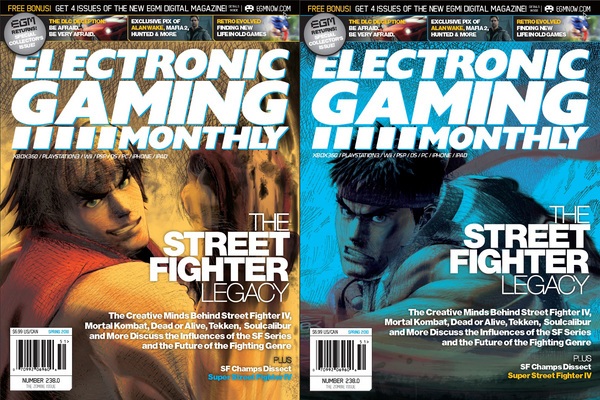
First up is: Electronic Gaming Monthly:


EGM began back in 1989, becoming, along with Gamepro, Game Player's, and Video Games and Computer Entertainment, some of the first dedicated video game magazines on the market. It was sold to Ziff-Davis in 1996, who then sold it to Heart Publishing in 2009. Hearst had little faith in the print market, so they canned the mag while letting 1up.com, its online equivalent, survive. Not long afterward, Steve Harris, the original founder, bought the rights to the magazine and promised to relaunch it, feeling the name still carried plenty of weight in the gaming industry. Over a year after it shuttered its doors, EGM is back, and while it's not technically the same as it was a year ago, it carries many notable names, including Brady Fietcher (ex-editor of Play), Dan Hsu (EGM alumni), Marc Bozon (from IGN), and numerous others.

They brought back the old logo, which was ditched in an EGM redesign from a few years back. The whole magazine feels more like the EGM from the late-PSX, early PS2 era, at least in design. It's obviously not as thick as it used to be, but the paper stock is heavier - I still liked the old EGM even in its waning days, but there's no doubt that it began to feel really thin and flimsy, while this carries some weight. It's not Edge or Next-Gen thick, but it's a step up from most other modern US mags.

The key feature is on Super Street Fighter IV, and has interviews with not only Yoshinori Ono, but brings John Tobias (Mortal Kombat) and Tomonobu Itagaki (Dead or Alive) into the mix with some interesting commentary. (The highlight - Itagaki votes Tekken 1-5 as the Five Worst Fighting Games of All Time. Truly a man after my own heart.) The Review Crew has gone from three reviews down to two, with a main review and a second opinion. There's a four page spread on the history of EGM, as well as some features on the effects of Metacritic and some commentary on Sony's motion controller, as well as a short feature about the recent retro revival. Many of the editors have their own columns towards the back, and includes Dan Hsu doing what he does best - ripping pieces into his lesser video game journalism peers. They even brought back Seanbaby to talk about Jonas Brothers and Barbie games. I thought, like most of the Internet, that I'd gotten sick of him, but as it turns out I really haven't. There are a couple of previews that feel a bit redundant based on all of the coverage elsewhere (Alan Wake) although it covers a few I hadn't heard of (Naughty Bear). There's also some digital content you get access to if you subscribe at EGMNow.com. A quality effort overall!

And now, GameFan:

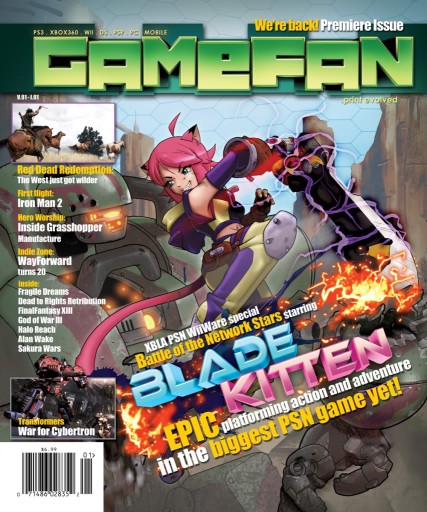
The issues of this one are a bit shiftier. As we've blogged about before, Play Magazine died a quiet death earlier this year, with the January issue (the Mass Effect 2 one) being its last. Somehow, publisher Dave Halverson was able to recover and almost immediately start a whole new magazine with a whole new staff, leaving over $40,000 due to his previous writers unpaid. (And all of his subscribers left in the dust. Boo.) I don't know how this all happened, but three months later, the revival magazine, going under the old moniker GameFan (they dropped the "Die Hard" part, presumably because it's under use by another website) and sticking on a short "MovieFan" section to act as a dual genre magazine.

It's been upgraded to a large format, similar to Rolling Stone. It's nice and large on the newsstand, although it uses thin, glossy paper stock, so it feels kinda cheap to hold. The large format also makes it very difficult to fit on a shelf, or makes it all the more liable to get torn up if you stack them in a pile. The layouts are busy, but much more cohesive than the GameFan days. I think they're a bit more attractive then EGM, although not quite as professional looking.

The content is pretty similar to what you'd find in Play, seeing how the cover heralds a fairly obscure title, the upcoming downloadable game Blade Kitten. There are the usual previews and features, with the best being an interview with Suda 51 and other Grasshopper Manufacture folk. The coverage is alright, although I feel like a lot is lost from Play. I always felt the cool Japanese coverage was kept aloft by Eric Patterson, Nick Des Barres and Casey Loe, none of which are involved in this one. (Casey is onboard EGM, and all three have form an excellent podcast, WARNING! A Huge Podcast is Approaching Fast! (a reference to Darius.)

The reviews section is a bit confusing, because it's done like the old Die Hard GameFan. There's the "Viewpoint" section, where two people (reduced from four) give a brief opinion on a game, along with a rating. Later, there's a fully review for the title, although it more describes what the game is about rather than offering any criticism. The coverage is inconsistent, because some games get a Viewpoint but not a real review, or vice versa.

As expected, a huge chunk of the reviews are written by Halverson, so if that put you off about Play, this isn't going to be any better. In fact, one of the best things Play Magazine did was get rid of the scores, because it made it less apparent that they gave high scores to any old piece of crap. Well, the scores are back. In typical fashion, practically each and every game is awesome, with nearly every one scoring an average of an 8 or above (the only one with a flat out negative rating is the widely derided Blood Bowl) and stuff like Final Fantasy XIII gets a 10, because it's much easier to pen flowery love letters than it is to write actual criticism.

As for the MovieFan section - I'm not sure it really works. You're supposed to turn the magazine over and flip it, and, hey, a whole new magazine! Sort of. The thing is, the bar code is clearly on the GameFan side, and any book store I've seen stock this only stocks it in the Gaming section - the movie side may as well be invisible. The cover article is on Alice in Wonderland and the designs of some of its creatures, while there are shorter articles on large movie monsters and vampires, along with a summer movie preview and a noting of some upcoming 3D movies. It's not altogether bad, but it is completely pointless. If I wanted to read something of vague substance, I'd just pick up Entertainment Weekly or Premiere. It feels like Halverson wanted to cover movies and just kinda stuck this on there, with little regard of whether anyone would actually want to read it. As such, it just feels like it's taking away from the game coverage. Arguably the same thing could be said of the anime section of Play, but even that was smaller than the movie coverage.

THE VERDICT:

As you can tell, I'm being much harsher than GameFan. It's not a terrible magazine, and I feel its niche coverage is more up my alley than EGM, which aims a bit broader, although neither as mainstream as Game Informer. But EGM is, on all accounts, more professional and better written. It's also cheaper to subscribe - $25 for a year compared to $40 for GameFan, and after the shenanigans with Play, I don't exactly have faith that Halverson just won't take my money and run again. Maybe if they do more stuff like that awesome article on Japanese Xbox shooters from late last year, GameFan can hook me again, but until then, I'm going to have to be a bit wary.

Tuesday, February 9, 2010

PLAY magazine is (probably) dead

According to a Facebook entry and subsequent forum topic, plus the editor-in-chief showing up at the new Electronic Gaming Monthly it would seem Dave Halverson’s Fusion Publishing has filed for Chapter 7 bankruptcy. This likely means that PLAY magazine is dead. Let’s raise a glass to this fine publication, and the poor jobless souls who helmed it.

QUICK UPDATE:

No sooner than we hit the "Publish Post" button on this, there's some Official News - yes, Play is gone, but Halverson is relaunching Die Hard GameFan, albeit with a split focus on games and movies. So everything nice we say about Play still stands, and at least there's some hope yet.
.
.
.
I love PLAY magazine. My first subscription issue was December 2006 until present, and I’m only sorry that I hadn’t started reading it earlier (it was never officially sold in the UK, unfortunately). While I’ve subscribed to EGM, EDGE, GamesTM and Retro Gamer, none of them gave me as much reading pleasure or valuable information as PLAY did. The only magazine coming close would be its predecessor, Diehard GameFAN.

A lot of people gave it a lot of criticism over the years, and while some of it is justified, I still stand by my statement that they were the best magazine available, for a long time. I suppose I like them for the same reason I liked Working Designs - whatever faults you can raise against them, the fact remains they did things which needed to be done which no other company would have. Working Designs brought us classics we’d otherwise never experience, and PLAY fought the good fight in a difficult publishing world.

Since I started subscribing I showed it to two friends and ex-colleagues in the magazine industry. One is now a prominent, rising figure of power, the other a veteran editor. The first, seeing my initial issue, was struck by the fact that in the editorial page it showed the previous issue as having Lunar Knights on the cover - “No magazine would ever have given such a niche game cover time.” And that for me epitomises PLAY, they were an independent little guy, the scrappy junkyard dog of the magazine world, putting up the good fight for the little guy and championing what would otherwise be overlooked. They gave Odin Sphere cover time, with Halverson stating he did it to change things. They gave Castlevania on PSP cover time, where for the first time we received Chi no Rondo in English.

They gave Muramasa cover time, with a racy nod to one of Hokusai’s prints, and then gave it 18 pages of editorial. I’ve never seen 18 pages for anything, in any other magazine. The two authors, who went to Japan, spent the time talking about obscure Kabuki plays and even included a photo of the outside of the company’s building. It could be the best article I’ve ever read. No one else gave so much attention to Muramasa. In that same issue they gave detailed coverage to shmups, an otherwise dying genre. How many other mags would take the time to examine the genre across all formats, especially when you’d need a Japanese 360 to do them justice?

PLAY tried to change the world, but no-one listened.


And what multi-format alternatives are there? EGM died a long time ago (though will be returning), while Gamepro and GamesMaster appear to be aimed at children.

Also, PLAY had a deep appreciation for Japanese games in a world where the pendulum is slowly shifting and it’s becoming cool to hate Japanese games, or criticise the design and aesthetics. Just look at PLAY’s reaction to games like The World Ends With You, a game which I felt should have revolutionised the RPG genre. I guess part of why I liked PLAY, is that the words it printed resonated so strongly with the words in my mind.

While most UK magazines will hire Tim Rogers or Jonti Davies to do their Japanese coverage, PLAY had its own dedicated correspondents: Nick Des Barres and Dai Kohama. There’s nothing wrong with Tim and Jonti, they’re great writers, but it’s worrying to think that around a dozen magazines rely on only these two people, writing under pseudonyms, for Japanese coverage. PLAY’s coverage of Japanese conventions was epic, multi-page affairs and were always fascinating to read. If I wanted to nitpick, I’d complain they never covered the doujin comiket conventions, but that’s just being pedantic. Anyway...

EDGE is a sterile, desiccated boil on the arse of the Queen’s horses - arrogant, brash, pompous and full of itself, not to mention in the pocket of Sony as highlighted by the Paul Rose debacle where they refused to print his column criticising a forced PS3 auction at a charity music event. Furthermore, how can anyone trust their judgment when they give something like Gunstar Heroes a 6 out of 10, and Valkyria Chronicles an equally low score and only a half-page review which reads like a recycling of the box’s blurb? They represent a lie which people continue to accept as truth, and that’s sad.

GamesTM has a fairly good design and content, with a decent range of features and niche coverage. I know the people who make it, and I know they’re good people. But I also know for a fact that any quality GamesTM displays is the result of the blood of its prole labourers, who are paid very little and worked very hard. Every word in that magazine has been beaten out of them, both the internal staff and the external freelancers, under pain of long hours and the worst writing contract I’ve ever seen. And to make this pissing of razors even more painful, all of them are uncredited with the article bylines stating not the author, but the magazine itself. Paying the publisher money for the magazine is the equivalent of buying any piece of designer clothing where you’re aware that Indian children went blind working in a sweatshop to create it. A good mag, but I can taste the blood on the pages.

I sometimes wonder, maybe PLAY was like this behind the scenes? If it was, I’d rather not know, and continue to live out my fantasies of it being a nirvana across the Atlantic. On one occasion a member of staff on PLAY was in correspondence with one of my magazine colleagues in the UK, and they complimented our magazines, saying something like along the lines of how our mags are difficult to get in the USA, but they’d love the opportunity to work on something like them. Would they if they knew the truth? Or were the inner workings on both mags much the same? I suppose there are things hidden from view at all publishers.

What I liked most about PLAY was their unashamedly, unapologetic attitude. I’ve heard people who read PLAY describe Dave Halverson as insane, but that only made me like the magazine more. Who else would write two features on Gaming Critters (even if he did omit Superfrog) and get away with? Which other editor would write an online column publicly criticising every other journalist in the job, over their treatment of Golden Axe? I’ve never played the game, but I like the fact that they were unpredictable, scrappy fighters. Whether they were correct or mistaken is irrelevant, they did things which made you pause, while all other magazines danced to the tunes of big publishers like Activision, suckling on the teats of bribery. Who else would run that Muramasa cover and include a lengthy feature on shmups, a genre few care about? Like I said, PLAY were the foaming junkyard dogs of magazines (and I say that with only the sincerest of compliments), and I like to think publishers were frightened of them. Or at least didn’t like them. The only other editor who I respect more would be Dan Hsu who spoke out against bought coverage in magazines - and look what happened, ads fell away and EGM died. Having worked in magazine I can say the corruption he hinted at is darker than you could ever imagine.

There was so much that PLAY did which was cool. I loved how the reviewers were named for everything they wrote. A far cry from EDGE and GamesTM which choose to hide behind a veil of anonymity. I grew to appreciate the style and views of each of their reviewers. I know who I could agree with, and who I could disagree with. Considering how little I trust reviews these days, the reviews in PLAY became like the discussion topics on a good forum, like Selectbutton or HG101 - it felt more like a chat with acquaintances who you know could trust. They spoke personally about what they liked, which really is the only way reviews should be written, with so many diverse genres and styles of thought today. Modern critiquing cannot be objective - you cannot simply divide the sum of a game over graphics, sound and gameplay, and then arbitrarily attribute a score. (more on scores further down) The best reviews are those that are a little personal.

Even PLAY’s adverts were cool, covering obscure, niche stuff like J-List, Hero’s Saga Laevetain Tactics on the DS, and the first official Sakura Taisen game to reach the west. There was also always niche stuff from XSeed, like Half-Minute Hero being prominently displayed. When I showed my friend my latest copy, he’d comment on the adverts, feeling that because PLAY catered to a hardcore audience, these smaller publishers might have been keener to advertise with them because they realised they’d be reaching their target audience. Certainly we’d never seen adverts like that in more mainstream mags, which would always place focus on fatcat publishers who paid more for their product placement (of course our frame of reference was UK mags - perhaps other mags carried the same ads). Game publishers are fickle and often punish magazine publishers by withholding adverts, and it’s also possible that the cruel reality for Play was that only the smaller groups showed interest. Even so, I like the fact that there was such an outlet for the little guy, and whereas I would glaze over the mainstream shlock being touted in places like EGM, EDGE and GamesTM, I’d always pause and reflect on the ads in PLAY.

Bankruptcy and what it does

I’ve lived through two publisher bankruptcies in my time. Once through Live Publishing, and then through Highbury/Paragon - both of which left huge freelancer debts and psychological scars which remain with me even today. So I know how those poor guys and gals involved with the mag must be feeling. Most vocal will probably be the many subscribers who lost $50 or so on magazines they’ll never receive. Next will be the external freelancers, who could be owed as much as several thousand dollars. They won’t be quite as vocal, because if you’re a career freelancer you don’t want to sh*t your own bed by going off like the 4th July and ranting about the injustices of the world. So they’re probably drunk on a cocktail of misery and gin, or they just don’t care, because in a while the appointed team of Corporate Banking Men will send out letters saying they’re unsecured creditors and won’t be getting anything from the sale of assets. Finally there’s the staff, who may not have received their last paycheck and have either already jumped ship to greener pastures, or are wondering how the f**k they’re going to find a new job in this depression - or they’re hoping another publisher will buy up the rights and continue to publish it.

And I knew these people. Well, two of them, from my days on The Gamer’s Quarter. And they were good people. TGQ’s editor-in-chief, Matt Williamson, survived the flood in New Orleans. He also agreed to act as a reference for me which eventually helped me get a job at Time Warner (which was paradise compared to games magazines). Then I found out he became an online editor for PLAY. I can only wish him well what with PLAY’s demise (though his last piece was for August 2009, so maybe he left long ago). Then there's Heather Anne-Campbell, comedian and previous contributor to TGQ, who was always jovial on the forums, answering my most pedantic of questions.

Assets for multi-format magazines tend to be more permanent than single-format mags which are tied to the life of a system, so there’s a good chance PLAY will be sold on, reshaped, and then possibly remarketed by someone who feels they can capitalise on the brand with a little a investment. I normally don’t like these kinds of rebuyers, because in my experience they dangle their salvation over you like some kind of pious Kim Jong Il and will likely profit from work that the original authors were never paid for. Still, a job’s a job, right? The alternative is that whoever owns Fusion Publishing will sell it to themselves for a dollar, and then simply rename the company, while keeping all the old staff, assets and office space. This happened with Live Publishing. That bastard Wilkinson who owned everything simply signed away his debt and sold everything he owned back to himself. He signed away the money he owed his employees, but kept all his mags, and his offices, and pretty much everything. Just not the debt. Now he’s trading under the name Magnesium Media. Me, bitter? Nah, if I were bitter I’d be hiding in the bushes outside Wilkinson's mansion, biding my time...

Anyway, enough of my personal demons, we’re meant to be remembering a fine, fine magazine, which is no longer with us. And unless I’m mistaken, this also means that the last independent US magazine has fallen, at least until the new EGM is released.

The Dropping of Scores

I’m giving this its own title, because it needs to be said: PLAY set a precedent on so many levels, especially by dropping scores. EDGE tried it for one issue, and even then listed the scores after the review section, and then promptly abandoned the debate. Other mags at the publisher I worked at debated it too, but were too afraid to do so because it meant not being listed on Metacritic and Gamerankings. PLAY had the balls to do what no other mag could - abandon scores, which are an irrelevance today.

Admittedly they went back on this, capitulating and admitting defeat by adding scores to their online reviews so as to be again featured on Metacritic. But I like the image this creates in my mind: like some kind of ragtag platoon making one last stand against the ungodly hordes. They didn’t make it, hell, all of them died trying, but they stood at the gates and fought the fight, like a divine wind which, sensing the end, chose to eclipse itself.

It wasn’t perfect, but it kept me subscribing for four years. Let’s take a moment to remember PLAY, and think of all the people who’ve lost not only freelance money, but also their day jobs. Here’s hoping they all move on to better things.


Wednesday, December 9, 2009

Purgatory Kabuki – can’t give it away!


Quite a while ago Treasure artist Yasushi Suzuki created a manga called Purgatory Kabuki – rather than being the perfect cross-over between videogames and manga that people dream about, it was awful. So awful, I couldn’t even give it away. For free!

(This blog entry comes with bonus IT Crowd script)

Author: Yasushi Suzuki
ISBN 13: 978-1-59796-070-0
Date Published: 12/27/2007
Format: paperback / B&W
Number of pages: 144
Rating: 13+
Price: $9.95
.
.
.


I recently moved house, and with that I sold off, gave away and threw out most of my surplus clutter – so all the manga I didn’t intend to read again, all the anime I disliked, and the majority of my Dreamcast CD-Rs (man, did I really burn a copy of Memories Off?). Most things sold except for Purgatory Kabuki. I then offered it to a games journalist friend who loves Treasure games and had happily accepted a poster for Gunstar Heroes – signed by the Treasure team – which I’d given him previously (which I’d actually had to rescue from the dustbin of my ex-boss, who’d received the signed posters for use as competition prizes and then simply chucked them out). But even he didn’t want Purgatory Kabuki.

The sad thing is, it is one of the worst manga/graphic novels/comics I have ever read.

Since late 2006 I’d been following its production in Halverson’s PLAY magazine (which, I should add, I think is now on the verge of bankruptcy, seeing as myself and several other European subscribers haven’t received the last 3 issues, plus a whole bunch of other things I’m not at liberty to divulge – but trust me, I’ve seen several publisher bankruptcies in my life, I know the signs. You read it here first!).


Anyway, Purgatory Kabuki was released in America and then proved stupidly difficult to get in the UK due to delayed release dates and suppliers running out. No one seemed to have heard of it anywhere, with only PLAY in America championing it. Not even NEO Magazine covered it, despite the Treasure/videogame/manga crossover connection. Not even my local ‘comic book guy’ had heard of it. This highlights an endemic failure in the media to publicise things, much like Agarest. Even if it is awful, it sets a historical precedent.

So anyway, eventually Waterstones orders it from a different supplier and I pay my £6.99 and wait for it to arrive.

So I get a call one day and go in the following morning. Well, the woman who actually handed it to me was one of the most attractive, intelligent sounding, bubbly, nubile strawberry-blondes I’ve ever seen in my life. All wise smiles and bosom. Geeky guy getting served by a young maiden, buying a manga graphic novel... Sorry, comic book. And suddenly I feel like I'm in the episode of the IT crowd.

I can just imagine myself as Moss...


Moss: You’ll never guess what Roy!


Roy: Oh, hello der Moss. What is it?


Moss: I was speaking to such a lovely young woman this morning!


Roy: Oh really?


Moss: Yes! We spoke about this, and we spoke about that, and she asked how things were, and she was smiling the whole time I made light conversation, Roy!


Roy: Oh, so did you ask her out then?


Moss: No Roy, I was buying the first print volume of the new Purgatory Kabuki graphic novel, by Treasure artist Yasushi Suzuki, who worked on hardcore titles like Ikaruga. Man, those were some great games, weren't they Roy?


Roy: Yes, dey were. I really liked Sin & Punishment which I bought on import, I bet she didn't even know that, huh Moss?


Moss: No Roy, she certainly did not know about Sin & Punishment, or who Yasushi Suzuki is, or Treasure.


Roy: So, did she continue speaking to you after you'd bought the comic?


Moss: It's a graphic novel book, Roy. And no, I quickly left the establishment and then ran off. But I think we had a real connection there.

***


Anyway, I finally had Volume 1.

And, like I said, it was shit.

I'm not a massive manga fan, since apart from Welcome to the NHK and Genshiken I can’t actually find anything that’s to my taste. Well, maybe Nausicaa, but I digress. I bought Purgatory Kabuki solely because of the videogame crossover and the fact that it’s by the main artist from Treasure. It HAD to be good, plus PLAY raved about it.

Unfortunately, it might be the worst manga EVER made.

There were only two colour pages at the start, despite the quality of monochrome shading making it look as if the whole comic was created in colour then converted to black and white – meaning you lose a lot of detail.

Worse still, it comes across as a piece of work created by someone who has no understanding of the comic medium, or even literature in general. Large panels are used almost exclusively for posing shots, while kinetic fights are displayed in tiny postage stamp squares, making it impossible to work out what’s going on. Worse still, there are several instances of panels taking up both pages, with the key details (as in main characters), being lost in the book’s gutter – this is a schoolboy error. Plus you’re left with panels displaying only empty scenery.

There’s also very little text. Which is no bad thing, I once read a fantastic graphic novel which had nearly no text whatsoever (it was about a lone wanderer venturing into a city of rats to find his lost wife, in some post-apocalyptic future – titled “The City”, it was by James Herbert). But in Purgatory Kabuki this lack of text makes things even more confusing, because the story is an incoherent, poorly written mess; a veritable rotting whale on the beach of narratives.


The story, of what I can understand, is absolute nonsense. Some guy with no name kills demons and takes their swords, until he kills a headless demon, and a child demon comes out of its belly, cuts his arm off, and then makes a deal with the nameless guy. Kill a thousand demons and take their swords, and I'll give you a new body with a working army. He accepts and is suddenly given a name. It's tough working out the rest, since it's like trying to read text fragments through a bowl of shredded wheat.

I didn’t look into buying subsequent volumes. And while I couldn't give away the first volume, I couldn't bring myself to throw it away either. So I've kept it, on my shelf, as a reminder to in future be more careful about what I buy.

Sad too, since I thought we were on to a winner, and I don’t want to criticise Yasushi Suzuki. His artwork is fantastic. The man is an extremely gifted artist, with a diverse range of styles, able to work in various mediums, and his artwork deserves nothing but praise. His other book, The Art of Yasushi Suzuki, in contrast is a fantastic coffee table read since it focuses on what he’s good at: art.


Purgatory Kabuki stands as an example where being skilled in one thing doesn’t necessarily mean you’ll be good in related fields.

Insert Credit had a fascinating interview with him, as did the publisher, DRMBooks. Apparently Suzuki-san wanted to make a game based on Purgatory Kabuki.

On a related note, someone else also raised the question pertaining to another videogame artist who attempted to branch out into manga: Anyone know what's become of Junya Inoue’s (Joker Jun, Cave’s artist) manga? It was supposedly translated into English.


After getting burned on Purgatory Kabuki I’m hesitant to investigate further. Taken from Amazon:
Otogi Matsuri 1: Dark Offering

A demon thirsty for human blood, a young girl who can see supernatural beings and a boy who inadvertently promises his future to the god of the south—all combine to give Otogi Matsuri the speed and power of a runaway bullet train. From the first appearance of the bone-crunching "cat-spider" monster, Inoue gives notice that this adventure story is deadly serious. Its teenage heroes are enmeshed in a realm that has it in for any puny humans who get in the way of its gods and demons. Luckily for plucky high school boy protagonist Yousuke Suruga, he's been unwittingly armed with the bow of Suzaku, a weapon with phoenix-like powers. Together with Ryuuichi Ezo, who's similarly armed with the spear of Seiryuu, and Yomogi Inaga, armed with otherworldly vision, he's able to take on the cat-spider and, later, a horde of monstrous dragonflies controlled by a gigantic eyeball—leading to some amusing absurdist dialogue such as "I saw a big eyeball going down the street!" Eventually, the demons are defeated and order is restored, but tantalizing loose ends have been left dangling for the next instalment, making for a good, juicy adventure with evocative graphics and great promise for part two.