Showing posts with label atari 8-bit. Show all posts

Friday, September 10, 2010

Computer-Spiele


Took me a while to get to the second book...


Sopart's book is much lighter on the gaming strategies part, but of course it has to deal with a much broader market than Video Spiele covered two years before. The book not only introduces a big number of home computers, which had by then taken control of the market, but also consoles, LCD handhelds, "Mini Arcade" tabletops, even chess computers and the like.

While Videospiele gave me the impression that it was aimed at "gamers", Sopart has to spend 7 pages explaining "How he computer plays with humans".

Strictly speaking, computers are not ideal playfellows. From their makeup they bring neither intelligence nor flexibility, which are requirements for a good playfellows. But how could these devices became partners more demanding from the player than a human counterpart?


Picture with the funny caption "game for two", while the screen and the boxes above clearly show office applications.

Sadly, a lot of space is wasted with manual-like descriptions of stuff, but there are a few interesting points that kept being issues for many more years or even decades. So there's the reoccuring complaint about crappy boxes, evaluating plastic clamshells similar to VHS boxes (the winner here) vs instable cardboard boxes. Anyone who thought pro-gaming was a recent phenomenon is put into place by this argument in the joystick buyer guide: "Passionate gamers will be glad to hear that there are even joysticks that ship with interchangeable handles. Slowly, the industry is becoming more active for professionals."


Kinda defeats the purpose of a "wireless" controller, doesn't it?


From the chapter "Pictographs or cinema quality?":

You know them from so many images: The famous computer people. They are pictographs, stylized depictions. Computer games are still identified with pictographs. (...) Why?

Especially with the transition from pictographs to almost realistic figures [don't forget: this is 1984!] it becomes visible, how quickly computer games have developed [yes, perfect tense].

(...) Some of the things we get to see on our screens nowadays really almost look like movies [talking about home computers, so probably not even meaning Dragon's Lair. As it goes on:]

What does that mean for the computer gamer? He should know that these pictographs actually already belong into the realm of history, even if they're sometimes still sold.


And, most interestingly for retro gamers:

Game cassettes with pictograph-esque visualizations could, as scene insiders assume, become bestellers again already in a few years - as computer antiquity. For that one has to recognize, that we're still living in the beginning days of the computer industry, and thus also of computer games. In few years we will experience the same effect as with shellac records. Those classics from the founding years of the music industry are now en vogue. (...)

A similar phenomenon could soon become evident with computer games. Therefore, it is advisable to archive old games that don't satisfy the desired standards and quality today. This not only under an economic aspect (...), but also under consideration do be able to get a "notalgic effect" out of them in a couple of years.


On "war games":

There is no doubt: The bad reputation of computer games in some social strata is mostly due to the games, that contain elements of war. But there are differences world wide. In the USA war games are less strictly rejected by most of the population than in Europe and particularly in the Federal Republic [of Germany]. Yes, one could even say in the USA a greater group developed into downright fans of these kind of games. The special situation in Europe and most of all in Germany resulted from the experiences from two world wars.


In case you wondered how to get the best high scores:

Whoever wants to become a good or great gamer also has to be an adept with the joystick. So it's necessary to make exercises to strenghten the hand's musculature. Thereby, the hands tightly grasp an item [no, not what you're thinking] - a candle, for example.


"In this posture, you'll hardly achieve maximum performance on screen."


The book even has a chapter on game programming, but it doesn't do much more than listing a number of basic Basic commands...

Monday, September 6, 2010

Study the past to learn about the present.


Digging deeper into the history of non-English video game journalism, today we're unearthing two of the oldest German monographs that deal with our favourite hobby.

Peer & Ulrich Blumenschein co-wrote Videospiele in 1982. The team of father and son made sure that the book was written well (Ulrich Blumenschein had worked for rennomated magazines such as Spiegel and Stern) but also knew what it was talking about. I only recently found this book when I decided to write about the other one ...

... Computerspiele, by Christa-Maria Sopart. This is from 1984, but I got it sometime during the early 90's at a bargain bin for 1 Deutsche Mark.

It's astonishing to see the many aspects where we've come an incredibly long way during the last thirty years, and even more astonishing to see how some things never change.


Videospiele was focused on Arcade games and home console, and understood itself mostly as a playing and buying guide. Even the introduction sounds like an economy advisor:

Gratulations ...

... dear reader! The few bucks you've spent for this paperback volume are well invested. For if you use these guide properly, you can save more than the price of the book in a short time. That applies to the young Arcade-Freak as the family dad, who plans to buy a video game console for home use or even a new cassette for his son.


So after ten pages of video game history (interesting how the book already saw the decline of the American industry in favor of the Japanese) it goes on with strategies for the most popular arcade games at the time. Today this section mostly delivers entertaining value for the German paraphrases to the English game titles and a few funny drawings of game scenes. A few examples:

Asteroids: Gefährliche Reise durch den Raum (Dangerous Journey Through Space)

Galaxian: Überleben is alles (Surviving Is Everything)

Defender: Entführungsdrama auf dem Planeten X (Abduchtion Drama On Planet X)

Berzerk: Der üble Otto (The Evil Otto)

Phoenix: Hitchcock im Weltall (Hitchcock in Space)

Donkey Kong: Der Affe und die Jungfrau (The Ape and the Virgin)


Oh, and not to forget the Seven Golden Rules of arcade gaming (These have longer text explaing the rules, I'm only translating the catchphrases):

Rule No. 1: Select a game that appeals to you and that still gives you joy after a few test rounds - and specialize to that game!

Rule No. 2: Assemble your own list of Questions while watching others play, and don't stop watching until it seems you've answered all your particular questions!

Rule No. 3: Examine the machine before you start! [this warns of inferior rip-offs with similar titles and the condition of the conrols]

Rule No. 4: Training brings Score!

Rule No. 5: Let others help you, when you can't cope with a difficult situation in your game.

Rule No. 6: Concentrate while playing!

Rule No. 7: Keep cool while playing!


After that follows a comparison of the four consoles available in Germany at the time and their games - Atari VCS, Intellivision, Phillips Videopac Computer G7000 (that's what the Odyssey II was called here) and the German console, Interton Electronic Video Computer VC 4000. It seems the latter was already out-of-date by the time the book was published, as it is rather neglected. There's no picture of the hardware, and no single screenshot of any game (only one picture of a game box).


For each available game there's a review, if you want to call it that, with a description of the game's mechanics, a sentence about "What caught our attention" and two scores, Spielwert (Game Value) and Gesamturteil (Overall Assessment), of which I don't quite get what's the difference, although the latter is sometimes one point below the former. The unit are once again german school grades.

"What caught our attention" is once again good for chuckles:

"Once again Atari didn't even manage to find an understandable German title for the game." Yars' Revenge (Die Rache der Superfliege)

"The spookhouse can be really frightening, you shouldn't give it to your kids in the evening." Haunted House (Das Spukhaus)


Not so scary: Haunted House

"Simple as Pong. The coloring is very nice." Super Breakout

"You'll need strong nerves." Astrosmash

"It pays to win; the explosion of the enemy battlestar is worth to see and hear." Star Strike

"When playing for a long time, the trigger finger starts to hurt." Weltraum-Armada

"If it wasn't only three field players per team, the illusion would be perfect" Fußball

"Funny how the spectators turn their heads after the ball." Tennis

"Not suited for a small screen. Only with 60-cm color TV are the details on the map overview properly recognizable." Flotteneinsatz (Sea Battle)

"Pong in 2D" Tennis


Interesting in a historical sense is an article on the future of video games, surprisingly cautious with wild speculations, but rather focusing on technologies that were in development at the time or new trends in the US, mentioned are talkie peripherals and Subroc-3D, the first "real" 3D arcade game based on similar technology as we know from the Virtual Boy. On the rise of independent developers (here meaning not what we call indie games today, but 3rd party developers like Activision):

For the video gamer this are of course great perspectives. He can more and more feel like the reader [of books], who is able to read any book with only one pair of glasses. Or with other words: he isn't pressed for a decision between this or that hardware system when buying his basic equipment.


But of course there also had to be:

It seems we are not far from laser light to create spatial images (Holograms) or language controlled computers in Telegames, anymore.


An early announcement for ET the game?
Atari has already teamed up with Steven Spielberg, the man who raised the science fiction film to a new level with his "Star Wars" series (sic!) and [Spielberg] made a contract with Lucasfilm Ltd., the best special effects studio in the world, which created the phantastic scenes for films like "Star Trek II", "Poltergeist" and "ET". Goal of the cooperation is to create novel Video-Games, that appear like a movie at the cinema, with life-like characters in realistic surroundings.


(Almost) at the end of the book stands the eternal question: "Video Games - A danger for young people?"

Question: Are video games addicting?

Answer: (...) Of course there are gamers that overdo it.
One could compare them to buyers of season tickets to the Fußballbundesliga [premiere league of soccer]. No one accuses them of any addiction.

(...)

Question: Shouldn't the young arcade machine fans spend their money for better things?

Answer: (...) There are many temptations in our sparkling, pluralistic world. Cigarettes. Bubble Gum. Pot ... video games seem to be a lesser evil here.

(...)

[after an answer mentioning the learning effects of video games]
Frage: I hope this learning effect doesn't apply to those "War Games"?

Answer: Whether anyone plays "War" is first of all a question of good taste. Parents should definitely make sure not to draw in again that kind of war toys through the back door that has long been banned and disappeared in other places. Program cassettes like "Blowing up dams" are certainly not suited as gifts for a child's birthday or christmas.


Yeah, Germany had/has a rather troubled relationship with the topic "war".

The video game companies are well-advised to follow the example of Mattel Electronics, who didn't even bring a game with the title "B-17 Bomber", that's freely available for home use in the US, to the german market. The task in this game consists of flying bombing attacks on a mass of land that clearly recognizably shows the shape and characteristics of Europe.


By the way the definition for "War Games" by the federal ministry of youth, family and healthcare quoted in the book is: "Entertainment games without profit opportunity [not sure how to translate that, it means no gambling], with which cruelty or acts of war are depicted or where technical appliances are used to simulate bursts [meaning lightguns]."


When watching and questioning real Arcade-Freaks in Hamburg or Munich, it quickly becomes evident that in case they should encounter a green man of Mars on the street after leaving their Arcade, they'd prefer to go have a beer with him instead of putting him down with a laser gun (where to get such a thing, anyway).


Oh, this is getting really long, and it's getting really late. Going to bed now, there'll be a closer look at Sopart's book in a few days ...


Atari Advertisement


Friday, August 20, 2010

Obscure Video Game Controversies - Hard Hat Mack


My dad was digging through the closet and found some old Atari 400 games from my childhood, which spurred me to rediscover some of the stuff I used to play when I was really young. Please forgive me if the next few entries rely on such self-indulgence.

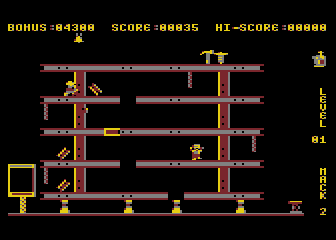
One of these games was an Electronic Arts game called Hard Hat Mack. It's clearly inspired by Donkey Kong, in that it takes a single screen arcade-style platformer that takes place on a construction site. Instead of simply reaching the top of the screen, each level has its own unique goal. In the first screen, you need to grab girders spread throughout the screen, place them them in the gaps of the structure, then grab the jackhammer that's mysteriously floating the around the screen to solidfy their place. In the meantime, there's some guy causing trouble running around, along with rivets that are shot from the top of the screen and bounce down.


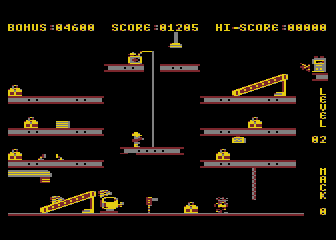
In the second screen...well, I never beat it when I was a kid, and even with the benefit of save states and twenty five years of gaming experience, I still can't. It seems to be a factory and apparently you need to gather all of the lunch boxes somehow, but some of the obstacles require such pixel perfect jumping that it's practically impossible. There is a third level, apparently.

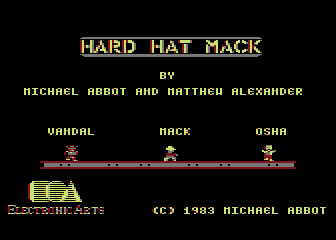
It's an alright little game. Like Dig Dug, the music stops and goes as you move your character, playing a short little ditty that becomes remarkly catchy despite maybe being four seconds long. But the most interesting aspect is the title screen, which shows all of the characters.


Now, if you were gaming at a young age, you probably picked up some vocabulary from whatever you were playing. (Zillion for the Master System taught me the meaning of "suicide". It was an awkward moment for my parents.) Hard Hat Mack taught me what a vandal was. More confusing was the character labeled "Osha", which I just thought was a weird name, and my dad didn't know either. Twenty-some years later, I realized it was actually OSHA, which stands for the Occupational Safety and Health Administration, the governmental division that strives to ensure safe working conditions. I was googling around, then, and found this interesting story from a 1983 issue of the computer magazine Infoworld:

Earlier this month, Electronic Arts, a home-software publisher based in San Mateo, California, found itself in hot water with the state government. Hard Hat Mack, one of the company's arcade-style games, was banned from at least one Emporium-Capwell store after a California legislator objected to one of Mack's enemies, a white-shirted good name OSHA.

In Hard Hat Mack, OSHA runs around the game screen, clipboard in hand, trying to squash Mack, a blue-collar construction worker...California state senator Dan McCorquodale took offense to Electronic Arts' comic portray of OSHA as a video-game villain and dashed off a latter of complaint to the Emporium store in Santa Clara, California. Hard Hat Mack was anti-worker, he said, and it gave the children playing video games the wrong idea about their friendly federal government. Six days later, the store pulled the video game.

The last laugh may be on Mr. McCorquodale. All of this publicity will probably spur sales of Hard Hat Mack. It's rare to find a game that is part fun and part humorous social commentary.


In the long-run, obviously this didn't affect much of anything. No one really remembers the game nowadays, and since it's not violent in the way Death Race was, it hasn't exactly made a mark on history. Still amusing, though.