Monday, September 6, 2010

Magic Box – feel the different and wonderful Farmer product

Today I finally received my Magic Box controller adapter for my original Xbox, and with it so begins a revolution in the way I play games. Because now, dear readers, I can use the most beautifully designed controller in the world, the Japanese Saturn pad, with one of the world’s ugliest consoles, the Xbox, to play Super Nintendo games! WARNING: this entry contains satire.
.
.

I recently burned a disc with all 4 of the Turbo Duo Valis games on it (or PC-Engine CD-ROM2 if you’re one of those infuriating pedants), for use on my original Xbox via the Mednafen PCE emulator. Mainly since as I’ve said before, the last time I tried PC-based PCE emulators, they all sucked, since the authors insisted on making it difficult to load ISOs (apparently an attempt to curb piracy on dead hardware), which forces me to use mounting
programs and bugger around with setting up the correct CUE files and correct TOC. As Dave Shadoff explained, he intentionally engineered Magic Engine to be difficult to use: “The reason Magic Engine doesn't facilitate cue/mp3 rips are several, but basically it's because the intent was to allow people who actually owned the games to run them.”

Yes, because everyone has the money today to buy rare, out of print CD titles
which cost triple figures, for DEAD hardware, off people on eBay, instead of downloading them. Well done that man, well done all round. Mednafen, god bless it, is a simple LOAD AND GO type of emulator. It’s my kind of emulator.

Unfortunately I’ve been finding the Xbox controller somewhat uncomfortable – my hands are those of a poet or pianist’s, unaccustomed to the lumberjack-styled designs put forth by Microsoft (seriously, what is with Western pad design? The Saturn pad was crazy chunky, as was the Xbox’s! Too much red meat in the designers' diets methinks). The Japanese Xbox pad is an improvement, but jeez, it’s still a little too unwieldy for my refined bone structure*.

What I wanted was to somehow use my USB Saturn pad. It turns out there is a mod to install a USB slot in a chipped Xbox, but it apparently only works under Linux for things like a keyboard. So I was told. Thanks to Xbox Scene for the image.

But then someone pointed out the Magic Box to me, a device which allows you to plus Saturn, DC or PlayStation controllers into your Xbox. I absolutely had to have one. Unfortunately all online which once stocked it are now sold out, since it’s quite old. But I found one of eBay. Sadly I big $65 dollars and was outbid at $66, and there wasn’t another in sight. So I put a reward on a UK forum: £35 to the man who posts me a Magic Box. Within minutes I had a reply, wired the PayPal funds over, and now I have it.

The Engrish on the front is priceless. While inside is a series of exotic fliers with enough cool-looking Chinese characters to make you think you were in Bladerunner or something. At first, reading the instructions, it implies that the L and R buttons on the Saturn pad are disabled, which disappointed me, but upon loading several emulators I discovered they do actually work, and are mapped to the L and R triggers on the Xbox, albeit reversed. Which is fine, since using the configuration utility in the emulators now allows me to remap the perfect SNES, Genesis, NES, Turbo Duo and other emulator system. As for the PS1 emulator, which is also great, I can just use an original PS1 controller, or stick with the Saturn pad.

I’ve spoken about my love for the Saturn pad many times before, but it really is the best digital specific pad ever made – as are the USB versions they made for PC (my USB Saturn pad is by SLS). Plus, if you get a black USB Saturn pad, it matches your PS3 (I play all non-analogue PS3 games with the Saturn pad, such as the new Scott Pilgrim game). What I like is how well designed the d-pad is, besting even Nintendo’s original d-pads, with finer diagonal control. It also has 6 face buttons, more than any other pad except the Genesis revision. It also has 2 shoulder buttons which, despite not being analogue, have a seriously nice CLICK to them (the quality of click differs from the USB pad, and I’ve heard that fighting enthusiasts actually prefer the original Saturn pad’s click).

It lacks a Select button, which is mildly annoying, but otherwise it’s damn awesome. The PlayStation brand of pads comes a close second, let down only by a poor d-pad, but is otherwise my favourite for analogue sticks. The N64’s broke to easily, the Dreamcast’s came loose (though it did have better analogue triggers), and the 360 has its sticks in a non-symmetrical fashion which disorients me quite badly.

Now I have the best of both the Saturn and the PS2, for all my digital and analogue controller needs (unless I need some good triggers, in which case the DC can be used). Click the below image for how the buttons are mapped.

As for performance, there doesn’t seem to be any lag. The d-pad controls as tightly as you could hope for, and there was only the slightest hint of lag when using the face buttons. But it never affected my ability to play precise platformers, so is either my imagination or easily compensated for. All in all, while a little pricey at £35 (roughly $55?), it was well worth it. It also means I can now sell of my self-modded SNES, MD1 with Sega CD 1, and MD2 with Sega CD2, since the emulation is perfect on the Xbox. I’ll kinda miss my dwindling collection of UK, US and Japanese SNES games, but I’m sure they’ll better serve someone else. (these are 3 of my favourites)


* For those who need me to explicitly say what is satire: all statements pertaining to the build of one’s hands and bones, and the profession of lumberjacks, is SATIRE, and not meant to offend those with big hands, or connections to the lumberjack industry or anyone who works with wood. I am not a pianist, nor a poet, though get a few drinks in me and I will saunter around in a Greek toga. HG101 is an equal-opportunities blog, and we are not prejudiced against people with freakishly large hands and those who need a freakishly chunky controller for that extra bit of support. And now for your international moment of Zen, a scrapped lumberjack controller by Microsoft for the 360...


Saturday, September 4, 2010

New voices, same Mku

The Miku Append was a software update that added six new voices to Miku's existing Vocaloid database, meaning that this software update won't install unless it detects that you already have Miku's first voice bank installed. Along with the software update was a new look for Miku, and it looks totally cool.

Even though it's been less than three months after the database update was released (well, technically, it was available for beta-testing for several months before its official release), there's already some pretty good songs out there. One of them comes from an artist who calls themself Captain Beefheart (I'm serious!) who made a song with a mellow drum n bass-esque song using Miku's sweet voice:


There's also another artist called bunga who's made several songs using the new Miku voices. The artist's style is more mellow than Captain Beefheart's and uses otherworldy sounds:


As for whether or not the new voices sound better when using them to say stuff in English, only time will tell. Or when I stop being lazy.

Update - 9/4 - Lots of Japanese PC games, Higemaru, Hugo, Leather Goddesses, Secret Files, Strong Bad, Blazing Dragons and Megaten update!


So this site's TV Tropes entry (which I did not write but thanks to those who did) came to the conclusion that the site usually updates about once every three weeks. It's more like once every five..maybe six?...nowadays, although if you follow the blog, join the Facebook group or read the forums, you see things pop up a bit more often. At any rate, this update's pretty big, at least.

Contributor Sketcz wrote awhile back about a neat little old Japanese computer game called Kagirinaki Tatakai. In doing some research, he actually tracked down the original programmer, Hiroshi Ishikawa, and did a profile on him, as well as an article on his other game, Brain Breaker. You may not have heard of or played these games, but it's a fascinating look into the early 90s Japanese computer development scene. Sketcz has also contributed reviews of Hudson's ports of the Mario games to the various home computers, all of which turned out kind of weird.

Further on the old Japanese history side, our reviews include one of Capcom's first games, a single screen arcade title called Pirate Ship Higemaru, which soon bloomed into a Zelda-esque Famicom game which almost came out in America, and then didn't. Rune Master is a cool strategy game for the MSX by HG101 favorite developer Compile. The Megami Tensei article has also been updated to include Devil Survivor, Strange Journey, and Devil Summoner 2, although we're still getting around to Persona 3 PSP, because we're honestly a bit burnt out on it at this point.

On the adventure-y side, old PC shareware fans may remember the Hugo series, not related those weird European games based off that troll thing, which were cheap, Sierra-style games. There's also Leather Goddesses of Phobos, the classic bawdy sci-fi tale, which started as an excellent Infocom text adventure and graduated to a not-quite excellent graphic adventure. Blazing Dragons is a full Discworld-style graphic adventure that, for some reason, was only released on the Playstation and Saturn. And for more modern fare, we have a look at Secret Files, a German sorta tribute to Broken Sword, and Strong Bad's Cool Game for Attractive People, Telltale's excellent adaptation of the Homestar Runner cartoon.

And finally, we have the winner of the 3D Dot Game Heroes Copyright Competition, so check out some of the submissions to see game characters reimagined as pixelly warriors, along with save files to try them out yourself!

Look, I'm just doing what Crypton originally wanted with Luka, alright?

The first thought that went into my head when I saw Luka's design was this:

"Woah, she looks totally cool and mysterious and stuff."

Which was then followed by something more bizarre:

"Wait a second, that dress looks totally familiar. Nah, it can't be."

And then I double-checked. And I was like, "maybe the character designer was looking at Wrath of the Lich King artwork right before he had to submit Luka's design for Crypton." So I convinced a friend of mine to make a 4-panel comic about how Luka ended up with the final costume design that you see today:


What I find extremely humorous about this comic is that something very similar happened when Luka's voice actress was put in a similar situation during a Q&A session at Anime Expo.

Also, one other thing I find funny about Luka is that despite her appearance, it seems to be confirmed that she can sound like a ditz.

Thursday, September 2, 2010

Haiku Quest – the MAKING OF


For the record, no that sadly wasn’t Christopher Walken’s voice in Haiku Quest. I had thought this would be obvious, but it says a lot about the internet that for a time it was regarded as fact. For a full explanation on how Haiku Quest came to be, read on! (heading image from Zen Albatross on Motherboard)
.
.

My motivation for creating Haiku Quest was mainly to give people the experience of the haiku minigames from Boku no Natsuyasumi 3 in English. As several pointed out it’s actually very similar to the insult sword-fighting in Monkey Island, though I personally didn’t make this connection at the time. I also wanted to experiment with QB64’s sound playing options, and I really wanted to have an entry on TIGSource, since I love the website and the whole indie community. As I’ve said before, I regard myself as the Ed Wood of indie games development, and getting people to take notice of anything I make is nigh on impossible. But my haiku RPG idea had just enough merit, and was just within my abilities, to actually appear worthwhile.

My initial idea was a grand multi-screen RPG, where verses of haiku could be acquired for doing tasks and could be used like equipment. Haiku are meant to be seasonal, so imagine sticking winter verses on your armour to keep cool when fighting a fire-breathing dragon. Maybe boss battles could take the form of haiku stand-offs similar to the rap battles in 8 Mile, and you’d absorb the haiku verses of defeated poets, to then find and take on more powerful haiku poets. Stuff like that. It was within my abilities if I could set up an array to handle all the verse combinations, but I knew I’d get bored before completion. So I scaled it down to 4 screens, and replicated the BnN3 minigame exactly, except I used 5 poems and it used 10.

In the end I decided rather to create a proof of concept game, something you could finish in 10 minutes, but which might encourage other indie game makers to do something similar. I also went with ASCII in the end since despite creating an animated sprite, the amount of work needed to create perfect collision detection was rather daunting, since I’d need to cater from the start X and Y points, and the ending X and Y points for not only the main character, but anything he touched. So 8 variables, as opposed to only 4 axis positions with ASCII.

Of course my decision to claim that the legendary Christopher Walken had lent his voice to the game ignited some internet rage – though it serves you all right, since most sites didn’t even take the time to check the WAV files before posting a news story. 1UP actually had the best, and most intelligent coverage of this, and I’ll be discussing all of these in a moment. But first, a list of all the places I found that spoke about this:

GameSetWatch
1UP
Colony of Gamers
NeoGAF
Reddit
RPGcodex
Metafilter
Motherboard
French website
HG101


CALCULATED DESIGN

One of the biggest surprises regarding the game is how many people posted online saying they didn’t know how to play it. I have a great dislike for long-winded tutorials, and I thought that the basic mechanics of the game would be fool-proof in their simplicity. There are 4 screens, only 2 which contain anything. You visit Haiku Man, he recites a poem and asks you to grade him (your grade to a degree affects what grade he gives your lower level poems), and then all that’s left is visiting the village.

The daylight meter at the bottom continuously goes down, and I thought it would be obvious that if the inn keeper says it’s too early for bed, you need the bar to be a little smaller. It needs to be around 20 pixels long I think, and it decreases 1 pixel with each step. So when the inn-keeper boots you out, I made sure that even if the bar was at 21 (the lowest it would go without letting you sleep), you’d still have enough time to walk AGAIN from the village entrance to the inn without it reaching sunset – by which time it would OK to sleep. Calculated design that was, people. Also, the more expensive sleeping option is redundant. A lot of games feature utterly redundant options, and this is my homage to them. Stay in the cheap room!

After sleeping the bar refills and you need to spend the rest of your money increasing your supplies bar. I decided that in so many RPGs, winning came down to having enough gold to buy the most health restore items, plus the best equipment and weapons. No one intentionally buys anything less than the best they can afford, so I streamlined it. Imagine a thousand useless variations on items and equipment, and assume that based on your current money, you will always buy the best you can afford. So your bar fills up, representing armour integrity, health potion numbers, HP and so on. I was reminded that in Final Fantasy 7, the majority of boss battles came down to how many Mega Elixirs I had, since this restored the entire party. The only tricky bosses were the Ultima Weapon bosses, which were my favourite, since they required genuine strategy to clock, involving complex things like W-Materia and clever use of material in dual weapon slots, plus the need for underwater material so you could breath, and instant-revive set-ups for when the entire party was wiped out. Most other battles though, like most RPGs, came down to buying the best sword before a big boss, and buying as many restore items as you could. Then it was a case of hitting attack or magic until it died, while regularly using said items.


NPC IRONY

Also, I thought it rather clever that the game’s only NPC (assuming Haiku Man is the game’s only boss) says only “...” to you. That well known JRPG cliche of the ellipses, which says and does nothing other than waste time. But actually, Ojisan is extremely important. If you enter town and it’s too early sleep, rather than run left or right, he acts as a wall you can run into to decrease the daylight bar more quickly. In short: he exists purely to waste/pass time. How many times did you play Shenmue and wish there was a quick way to make the time pass? Deadly Premonition had the clever idea of cigarettes, where smoking would cause time to pass. Ojisan falls into this category.

STEALING AND MUSASHI’S WIFE

I had to laugh at how several people online claimed the game was unfinished. A guy on Reddit said: “A lot of the game is not even really implemented or just put in to look like there is more when there isn't like menu options that aren't selectable.” He was referring to Musashi’s inn where there’s the option to “sleep with Musashi’s wife” but the cursor won’t go there, and in Takashi’s store there’s the option to steal from Takashi, but again you can’t select it/

This wasn’t really an attempt to make it seem like the game contained more – it was a kind of post-modern, abstract dig at all those jerkoff Western developers who are claiming JRPGs aren’t really RPGs, because you haven’t got the freedom to kill anyone, or rob from anyone, or do totally pointless shit like decide what your character looks like. For these narrow-minded idiots, the lack of freedom do irrelevant things means JRPGs don’t deserve to be called RPGs. I disagree. It is a crazy idea for games to allow total freedom outside the context of what they are. I think it was EDGE magazine that once complained about Metal Gear Solid, that while Snake had a packet of cigarettes, it was unrealistic that he couldn’t kill himself by smoking the entire pack at once. How absurd is that? So with all this in my mind, I added 2 options which no one can ever select. I suppose if this were a Bethesda game, you could kill the storeowner and steal all his goods, or if it were Fable you could sleep with whoever you choose.

Actually, the stealing the from the store bit reminded of Zelda: Link’s Awakening on the GB, where you could steal the bow, which was a seminal moment in gaming for me. Since the only penalty was your name changing to THIEF and you losing a life. Which was a small price to pay for saying 980 rupees. But yeah, the inaccessible menu options are part of this game’s modus operandi – messing with your mind.


INSTANT-TIME BATTLES

This bullet point, along with the claim of a massive overworld, should have sent bells ringing that most of this was satirical. I had recently completed Dragon Knight 3 (aka Knights of Xentar) for DOS, and what I liked most about it was that all the battles were automatic. Random battles in almost all RPGs fall to you repeatedly hitting attack or magic, over and over, and if you’re lucky the bosses prove more challenging. But Knights of Xentar streamlined this, resulting in automatic damage to yourself and enemies, with your only input being occasionally hitting the items button to give a health potion. It was great, since what is the point of going through the motions of your standard JRPG battle? It also reminded me of Earthbound, where after getting to a high level, touching an enemy results in their instant defeat. People have compared it to Roguelikes, but I have never, in my life, played a Roguelike. So I can’t comment on this. Mainly it was inspired by Knights of Xentar.

Speaking of battles, my idea was for a very avante guarde art style, with the game entirely in black and white. And then I thought, wouldn’t it be interesting if the monster names were in colour? No one has commented on the fact that you inhabit a world where the only source of colour is its monsters – the things which kill you. I also chose names which would sound foreign, rather than crap like orc and elf. Wyvern is common in Europe, but babayaga (witch) isn’t, and neither is gorbunok (a flying horse from Russian legend).

THE POETRY

I wrote these first. As an accomplished writer, and author, I could probably write some decent haiku. I quite like the Game Over haiku I did, even though they lacked any kind of seasonal theme or “cutting word” at the end. Regardless, I decided to make my job easier, and make this appeal to game geeks, but basing them entirely on games. First I wrote the 5 perfect haiku (each inspired by a certain classic series), and then I tweaked them so that the different verses would work when you mixed them up.

Darius:
The small ship flies / A huge enemy approaches / Smell of dead fish

Street Fighter or Streets of Rage:
Two men in the street / Ancient bare knuckle technique / Fierce burning is felt

Mario:
In and out, again, again / Glade of green pipes stretching forth / Princess in a castle

Tetris:
From the sky they fall / Moulding the body’s position / Conformists vanish

Metal Gear
In a box hiding / Rigid serpent in warm places / Father’s legacy


I’m a little disappointed that David Wolinsky of 1UP, despite “getting” the game better than anyone else, assumed the haiku were all filthy and about masturbation. The Mario themed one makes sense, since he goes in and out of green pipes which stretch to the horizon. And the reason? Princess in a castle. The Rigid Serpent verse is obviously “Solid Snake”, and the fact that most of his games are in a hot climate (MG, MG2SS, Snake’s Revenge, Ghost Babel, MGS3, MGS4, Portable Ops, etc). Dead fish? Come on, that has to be the aquatically themed Darius. And as for fierce burning, that’s obviously a hadoken from Street Fighter.

The only really abstract one I’m disappointed with in hindsight, is the Tetris one. I always picture Tetris as a metaphor for communist Russia. They fall from the sky represents the blocks, but moulding the body’s position is me thinking of George Orwell’s 1984, and how the state moulded you inside the Ministry of Truth, which eerily mirrors what the communists did to dissenters. Conformists vanish means that once you conformed, you vanished from the Ministry of Truth and room 101 – in effect let free. And in Tetris, if you conform to a single clean line, you also vanish. I imagine people are the blocks being moulded by the state, and as they form the imposed ideal, they are allowed to leave.

There are 3 columns of 5 verses, allowing for 125 poem combinations. Only 5 will give you a red haiku diamond to complete the game, and about 30 other specific combinations will net you above 70 points. The rest are likely to be nonsense poems which only allow for a maximum of 65 points, depending on what scores you gave Haiku Man and a few other factors.

THE ENDING and SECRET

Someone described this as the prank of a 7th grader doing his first coding project. I like to think of the ending as being as cool as the ending in Monkey Island 2. And based on how people fell for my Walken hoax, I’m sure one or two probably got a little frightened seeing the ending. Just push enter 5 times to quit. With the above perfect haiku answers, you can see it for yourself.

As for the secret, if you go to the upper right screen, right into the corner, you’ll get a special message showing the names of the Haiku Gods. The first 3 are actually game names/characters backwards, which I had hoped would give a clue as to deciphering the poems: Darius, Street Fighting, and Jump Man. The last 2 are Dave Hayter, voice actor in the MGS games, and Alexei Pajitnov, the guy behind Tetris. In hindsight, putting a clue in a such an out of the way place made it rather redundant.

CODING IT

I coded it up in about 10 hours over two days, and then posted a couple of topics on a forum asking for “sexy voices” – I wanted a silky smooth leading male and female voice for the game. Something which sounded fantastic, to elevate it from a proof of concept game to something with artistic merit. Hal Binderman and Topher Florence I actually knew from some podcasts I participated in, so I contacted them directly and they graciously agreed, without knowing how deranged my plans would become.

And then.... nothing. No female leads. Those I contacted directly declined, and only a couple showed a slight interest before promptly ignoring further forum messages. Perhaps the quite obviously sexual innuendos put them off. After about 3-4 days I was sitting on a nearly complete project and then thought, in my quintessentially Cockney lilt, bugger this for a lark. I’d waited long enough and wanted it out there. So I’d have to use my own voice I realised. So, against my initial plans, I’d have to use an all-male cast. And my voice isn’t actually Cockney, that would have been cool. In reality it’s a horrid, screechy blend of Afrikaans, British and East European. Well, with no other options, maybe I could milk the comedy angle and make the game sound awful on purpose.

CHRISTOPHER WALKEN

Then I watched Larry King, sometime last week probably, and he was interviewing a comedian who spoke about Christopher Walken. The comedian said that some everyone in comedy can do a Walken impression, and that Walken loves to DANCE. He’s also one of my all-time favourite actors. I mean, the guy is incredibly skilled, charismatic, funny or frightening depending on the role, with an incredible voice/persona, not to mention everyone who works with him says what a great guy he is personally. I have bought and watched mediocre films for no other reason than because Walken was in it. In fact I think Walken should have his own radio show, or podcast, just Walken, talking for an hour, about whatever the hell he wants. No set agendas or script, just Walken, discussing his thoughts.

I have nothing but the utmost respect and admiration for Walken - who is deservedly regarded as legendary.

I decided if I was forced to act in my own game, I’d try to salvage it by doing a Walken impression. Except my impression was terrible. But what was I going to do after 4 days of waiting and not even a cursory interest? So, with nothing to lose, I decided I’d say I got the real Walken to do it. Many have commented on how he loves acting and won’t turn down something he finds interesting – so it was certainly within the realm of possibility. I even tried to look for his agent’s contact details, but couldn’t find any.

My belief was people would download the 4.5mb file, instantly realise it wasn’t Walken, and chuckle to themselves at how ridiculous my attempted impression was. If Conan O’Brian can have Arnold Schwarzenegger impressions, with the moving lips, and people realise it’s fake, they’d sure as hell realise this was a lie. And this, ladies and gentleman, is why I’m not even remotely sorry for what I did. I have absolutely no shame regarding such a half-arsed hoax. Maybe, if I’d gone to the effort and got one of the many skilled people on youtube who do Walken impressions, and created a genuinely convincing set-up, I might feel guilty. But this was the equivalent of doing a doodle in MS paint and calling it a Da Vinci. Maybe I’d fool you until you actually saw it, but after that it should be obvious. And yet, incredibly, people continued to believe, and several who obviously wanted it to be real, argued why it must be.

This fiasco did reveal something very interesting about the internet though.

No one who initially reported on it even downloaded it, since the WAV files are right there to be listened to. WAVs A1-C5 were those meant to be Walken’s and it’s quite clear they’re a (very bad) impersonation. Even if you couldn’t load it on your Mac computers, you could listen to the WAVs. This was partly GameSetWatch’s fault, who reported on it first and wrote the story in a way that made you think it had to be true and that they'd checked this. And they fooled a lot of people who later quoted them as a source.

The best write up was David Wolinsky’s on 1UP, and I’m naming him not only because his was the most intelligent reporting on this, but because he has a Polish surname and there can never be too many of us Poles taking the internet limelight. As he wrote:
---
[...] a new freeware game with its claim that Christopher Walken, that cowbell-loving star of stage and screen, took “five minutes” to record voice acting for it on someone’s laptop. If you’re gullible enough to believe that, then you’re going to hate Haiku Quest.

Or if you choose to believe the lie, then you’ll appreciate the short JRPG-inspired game’s charm.
---

I think he missed out a word, and meant to say either “you’re NOT gullible enough” or in the next paragraph “choose NOT to believe the lie”, since at the moment each sentence basically says the same thing. But regardless, he’s right on the money. If you realised it was obviously a joke on my part, I’d hope you’d enjoy it for what it is: a 5 minute diversion which should make you think, “hey, this is kinda neat. It’s a great concept for a more fleshed out RPG.”

That’s all I wanted, really.

If I had any regrets (and I don’t) it’s that the main website of HG101 might receive some negativity because of this. Let the record show that I am only a contributor. Articles on the main site are checked by Kurt before going live, whereas with the blog I have total unchecked freedom to run amok should I choose.

Several people, some of whom I know and respect, have said they come to HG101 for serious article. And yes, the main site is a place for serious examination, but the blog should be seen as more light-hearted and fun. All I did was, at worst, waste 5 minutes of your life. And it was fun while it lasted, because my utter disbelief at how the internet ran with this made me laugh like a drain for hours.

I suppose this stunt detracted from whatever genuine merit the game originally had, and made people dislike it as a result, but I'm not really concerned since this was never going to make a huge splash. At least this has made Google searching for results even easier.

Haiku Quest was a 100% calculated and planned project, and up until the 3-4 days that I waited with no interest from anyone wanting to do the female voices, was not going to involve the Walken spoof. I didn’t do it to upset people, I did it out of frustration because no one got back to me and I needed this finished, and to amuse myself. And to quote Joey in that chocolate eating scene: I’m not even sorry!


T2 does not always refer to Judgment Day.

Sometimes it can refer to a Japanese illustrator who goes by the name of Tony Taka. Now for those of you who know him, this blog post is absolutely worksafe, so don't hit that Back button on your browser if you were expecting that. For those of you who are unfamiliar with the man, the best one-sentence description I can give to you is that he is a modern-day Satoshi Urushihara. And like Satoshi Urushihara, Tony is also well-known for the female designs of a particular JRPG series, except substitute Langrisser with most of the post-Sega console Shining "(Insert Noun Here)" games.

So the reason why I bring up this particular artist during Hardcore Gaming 101's Vocaloid Week is because he did an illustration of Miku for Comic Market 77, which was last winter:


What's really amusing for me about this illustration though is that this is actually the most non-sexually provocative pose of a female character I've seen this guy make. And for good reason: Sega told him to draw that for Comiket 77 because they wanted to not scare away Vocaloid fans from their booth since they used that illustration to sell a CD called White and Shadow, which contained two tracks that were composed by Hiroki Kikuta (Seiken Densetsu 2 and 3, Romancing Saga). The sad part is I haven't listened to that CD yet either. Woe is me.

Oh yeah, there's a figure of this illustration up for preorder, but you already knew that before you read this, didn't you?

Tuesday, August 31, 2010

So Today's Miku's 3rd year anniversary...

... And all I have to show for it is a picture:

Of her about to eat ice cream like you weren't expecting THAT to happen


And a sound clip of her saying the name of this website.

Monday, August 30, 2010

Haiku Quest – an RPG featuring haiku poetry and Christopher Walken


It’s taken me a long while to finish my latest game, Haiku Quest. Mainly I had trouble recruiting voice actors to play the parts (as in very few volunteered when I asked, my request topic was mysteriously deleted, and even less replied after I’d sent them the innuendo laden script). But, on a whim which I never expected to work, I emailed Christopher’s agent and, intrigued by the idea of a non-profit independent game based on Japanese poetry, he took five minutes from his schedule to record the lines on someone’s laptop and emailed me a giant WAV file to cut up. If his voice sounds a little off, it’s because he was pressed for time (he apologises) and it wasn’t done in any kind of sound booth. I did my best to clean it up though.
.
.


The game was inspired my experiences with the haiku mini-game in Boku no Natsuyasumi 3. This was in Japanese though, and I wanted something analogous in English for western players to appreciate.

The poems are generally free-form, but I tried to adhere to most of the rules for writing English haiku. Since only fellow game players are likely to take an interest, all the poems were based on well-known videogames. I suppose the great failing of this endeavour is that you need a background in games to understand them. Christopher mentioned he only got a couple of the references.


The game features:
* A JRPG style of design
* A large overworld to explore
* Villages to visit
* NPCs to speak with
* Stores and inns to stop by
* Unique “instant-time” battle system
* Five different monsters to fight
* Streamlined inventory system
* 125 different poems to compose
* 5 true haiku to decipher
* A special "hidden secret" from the gods of haiku
* An incredible ending which will leave you floored
* The voice work of Christopher Walken


Download it here!

TIP: When playing, please do NOT hold down the arrow keys, rather tap them, since otherwise it may skip certain poetry sections.


And if you like it, be sure to spread it around.

Now all I hope is that someone tips off those lovely chaps TIGSource and this gets some kind of news entry. Heck, email Kotaku too, while you're at it.

Saturday, August 28, 2010

And the winner of the HG101 3D Dot Heroes Competition is....


...Shantae, from the 2002 Game Boy Color game of the same name! It looks cool, shows some design prowess, and references one of the only portable games to fetch a going price in the triple digits. Congrats to hiryu64 for the great job, and he should be expecting a copy of the 3D Dot Heroes Original Soundtrack in the mail soon. You, reader, can also download his entry here.

There should be an actual update coming real soon, where you can see the rest for yourself too!

Wednesday, August 25, 2010

Old German game mags (2)


The Video Games was Germany's first game magazine dedicated to consoles in the modern sense, with reviews, previews, etc. It started in early 1991 as a special issue of the home computer & PC magazine Power Play, which itself originated in the not games focused Happy Computer, but like it's mother mag, soon evolved into an independent publication, first quarterly, but from 1992 onwards monthly.


Hurray, in fall 1992, we Germans finally officially got the SNES.


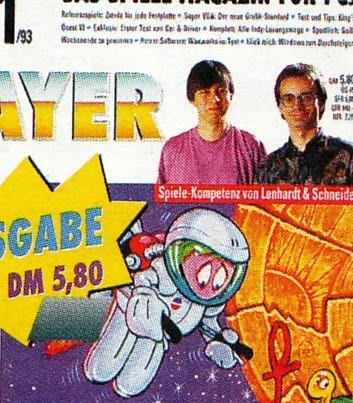
A look at the editorial staff in early 1992. Replace Stephan Englhardt with Heinrich Lenhard and you got all the big names for the early years of German games journalism on one page. Compared to today, there was almost kind of a personal cult around some of those. Imagine a games magazine that advertises its writers with their pictures on the cover, as the first few issues of the magazine PC Player did:


"Games competence by Lenhard & Schneider"

Some of those pioneers are still well known today. Winnie Forster founded Gameplan and publishes encyclopedic books (I think only the Encyclopedia of Game Machines is available in English, but there's also a volume entirely dedicated to game controllers and a company/developer encyclopedia in German). The first book went to its third edition by now.

Boris Schneider (now Boris Schneider-Johne) is also responsible for what might be the first fan translation ever, with his German hack of the C64 adventure Murder on the Mississippi (now there's a bit of trivia to update your translation article with, Sketcz). Afterwards he got hired by Lucasfilm games for their early games (from Maniac Mansion to Fate of Atlantis). Today he's the Xbox product manager for Microsoft Germany.

Julian Eggebrecht of course is (was? I'm not up-do-date what happened after the US "branch" went out of business) one of the leading figures at Factor 5, Heinrich Lenhard founded about half of Germany's computer game magazines in the 80's and early 90's, and later also moved to the US and became correspondent for some of them.


When working with Korean game magazines during the first half of this year, I often chuckled at the many typos for English game titles, but revisiting my early Video Games issues, I was put into perspective quickly. Behold the review of Sol-Deace (EDIT: Oh, turns out the Genesis version of Sol-Feace was actually really titled as such. But the other examples below are still legit and not the only ones).


In another issue I thought for a moment that I had found a mention of a forgotten unreleased game called "Makros", until after a few lines later they wrote the full title "Makros 2036". But worst was "Twinckle Tales", directly below the big, fat logo showing the correct spelling.

Looking back, some of the review verdicts are also hard to comprehend nowadays. Many titles now widely acknowledged as timeless classics got fairly low scores, sometimes with pretty weird reasoning. Interesting was their three-component genre categorization, though. So as you can see below, Quantum Fighter is an Action Platformer with more weight on the platforming (the actual category was "dexterity games", though, so it wasn't necessary for any platforming to be involved).


Sprite of the Month. It might seem now that I'm obscessing with Chun Li, but really, my sources are.


What's that? Didn't remember this ad at all.


Neither did I remember Hudson's 32 bit console prototype. Btw., the mag dedicated a news page to every console manufacturer, titling each of them with an alliteration ("Engine Events", "Sega Special", "Nintendo News", etc.)


Ad for Laguna, a big-ish independent German publisher of Nintendo games. Of the SNES games I own, Breath of Fire II, Soul Blazer, Lord of the Rings and Shadowrun are Laguna published. I remember calling Nintendo's game help hotline and not getting any help with Breath of Fire II. ("That game doesn't exist.")


WTF!? Comic strip in a feature about adult themes in games, originally from Famitsu ('twas Famicom Tsushin back then, right?).


Afterwards I kinda lost sight of the Video Games and only started buying it again regularly at Dreamcast times, when it looked like this:


Video Games was then discontinued in early 2001 (the millenium years 1999-2001 weren't very good to germany's old game mags overall. IIRC, the only early 90's-mag that survived this period was the Man!ac, now renamed just M!)


Before closing this post, I've two questions about games I've rediscovered here:


The caption identifies this game as "Chakan". The Chakan I know is very different, which game is actually shown on the screenshot?


Then there was a preview about Plugsy, Psygnosis' would-be first console only title. I couldn't find any references whatsoever about this game on the web. Is it unreleased, or did it end up with another title?


I should also link to Kultpower.de, a great ressource for many of the old German mags, even with full scans of some issues.