Friday, April 19, 2013

500-Word Indies: Rework the Dead: Evil

It's indies time again! This week, we're discussing another free game, the Abuse-inspired run-'n-gun Rework the Dead: Evil. In this rather morbid title, you delve into a dark underground complex to get behind the origins of a zombie apocalypse - as an anthropomorphic dog.


Wednesday, April 17, 2013

The Nintendo Power Retrospectives - Part 8

This time I'm taking a look at Nintendo Power #2, with the magazine's most controversial cover, and a few of the NES's controversial titles.


Monday, April 15, 2013

Dark Age of JRPGs (2): Some games we cannot play

Alright, before we can go on with the regular program, here is one issue that we need to deal with first, cause it more or less affects already the next three releases following after The Dragon & Princess: The obscure nature of the subject brings with it that some games still left we simply can't access at all yet, and this is just a quick look at what they are from the information we could gather:

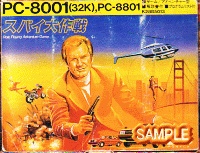
Spy Daisakusen (スパイ大作戦) - PC-80 (1982)

Different to the other games in this post, an image for Spy Daisakusen was actually findable, but for the life of me I can't figure out how to properly play this game, not even with a Japanese guide from the web. It's by the license masters PonyCa(nyon), so it doesn't surprise that Spy Daisakusen is actually the Japanese title for Mission: Impossible.

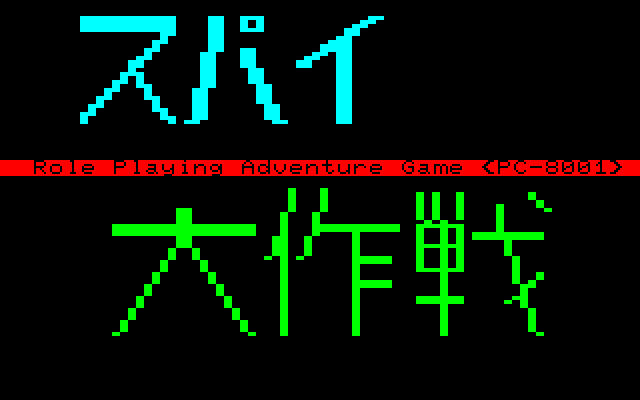
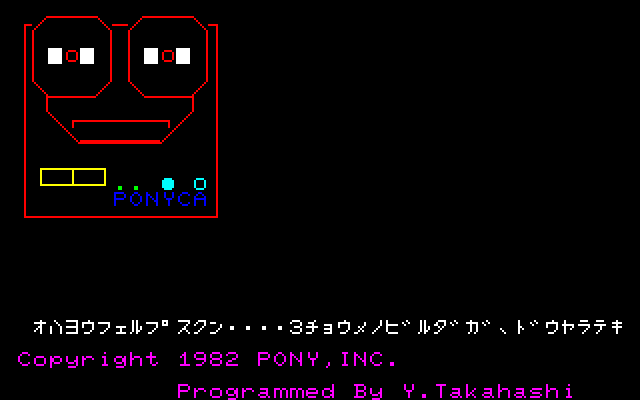
While The Dragon & Princess still is presented as part of the "KOEI adventure game series," this one is proudly proclaimed as a "Role Playing Adventure Game." It starts with this nice scene of the tape player, playing the typical kind of message for the series. "Good morning Mister Phelbs..."

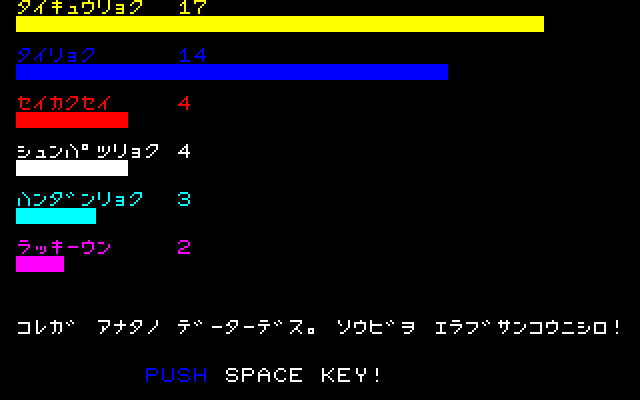
The stats are actually completely random with no means to take influence, other than restarting the computer. After that you can chose the loadout for the mission, including weapons like a pistol, grenades or a submachine gun, and some miscellaneous items like a bag, the famous disguide kit from the series, and so on.

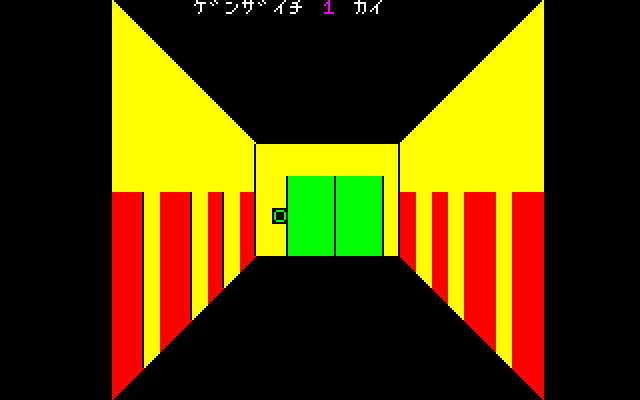
The game is played in this 3d view, but for some reason the scene is only visible for like a second after walking a step or turning around.

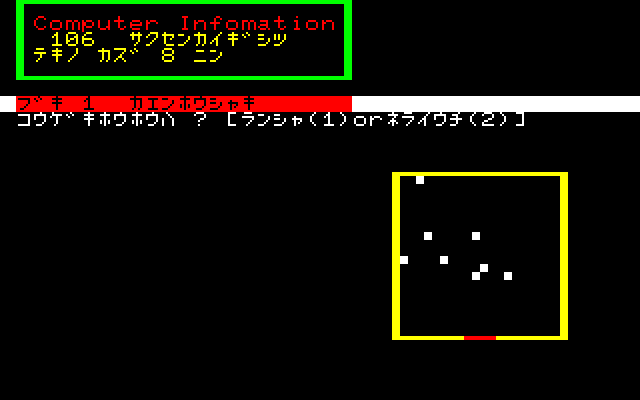
Trying to access the elevator at the end of the hall gets me killed at once, so I can only try to open the doors to both sides, which opens up this screen:

I guess the white spots are supposed to be enemies. One can chose an equipment item, and when I chose a gun the game asks whether I want to fire blindly or take aim. I always lose. I think. Next!


Genma Taisen (幻魔大戦) - PC-88, FM-7 (1983)

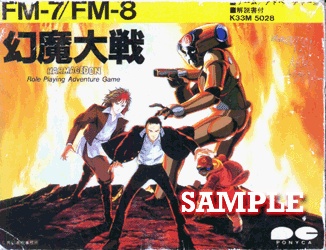
Based on a manga series with the same name, Genma Taisen is also by PonyCanyon. There has got to be a disk image floating around somewhere, as the Japanese retro gamers got perfect emulator screenshots for it, but we couldn't find it in English-speaking circles.

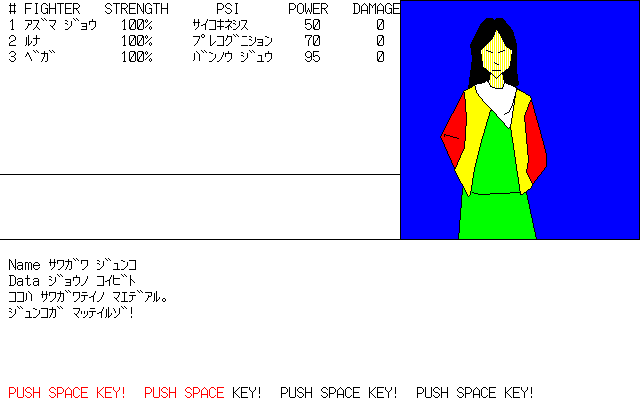
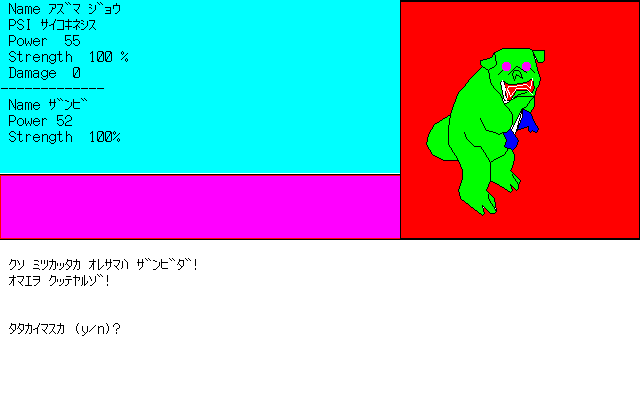
Like Dragon & Princess, it is mostly played in a text adventure-like mode, although this time there are some graphics in the upper right window. The monster designs are hilarious:


Khufu-ou no Himitsu (クフ王の秘密) - PC-80, FM-7 (1983)

Published once again by Koei, the title translates to "King Khufu's Treasure," and finding that is the goal of the game, which is a dungeon crawler through an Egyptian pyramid. Once again, the disk image has got to be somewhere out there, but it couldn't be found...

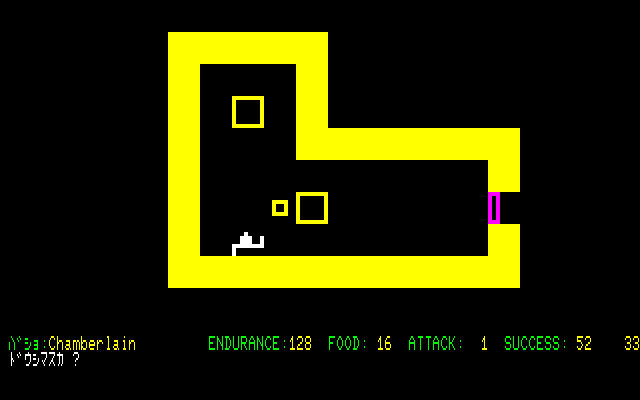
This seems to be what the FM-7 version looks like:


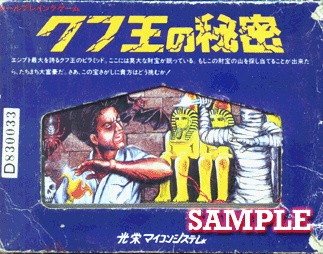
The (unfortunately marked) cover scans are from the PC88 Game Libary.

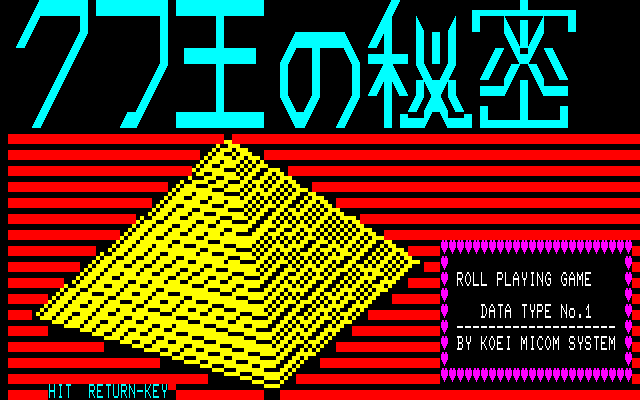
More screenshots of Khufu-ou no Himitsu.


Friday, April 12, 2013

500-Word Indies: Little Inferno and Home

I've already reviewed Home on the blog back when it came out. Back then it was held back by a few interface and QA issues. These have been fixed in patches by now, allowing me to streamline the review to what really matters and fit it into this column.

Since that is a mere rehash from an old review, we also feature some new content with a look at Little Inferno, a flaming physics sandbox by the creators of World of Goo and Henry Hatsworth. Is it a meaningful experience or just a mindless catalyst for pyromaniac desires? Find out in our review!

Also, sorry about the initially broken links last week. This time they should work.

Wednesday, April 10, 2013

The Nintendo Power Retrospectives - Part 7

This week I'm getting into Nintendo Power proper, with the magazine's first issue.


Monday, April 8, 2013

4/8 - MORTAL KOMBAT!

Just a single article this week, but this one's gigantic - an eight page review of the Mortal Kombat series, encompassing nine main fighting games, three spinoffs, several movies, comics and TV shows, and numerous version comparisons as you'd expect from HG101. While often looked down upon by more serious fighting game fans, Mortal Kombat has always been great for a goofy bit of fun, and the fact that such cartoonishness was ever controversial heralds back to the quainter times of the Clinton administration.

Our Spotlight Article highlights the many, many games that Jackie Chan has taken a part in over the years, including but not limited to, the classic beat-em-up Kung Fu Master (which originally tied in with the flick Spartan X in Japan), sidescroller NES/TG-16 title Jackie Chan's Action Kung Fu, the silly digitized fighting games The Kung Fu Master and Fists of Fire, and the PSOne action game Stuntmaster. And the 500 Word Indies feature, which is going to be update every Friday going forward, is Perspective, a free experimental puzzle platformer by students at DigiPen.


Dark Age of JRPGs (1): The Dragon & Princess (1982)

Most traditional histories of role-playing games in Japan open somewhere along these lines: "In the beginning when Enix created the JRPG, they called it Dragon Quest. And Enix saw that it was good." More elaborate investigations might point out that there was a Westerner named Henk Rogers who brought the gospel genre to the Land of the Rising Sun. Well, we've already shown that this is not a full account either, as there has been about a dozen games that more or less apply to the "RPG" label before that.

But even when knowing about the games' existence, it's not easy to actually experience them. Aside from the language barrier, actually obtaining a Japanese home computer game from the early 1980s may well feel like a quest for the holy grail, leaving emulation as the only option. But even tape and disk images are by far not as easy to come by as your average NES or SNES ROM, the emulators aren't well documented in English and as we will see, some titles just don't seem to be accessible to non-Japanese retro gamers, or even not at all.

So here we're going to try a number of these lost games to let you know what they are, what's interesting about them, and whether it may be worthwile to track them down. Since many of them are borderline unintelligible without the proper documentation, among the most punishing of their kind and often frankly terrible games, don't expect any in-depth analysis or Let's Play-degree coverage; we'll just be playing them long enough to be able to tell what they're all about and how they work. Without further ado, behold the very first computer role-playing game ever developed in Japan:

The Dragon & Princess ドラゴンアンドプリンセス - PC-88, FM-7 (December 1982)

Today it may surprise gamers that the game was published by Koei, but back then, they were the RPG company in Japan, accounting for half of all the titles released by the end of 1983.
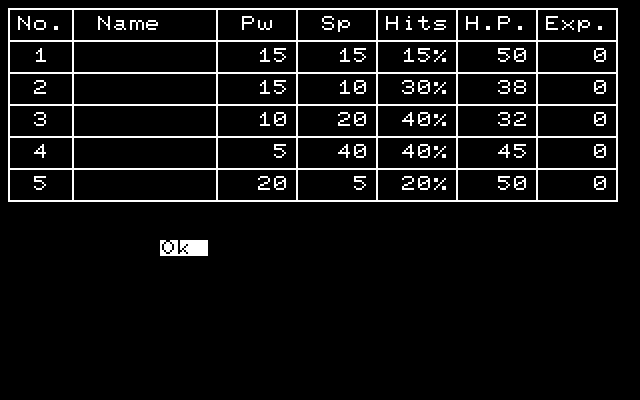
The player has control over a party of five characters, although their stats are fixed, and all one gets to customize are their names. The two main stats appear to be Power (Pw) and Spellcasting (Sp) - at least Sp is not speed, cause the turn order is always fixed. However, there is no command to actually cast a spell during combat, so the weaker characters are at a severe disadvantage.
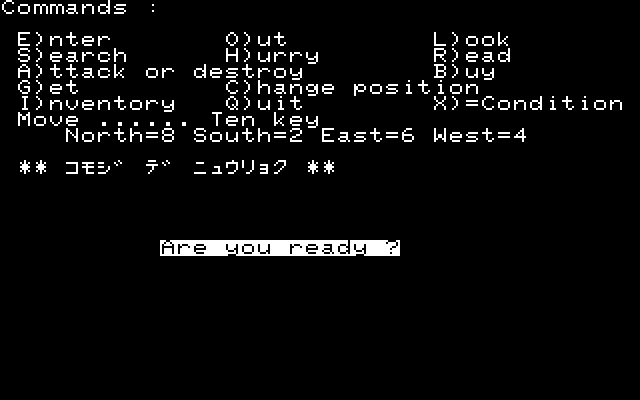
Other than most of its immediate successors, The Dragon and Princess is actually so kind as to spell out the keyboard shortcuts for you at the beginning, which are similar to what you'd know from the likes of Ultima. During the test play run, (S)earch, (G)et or (R)ead never brought any results, and the only human beings encountered were the king and princess in the starting castle.
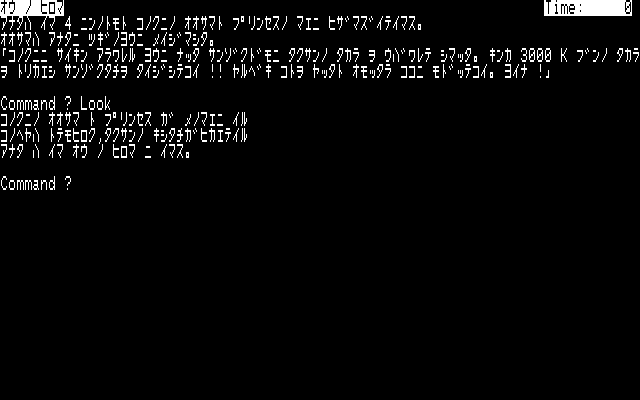
The party is sent out by the king to kill bandits and bring back the treasure they stole, plain and simple. The eponymous dragon might factor in after the required amount of gold is delivered, but so far there's been no sight of him.
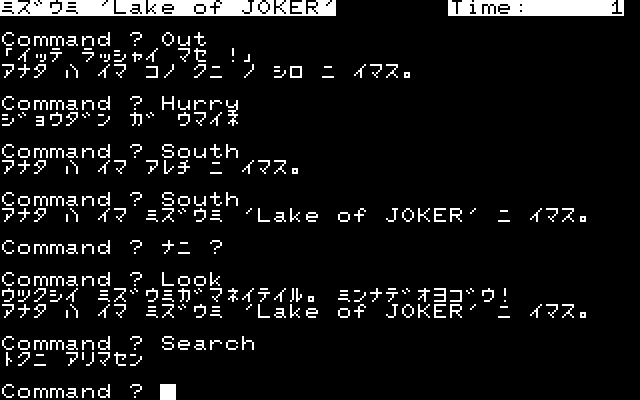
The main adventuring mode is entirely text-based and works like any other text adventure: (L)ook gives a brief description of the surroundings, while the numeric keys are used to move to each of the four cardinal directions. If you've learned some Japanese, you'll notice that all text is in katakana, which due to its simple layout was basically the standard computer font, until higher resolutions became the norm and allowed for proper kanji and hiragana display. Unfortunately, katakana, being usually used for foreign loanwords only, is likely not the script most learners are best used to reading. The party might be randomly attacked by some animals, bandits or monsters, upon which the game creates an overhead tactical view.
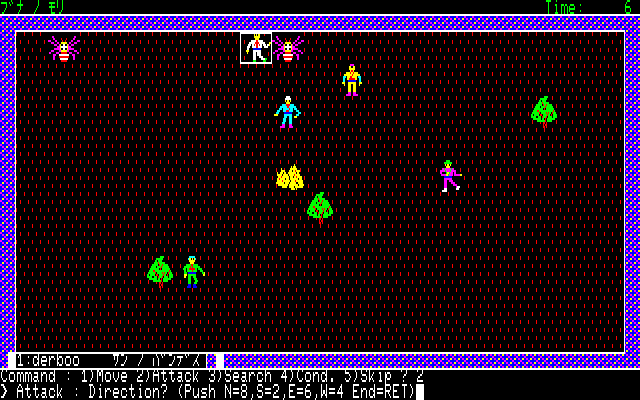
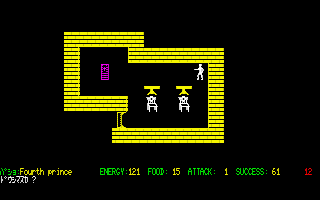
The version that could be retrieved actually appears to be an upgraded version, since some Japanese sites have a screenshot of a much more simplistic combat screen:
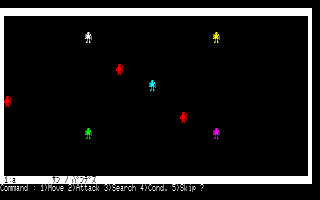
The tactical options are severely limited and the game suffers from Final Fantasy I syndrome, with characters and enemies alike fumbling most of their attacks, drawing out even the most small-scale battles. The fact that these mode exists in the first place is pretty damn interesting, though: Japanese sources date the game's release at late 1982, which means it was published before Ultima adopted the tactical party combat in Exodus. This leaves only two explanations: Either Mr. Hayase and Locke got this idea on their own, or they've played the obscure Tunnels of Doom (1982) on a Texas Instruments computer, the first RPG to ever use this kind of combat.
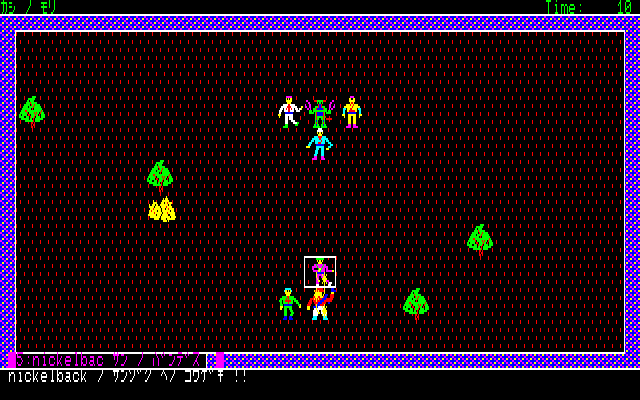
Unfortunately, there is no balancing whatsoever to the fights: During my run, I encountered a single snake, then two spiders, all of which were completely helpless. On the way back through the same territory, my party was ambushed by a brigand and a monster. The latter alone completely obliterated the heroes, ending my futile attempt at getting anywhere in this game.

In case anyone wants to try out the game themselves, the only available version of the game is hidden within a compilation disk. Thanks go to the community over at Tokugawa Corp. for their relentless efforts to unearth and share old Japanese computer software.


Friday, April 5, 2013

Friday is now indies day! This week: Perspective

You might have seen that we've started a new column for short reviews of games from the independent scene called "500-Word Indies" a while ago. It was originally intended to have one new contribution for every main site update, but it turns out due to their short length and a number of contributors, these can be done much faster than the usual content. This means in times when real life makes the main site updates get more erratic, we end up with a huge backlog of stuff to post.

So from now on I'm switching to uploading a new review every Friday, at least for as long as a steady stream of new contributions keeps coming in. Please note that these won't appear on the main page until the next "proper" update, so if you want to read them as they come, either keep an eye out for the blog, or bookmark the new 500-Word Indies index page. Until further notice, new contend every Friday (or maybe Thursday evening or Saturday morning, depending on your time zone) almost guaranteed.

The newest addition this week is Perspective, a free experimental puzzle platformer by students at DigiPen.


Wednesday, April 3, 2013

The Nintendo Power Retrospectives - Part 6

Okay... last time I wasn't totally accurate - this episode is covering the last issue of Fun Club News. Really, I mean it.


Monday, April 1, 2013

The PS2 Devil Summoners Seem to Have Been Reprinted

Atlus has done a pretty decent job in keeping all of the Shin Megami Tensei titles in print - you can find copies of Persona 3 and 4, Shin Megami Tensei Nocturne and Digital Devil Saga all for around $30-$40 on Amazon, keeping them from following down the path of a Suikoden II. Nevertheless, the one subseries whose prices has climbed has been the Devil Summoner: Raidou Kuzunoha series, the action-RPG offshot that takes place around the turn of the previous century. The first game had reached prices of up to $80, with the second game not far behind.

Well, no longer, because reprints have begun showing up at Amazon and other places, priced at $30 new or less. These include Devil Summoner: Raidou Kuzunoha versus The Soulless Army and Shin Megami Tensei: Devil Summoner 2: Raidou Kuzunoha versus King Abaddon. It's probably to help tie in with the release Shin Megami Tensei: Devil Summoner: Soul Hackers coming out in a few weeks, though from both a thematic and gameplay standout they have very little in common. But nonetheless, everyone interested in them should check them out now.

If you can only afford one, go for the second one. Both games share many identical assets, but the second one is far, far more polished.