Friday, November 25, 2011

Satellablog deserves our appreciation and respect

I’ve been meaning to post about Satellablog for months, but kept forgetting.

Apologies to all involved. Satellablog is dedicated to all things Satellaview, the satellite-based add-on system for the Super Famicom in Japan. Arguably one of several forerunners to today’s PSN and XBLA download services. The problem is, the service contained a lot of exclusive content, available nowhere else (most infamously a special version of Zelda which was dumped). In addition, neither Nintendo nor any of the companies from the time are interested in archiving or preserving this rare data. So it falls to Kiddocabbusses and his comrades to source the memory packs from Japan, pray they contain a never before found download, and then dump them for the world. It’s an expensive mission (there’s a donation plea), but it does yield rewards, such as the Satella-shooting trilogy, which ties in with our own Dezaemon feature. I feel no shame in saying that it’s absolutely worth donating a few spare dollars for the preservation of games history. Satellablog and its many ROM dumping specialists deserve our utmost appreciation and respect – because Nintendo sure as f*** doesn’t care about this stuff. Without us, the obsessive geeknocrats, history would simply die. My only criticism: create a proper site with easily navigable news archives. Blogs just don’t cut it for something so important.


GamesTM 116 – History of Metroidvania


I take a look at the latest issue of GamesTM, which includes a 6 page feature on Metroidvania games.

.
.
.
This month’s issue of GamesTM features the following (copied from NTSC-uk, courtesy of PrinnySquad).

Reviews
Skyrim - 9
Battlefield 3 - 7
Halo: Combat Evolved Anniversary - 8
Uncharted 3 - 9
Assassin's Creed Revelations - 8
Batman: Arkham City - 9
Dance Central - 360 - 8
Shinobi - 3DS - 4
Kinect Sports: Season 2 - 360 - 5
Modern Warfare 3 - 8
Saints Row: The Third - 7
Rayman Origins - 7
Ultimate Marvel Vs Capcom 3 - 7
Kirby Mass Attack - DS - 8
Sonic Generations - 7
Real Steel - 360 - 6
The Adventures of TinTin - 6
Raving Rabbids Alive and Kicking - 6
King of Fighters XIII - 8
Disney Universe - 3

Features
2012 Preview Special
Chat With Naughty Dog about the past, present and future
A Look at the new SSX
A look at the trend for remakes, reboots and rebirths

Discuss
GTA V
Operation Raccoon City
Backstage with the people behind Zelda's 25th Anniversary Concerts.
Chat with Tood McFarlane about work on Kingdoms of Amalur
Tim Schafer on his new thing and the merit of Kinect
thatgamecompany talk about Journey.

Retro
Behind the Scenes: Legacy of Kain Soul Reaver
Year In Review 1985
Conversion Catastrophe - Kung Fu Master on Speccy
The History of Metroidvania - the forerunners to the genre.

My main reason for posting though is my 6 page article on Metroidvania games. No credit as usual for the writer of said piece – though I was technically asked to write it as a favour, so I don’t begrudge this too much. The first dps is hi-res enough to read, though seeing as I’m getting paid for the article (at least I hope I get paid!) I don’t think I can get away with making the entire article free to read online – at least not until they put it on their website or the next issue is out. Of course if someone else, somewhere, has put hi-res scans up, by all means read it and pass the links around.

With it being the 25th anniversaries of Metroid and Castlevania, it seemed time to cover the portmanteau they went on to create later with Super Metroid and Symphony of the Night. Ironically most entries predate these two titles, showing that the genre classification is erroneous. But it’s still fun. There’s 24 entries, one for each year of the anniversary, with the 25th title to be voted for on GamesTM’s forum, or discussed here. I also quote Jeremy Parish, which I’m sure he is not pleased about! Sorry Jez, but at least you got credit whereas I did not. I also included interview quotes from several key people.

The list (year of release, then alphabetically):

Pharaoh’s Curse (Atari 8-bit, C64)
Below the Root (C64, DOS, Apple)
Brain Breaker (Sharp X1)
CrossBlaim (MSX)
Sacred Armour of Antiriad (Spectrum, C64, Amstrad)
Castlevania II: Simon’s Quest (NES)
Codename: Droid (BBC)
Legacy of the Wizard (NES)
Zeliard (DOS, PC88)
Zillion (SMS)
Blaster Master (NES)
Euphory (Sharp X1)
Exile (BBC)
Predator (MSX)
The Scheme (PC88)
Wonderyboy III: DT (SMS)
TMNTIII: RR (GB)
Takahashi Meijin Boukenjima IV (Famicom)
The Divide: Enemies Within (PS1)
Vigilance on Talos V (DOS)
Cave Story (PC)
La Mulana (PC)
Aquaria (PC)
Treasure Adventure Game (PC)


It’s not perfect, but I had around 80 titles on a rough list covering anything even remotely similar, which I whittled down to about 50 series entries, then 40, then 35, and then it got tricky requiring many redrafts.

My goal: differentiate the list from everyone else’s.

That’s why I’ve got silly stuff like the MSX release of Predator, and lots of obscure games. The trend? Metroidvania style games are predominantly on computers, followed by the NES. A reflection on the perception that console titles need to be simpler? Could be why console Metroidvanias are so well loved – they filled a desperately empty gap. Because admit it – how many other games like Super Metroid are on the SNES? Very few.

As for omissions, I left out some popular titles because I just can’t stand them. I absolutely hate Tombi for example – the jumping, where your guy flails forward in an uncontrollable belly flop, is unbearable. How can anyone stand playing that? It feels broken and uncomfortable. Metroidvanias are all about the jumping, and with Tombi every time I press the jump button I want to break the controller. Another omission was Shantae. I don’t care what anyone says, it looks great but the level design is dull, linear and really not much fun. Shadow Complex was on the list, but then I thought: that’s a little obvious. Why waste space on something people know and are enjoying, when something like Treasure Adventure Game can do with the publicity instead?

My big regret?

I never included Link: Faces of Evil, or Zelda: Wand of Gamelon, for the CDi. They just slipped my mind, but they actually follow the Metroidvania template quite nicely. And I love them dearly. For starters, for all the complaints about the controls, when using a wired controller (as opposed to the crappy infra-red remote) the jumping is more comfortable than the jumping in Tombi. I can actually dictate the direction for Link and Zelda, and they don’t lunge forwards with that moronic belly flop.

The rest of the world continues to spout vitriolic hatred for the Link/Zelda games, and people on various Zelda forum boards openly state that they 1) absolutely hate the games for existing and 2) will never, ever play them because they’re not true Zelda games. Their kind of passionate, blinkered, refusal to accept any other-point-of-view mentality, is something I’ve mainly seen with religious extremists. You know, the kind who claim dinosaur bones were put in the earth by the devil to deceive humanity.

How can you claim to hate something, and then refuse to examine it on the grounds that it’s inauthentic, when in that same sentence you admit that you have no idea what it’s even like? That’s like me saying: I hate apples, I’ve never eaten apples and I never will eat apples or even think about what apples are because I know that apples aren’t really fruit and so don’t even need to know what they are because I already know what they are not (ie: not fruit).

Really?

Bottom line: obsessive Zelda fans who claim to hate the CDi titles while simultaneously refusing to play them are retarded. To form an educated opinion on something you need to understand it first. Otherwise it’s just a mob mentality, no better than those crowds who wanted to burn women for witchcraft.

I suppose I would have removed Below the Root to fit Link/Zelda in. Interestingly, they were both by the same man, the late great Dale DeSharone. May he rest in peace.

Thursday, November 24, 2011

Dammit, that pixel art deserves a better game.


A while ago Parasitus: Ninja Zero by a team called Heart Attack Machine caught my attention on the XBox Live Indie Game marketplace. The screenshots promised a great 2D action platformer experience a la Castlevania, with some gorgeous sprite work for an indie game. Unfortunately, the game was not that great. The controls were awkward and the pacing was off. The game runs very fast overall, feeling like those old Chaplin movies run in 30fps. Furthermore the mostly fine dot graphics (with some lazy elements here and there) were spoiled by superficial hi-res CGI effects. So after going through the trial I passed on buying the full game.


Now recently HAM put out a prequel to their first game, dubbed Invasion. It was clear that it used many graphics assets from Parasitus, but it at the same time it looked more polished, as if some of the more unfitting background elements were phased out. I was hopeful to see my complaints rectified, although the new game was in a different subgenre.


At the place of the swordfighting in Parasitus stands a run 'n gun experience. But the controls are just as bad, if not worse. The games have that weird uneducated jumping mechanics where the character stops rising into the air the exact instance one lets going the button. Also in Invasion one shoots diagonally up by holding the left or right shoulder bumper, respectively. Holding both fires straight up, but when you press the left bumper while running right, nothing happens. Worst of all, doing any of this may lock up the fire button for seconds, resulting in many cheap hits because you simply can't fire.

Then there's this:

Seriously? You put that in the same game with the best pixel work on all of XBLIG? Are you quite insane?! One good thing about Parasitus besides the graphics was the fact that it didn't try to tell much of a story (at least not in the trial). Well, their first game didn't do so good on the marketplace, so they probably looked at hits like Braid and thought: "Lots of text equals success!" Needless to say, the writing is as abysmal as can be, with more pathetic, forced innuendos than Magna Cum Laude, and the crappy mugshots kill whatever cozy Amiga atmosphere the CGI effects left over.


OK, I might be a bit hard on the games. After all, they're not actually that bad, just alright homebrew games, with really really bad writing in the second, but I guess really really bad is the standard for writing in indie games, anyway. It's just that they hold back one of the more competent pixel artists in indie gaming today, while fun and even publisher-backed "2D" games often have to be covered in drab shadow figures or insipid flat-shaded "newgrounds" shapes. So, how do we tell this artist what could be accomplished with a team that knows to design (and write!) a great game around those great pixels?


Saturday, November 19, 2011

Ouch, that looks like it hurt!


Getting injured in video games is usually inconsequential. The hero loses a chunk of his health bar, maybe bleeds a little on the floor, but as soon as he's dealt with the enemy and marches on, you'd never be able to tell he's just been perforated by a gunload of hollow point bullets. Or take the amazon warrior, who needs no protection aside from her metal bikini, as her skin proves just as impenetrable as the steel her risque fashion choice is made of.

There's various reasons for that. Of course technical and workload limitations are always an issue, but aesthetic choice probably also spared us beaten-up, teethless brawler protagonists and RPG love interests covered in scars and bruises. Less superficial accounting for wounds also brings extraordinary game design challenges: How much fun is it being a platformer hero with a realistically depicted broken leg?

That doesn't mean that no one has ever tried showing us players what's going on with our alter egos on the screen. Here is a look at games that went through the lengths of visibly abusing their characters for our enjoyment. While there are tons of cars, tanks, planes and mechas that have been torn to shreds in the history of video games, we're only looking at characters of pixellated or polygonal flesh and blood. Gratuitous death animations aren't enough to qualify, either—characters have to live with their injuries, at least until the next health pack shows up.


Ghosts 'n Goblins (1985)

In the old days of low resolution and few colors, wounds on a player character simply wouldn't have been recognizable as such. There weren't many pixels left in between Arthur's beard and his helmet to make any scratches identifiable, so to show that he's now more vulnerable after a hit, the clever pixel artist at Capcom just took away his armor, leaving him running around in his underpants. A second hit then will leave nothing but hsi crumbling bones. This mechanic lives on in the game's various sequels, and is even picked up for the series reboot Maximo (2002). Capcom's own Black Tiger (1987) and Natsume's Pocky & Rocky 2 (1994) work similarly, too. (picture right: Super Ghouls 'n Ghosts, GBA; below: Maximo)


Super Mario Bros. (1985)

Released just a little bit later than Ghosts 'n Goblins, Super Mario Bros. shows another workaround for the fact that Mario's face can't take any more red pixels beside his cap and moustache. When he gets hurt, he simply shrinks in size. One could argue about the eligibility of this example, though. In the original, the small size appears to be his natural state. In Super Mario Bros. 2 (1988, pictured), however, Mario starts out big, and in the later 3D games that drop the feature, he's no dwarf, either.


Gladiator (1986)

Fighting games seem to be the predestined genre for this. But fighting game characters also start out with stripping their clothes instead of ripping their flesh. Hits on the different parts of a characters' armor will make them fall off, another hit on the now unprotected part kills. It is interesting to note how at least the Japanese version knew no discrimination of the sexes and shows the female warrior just as bare-chested as her male counterparts.

Developer Allumer refined the concept with their 1992 game Blandia, and it has since been imitated in various other, predominantly Japanese, fanservice-y fighting games like Fighting Vipers (1995) and Soul Calibur IV (2008), not to name all those Doujin strip fighters. Many gamers have been very curious what pieces of armor Ivy was supposed to lose.


Art of Fighting (1992)

NOW we're talking! Art of Fighting is the first game were players really can beat each other's faces to pulp. Towards the end of the fight, both combatants are often hardly recognizable, anymore. The game also became infamous because Yuri and King could get their shirts blown off when finished with a fireball attack, which carried over into the first King of Fighters games. Art of Fighting 2 works in the same way, but unfortunately SNK dropped the feature for the 3rd episode.


Time Killers (1992)

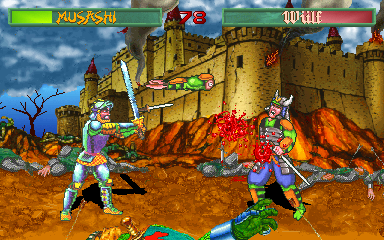
In the wake of Mortal Kombat came this new epitome of bad taste. The game featured fatalities just like its role model, but character's arms could also be severed during combat, forcing them to go on with a limited moveset. Continued with Bloodstorm (1994), where combatants could also go on without their legs, skidding over the floor on their intestines.


Wolfenstein 3D (1992)

Most first person shooters automatically disqualify for this list because... well, because you never get to see your character. Wolfenstein 3D circumvented this issue by placing the head of hero Blascovich into the on-screen display, where you can see it growing bloodier and bloodier the lower your health gets. id used the same feature in Doom (1993), and the animated mugshots were also adopted by the later Might & Magic games.


Robinson's Requiem (1994)

Another first person game, but Silmaril's science fiction retelling of Robinson Crusoe befittingly is a survival adventure. Visible damage comes into play on the player character's profile, which is used to apply bandages, makeshift splints and medication. This game is one of the rare occasions where your health also affects your general performance. As an extreme, your character literally goes blind when birds hack at his eyes! Continued with the sequel Deus (1996), which also adds an infrared view with your skeleton. Both games are available bundled at GOG.com. Call of Cthulhu: Dark Corners of the Earth (2005) features a simplified variant, so does Metal Gear Solid 3: Snake Eater (2004), although the latter without visually showing the damage.


Götzendiener (1994)

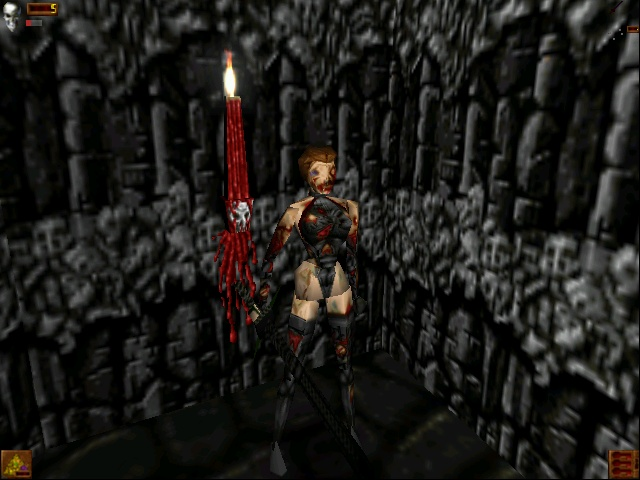
As our first example of story-driven damage, Götzendiener falls back to the old hurting=stripping formula. The heroine in this very short game starts out in cpativity of a demon. A knight in shining armor comes to rescue her, but dies together with his foe. No longer under watch, the resolute damsel takes her rescue into her own hands, losing parts of her garments with each chapter.

Many later games have taken the same approach: Die Hard: Arcade (1996), Prince of Persia: The Sands of Time (2003), Heavy Metal: FAKK 2 (2000). The latter has the heroine frequently changing her attire to counteract to the textile decay, which doesn't mean she's gonna show less skin that way, as her outfits just get skimpier and skimpier.


Resident Evil (1996)

Capcom's horror shocker didn't modify Chris' or Jill's models or textures to show how grave their condition is, but the animation. Injured zombie hunters started limping, which also made them significantly slower.

Kinda adopted by Silent Hill (1999), only Harry Mason always runs like he's just been shot in the foot.


Super Mario 64 (1996)

One of the innovators of the category makes his return. Mario doesn't shrink anymore, but when he's at the last quarter of his health, he's visibly out of puff. This becomes a very popular feature in cartoony 3rd person games, even just on the N64: Mystical Ninja Starring Goemon (1997), The Legend of Zelda: Ocarina of Time, Conker's Bad fur Day (2001) ... the list goes on.

This has also been seen in 2D games like Mega Man X4. Do you know any examples that predate Super Mario 64?


Bushido Blade (1997)

Bushido Blade and its sequel do away with the silly health bar convention in weapon based fighters entirely, and instead semi-realistically accounts for damage done to indivudual body parts. It doesn't have any of the instant gratuitous feedback of Time Killers, but characters start to limp when injured, and they'll wear bandages in the following fight.


Deathtrap Dungeon (1998)

The game that motivated this post. From my article on the title: "There is, however, one really cool feature that got dropped in the conversion [to the PSX]: On the PC, all the damage the adventurers took would show on their body. You see their bruises, cuts — even arrows keep sticking in their flesh until healed." 'nuff said...


Jurassic Park: Trespasser (1998)

Almost doesn't count, because it's not actually the heroine's body that changes appearence, just the tatoo on her chest gets tainted red.


Illbleed (2001)

Another interesting variant on cloth damage, and also a really surprising twist on New Game Plus. Eriko has to rescue her friend from a cursed amusement park, but whenever she fails and one of her friend dies in a second playthrough, her clothes get ripped apart a little more, posing a real moral dillemma for the young male player. If you really screw up, in the end she'll be covered by nothing more than smears of mud and three tiny shreds of cloth at three laughably convenient spots.


Tao Feng: Fist of the Lotus (2003)

Possibly the first fighting game to bring Art of Fighting's approach into the third dimension, the failed comeback of a former Mortal Kombat developer featured quite impressive damage ranging from cuts, dirt and bruises to torn clothes.


Fable (2004)

Fable sure as hell didn't go for short-lived diversions. In Peter Molineux' most persistent obsession yet, you don't get a love interest, you get spouses—lots of them. And you don't get merely injured, you get scars. By the second game those were the least of your worries, though, as skilled characters automatically turned into monstrous beings suffering from gigantism and shiny blue varices all over their body.


Fight Night 2004 (2kduh!)

As a genre were endurance is one of the deciding factors for victory, sports games simulated fatigue in some way or the other since 8-bit times, with slower movement, weaker passes or whatever. With growingly powerful hardware, especially wrestling and boxing games started to go to great lengths to convey how exhausted the combatants got. The most excessive example yet is the Fight Night series, where characters not only get cuts, black eyes and bruises, but also sweat like pigs and start dribbling when they've no energy left in their bodies. (picture below: Fight Night Round 4)


Oneechanbara (2005)

"You're bleeding!"
"Don't worry, that's not my blood."

The girls of the Bikini Samurai Squad turn into a bloody mess when they hurt others. Zombies bleed all over them with their cursed blood, eventually forcing them into a murderous frenzy. They also occasionally have to shake the blood of their swords, lest they become useless. Particularly tasteless: Some of the games offer settings to vary the color of the blood, white being one of the possible choices. It looks naughty.


Retro Game Challenge / Game Center CX: Robot Ninja Haggleman (2007)

Although it is predominantly a hommage to Ninja Jajamaru-kun, the fake-classic action platformer series also contains a nod to Ghosts 'n Goblins—only the little ninja doesn't lose his armor, instead is eyes bulge out. The spin-off Haggleman - Koume Version on Game Center CX: Arino no Chousenjou 2 features the ninja's sister, who has her arm in a sling after a hit.


Batman: Arkham Asylum (2009)

Actually another entry from the Götzendiener school, but nonetheless deserving of its own entry, because Batman also gets scratched here and there, and grows awesome stubble on his chin over the course of this longer-than-planned mission.


Mortal Kombat vs DC Universe (2008) and Mortal Kombat (2011)

You'd think that the one series so famous for its sadistic treatment of its characters would have jumped the train earlier, but up to Mortal Kombat vs DC Universe, characters may have lost gallons of blood, but they could only really be injured—and instantly killed—with Fatalities. The 2011 reboot goes one step further with x-ray vision for special combos.


The 3rd Birthday (2011)

Another stripping game, only here Aya Brea's clothing status is directly tied to her health. She can lose an impressive amount of fiber, but scratch marks also prove the monsters didn't just want to see her naked.


El Shaddai (2011)

It may be the shittiest high-profile game of this console generation, in El Shaddai instead of a health bar you see your armor cracking and shattering, revealing that the protagonist doesn't actually have huge man-boobs.


Tomb Raider (2012)

In Tomb Raider Underworld, the grave robbing brit could already get wet and dirty. (No, not what you're thinking!) Now trailers of the new reboot show a very beaten-up Lara Croft soaked in blood. It remains to be seen how it will all work out in the game, though.


Screenshots taken from Strategy Informer, GameFAQs and GOG.com.