Showing posts with label resident evil. Show all posts

Saturday, November 19, 2011

Ouch, that looks like it hurt!


Getting injured in video games is usually inconsequential. The hero loses a chunk of his health bar, maybe bleeds a little on the floor, but as soon as he's dealt with the enemy and marches on, you'd never be able to tell he's just been perforated by a gunload of hollow point bullets. Or take the amazon warrior, who needs no protection aside from her metal bikini, as her skin proves just as impenetrable as the steel her risque fashion choice is made of.

There's various reasons for that. Of course technical and workload limitations are always an issue, but aesthetic choice probably also spared us beaten-up, teethless brawler protagonists and RPG love interests covered in scars and bruises. Less superficial accounting for wounds also brings extraordinary game design challenges: How much fun is it being a platformer hero with a realistically depicted broken leg?

That doesn't mean that no one has ever tried showing us players what's going on with our alter egos on the screen. Here is a look at games that went through the lengths of visibly abusing their characters for our enjoyment. While there are tons of cars, tanks, planes and mechas that have been torn to shreds in the history of video games, we're only looking at characters of pixellated or polygonal flesh and blood. Gratuitous death animations aren't enough to qualify, either—characters have to live with their injuries, at least until the next health pack shows up.


Ghosts 'n Goblins (1985)

In the old days of low resolution and few colors, wounds on a player character simply wouldn't have been recognizable as such. There weren't many pixels left in between Arthur's beard and his helmet to make any scratches identifiable, so to show that he's now more vulnerable after a hit, the clever pixel artist at Capcom just took away his armor, leaving him running around in his underpants. A second hit then will leave nothing but hsi crumbling bones. This mechanic lives on in the game's various sequels, and is even picked up for the series reboot Maximo (2002). Capcom's own Black Tiger (1987) and Natsume's Pocky & Rocky 2 (1994) work similarly, too. (picture right: Super Ghouls 'n Ghosts, GBA; below: Maximo)


Super Mario Bros. (1985)

Released just a little bit later than Ghosts 'n Goblins, Super Mario Bros. shows another workaround for the fact that Mario's face can't take any more red pixels beside his cap and moustache. When he gets hurt, he simply shrinks in size. One could argue about the eligibility of this example, though. In the original, the small size appears to be his natural state. In Super Mario Bros. 2 (1988, pictured), however, Mario starts out big, and in the later 3D games that drop the feature, he's no dwarf, either.


Gladiator (1986)

Fighting games seem to be the predestined genre for this. But fighting game characters also start out with stripping their clothes instead of ripping their flesh. Hits on the different parts of a characters' armor will make them fall off, another hit on the now unprotected part kills. It is interesting to note how at least the Japanese version knew no discrimination of the sexes and shows the female warrior just as bare-chested as her male counterparts.

Developer Allumer refined the concept with their 1992 game Blandia, and it has since been imitated in various other, predominantly Japanese, fanservice-y fighting games like Fighting Vipers (1995) and Soul Calibur IV (2008), not to name all those Doujin strip fighters. Many gamers have been very curious what pieces of armor Ivy was supposed to lose.


Art of Fighting (1992)

NOW we're talking! Art of Fighting is the first game were players really can beat each other's faces to pulp. Towards the end of the fight, both combatants are often hardly recognizable, anymore. The game also became infamous because Yuri and King could get their shirts blown off when finished with a fireball attack, which carried over into the first King of Fighters games. Art of Fighting 2 works in the same way, but unfortunately SNK dropped the feature for the 3rd episode.


Time Killers (1992)
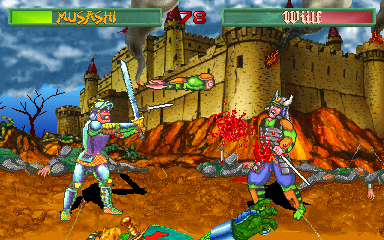
In the wake of Mortal Kombat came this new epitome of bad taste. The game featured fatalities just like its role model, but character's arms could also be severed during combat, forcing them to go on with a limited moveset. Continued with Bloodstorm (1994), where combatants could also go on without their legs, skidding over the floor on their intestines.


Wolfenstein 3D (1992)

Most first person shooters automatically disqualify for this list because... well, because you never get to see your character. Wolfenstein 3D circumvented this issue by placing the head of hero Blascovich into the on-screen display, where you can see it growing bloodier and bloodier the lower your health gets. id used the same feature in Doom (1993), and the animated mugshots were also adopted by the later Might & Magic games.


Robinson's Requiem (1994)

Another first person game, but Silmaril's science fiction retelling of Robinson Crusoe befittingly is a survival adventure. Visible damage comes into play on the player character's profile, which is used to apply bandages, makeshift splints and medication. This game is one of the rare occasions where your health also affects your general performance. As an extreme, your character literally goes blind when birds hack at his eyes! Continued with the sequel Deus (1996), which also adds an infrared view with your skeleton. Both games are available bundled at GOG.com. Call of Cthulhu: Dark Corners of the Earth (2005) features a simplified variant, so does Metal Gear Solid 3: Snake Eater (2004), although the latter without visually showing the damage.


Götzendiener (1994)

As our first example of story-driven damage, Götzendiener falls back to the old hurting=stripping formula. The heroine in this very short game starts out in cpativity of a demon. A knight in shining armor comes to rescue her, but dies together with his foe. No longer under watch, the resolute damsel takes her rescue into her own hands, losing parts of her garments with each chapter.

Many later games have taken the same approach: Die Hard: Arcade (1996), Prince of Persia: The Sands of Time (2003), Heavy Metal: FAKK 2 (2000). The latter has the heroine frequently changing her attire to counteract to the textile decay, which doesn't mean she's gonna show less skin that way, as her outfits just get skimpier and skimpier.


Resident Evil (1996)

Capcom's horror shocker didn't modify Chris' or Jill's models or textures to show how grave their condition is, but the animation. Injured zombie hunters started limping, which also made them significantly slower.

Kinda adopted by Silent Hill (1999), only Harry Mason always runs like he's just been shot in the foot.


Super Mario 64 (1996)

One of the innovators of the category makes his return. Mario doesn't shrink anymore, but when he's at the last quarter of his health, he's visibly out of puff. This becomes a very popular feature in cartoony 3rd person games, even just on the N64: Mystical Ninja Starring Goemon (1997), The Legend of Zelda: Ocarina of Time, Conker's Bad fur Day (2001) ... the list goes on.

This has also been seen in 2D games like Mega Man X4. Do you know any examples that predate Super Mario 64?


Bushido Blade (1997)

Bushido Blade and its sequel do away with the silly health bar convention in weapon based fighters entirely, and instead semi-realistically accounts for damage done to indivudual body parts. It doesn't have any of the instant gratuitous feedback of Time Killers, but characters start to limp when injured, and they'll wear bandages in the following fight.


Deathtrap Dungeon (1998)
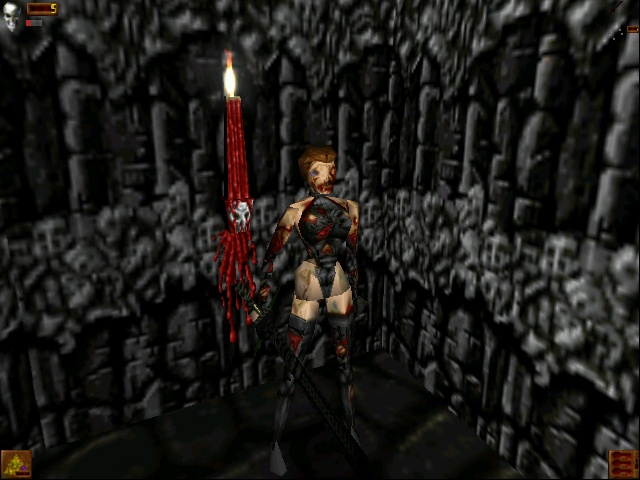
The game that motivated this post. From my article on the title: "There is, however, one really cool feature that got dropped in the conversion [to the PSX]: On the PC, all the damage the adventurers took would show on their body. You see their bruises, cuts — even arrows keep sticking in their flesh until healed." 'nuff said...


Jurassic Park: Trespasser (1998)

Almost doesn't count, because it's not actually the heroine's body that changes appearence, just the tatoo on her chest gets tainted red.


Illbleed (2001)

Another interesting variant on cloth damage, and also a really surprising twist on New Game Plus. Eriko has to rescue her friend from a cursed amusement park, but whenever she fails and one of her friend dies in a second playthrough, her clothes get ripped apart a little more, posing a real moral dillemma for the young male player. If you really screw up, in the end she'll be covered by nothing more than smears of mud and three tiny shreds of cloth at three laughably convenient spots.


Tao Feng: Fist of the Lotus (2003)

Possibly the first fighting game to bring Art of Fighting's approach into the third dimension, the failed comeback of a former Mortal Kombat developer featured quite impressive damage ranging from cuts, dirt and bruises to torn clothes.


Fable (2004)

Fable sure as hell didn't go for short-lived diversions. In Peter Molineux' most persistent obsession yet, you don't get a love interest, you get spouses—lots of them. And you don't get merely injured, you get scars. By the second game those were the least of your worries, though, as skilled characters automatically turned into monstrous beings suffering from gigantism and shiny blue varices all over their body.


Fight Night 2004 (2kduh!)

As a genre were endurance is one of the deciding factors for victory, sports games simulated fatigue in some way or the other since 8-bit times, with slower movement, weaker passes or whatever. With growingly powerful hardware, especially wrestling and boxing games started to go to great lengths to convey how exhausted the combatants got. The most excessive example yet is the Fight Night series, where characters not only get cuts, black eyes and bruises, but also sweat like pigs and start dribbling when they've no energy left in their bodies. (picture below: Fight Night Round 4)


Oneechanbara (2005)

"You're bleeding!"
"Don't worry, that's not my blood."

The girls of the Bikini Samurai Squad turn into a bloody mess when they hurt others. Zombies bleed all over them with their cursed blood, eventually forcing them into a murderous frenzy. They also occasionally have to shake the blood of their swords, lest they become useless. Particularly tasteless: Some of the games offer settings to vary the color of the blood, white being one of the possible choices. It looks naughty.


Retro Game Challenge / Game Center CX: Robot Ninja Haggleman (2007)

Although it is predominantly a hommage to Ninja Jajamaru-kun, the fake-classic action platformer series also contains a nod to Ghosts 'n Goblins—only the little ninja doesn't lose his armor, instead is eyes bulge out. The spin-off Haggleman - Koume Version on Game Center CX: Arino no Chousenjou 2 features the ninja's sister, who has her arm in a sling after a hit.


Batman: Arkham Asylum (2009)

Actually another entry from the Götzendiener school, but nonetheless deserving of its own entry, because Batman also gets scratched here and there, and grows awesome stubble on his chin over the course of this longer-than-planned mission.


Mortal Kombat vs DC Universe (2008) and Mortal Kombat (2011)

You'd think that the one series so famous for its sadistic treatment of its characters would have jumped the train earlier, but up to Mortal Kombat vs DC Universe, characters may have lost gallons of blood, but they could only really be injured—and instantly killed—with Fatalities. The 2011 reboot goes one step further with x-ray vision for special combos.


The 3rd Birthday (2011)

Another stripping game, only here Aya Brea's clothing status is directly tied to her health. She can lose an impressive amount of fiber, but scratch marks also prove the monsters didn't just want to see her naked.


El Shaddai (2011)

It may be the shittiest high-profile game of this console generation, in El Shaddai instead of a health bar you see your armor cracking and shattering, revealing that the protagonist doesn't actually have huge man-boobs.


Tomb Raider (2012)

In Tomb Raider Underworld, the grave robbing brit could already get wet and dirty. (No, not what you're thinking!) Now trailers of the new reboot show a very beaten-up Lara Croft soaked in blood. It remains to be seen how it will all work out in the game, though.


Screenshots taken from Strategy Informer, GameFAQs and GOG.com.


Tuesday, May 17, 2011

Profile of British developer M4


In my recent Resident Evil Gaiden article for Retro Gamer (hi-res scans in this Biohaze forum topic) I profiled the developers behind the game, but due to dwindling space these weren’t able to used in the article itself. So they won’t go to waste, I’m posting them here. The above photo is from their office during better times.

Here's a web archive of their old website.

M4 was a British developer formed in 1995 by Tim Hull. Primarily known for handheld titles, it was comprised of several former BITS development staff. Although they formed to create new titles, paying the bills necessitated working with licences. Three of their biggest titles, Bounty Hunter (PC), Stuntpigs (Next Gen) and Space Cadets (GBA) never made it to market. Though Space Cadets was actually completed.

As Tim Hull explained in the RG article: “Sadly no original M4 titles made it to the shelves. Bounty Hunter, Space Cadets and Stuntpigs were all games we really wanted to bring to market. The later two are still held by us in Stuntpigs Ltd a dormant company. Who knows maybe one day they will rise.”

With backups of everything still with Tim, there is a chance that in the future we’ll see one of these unreleased M4 games.

The question then is: WHERE ARE THE DISBANDED TEAM NOW?


Elliot Curtis
Creative Producer
Making Fun Games
Elliot now runs an indie development company called Making Fun Games. They produce browser games for PC and are currently expanding their most popular games onto other platforms, including mobile and X360.
www.makingfungames.com

[Sketcz’s note: I’ve checked out the website and it’s got a nice selection of totally free browser games! I tend to dismiss them, because most browser games I see people playing are terribly uninteresting – but I had a go on Outbreak 2012 on the MFG website, and it’s actually pretty damn awesome. It’s a 2D side-scrolling survival horror with an interesting mouse-based combat system and some great atmosphere. Definitely worth checking out! There’s also a diverse range of other games on there.]

[Elliot in RG article: Bounty Hunter was in production when I joined M4 and it really was stunning. As for Stuntpigs - the best game never made. I think it was just ahead of its time... Space Cadets though, that was actually completed and it was a really good game. It was different though and it really worked best multi-player. It’s typical - generally publishers don’t like to risk money on original stuff, especially when there’s cartridges to pay for.]


Stefan Barnett
Artist / Game Designer
Rice Media
Is in Birmingham where he’s working as an Artist/Game Designer on iPhone games.

[FROM RG ARTICLE: I worked as a traditional model-maker on Pepperami adverts, In the theatre with sets, and props and also in Childrens books. I was thrown in right in at the deep end with Resident Evil: Gaiden being my first project]


James Cox
Head of Development
PlayStation Home
Sony Computer Entertainment Europe


Tim Hull
Games Explorer
Globaltimoto
One man on a motorcycle around the world in a quest for gameplay.


Kieron Wheeler

I’m not entirely sure what Kieron is doing, to be honest. I liaised with Tim and I don’t recall being told where he moved on to. Perhaps some form of top secret project?


As I've always said, it's important to know who makes your games, never mix up the publisher with the developer, and if you like a game, take a look at the credits to see who made it, since they seldom get the attention they deserve (unless they're someone like Kojima or Molyneux), and they've probably made other great games you might not know about.

Sunday, November 21, 2010

Resident Evil Gaiden – those who dislike it are nuts

I’m a man who tends to upset people. This happens because I’ve never been one to care what others think of me. What I do care about though is when creative works, be they film, music, books, or London arthouse theatrical plays, don’t get the praise they deserve or are wrongly criticised. This is why I’m calling out the plague of paid reviewers who were paid money to play and critique RE:G. I’m calling them out for dereliction of duty. Someday I will be dead and later forgotten, but creative works exist for as long as humanity does, hence why I feel it is my duty to correct the mistakes of critics who came before me. This week I’ve been playing Resident Evil Gaiden on the GBC, and contrary to what a dozen shrill voices once said about it, the game is astoundingly good. This is my defence for the unfairly maligned.
.
.
.


If you want my views specifically on RE:G as a game, scroll down.

I tend to defend critically panned games quite a lot. I did it for Zelda on CDi, I did it for The Divide: Enemies Within. I also feel an unspoken camaraderie for Duane Alan Hahn, who wrote the To What Degree Do You Love ET feature and who convinced me of the game’s merit. I like to think that my appreciation for critically hated games is more than simply supporting the underdog (though as a consummate underdog myself, I do like to help fellow comrades). Rather, I believe it’s because I tend to examine games in the context of the time of release, the genre and the hardware they are on. Some reviewers actually criticised RE:G because it wasn’t as atmospheric as other titles, which run off CD and have the benefit of a television screen. You might as well say it sucks because its multiplayer wasn’t like Madden’s. Man, some reviewers are idiots.

Metacritic doesn’t have an entry for the game that I could find, but go to GameRankings to read what they said about RE:G. Look at the scores which average out to 56%. A quick Google brings up comments by sites such as Planet Resident Evil which describe it as a game no one should play. Back in the day it was these same comments in magazines which stopped me from buying it, despite liking the look of it in screens. It was because of the casually dismissive voices of these few pissant cretins who held power in reviewing circles, that I was denied until now one of the greatest gaming experiences I can recall. They failed both me and every other GBC owner.

I only played RE:G this last week by emulating the GBC on my PSP – with the unfortunate side-effect that the digitised voices of moaning zombies were lost (the latest MasterBoy doesn’t emulate them sadly). Even so, it was incredible.

It was a revelation.

It was a reminder that older games can still rock my view of gaming as hard as any new release. It now stands as my joint 1st favourite GBC game, alongside MGS: Ghost Babel. Maybe I even like it more than Ghost Babel. Survival Kids comes a very close third on my GBC list. Furthermore, acknowledging the obvious technological differences, I regard RE:G as a more substantial zombie and survival horror game than either Resident Evil 4 or the Dead Rising games.

And please do me the courtesy of allowing me to explain myself.

RE4 is an over-the-shoulder shooter. It’s Gears of War without the cover system. Ammunition is plentiful, saving unlimited. Enemies are all over the place and it’s very fast. It has more in common with the Contra series than it does with older Resident Evil games. It’s a great game, of course. But it’s not Resident Evil as I know it – which is slow and has a chronic shortage of ammunition and save ribbons. RE4 is an action man’s game and is too easy, which is why I don’t like it.

As for Dead Rising, it’s not a survival horror at all. It’s like a very easy 3D scrolling fighter. It’s Final Fight with an extra dimension. You walk along hitting dudes in the face, eating food you find lying around, picking up scenery to hit the dudes, and then you fight a boss. Then repeat. Like I said, it’s by Capcom so they might as well have called it Final Fight 3D: ZOMBIE EDITION.

Resident Evil: Gaiden on GBC is the pure distillation of everything I loved about classic RE, minus the puzzles. It’s also a British developed game, by developers M4, which sadly didn’t last for very long.


--- THE GAME ITSELF ---


Succinctly put, it’s Diehard the film. It’s a guerrilla war against massive odds, where instead of a full frontal attack you need to chip away at the enemy’s sides, take down who you can, ration all supplies, and crawl on your belly through painful situations just to survive.

Instead of Nakatomi Plaza you have the Starlight ship. Instead of Bruce you have Barry, and later extra characters Leon and Lucia. Bruce starts with a gun, so do you. Then you get a slightly bigger gun, but not enough ammo, and so it goes: gradually increasing your power.

And RE:G is difficult. I mean relentlessly, proper balls-to-the-wall VIDEOGAME hard. To go back to my comparisons earlier: RE4 and Dead Rising were both cakewalks, designed for people with short attention spans and limited gaming skill. They’re fantastic games, but let’s be honest, they’re very easy on default settings. Contrarily though, a lot of reviewers commented on the high difficulty of these games. Which I accept. Some of the critics who reviewed the above zombie titles and RE:G aren’t as good as me and never will be. Maybe that’s why they didn’t get RE:G – they just couldn’t handle the save system or severe dearth of ammo.

But it’s this high difficulty, this guerrilla war which feels like you’ll never win, that makes me love the game so much. I like not having enough supplies. I need to have not enough.

A true survival horror game is about trying to survive against insurmountable odds. Not spamming recovery items and ammo respawn points. To instil horror you need limited resources. RE:G doesn’t actually give you anywhere near enough ammo to finish the game comfortably. Skilful use of the knife, which could be ignored in previous games, is now essential for success.
On countless occasions I would have to sit and spend several minutes planning my next assault, just like John McClane: I’m stuck in an elevator. I’ve got a handgun with 5 bullets. A shotgun with nothing. An assault rifle which has 4 rounds. A few grenades, but I’m saving those for a potential boss. Plus a selection of powders. I’m low on health and I’ve got a small girl in tow who has almost no health and is carrying the infinite knife. Just in case. There’s at least 10 zombies between me and safety, now – how the hell do I make 5 bullets and 4 rounds take down 10 enemies?

So, you turn to the knife. I like to call him Mr Knife. Or maybe Sir Knife. Lord Knife. KING KNIFEY. You kind of stare at the blade, contemplating its physical existence; an infinite razor which extends from and beyond all known space and time. The one object in your universe not shackled by the laws of entropy. It never blunts, it never dulls, and its thirst for zombie flesh is unquenchable. It is infinite.

Yes, the knife my dear friends. We will use the knife.

And so it goes, as your ragtag bunch of survivors encounter and escape from increasingly dire situations. As you trek it from one hell to another, desperately trying to preserve every resource you have and wondering if you’ll have enough by the end. It’s all too easy to reach the final section of the game and simply not have enough ammunition to kill the last few bosses, thereby demanding a restart. And the game is long, so you’ll be restarting from quite a ways back. And this happens because you’re just not good enough. Perhaps reviewers didn’t like the fact that M4 was basically saying to them: you’re just a bit rubbish, son.

This is all good though. If you’ve not got the tenacity to tackle a real challenge, go play Famrville or something equally insipid. As it stands I finished RE:G on my first go, with 2 rockets spare.

So actually I lied. It’s not really difficult at all. But it gives that impression.

The plot is good with plenty of twists, while the need to switch characters interesting. I also like the combat, since it makes great use of the GBC’s technical limitations. Getting a good rhythm with the knife is fun, and overall it’s a very clever idea. I love the combat. A quick note must also go to the sound – the extensive use of digitised speech is genius, at least on original hardware. The music is also cool, making good use of the GBC’s limited sound chips. Previous RE games to my knowledge were never big on music. They had a few ambient chords to add tension, but were generally minimalist. Here there’s proper albeit simple tunes which really got me in the mood. The simple music loops here kept me pumped as I Run-and-Shunned my way through hostile territory.

I also want to make special mention of the sprite art. They say the skill of drawing sprites is almost dead in the commercial world. Very few games use it. Those that do don’t always look so hot. In RE:G every animation frame of each sprite is dripping with gorgeous detail and effort. Notice the cadavers around the piano and bar areas. Notice the detail in the run animations of the main characters. Notice how light and shadow are portrayed, so that both yourself and the enemy is draped in darkness when standing in unlit areas. Notice the colour and detail of the backgrounds, and the minutiae resplendent in everything you come across. It is a painstakingly gorgeous, low-resolution 2D game. I love Muramasa’s big screen splendour, but as a connoisseur of videogame visuals, I also appreciate what can be done with less.

These washed out screens which I stole from the internet do not convey its splendour.

Reisdent Evil Gaiden is a fantastic game. It deserved more than 56% on GameRankings, and frankly I’m embarrassed by the dismissive, shallow, unskilled, and unnecessarily negative views of my predecessors and contemporaries.


Because it sadly didn’t receive critical acclaim, and because I doubt it sold well, I want to call out the talented British developers at M4 who deserve more credit for what they achieved. If the rest of the world was too narrow-minded to appreciate the skill of this team, to hell with the rest of the world. History shows that quality and skill are not always appreciated.

Take a bow, fine sirs. Your creative endeavours have sparked my soul.

Game Engine Programmer:
James Cox


Lead Programmer:
Kieron Wheeler


Support Programmer:

Odin Phillips


Lead Artist:

Stefan Barnett

Background Artist:

Bruce Silverstone


Presentation Artist:

Mark Brown

Artist:
Elliot Curtis

Musician:

Shahid Ahmad


Game Designer:

Tim Hull
EDIT: I've just discovered, Tim Hull actually does the Global Timoto website, which documents cultural games from around the world and is definitely worth checking out. It's kinda similar to HG101's Games of the World section. Awesome stuff!

Special Thanks:

Marvin Hill