Showing posts with label wii. Show all posts

Saturday, June 25, 2011

Operation Rainfall: The Nintendo of America Localization Persuasion Initiative

I just caught wind of this from NeoGAF.

Basically, Japan's been getting no shortage of noteworthy Wii releases, foremost among them-


Xenoblade


Gorgeous looking action RPG made by members of the Xenosaga team.

Amazing music.

Pandora's Tower: Until I Return To Your Side

Interesting looking action RPG. Beautiful art design.

The Last Story

Probably the least remarkable of the bunch, relatively speaking. Another endeavor from Hironobu Sakaguchi and Nobuo Uematsu. So you know the music's going to be good.

The big deal? These are supposedly getting European releases. Xenoblade was already confirmed. Nintendo of America has not made any plans to localize these games, even going so far as to deny NoE a spot to market them because they're not 'planned for the western market'.

So how can we change NoA's tune? Glad you asked!

From NeoGAF, c/o Mockingbird:

There is an increasingly growing campaign, spanning multiple forums and gaming sites (NeoGaf, IGN, Kotaku, Destructoid, Nintendoeverything, and more), trying to get Nintendo to listen up and release Xenoblade (also known as Monado: Beginning of the World), The Last Story, and Pandora's Tower in the U.S.

The campaign includes snail mail writing, e-mail, phone calls, facebook, and twitter and the turn-out has been beyond all expectations thus far. Comments on Nintendo's Facebook had passed 1,300 in just 24 hours. (see below on how to contribute to this.)

But actions speak louder than words, so to convey that Nintendo fans really want this, people have decided to show for it by pre-ordering on amazon -- hoping to get it to the #1 sales rank in video games from #12,000+

Results:

Amazon Bestsellers Rank: #30 in Video Games (See Top 100 in Video Games)
#1 in Video Games > Wii > Action
#5 in Video Games > Wii > All Games

See this too: http://666kb.com/i/bunsqwbujfsk3nuqf.gif

So the deal is this, please pre-order it to help get it released in the U.S. Remember: actions speak louder than words.

Pre-Order at Amazon

It costs nothing to pre-order! also, if the game does come out, the MSRP will surely drop to $49.99.

If you don't intend to buy the game, don't pre-order just to cancel, and you absolutely should not order more than one copy just to inflate the numbers. It'll cause the campaign to backfire.

-------
Let them know on Facebook/Twitter:

http://www.facebook.com/Nintendo/pos...1?notif_t=like

http://twitter.com/NintendoAmerica

----------

How it the campaign came about:

2008: Nintendo of America stops localizing select games from Japan. Fans found this questionable, but decided to wait it out a bit.

June 2009: Nintendo of America announced Monado: Beginning of the World for release in North america. Monolithsoft fans rejoiced and gave out a small amount of forgiveness over their trespasses in 2008.

May 2010: Monado: Beginning of the World is released as Xenoblade in Japan to completely outstanding reviews and overwhelmingly positive impressions on Gaf and 2-ch. Word of mouth of the high quality of the game spread and gave the game some decent legs. North american fans eagerly anticipate the release date reveal during E3 2010.

June 2010: During E3 2010, Nintendo had no news / announcements regarding Xenoblade in the U.S. a whole year had passed since E3 2009 -- where Xenoblade was announced for a US release. Nintendo fans grow slightly worried but still very hopeful for an announcement later in the year. Meanwhile, many other games, such as The Last Story and Reginleiv, were left unannounced as well.

June 8, 2011: at the end of Nintendo's E3 2011 press conference, Xenoblade, The Last Story, and Pandora's Tower were still left out of the upcoming release list. With the end of the Wii's life-span fast approaching, Nintendo fans lost almost all hope for a release of the three J-RPGS.

June 22, 2011: IGN user themightyme, proposes "Operation: Rainfall," a campaign to get Nintendo's attention and inform them that Nintendo fans are fed up and want Xenoblade, The Last Story and Pandora's Tower.

June 23, 2011: Mathieu Minel, marketing manager of Nintendo France revealed that "Nintendo of Europe wanted to show Xenoblade Chronicles at E3 2011, but Nintendo of America wouldn't let them because they didn't want to show products they aren't planning to sell." (http://www.nintendoworldreport.com/news/26928). Nintendo fans start to remove the knives from their backs.

June 24, 2011: Clinging to the last bastion of hope, many Nintendo fans started to gather and lend their voice for operation: rainfall.

-------
Links

Operation: Rainfall (where it started) http://boards.ign.com/nintendo_wii_l...0/203345328/p1

Coverage of Operation Rainfall:

http://kotaku.com/5815447/how-badly-...oblade-for-wii
http://www.destructoid.com/letter-wr...r-204505.phtml

I'll be honest: I highly doubt this will make a difference. But it's definitely worth a shot.

Tuesday, June 8, 2010

Sin and Punishment: Successor of the Skies – Wii

Already out in Europe and due out in the USA on 27 June, and no doubt covered in US mags by now, I thought I’d share my early Euro views on this stunning gem from Treasure. (also, check out that awesome reversible cover art)
.


Despite owning the cartridge I wasn’t able to play the original Sin and Punishment on the N64 until it was released on the Wii’s virtual console. When I did it was an incredible experience, reinforcing my belief that Treasure is one of the best developers in the industry, with an incredibly precise understanding of good game mechanics.
Fast forward to a few weeks ago, when I saw a UK advert for the release of Sin and Punishment: Successor of the Skies on Wii, where for a rare change Europe received something nearly two months before the USA (well, there’s also Disaster and Another Code R – but it’s not a common occurrence).
Being a proper, old-fashioned shooter, mixing on-rails with 2D hori gameplay (think the original Starfox meets Forgotten Worlds), a lot of people on forums have commented on wanting to wait for a price drop. Personally I traded in some games to buy it at full price and show support for such a maligned genre – games like Uncharted 2 and Modern Warfare, with their slick production values and 60+ hours of gameplay, receive more than enough first-week sales, and it’s sad to think that this, which is technically very accomplished, is likely to be overlooked not just because of the hardware it’s on but also its genre.

NARRATIVE

The story is basically: alien Girl with a tail (Kachi) is hounded by flying Bad Dudes (elite human soldiers called the Nebulox), while being protected by unnaturally powerful Boy (Isa – formerly a Nebulox henchman sent to kill Kachi). Throughout there are several semi-romantic interludes between Girl and Boy, which are interrupted by the Bad Dudes, whereupon Boy promptly saves Girl, until eventually Girl ends up inside Boy... Wait a minute, that doesn’t sound quite right.
My manual was in French so I lost all the backstory, but it’s set some time after S&P on the N64, with Isa being the adult version of the boy you protect on the New York subway train in stage 3-3’s 10-years-in-the-future-flash-forward, who turns out to be Airan and Saki’s child. Kachi in the Wii version doesn’t seem to be directly related to either Kachua or Achi from the first game – though presumably is a similar alien entity to Achi. Who knows?!
Stylistically and thematically the game is extremely reminiscent of the Panzer Dragoon series – and not just because of the on-rails comparisons. Taking place on Earth IV, the world is described as having been ruined by mankind, and is now roamed by synthetic creatures which act as the planet’s immune system, wiping out perceived threats. Stage 1 is a decayed city infested with swarms of flying creatures, and crab-like animals scuttling over buildings amidst human survivors. Stage 2’s underwater tunnels meanwhile are strongly reminiscent of the Ruins of Uru, Stage 4 is like Zwei’s forest stage, while Stage 5 has you flying over a desert highway battling mutated creatures. Stage 6 actually seems like a homage to the Lava Stage in Konami’s Axelay – which might or might not be a cute reference to the two companies’ former connections.
I’ve often read people saying that with a shooter story is unimportant – but I don’t like this view. Although the story doesn’t impact the gameplay mechanics, which has always been Treasure’s strong-point, the company has also always done very enjoyable videogame stories. Take the Love Love Dancing scene from Gunstar Heroes, or the silliness of Dynamite Headdy’s theatrical stages, or the complexity of Radiant Silvergun’s time-travel shenanigans. These are always cool. Although never essential, a Treasure game just wouldn’t be a Treasure game without a funky story (which is why I absolutely hated Bangai-O Spirits).

MECHANICS

Move character, move cursor, jump, shoot, charge attack, melee, dodge and manual lock-on – these are your controls. You’re able to control either Isa or Kachi, which alters the cut-scenes ever-so-slightly. Isa has a powerful charge shot, while Kachi has an auto-lock which proves more hindrance than help, and instead of a splash-damage charge shot can manually lock on to multiple enemies by charging. Both can dodge, which renders them immune to enemy fire, and both can melee attack which cancels out most enemy projectiles and rebounds several of them in the direction of your cursor.
At the time I thought the N64 iteration’s controls were sublimely intuitive, but after clocking the sequel the original seems clunky and barely playable. You can use either the Wiimote/Nunchuck, Classic Controller, Gamecube pad, or Wii Zapper. The Wiimote allows for some very fast and precise cursor control, since it acts like a lightgun, but I also found that some bosses benefited from using the GC pad (my preferred control method throughout). The game allows you to switch between them mid-game, though, which is awesome.
What I love about this game is that it’s not just pure into-the-screen shooting, and like many Treasure games mixes in other genres. In several stages the game switches to a side-on-view with you able to fire in 360 degrees, as well as into the background, giving it the feel of old scrolling shmup Forgotten Worlds. Other stages directly copy Senko no Ronde/Psychic Force’s floaty melee combat, while one later boss suddenly turns into a 2D Street Fighter-esque beat-em-up with you handcuffed to your opponent.
In many instances there’s a beautiful dynamic between aiming and shooting at background elements, while at the same time dodging and melee attacking enemies in the foreground. Needing to concentrate on two separate planes of gameplay keeps the gameplay intense, and it’s tremendously satisfying when you hit the zone, dodging, rebounding missiles and tearing stuff up with a massive score multiplier and not a lick of damage on you.
There are 6 stages, but each is very long with several checkpoints and, assuming you play a perfect game, offer several hours of content. Though if you like the genre you should expect and enjoy replaying stages. Different difficulty levels alter various aspects of a stage – for example in Stage 3’s floating factory, you have to manually shoot the mechanical laser barrier at the halfway mark on normal difficulty, in order to protect yourself, whereas on easy it moves on its own.
Normally when playing a shmup I view it as being either a score attack game, aiming for the biggest number as quickly as possible, or one of survival as you attempt to 1CC it. I normally ere towards the latter, even if means I end up with a very low score, which is probably a cognitive throwback to wanting my arcade money to last as long as possible. I had a bit of a score competition with a guy on a forum who clocked 84 million before dying on stage 4, and I was rather pleased to get 94 million by Stage 6. After someone told me they’d got 270 million by that same section, I decided to forgo score-attacks and return to my 1CC attempt.
There are opportunities for some really insane scoring through. Each time you hit an enemy your score multiplier goes up, seemingly slowing down after 10x, but with so much background fodder it’s easy to quickly hit 10x and then not too long after 16x (my highest, on stage 2). The trick is not getting hit, since this knocks it way down. But if you can finish a stage unscathed, you’re looking at potentially much higher than 30+ million (my highest was about 27 mill on stage 2).
Several sections in Sin and Punishment 2 are extremely reminiscent of Panzer Dragoon. Stage 2's underwater tunnel for example, reminds me of PDS' Ruins of Uru areas.

Another cool thing is the medallion system. Doing certain things on different difficulty levels will reward you with a medal worth 200k (normal). For example, shooting the stage 1 boss in the face with a full charge at the outset will net you a medal. The points though are only given if you get the medal and survive the stage, and the score isn’t affected by the multiplier, so it’s mainly for personal satisfaction, but it makes for a lot of fun trying to uncover.

CONCLUSION

There are infinite continues from the outset (making it easier than the original). Using one resets your score and takes you back to a previous checkpoint, which forces you to improve your skill at that section before being allowed to move on – which, according to one forumite’s comments, is better than Gradius V’s system of rewarding continues for prolonged play, which then act as invincibility and allow progress regardless of skill. Even so, you can credit feed Sin and Punishment and see the ending in a few hours.
For many this will incline them towards that price-reduced purchase – but if you like classical shooters, or Treasure games in general, it’s essential to experience and worth supporting. Personally I have so many games to play through, I don’t mind that I can practice and totally rinse it in a week of playing. It’s fun, challenging, and filled some really incredible set-pieces which you’ll want to replay. My favourite was Stage 5’s desert bike-ride, which sees you hurtling along at high-speed, passing explosive gas canisters by the roadside. The trick was to frantically attack nearby enemies while waiting for precisely the right moment to fire a single shot at the canisters, thereby taking out an entire swarm of fodder and boosting your multiplier.

The final boss disappointed slightly, turning into Fantavision, and the ending typically leaves things unanswered, but I still want to go back and clock it again. Sin and Punishment: Successor of the Skies is a triumphant hardcore hurrah for a system which is dead to the people who would appreciate it. A PSN/XBLA port is unlikely, but if it happened, I’d buy it again.
For further reading, let me recommend Tim Roger’s ActionButton review, which I think is one of the best things he’s written and full of panache. Also, check out this video interview with the extremely talented people who made the game. In a world where development teams are in the hundreds, I love how they proudly claim to have started on S&P with only 4 members of staff.

To finish off, I’m going to quote pieces of Roger’s text which, as he aptly put it, should really be on the American release’s back-of-the-box.

“. . . a veritable monster pancake stack of delicious, sticky frictions.”

“. . . the crunchiest, stickiest, most frictive game we’ve played in ages.”


“. . . graphical effects so freaky you’ll forget you aren’t wearing 3D glasses.”


“. . . the most fun we’ve had with our Wii since the News Channel.”


“It took Treasure to make a Treasure game.”


“Nothing short of masterpiecely.”


“. . . the “Sin” is breathing, and the “Punishment” is death by gunshot wound to the head-equivalent.”


“You are a guy with a gun.”

“The shit in this game gets way too real way too quickly. Get over yourself, and use the fucking Wii remote.”


“ABS: Always Be Shooting.”


“Brilliant”.


“. . . pulls no punches . . .”

“. . . the scariest kind of straight-ahead run-and-gun shooter. . .”


“. . . the most teeth-grinding type of perfectionist boss parade. . .”


“big set-pieces . . . hearty, chunky, soup-that-eats-like-a-meal progression.”


“We love this game.”

“Huge Fun.”

“A pretty great game.”

“Very real, and not at all tenuous.”

“A desperate struggle of two dumb kids with laser guns against all manner of supernatural freakbeasts or bad-science robots.”


“Probably the first foundation building block of the Monument of Games to Come.”


“A bizarre, virtuosic, mishmash-collision of great ideas and terrifying filth, to be later lauded as a turning point in the creative development of some great figure to come.”


Sunday, March 7, 2010

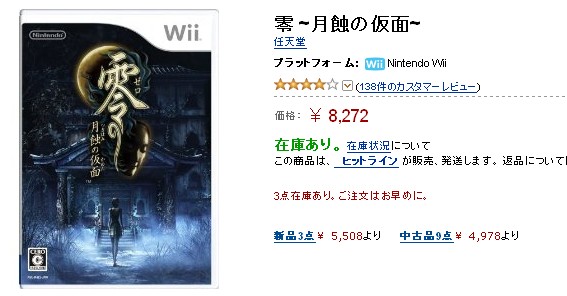
Japanese Game Price Watch - Zero: Tsukihami no Kamen

Zero: Tsukihami no Kamen, otherwise what would have been known as Fatal Frame 4 (in North America) or Project Zero 4 (in Europe) got caught in a bad position. Unlike the previous games of the series, which were published directly by Tecmo, the latest release was handled by Nintendo themselves. The game apparently shipped with some annoying bugs. The way I understand it, Nintendo ask Tecmo to fix these issues, and Tecmo told them to, more or less, shove it. It was vaguely almost scheduled for a European release, at least, but that fell through the cracks for any number of reasons.

The awesome thing about the current generation of consoles is that they're much closer to modern computers than the 8, 16 or even 32-bit days. This means that, programming wise, they tend to be much easier to hack. We've already seen fan translations for Tales of Innocence and Soma Bringer picking up the slack where Namco-Bandai and Nintendo have failed. Well, there's now an English translation for Zero: Tsukihami no Kamen, going under the name Fatal Frame 4: Mask of the Lunar Eclipse. What's more, you don't have to resort to piracy to get the patch working - I've heard it won't even worked with pirated versions, although there appears to be torrents around that suggest otherwise.

Assuming you want to play the game legitimately, you'll need a copy of the game. - the problem is, finding it.

Zero: Tsukihami no Kamen is a year and a half old now, having been released in July 2008. Most import retailers no longer carry it, or are still carrying it at retail price. My eyebrows furrow when stuff like this happens, because while prices can plummet in the Japanese marketplace pretty quickly, the importers usually never drop their prices unless it's a huge failure or it gets a reprint, so new titles that can be found on the streets for a few thousand yen are still being sold to the rest of the world for the equivalent of $75. It's good to be aware when you're being gouged!

So I checked with Amazon Japan and:


Yeah, it's still pretty expensive over there, too. Of course, like other marketplaces, Amazon isn't the be-all-end-all of price gauging, but it certainly hasn't dropped all that much, either. The cheapest used copy there is 4900 yen or about $55. I browser around a bit and all of the other internet retailers I found still listed it for a bit under the retail price, about 6200 for this one here. (Does HMV Japan ship outside the country?) All of the other Zero games can be found cheap in Japan since they all got reprints, but given all of the drama surrounding this release, that may not be the case. In other words, if you're curious, you might want to grab this soon before it completely disappears.

Tuesday, December 1, 2009

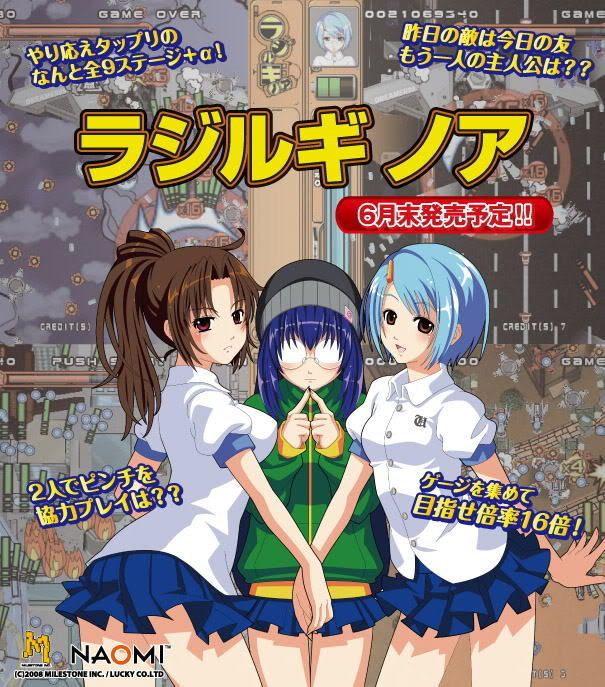
Radio Allergy 2 headed to the Wii


Milestone, mediocre shmup specialists, are working on the sequel to the cel-shaded original. The first game has something of an interesting history, since it was supposed to get a US release as a Gamecube game, cancelled due to the death of the system.

It later got a release on the aptly named 'Ultimate Shooting Collection' along with Karous(another Milestone game) and Chaos Field, published by UFO Interactive.

Will they publish the sequel in the states as well? It'd be nice.

Sunday, August 16, 2009

Contra Rebirth

So while I was looking through the files of the Contra HQ, it was particularly distressing how BAD the reviews were, if there were any at all. The site had always been mistreated by me, mostly for time issues. I started the site, went to college, and let it rot for four years, more or less. Then I redesigned it and brought it a bit up to par between jobs, then it fell through the cracks again. It was really cool that Contra 4 actually mentioned the site in the credits - I think those pictures from the Contra Shattered Soldier (Shin Contra OST) are the ones I'd scanned myself - but pretty embarrassed that the site really never became what it should've been. At least it's functional as a graphic and media archive. It's maintained by Ed Oscuro now, and I believe he's moving it to a different server.

At any rate, this is a long roundabout way of saying I'm working on an HG101 article to Contra, mostly to accompany another Konami themed write-up I'm working on. I don't know when that'll actually go live, but in the meantime, here's a review of Contra Rebirth, which was released last month in Japan for WiiWare. I won't lie - I totally pirated this. I WOULD have paid for it, because it is excellent and way worth the 1000 points they're charging, but Nintendo's nimrod approach to digital distribution will continue to guarantee that they won't be seeing any real money from me until they get their act together.

Contra Rebirth


The purpose of this Wiiware game is initially a bit confusing. The Rebirth series began with Gradius, which brought the series back to its 16-bit roots using similarly styled graphics, music and gameplay. But wait – wasn’t that what Contra 4 was supposed to be?


Well, kind of. If Contra 4 focused mostly on the first three games, Contra Rebirth also adds in some influence from Hard Corps, as well as bits and pieces from the other, later games. It’s another 2D game, with a visual style much like Contra III, and it plays pretty much the same way, including the two-weapon system and the position lock without strafing abilities, although the bombs are gone like in Contra 4.


The heroes from the get-go are Bill Rizer and Yagyu Jubei, the latter marking his second appearance after his debut in Neo Contra. The sprites look pretty decent, but the backgrounds are boring and look totally shameful – it’s sad that a portable title manages to look substantially better than a console game. Still, in action, it’s hard to notice, because it uses some effects, like the huge explosions from Hard Corps, as well as some scaling effects when certain enemies enter the playing field. The music is taken from a range of the Contra games, from the original up to Hard Corps, including even a song from Operation C, all done in the style of the arcade Super Contra, which is FM sound with some strong, digitized percussion. Once again, it's provided by Manabu Namiki, who, with Gradius Rebirth and Fantasy Zone II DX to his credit, seems to be the go-to guy for retro style arrangements.


While Gradius Rebirth was a bit too familiar for its own good, Contra Rebirth is a bit more innovative. The second and fifth level, the city and alien base stage respectively, should ring some bells for series fans, the other levels are mostly new. The first stage takes place in a spaceship under attack (you’re delivered by the same helicopter as the rest of the games, even though you’re in outer space) As you run past a window, you see a huge snake-like monster fly by, shooting it scales at the ship, which in turn crack through the floors and ceilings and start hatching little aliens. At the end, it launches another one of its spores on the window. Once you blow it up, it sucks you out into space, as you jump from debris to debris falling through orbit, destroy the snake bit by bit. The third stage has you riding a series of cyberneric llamas through the wilderness, first destroying a ninja-robot, then facing off against a gigantic missile which attacks by shooting other, smaller missiles. The fourth stage is a descent into a lava cavern and ends up with a fight against an animated stone statue. The final battle is against a huge floating garbage ball which lips the orientation of the screens. Like Contra 4, there’s just enough “holy crap” moments to keep it exciting while still feeling familiar.


The biggest problem is its lengths – it’s only five levels, along with a final boss fight, and it’s over. Still, Contra III was only six level, and two of them were wasted on the simple overhead stages, whereas Rebirth only has side-scrolling levels. For a Contra game, it’s also relatively easy on the standard difficulty settings, although the higher ones prove a nice challenge. Beating the game on different levels unlocks two additional characters – a cute little robot named Tsugumin and a robotic lizard-thing named Plissken. It’s probably not related to Snake’s callsign from Metal Gear Solid 2, instead going back to the original source of Kurt Russell’s character in Escape from New York, but you never know. In this case, you’re fighting against the General Salamander, and one of the pictures in the backgrounds looks like Venom, the bad guy from the MSX Gradius games (and Gradius Rebirth.) Could this be Konami trying together all of its classic game series together into the same canon?


The voice clips are remarkably cool and many pay homage to prior Contra games. Bill yells “Locked and loaded!” and "It's payback time!" upon respawn, like Ray and Wolf from Hard Corps. Plissken yells “It’s time for revenge!” and “Let’s attack aggressively!”, the same quotes from the English version of Contra III. Yagyu seems to be around just to yell out awesome sounding Japanese, while the little robot has a cute little synthesized voice. (A flower even pops up from her corpse when she dies.) In the intro, where Bill Rizer once again wakes up cryogenic sleep a la Shattered Soldier, the camera closes up on his face as his eyes shift back and forth wonders out loud “What is this place?”, just like the arcade Super Contra intro. It’s all so beautiful. All of this taken together not only works as a series tribute but also stands alone as an excellent game, easily up to the level of the 16-it titles.