
- Silent Service
- Pinbot
- 720
- A Boy and his Blob
- Wrath of the Black Manta
- Astynax
- Nemesis
Showing posts with label atari. Show all posts
Showing posts with label atari. Show all posts
Saturday, August 10, 2013
Nintendo Power Retrospectives - Part 20
This episode we're hitting Nintendo Power #11, with an unfortunately mediochre lineup, in spite of the cover.
Games Reviewed:

Wednesday, May 29, 2013
Nintendo Power Retrospectives - Part 14
This week I'm continuing through the Best of the Rest of Nintendo Power's first year, with two movie licensed games, two puzzle-platformers, and two shoot-em-ups.
Tuesday, July 17, 2012
Adventure, a game released in the year of wedontknow; or: Wikipedia continues to be a danger to video game historiography and should never be used as a source
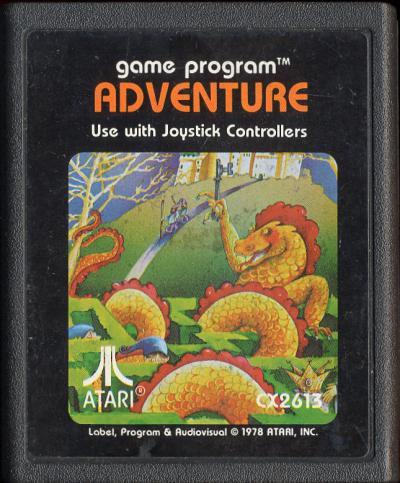
 Warren Robinett (photo taken from the developer's homepage) also programmed Slot Racers and Basic Programming for Atari, and later founded The Learning Company |
It all started a long time ago, back in 1979... or was it 1978? Or even 1980? We'll see about that; let it for now be said that this is the story of an Atari game called Adventure and its Wikipedia article. Adventure was programmed by Warren Robinett, conceived in 1978 (so the story goes) as a video game adaption to the original text adventure game "Collossal Cave" by William Crowther and Don Woods. Limited to tiny amounts of cartridge space but the Atari VCS' marvelous graphical capabilities, the game eventually had to take a very different shape than its first inspiration. Instead of navigating in turns through parser inputs, the player was to move around in real-time, maneuvering through a maze, searching for the tools to solve it (there was no inventory: the hero could only carry one item at a time), and fighting dragons like in an action game. The game is rightly considered the origin of the action adventure genre, building the foundation for milestones such as Icon: Quest for the Ring, The Legend of Zelda and Metroid. However, it goes beyond being an inspiration for a number of later games. It can be considered as the first step to combine the typical characteristics of both computer games and video games (which then encompassed arcades and home consoles) - we might have mostly the same kinds of games on all platforms now, but back then they were considered entirely different mediums: One where players were supposed to use their intelligence, and another that demanded their dexterity with a joystick. Its most immediate call to fame, however, was what is now called the first Easter Egg in video gaming (but what Robinett himself considered his "signature" at the time) that Robinett, fed up with the way Atari treated its designers, deftly hid to sneak in his name into the game: An object barely recognizable as such, only a pixel in size and colored the same as the floor, would open the passage to a secret room when carried to a certain location under certain conditions.
 The Adventure begins |
Well, but when exactly was the first action-adventure, if not the first video game genre-mix ever, unleashed on Atarimaniacs? The game's Wikipedia article has long bounced back and forth between 1978 and 1980, mostly motivated through conflicting copyright information on the cartridge and manual (a box with the 1978 date hasn't been spotted on the internet so far). We can now say with certainty that the 1978 date has been an obvious error on Atari's side (more about that in a minute), but it doesn't seem to matter, as in October 2007 a four-year-older interview with Robinett (Internet Archive backup as linked on Wikipedia; the site itself has since moved here) had been found, in which the creator states (in answering the question how long it took for the "Easter Egg" to be discovered):
I don't know exactly. About a year, maybe less. I handed over my finished code (with the Easter Egg in it) in June 1979, and quit. The game was released for the christmas season in 1979. I went back to my hometown in Missouri for a while, then traveled around in Europe for a while. When I returned to California in the spring of 1980, I think it was known by then. At least by summer 1980, it was known. I went out with some of the Atari game designers one night for pizza and beer and told them about how I did it. I saw a gleam in Rob Fulop's eye, like he was already planning his own Easter Egg."
 Fighting dragons |
There are several factors that should alarm any attentive reader about the use of this passage as a source: First, it starts with "I don't know exactly." Admittedly, that is his answer to when the easter egg became known, but it sets the right tone for what follows: Robinett left Atari half a year before his date for release, then left the state, and the country. He doesn't give dates for his geographic departures, but that can only amount to the problems of this passage: The language simply isn't very precise. I feel like I'm regurtitating this simple fact over and over again: Interviews are helpful and valuable, but we cannot write history based on people's 30-year-old memories alone, especially given the indefinite-sounding nature of the statements in this case. After all, there is an even older interview, which seems to contradict certain details in the later account, concerning the time frame between him finishing the game and quitting Atari. When I contacted Warren Robinett, he was so kind as to clarify this perceived conflict from his memories:
I handed over the what-I-thought-was-final code for Adventure at the time that I quit Atari in April 1979. I then went back to my hometown in Springfield, Missouri for a couple months. When I returned to California in June 1979, the two pieces of code which I had handed off in April -- for the VCS cartridges Adventure and Basic Programming -- had been criticized fornot being completely finished, and/or having bugs. So I spent a few days fixing these things, and got paid for it by Atari as a short consulting job. (They were considered not finished because I had not implemented an "attract mode" in which the colors cycled if no user input was received for several minutes.) The bug was that the screen rolled in Basic Programming under certain conditions. My fixes to the code seemed to satisfy everyone. This was June 1979.
He also granted that it was an assumption - however well-reasoned - that brought him to the Christmas 1979 release date:
Soon after that, in late summer 1979, I went to Europe. I was 27 years old. I traveled around and stayed in youth hostels sometimes, cheap hotels other times, and sometimes slept on the train on overnight trips, since I had a Eurail Pass. I stayed for a month in Hannover Germany, where I had friends, Johannes Goebel and Walburg Kicia. I returned to the US in early 1980. I am pretty sure the Adventure cartridge was released during the 1979 Christmas season. But I was in Europe during that time. People were definitely playing Adventure in early 1980. (...)
Anyway, the Adventure cart was definitely out in the world by June 1980, and had been out there for a while. My belief is that it was released during the 1979 Christmas season, but I did not actually see an Adventure cart in a retail store prior to Jan. 1, 1980. So I guess I don't truly know for sure.
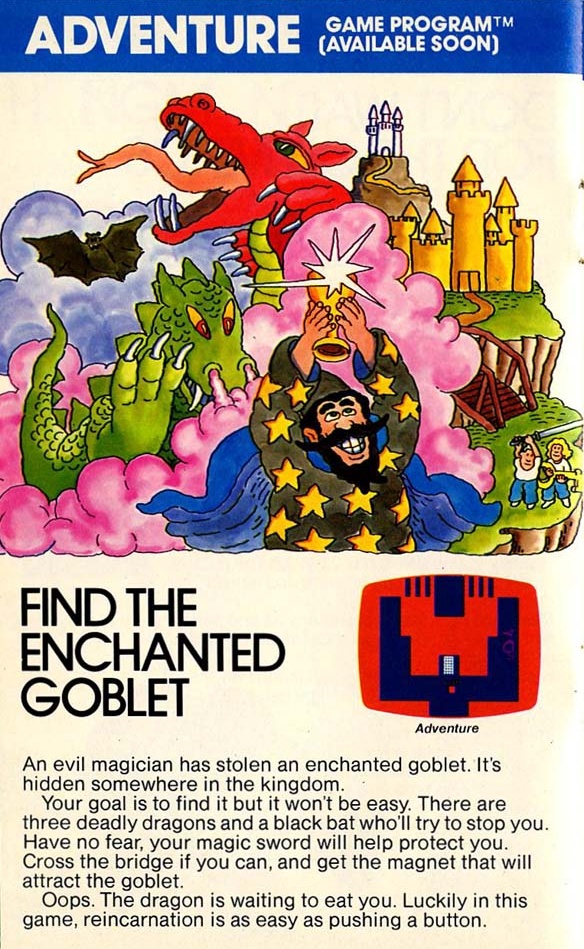 AVAILABLE SOON (1980 catalog) |
For Wikipedia, however, that one interview quote should suffice, and thus Adventure became "a 1979 video game." Since then, more evidence has been brought up to put the "Christmas Season 1979" date in question. Atari has published not one, but two revisions of their software catalog with a 1980 date, both of which build up hype for the game, which would become "available soon." Only in their 1981 catalog (judging from those that are preserved and available at the archives of the awesome AtariAge.com), the label dissapeared.
If one was to sacrifice a lot of time and effort, one could also entertain an extensive sighting of newspaper advertisements and find two ads by Hobbyworld Electronics in InfoWorld issues, which don't list the game by May 1980, but in the June variant. Now it would be naive to assume that every retailer got and advertised the game at the same time, but how much time can pass in between? Unfortunately this approach is crushed immediately by the only other added game: Indy 500, one of the very first games Atari published for the VCS. It should be noted, though, that it seemed impossible to find any advertising samples before June 1980 that have the game, but plenty printed after that, as well as many more earlier ones that don't.
Furthermore, the Magazine Video, one of the first outlets in the US to regularly report about video games thanks to legendary editors Bill "The Game Doctor" Kunkel (RIP) and Arnie Katz, was also the first to give independent awards for video game achievements. Video proclaimed Adventure the most innovative game of the previous year for the 1981 awards. Given the wording as later referenced in Kunkel & Katz' standalone video game magazine Electronic Games (Winter 1981, page 38/39) isn't as specific about the release date as one would hope ("reflects accomplishments during the 12 months of the preceding year"). The 1980 awards were still clearly cut to the end of the year 1979: "The first set of Arkies was announced in February 1980 and covered all hardware and software produced prior to January 1, 1980" which if followed through would have included Adventure had it been put out for Christmas 1979. For the record it should be said that by 1983 the time frame had shifted: "a title must have become available between October 1, 1981 and October 1, 1982 to be eligible this time." The text in the magazines gives no reason to assume that that the same had been applied before, but the 1981 Arkies (so those for 1980 games, bit confusing) do contain other games we think were released for "Chrismas season 1979" (And one Wikipedia still thinks was released in 1978).
Finally, the database of the US Copyright Office, which professes to contain all filed records from 1978 to the present, contains only one entry by Atari for Adventure, registrated years after the fact on May 14th, 1985, with the registration number TX0001344614. It lists the date of creation as just "1979", but the date of publication as June 29th, 1980. It is not exactly knowable what exactly had been copyrighted here; the type of work is listed as "Computer File," but Atari had only submitted a printout, as opposed to the audiovisual material that would usually go with registrating a video game, but it lines up in the long row of sources that don't know of any kind of publication before 1980.
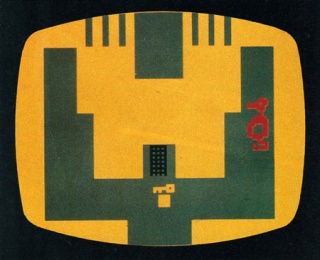 Screenshot from Electronic Games |
We've arrived at an impasse similar to the one Frank Cifaldi found himself at when trying to establish a definite date for the US release of Super Mario Bros.. Although we have several clues that hint at different dates, we're left with no solid proof for either of them. All we can say for sure that Adventure was available by June 1980, as evidenced in advertisements and supported by the point in time Warren Robinett is confident to attribute absolute certainty to, as well as the only available copyright notice with that name filed by Atari.
I'm by no means dead-set on establishing that Adventure was published in 1980 - what's there to gain? It's not like there have been any games like it in the meantime, and it stands as a groundbreaking achievement either way. In the best case it'd make only a difference of a couple of weeks, and certainly no more than six months. It's still entirely possible that 1979 is correct - but if it is, it's so by chance and not by method. We have no facts whatsoever to support the assumption. I've tried adding Template:Refimprove to the article, indicating that "there are some, but insufficient, inline citations," but Wikipedia brass (this isn't a figure of speech, Wikipeda actually likes to award virtual medals to its editors for being editors, as if it were a little despotic military regime) quickly jumped in to fiercely defend the 1979 date. (Turns out the better label would actually have been Template:Disputed, although the argument for deleting the Refimprove shows a lack of comprehension of the site's own rules as they're defined, and the editor in question didn't bother to replace it with the correct and necessary Disputed, either.)
And by Wikipedia brass, I actually mean the one guy who dug out the interview for its citation in the first place, and who shows an unhealthy clinging to the version he has personally promoted in the past, including its listing in several print articles. And the defense he's bringing up to support the weak (by historiographic standards) original source? A long list of new "sources" attached to the release date. I've gotten used to the frequent misuse/abuse of false and invalid sources on Wikipedia by now, but this is too hilarious to not count them up one by one:
- The first one is 1UP's entry for Adventure in their The Essential 50 series. If the iffy dating of 1UP's articles is to be relied on in this case, it was posted on January 31st, 2004 - before the date was adopted by Wikipedia, but after the interview with Robinett that popularized the Christmas 1979 date. Being a strictly journalist venture, 1UP of course simply lists the release date, without elaborating how they ended up with it.
- Next up is the current Atari's official site for the game, where it can be played inside the browser. The page itself is not dated - only the Atari homepage as a whole is decorated with a 2012 (it was 2009-2011 about the time it was added) copyright. That doesn't matter at all, though, as anyone whose ability to read is complemented with the rare skill to actually comprehend a written sentence, the site doesn't even say the game was published in 1979, merely that Robin Warinett created it that year, which by all accounts has to be assumed as correct.
- Now things are getting really funny. Or really sad, I'm not sure yet. The editor actually had the nerve to quote The Video Game Theory Reader 2 and Vintage Games: An Insider Look at the History of Grand Theft Auto, Super Mario, and the Most Influential Games of All Time. They have both been published in 2009. Which without further insight should give them about a 90% chance that such a minute, seemingly trivial detail as the game's release date was either taken directly from Wikipedia in the first place or directly from statements by Warren Robinett himself - especially since neither work goes out of its way to cite its sources in detail (Robinett contributed the foreword for the first volume of The Video Game Theory Reader, so the authors are more than very likely to have gotten their information from him; Vintage Games does put a couple citations, though its very spotty about it; the passage my antagonist is likely to have abused has none). What the editor has done here can be likened to just having missed seeing a coin thrown into the water, and declaring the amount of money lying on the ground based on the number of ripples it caused.
- Finally we have The Medium of the Video Game, originally published in 2001 and thus the only source that predates the fated interview during which Warren Robinett has first (it seems) spoken out about his assumption for the game's publishing date, but equally indifferent to sourcing as most of its new neighbours on the article page. My suggestion to correct the many other newfound pieces of knowledge this book blesses us with to improve Wikipedia in the same manner, has been hypocritically ignored by the editor. To commit the indecency of quoting myself:
(...) then it also has to be used to "correct" the release dates of the Atari 2600 games Haunted House (1981 instead of 1982), Superman (1979 instead of 1978) and the name of the hero in the original Donkey Kong as "Mario Mario" instead of "Jumpman". And that are only the cited + the following page. No doubt if you'd READ the whole book, you'd find at least a couple hundred new facts that obviously need to fix other, now obvious falsehoods in Wikipedia all along.
(Not to go on any more tangents here, but Wikipedia's 1978 for Superman is indeed most definitely wrong. Might elaborate in the comments in case someone's dying to know more.)
 The bridge should feel familiar to first-hour Zelda fans. |
To complete the package, all those new citations are now attached to a cell reading "Christmas 1979," while neither of them even mentions the season. As long as the very people that reign over Wikipedia's coverage on games history keep demonstrating this utter lack of the most basic principles of modern historiography, falsehoods and rumors will continue to run rampant throughout its pages. The shoddy methodology applied here is nothing short of outrageous, any real historian would have a field day tearing apart a bachelor's thesis with this kind of sourcing.
Now I'm not one to quickly call out people by their names for their failings, but in this case the sheer magnitude of influence this man exerts over game historiography makes it necessary that people know who he is. Besides being a member of WikiProject Video Games and the "Atari task force," as well as a "recent changes patroller" (the icon for that is very fitting for someone who likes to act as a self-proclaimed sherriff) at Wikipedia, Martin "Marty" Goldberg was for a long time in charge of classicgaming.com, where he used to run a site called "Electronic Entertainment Museum", is the current admin of atarihq.com, a member of the International Game Development Association's (IGDA) Game Preservation SIG, and calls himself a "fact checker" for the British magazine Retro Gamer. He will soon publish a book on the history of Atari. The book is Kickstarter-funded, which means people have given more than ten thousand US$ to this man to produce and publish a book on the history of our hobby.
To be fair, Goldberg is known to have done some decent journalist work on other occasions. For his articles and the book he conducted tons of interviews, and he appears to have access to a sizeable archive of actual "Atari documents" in the possession of his partner for the book, Curt Vendel. Vendel is also the admin of www.atarimuseum.com, where he indeed showcases a number of documents (though none pertaining to data that would be of use in this case). Goldberg's claim to belong on a higher plane than authors like Steven Kent, to be a "video games historian," and the lack of fulfillment to that claim, is what's really the problem here. He has demonstrated a tendency to accuse others of relying too much on mere interviews instead of "actual facts," yet his proposed remedy mostly consists of interviewing other people - Dare I propose those he personally admires more - to "clear up the issues," practically elevating their statements to dogma status. The promotion of his book also strongly relies upon this practice, claiming to be the "TRUE, unvarnished accounting" of history. Former Atari-employee Steve Woita spurs, quoted on the book's homepage: "I've yet to read a book about what really went on inside of Atari, by the actual people who worked there." Well, that only attests of a lack of knowledge of the more noteworthy books on video game history, as Steve Bloom, Dave Kent and even David Sheff, who had a strong focus on an entirely different company to begin with, all gave plenty of quotes from "actual people who worked there." Atari Inc. - Business Is Fun might turn out a great collection of memories and opinions. The available sample looks promising enough - for a journalist accounting. He has written a number of articles for Retro Gamer that claim to come "From the Archives," but that so far has manifested mostly in some fancy vintage photos (which are, it should be admitted, awesome) to decorate the actual article, which itself is carried by interviews. Business as usual. The greatest secret stash of original documents is useless if you bury it under a mountain of subjectively retold stories without providing for means to distinguish between the sources. It is important to recognize that this is not a historian's work, but a journalist one.
Let's assume though, for a moment, that Goldberg actually has access to the evidence needed to establish the 1979 release date - then why wouldn't he bring it up? Does he want to keep it for his book, actively damaging the integrity of Wikipedia for selfish ends? Well, that are just fancy conspiracy theories; as long as Martin Goldberg doesn't show any actual evidence that supports his clinging to the 1979 release date, it's all just juggling of personal retellings and random google results - be it unreflected or malignous. A good number of the entries he "significantly contributed" to at Wikipedia appear quite well-sourced, at least at first sight. (I'm not going in there to count which sources were added by whom.) He has shown on multiple occasions that he actually knows methods to do decent research (as in this snippet from the latest issue of Retro Gamer), and him doing the opposite in this case cannot possibly be but an act of choice for whatever reason, be it the inability to accept the idea that his hero(?) just might have erred or something else entirely. But even if he acts as irresponsible as he did with Adventure maybe only 1% of the time or less, maybe only for articles he personally doesn't care about too much - what does that say about credibility as a fact checker for an encyclopedia?

We don't know for sure when Adventure was first released, Warren Robinett doesn't know for sure, and if Martin Goldberg beliefs he has valid proof, he'd better produce it, or else admit that he doesn't. In the meantime, I can only repeat myself: Never use Wikipedia as a source, instead check their citations and see if those hold up, then cite from the original sources.
Wednesday, June 20, 2012
A Dollar Menu History of Cooking Games
Ever played Cooking Mama? I wouldn’t be surprised if the answer is yes; after all, the franchise has, at last report, sold over 16 million copies. It’s not exactly the most “hardcore” of games, but there’s no denying that it’s at least reasonably fun. (Not to mention hilarious, if you suck enough at it.) But of all the things Cooking Mama is, there is one important thing that it isn’t: a first. Cooking Mama might be popular around the modern family video gamer, but it’s far from being the progenitor of the cooking genre. The fact is, cooking games have been around pretty much since the very dawn of video gaming as we know it.
For purposes of clarification, it’s a very specific category of game that I’m (briefly) covering here. Burger Time doesn’t count, because making the food is compounded by obstacles like enemies. Diner Dash doesn’t count, because you have no part in actually making the food. And Pizza Tycoon also doesn’t count, because it’s arguably more about managing the restaurant finances than it is about making the food. The primary focus of the game should be making the food to order, and little or nothing else. So that also means nothing based tangentially on a food mascot license, either (I’ll leave that in Bobinator’s hands, honestly).
Pressure Cooker
 So we start pretty much at the beginning, with Activision’s Pressure Cooker for the Atari 2600. This is one of my all-time favorite Atari games, and that catchy theme song is only half the reason. The other half is the utter insanity of the concept: you’re a fast food chef, and your job is to assemble burgers according to orders on the bottom of the screen. Except you aren’t just grabbing toppings out of bins like a normal chef; instead, you are in a room with a conveyor belt and five cannons that fire the toppings at you. You catch a topping simply by facing it while it is in flight. If the topping hits you in the face, back, or conveyor belt, it explodes, and you lose one of your 50 performance points. The performance points are basically this game’s equivalent of lives; you lose only one for dropping a topping, but you lose a lot more if you do things like put more than one of the same topping on the same burger, or let a burger drop off the conveyor belt, or try to deliver the burger down the wrong chute. It goes without saying that running out of performance points results in the game ending. They go fast, too, since the toppings fired at you do not necessarily correspond to the orders on the screen. Death is inevitable. Sometimes the game absolutely will not fire the correct topping at you. Such is the limit of video gaming in the early 1980’s.
Short Order
 Moving on from Pressure Cooker is the NES game Short Order/Eggsplode!. We’re really more interested in the Short Order half of the game, as Eggsplode! (the alternate game you get if you flip the Power Pad over) is really just a foot-controlled Whack-A-Mole clone. This is one of those NES games that requires the Power Pad, Bandai’s attempt to get gamers to exercise more. Short Order is simple in concept. You are given a sandwich order, and you must assemble it perfectly to order by stomping on the correct buttons on the Power Pad. Honestly, a game like this is really not very fun when playing in a modern emulator, since the game is deliberately simplified to make up for how relatively unwieldy the Power Pad is compared to a traditional controller. It’d probably be much more fun - and more prone to human error - to play with one’s feet.
Ore no Ryouri
 Dialing the Time Machine forward a handful of years, we have a Japan-only Playstation release by the name of Ore no Ryouri, which I’m told translates into “I’m the Chef!” This game gained a small cult following in the States after the Japanese demo was hidden away on a Playstation Underground demo disc. It is one of the few Playstation games to require the Dual Shock controller to play, because the preparation of each dish (and all other tasks for that matter) involves a unique minigame involving the use of both analog sticks. Pouring a glass of beer, for example, is more than just sticking the mug under the spout and pouring. You are actually expected to make sure that the beer has a good head, by tilting the glass with one stick while adjusting the spout pressure with the other. Chopping meat and vegetables requires you to move your hand with one stick and the knife with the other, and it’s entirely possible to accidentally cut yourself. Being a Japanese game, most of the dishes are decidedly Japanese in origin, like ramen and soba. I am told that there is a more modern Wii-based version available called Order Up!, but I have not played it.
Ore no Ryomi 2
 While that game never got an English release, a Game Maker developer going by the name Mr. Chubigans released two games based on it, entitled “Ore no Ryomi” (which I’m told translates into nothing at all) and made not as a straight remake of the game, but as an interpretation of a magazine preview for it. While they bear amateurish graphics and music borrowed heavily from other games (and Hollywood film scores), the gameplay carries over to the keyboard input quite nicely, at times feeling more like a typing tutor game than a game about cooking, but as you purchase the supplies for more dishes to cook, your restaurant becomes more and more crowded, and the game becomes more hectic. This game was quickly followed up with a more featureful sequel, whose graphics are now 100% drawn by the author, as opposed to being screenshot rips from the Playstation game...for better or worse. The game is still available to download for free at Vertigo Gaming. (Hey, do me a favor while you’re there, pester the guy to make a third game, will you? =P)
Taco Joe
 A lot of cooking games are actually not of the sort you can stick in a game console. Many are actually browser-based, but are not any worse for it. Back when games in browser windows were actually starting to become a thing, there was a Shockwave game by the name of Taco Joe (originally hosted at Shockwave.com, now taking refuge throughout the rest of the Net, like here at I-Am-Bored). In this one, you basically work up a rhythm as taco shells scroll by on a conveyor belt. You aren’t working with different order types; all you need to do is make sure that every taco that passes gets one of every ingredient, and that you send the taco to the correct window (don’t try sending the taco to a window with no customer). In practice, it’s much harder than it sounds, especially with the need to kill cockroaches while you’re adding ingredients. The goal in each level is to make enough money (by giving customers complete tacos - you get no money if you forget an ingredient) to bribe the health inspector to let you stay in business.
Papa’s Pancakeria
 A personal favorite among the browser-based games is the Papa’s series on Kongregate, by Flipline Studios. They aren’t in any particular order, but each one focuses on a different kind of restaurant. Papa’s Pizzeria obviously deals with pizza, but there are sequels involving pancakes, hamburgers, ice cream, and tacos. These are all made to order, naturally, but instead of being a strictly pass/fail thing like all the other games above, the Papa’s games will actually grade you in a percentage, based on how accurate you were with the various steps of the order, from how well-cooked the meat was, to the distribution of toppings (the rating won’t be as good if you just stack a lot of pepperoni on one side instead of spreading it) and how long it actually took you to get the order ready. Better ratings actually dictate how much money you make for each dish sold, which admittedly doesn’t work so well in real life (though I admit, I would love to see a pay-what-you-want burger joint).
Cooking Mama
 And then we end up right back where we started, with the Cooking Mama series. Really, there isn’t much actual game to Cooking Mama. You are graded on the “quality” of your final dish, which does give you various medals (so you can brag to your friends that you got a gold medal on...popcorn?), but you generally aren’t pressured for time, and failing any of the individual steps of a dish just has Mama throw it away and do it herself. Where’s the “game”? Once you’ve cooked every dish, where’s the replay value? Why bother going back and making a dish again? Why is it that this game, as a series, has sold 16 million copies, while nobody really talks about the likes of Pressure Cooker or Taco Joe, despite them being better at being games?
Or maybe I’m just looking at this too hard?
Whatever the case, though, I would love to see more games about making food. We have yet to see games where you run a catering business, or games where you run a soup kitchen (there’s ripe material for one of those “Serious Games,” there)...
There’s one other idea, though, and I’d love to see a game developer roll with this one. You and your opponent are both chefs on opposite sides of a kitchen arena. You are each tasked with making various types of pies to throw at your opponent. Each pie has its own strengths, weaknesses, and individual traits - for example, a cream pie is quick and easy to make, but isn’t very “damaging,” but a lemon meringue pie takes longer and requires more precision in each step, but takes a lot out of your foe’s energy bar if it hits - but both chefs are not exactly stationary targets, as they dash between the different stations for making crust, filling, etc., so when a chef is aiming a pie, they need to be patient. Perhaps one could throw in a Scorched Earth sort of thing, too, where you need to adjust the angle and power of your throw in order to actually hit the opponent, giving you a reason to cook up lots of cream pies to use to gauge your throw for a costlier pie.
At this point I have to wonder if I’m actually this crazy, that I’m dreaming up ideas for fighting games involving pie.
(edit on 6/22/2012: when copying the blog post from my google docs account, i forgot to include the hyperlinks.)
For purposes of clarification, it’s a very specific category of game that I’m (briefly) covering here. Burger Time doesn’t count, because making the food is compounded by obstacles like enemies. Diner Dash doesn’t count, because you have no part in actually making the food. And Pizza Tycoon also doesn’t count, because it’s arguably more about managing the restaurant finances than it is about making the food. The primary focus of the game should be making the food to order, and little or nothing else. So that also means nothing based tangentially on a food mascot license, either (I’ll leave that in Bobinator’s hands, honestly).
Pressure Cooker
Short Order
Moving on from Pressure Cooker is the NES game Short Order/Eggsplode!. We’re really more interested in the Short Order half of the game, as Eggsplode! (the alternate game you get if you flip the Power Pad over) is really just a foot-controlled Whack-A-Mole clone. This is one of those NES games that requires the Power Pad, Bandai’s attempt to get gamers to exercise more. Short Order is simple in concept. You are given a sandwich order, and you must assemble it perfectly to order by stomping on the correct buttons on the Power Pad. Honestly, a game like this is really not very fun when playing in a modern emulator, since the game is deliberately simplified to make up for how relatively unwieldy the Power Pad is compared to a traditional controller. It’d probably be much more fun - and more prone to human error - to play with one’s feet.Ore no Ryouri
Ore no Ryomi 2

Taco Joe

Papa’s Pancakeria

Cooking Mama

Or maybe I’m just looking at this too hard?
Whatever the case, though, I would love to see more games about making food. We have yet to see games where you run a catering business, or games where you run a soup kitchen (there’s ripe material for one of those “Serious Games,” there)...
There’s one other idea, though, and I’d love to see a game developer roll with this one. You and your opponent are both chefs on opposite sides of a kitchen arena. You are each tasked with making various types of pies to throw at your opponent. Each pie has its own strengths, weaknesses, and individual traits - for example, a cream pie is quick and easy to make, but isn’t very “damaging,” but a lemon meringue pie takes longer and requires more precision in each step, but takes a lot out of your foe’s energy bar if it hits - but both chefs are not exactly stationary targets, as they dash between the different stations for making crust, filling, etc., so when a chef is aiming a pie, they need to be patient. Perhaps one could throw in a Scorched Earth sort of thing, too, where you need to adjust the angle and power of your throw in order to actually hit the opponent, giving you a reason to cook up lots of cream pies to use to gauge your throw for a costlier pie.
At this point I have to wonder if I’m actually this crazy, that I’m dreaming up ideas for fighting games involving pie.
(edit on 6/22/2012: when copying the blog post from my google docs account, i forgot to include the hyperlinks.)
Tuesday, February 15, 2011
Larry Siegel of THQ - do you know him?

Or for that matter Jim Gregory at Atari? I'm tracking these two gentlemen for HG101, in connection with something that will prove very, very exciting for readers. Read on to find out more...
Unfortunately I've hit an impasse, so am turning to the readership to ask - do you know these gentlemen? Do you work with them or know how to contact them? Do you know where they are now? Both of them seem to have dropped off the radar entirely.
I can't explain precisely why, just yet, because it's a bit like the Orz, or maybe Cthulu. Once the world knows of its existence, potentially bad things could happen. But trust me when I say it'll be worth it. Unless I find nothing, in which case I'll explain why and it'll be open season for everyone.
Some facts:
Larry Siegel was at Black Pearl Software and then THQ up until around the millennium. According to Mobygames he's credited on the following:
* Rugrats: Scavenger Hunt (1999), THQ Inc.
* Bass Masters Classic (1995), Black Pearl Software
* FIFA Soccer 96 (1995), THQ Inc.
* Madden NFL '95 (1994), THQ Inc.
* The Ren & Stimpy Show: Time Warp (1994), THQ Inc.
He also appears to have a profile on LinkedIn, but attempts to contact him via the site haven't had any results.
Jim Gregory was at Handmade Software (Swinton, UK) for a time, making Atari games. Notably several Lynx titles and Kasumi Ninja for the Jaguar. According to Mobygame he's credited on the following:
* Battlezone 2000 (1995), Atari Corporation
* Kasumi Ninja (1994), Atari Corporation
* Awesome Golf (1991), Atari Corporation
The original companies these gentlemen worked at no longer exist, and despite managing to contact their former colleagues, no one as yet knows how to contact the two.
If you have any information pertaining to their whereabouts, post in the comments or email HG101 via the contacts on our front page.
Subscribe to:
Posts (Atom)