
Over the next few weeks, I'll post one video per week until we get current with the series.
Showing posts with label video game magazines. Show all posts
Showing posts with label video game magazines. Show all posts
Wednesday, February 27, 2013
The Nintendo Power Retrospectives - Part 1
For the past few months, I've been doing a bi-weekly series on YouTube re-capping old issues of Nintendo Power, starting with the Fun Club News, and doing reviews of each game featured in the magazine. If this sounds familiar, I started something like this earlier in written form.
Over the next few weeks, I'll post one video per week until we get current with the series.
Over the next few weeks, I'll post one video per week until we get current with the series.

Sunday, February 10, 2013
Power Play - One of Germany's greatest game mags is back (sort of)

I don't check the games corner in the newspaper shops very often these days, but today I've been reminded that it can be worth to pop in every once in a while. Started in 1988 as a companion booklet to Happy Computer, Power Play was one of the earliest German computer and video game periodicals. Together with almost all other old mags in the country, it was discontinued around the turn of the century, but now it's back! Well... sort of. Although the cover bears the enchanting label "N°01 2013," at the time being the new Power Play unfortunately is only a one-off special of the general computing magazine Chip.
The good news is, this isn't a mere resurrection in name only, but actually put together by some of its founding fathers and other veterans of the trade - compare the list of contributors below with the people I've mentioned in my earlier look at some ancient German mags.

With almost everyone's age on the team being beyond 40, the publication focuses on games with a history - be it retro remakes, sequels of long-lived series or games that follow design philosophy of old.

The mag itself takes a very mature (in the real sense) stance towards the medium. With several making-of features and developer interviews (Richard Garriot, Chris Hülsbeck, Ron Gilbert and many others) there is a strong focus on "proper" journalism. Thanks to the bundled experience, the quality of the writing is superior to any other mag out there (please pardon my wooden English translations of the quotes in this post). Several contributors get their own column, which they mostly use to bitch about recent negative trends like achievement exploitation, the oversaturation on the iOS app store, or soulless cash-ins on beloved franchises, as Heinrich Lenhardt writes on Lord of Ultima: "It doesn't play one bit like something one would expect with the name Ultima. The damage to its image shouldn't be underestimated. As EA is now trying to bake a modern follow-up to Ultima IV with Ultima Forever, part of the fan base will be somewhat reserved due to the adulteration in Lord of Ultima."

The new Power Play also does reviews, but ditches the ridiculous percent rating system that is still dominating the German games journalism landscape in favor of a personal 5-star rating. The choice of titles to review is also very selective: "Our team of reviewers is proud of its Midlife-Crisis-worthy average age. We hope for a higher compatibility to the taste of a mature readership. (...) An obscure indie game with retro style elements or the remake of a classic may be more exciting to our reviewers than the generic sequel of a popular series."

The 2-page reviews all contain an overview of the history of the franchise or its designer, and a selection of three quoted opinions from other (online-)publications. About a third of the reviews is squeezed onto a single page, where those are missing.

Fifa 2013 - the longest review - is accompanied with a collection of 11 soccer game milestones.

The mag ends with a retro section proper, which contains company profiles of Super Fighter Team and Psygnosis, an overview of the Commodore Amiga's career, a making of about Q*Bert and a number of retro reviews - now without any assigned score, but interesting quotes the authors (and some of their German colleagues) wrote about the game back in the day.

All in all, stumbling over the mag has been a very pleasant surprise, the writing is top notch, and the selection of topics is perfect to the taste of a Hardcore Gaming 101 editor/reader (the only slip-up being the interview with the German alternative rock band The Donots, which apparently just happens to like video games).
The mag comes with a DVD, but distributing the contained freeware games, demos and tools this way now really feels anachronistic. It has also a video show moderated by Lenhardt that contains a few neat features like a visit at Chris Hülsbeck's studio and a tongue-in-cheek comparison of Fifa 2013 and the 1983 C64 game International Soccer, alongside trailers for Wreck-It Ralph, the reality TV-style retro tournament movie Brot und Spiele (another one of those, ugh!), Chris Robert's new space sim Star Citizen/Squadron 42, but that doesn't even run in regular DVD players, and they would've been better off just posting it online to keep the costs low.

The price of €8,90 for 130 pages might seem a bit prohibitive (or am I that out of touch with the price range of print mags these days?), but I cannot but urge any German-speaking reader to make that purchase - who knows when we'll ever see such a well-written, well-composed magazine again? (Actually, the editorial hints that more issues might be a possibility if this proves successful, so buy, buy, buy!)
Sunday, March 18, 2012
Scroll Magazine is Pretty Great

I've been remiss in talking about Ray Barnholt's excellent Scroll magazine, and with the fifth issue released last week, it's a pretty good time to talk about how rad it is.
With the few remaining video game magazines going on as business as usual (and GameFan only coming out intermittently), the door is open for publications to niche interests. The average person gets their news from the internet anyway, so why not gear coverage towards more underground topics, towards the people that value this kind of writing? That's pretty much what Scroll does.


A majority of the issue is devoted to Konami's Love Plus, the recent dating sim that's the topic of much derision and scorn from the Western gaming press. While it's all too easy to mock the concept of a virtual girlfriend, the feature rather explains the history behind it (including the background of Tokimeki Memorial, a game which I have a love/hate relationship with), what it attempts to do, what it accomplishes, and even a bit about it might be healthy, to a certain extent. Anything like this can be taken to ridiculous extremes (and some of it, like the guy who took his Love Plus gal to Guam to get "married", sounds like it was more of a joke, or at worst, a marketing ploy), in moderation the review makes it sound kind of cute, if still not something I'd personally be interested in. There are also several pages devoted to the girls and their families - I've never heard of a dating sim where you'd get introduced to your lady's folks, which is sort of terrifying in principle! Like Tokimeki Memorial, there are also apparently a few old Konami classics buried in there when you spend enough time with the girls.
The rest of the issue has some short write-ups on 7th Dragon 2020 and Cool Boarders, as well as a look at the retro game bar Genesis, which recently opened up in Nagoya. Retro game bar stories are simultaneously awesome and depressing to read, because the liquor laws here in the US (or at least, in my part of New Jersey) pretty much ensures such things will never exist, because the licenses are largely allocated to broader interests like clubs, sports bars, and awful franchises.

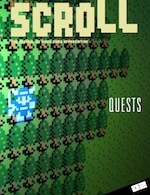
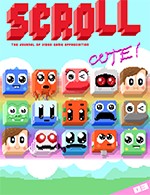

Going back a bit, the first issue is a love letter to the Super Famicom. The second one focuses mostly on Dragon Quest, and is worth it for the excellent original artwork pieces, one each for the main games. The third one is the "cute" issue, for the many absurdly adorable games that have come out over the years, with the focusing on 8 and 16-bit arcade and console titles. (Amongst titles like Kirby's Dream Land, Yoshi's Island and Dynamite Headdy, there are a number of games I've never heard of featured in there, including Namco's Marchen Land and Indiezero's/ Nintendo's Sutte Hakkun). The fourth issue is devoted to the floundering existence of the original Xbox in Japan.
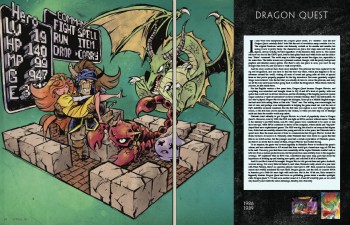
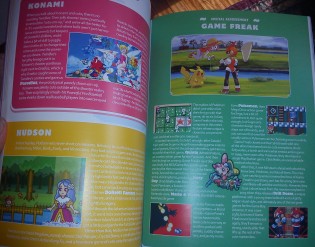
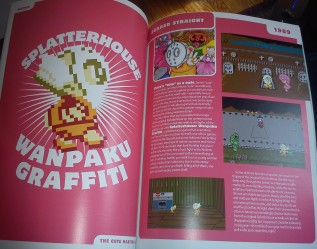
The physical issues are printed through Magcloud, which is pricey, but puts on some damned slick productions with heavy stock, far nicer than a typical newsstand rag and even a step up from the British ones. The actual price depends on the length, generally between $10-$20, though PDFs versions for the price conscious/dead tree haters are available too. The PDF version of the second issue is available for free as well.
Tuesday, January 17, 2012
Magazine Reviews - Nintendo Fun Club #2
It's been a while since I started with my recaps of back issues of Nintendo Power. It's time to rectify that with a look at the Nintendo Fun Club newsletter's 2nd issue.
This issue starts off, as with the last, with another major Nintendo title - The Legend of Zelda. We get a very detailed description of the game's plot. The next page of the magazine includes descriptions of Volleyball and Slalom, developed in-house and by Rare, respectively. This makes Slalom the first non-Nintendo developed game to be covered in a Nintendo publication.
There is also a description of Pro Wrestling with some information on the game mechanics, as well as portraits of the characters. I'm presuming the character portraits are from the Japanese version, as they're done in an anime/manga style. Later titles for the NES and SNES, would have character portraits become "western-ized" for their US release. There would be some exceptions for this, but this would remain something of a constant until anime and manga started to become more popular uner the 16-bit generation.
Next up is the Pro's Corner column. We get a bunch of hints and tips for Super Mario Bros. In particular, they repeat the fireworks tip from last issue, as well as the continue code. There's also a trick for phasing through dungeon walls, and getting a small Firey Mario (as opposed to Firey Super Mario). We also get the unlimited lives turtle trick, and a trick for getting 50,000 points in the castles, and, finally, the Minus World cheat. We also get some tricks for Salom and Pro Wrestling, but they're really basic.
We also get a look at the first after-market controller for the NES - the Advantage, which features rapid fire and an arcade stick. What more could you ask for?
Issue #2 - Summer, 1987
 |
| Page One |
There is also a description of Pro Wrestling with some information on the game mechanics, as well as portraits of the characters. I'm presuming the character portraits are from the Japanese version, as they're done in an anime/manga style. Later titles for the NES and SNES, would have character portraits become "western-ized" for their US release. There would be some exceptions for this, but this would remain something of a constant until anime and manga started to become more popular uner the 16-bit generation.
Next up is the Pro's Corner column. We get a bunch of hints and tips for Super Mario Bros. In particular, they repeat the fireworks tip from last issue, as well as the continue code. There's also a trick for phasing through dungeon walls, and getting a small Firey Mario (as opposed to Firey Super Mario). We also get the unlimited lives turtle trick, and a trick for getting 50,000 points in the castles, and, finally, the Minus World cheat. We also get some tricks for Salom and Pro Wrestling, but they're really basic.
We also get a look at the first after-market controller for the NES - the Advantage, which features rapid fire and an arcade stick. What more could you ask for?
Sunday, November 27, 2011
The New Gamepro Quarterly journal
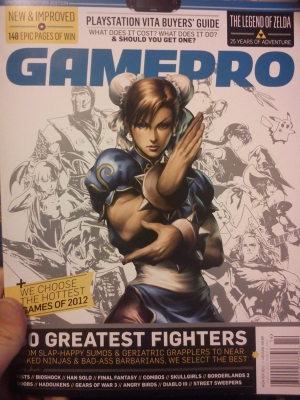
Not too long ago, Gamepro Magazine announced a switch in format, from a typical monthly magazine to a quarterly "journal" that would focus less on news and reviews, and more on features. This sounded like a brilliant idea to me, as it would establish something more meaningful that would be worth paying money for and re-reading, rather than something to pick up for five minutes, glean a few review scores, then put back on the magazine rack. The first issue of this new version of Gamepro hit the bookstores recently, and I picked it up a few days ago.
For anyone unfamiliar with the magazine's evolution lately, it's a taken a huge departure from its 5.0 HOT smiley face and PROTIP origins, both of which have long been staples of ironic hipster websites everywhere. For a long time it was kept alive for reasons no one really understood, even though no one I knew appeared to actually read it - it always seems like it was meant for kids, which I guess would answer my own question. A couple years ago it shifted gears and got a makeover into a more mature format. I liked the change in direction, and they employed writers whose works I admired, but at the same time never actually bought an issue - their cover stories were consistently about topics I had zero interest in, and each issue felt remarkably flimsy.
The new format is a bit beefier - it feels weightier with a total page count of 148. It retails for $9.99, but costwise that puts in the league of Brit mags like Edge and games(tm), both of which use heavier stock that looks and feels quite a bit nicer. All of read on the 'net so far are people complaining about the "148 pages of epic win!" tagline on the cover, which seems like a silly thing to get in a huff about.
In spite of initial impressions when holding it, it really is packed to the brim with content, with tons upon tons of features. A few pages are devoted to artwork for the upcoming Western-developed fighting game Skullgirls, the meanings of color and psychology (and how it affects games), a quick summary of the launch window games for the PlayStation Vita, a standard "best games in 2012" preview, a lengthy section called "Now Playing", where staff members casually discuss what's on their minds (probably the best holdver from the old format) and numerous others. A bunch are simply a page or two long, like the one that ponders why all video game heroes look the same, and another showing off obscure t-shirts of the writers. However, most features clock in at six-to-eight pages. The benefit of these short-but-sweet articles is that if one doesn't catch your fancy, just flip a few more pages and maybe you'll find something more suited to you. On some levels they might appear shallow, but for what they are, they work well.
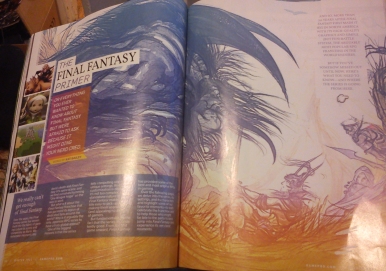
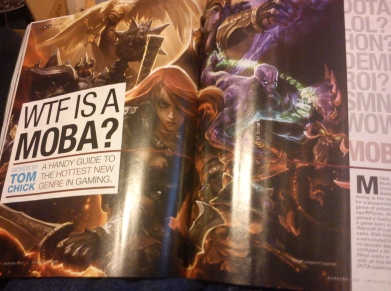
For example, it's hard to explain much about the intricacies of Final Fantasy in a limited amount of space, but the primer does a reasonable job of sorting it all out for newbies. There's also a brief article about the history of Zelda, though it seems like every mag has one of those (Future Publishing put out a whole special issue devoted to it) so it doesn't stand out as much. The one explaining what the hell a MOBA is (that's basically the title of the article) that's also quite well done. (They're sorta like an RTS where you control a single player character and you help the other guys, who are controlled automatically.)
There's a lot of introductory-type stuff which hits more towards the mainstream than readers of this site would probably like, so it's not exactly Gamefan, but at the same time the writers have an obvious appreciation outside of the usual AAA blockbusters that's usually featured prominently in US game magazines.
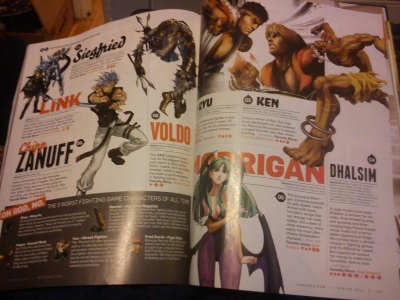
I do have to take issue with the cover article, which ranks the top 50 fighting game characters of all time. There are some things which rub me slightly the wrong way - not so much that they picked characters from Super Smash Bros., so much as Marth, Pikachu and Link aren't really original fighting game characters. More annoyingly, its preface is meant to defuse any "where's my favorite character?" arguments, but its problem is much larger they that - they almost entirely ignored SNK's line of fighers. These aren't some fringe, obscure games either, they were one of the most popular developers in the 90s, and just because their properties haven't been kept alive in the same way that Capcom's have, doesn't mean they should've been ignored. I don't expect everyone to know how goddamned awesome Gato from Mark of the Wolves is, but where's Terry Bogard? Kyo Kusanagi? Iori Yagami? Geese Howard? Haohmaru? That's only scratching the surface of the huge array of iconic characters in SNK fighting games, and only one that even got a mention was Mai Shiranui under the "hottest gals" category. Why were the others passed over in favor of joke entries like "Red Guy" from Karate Champ, Meat from Mortal Kombat 4, and the midget from Thrill Kill, which was never even officially released? It's things like this which suggest that the people in charge of the list either weren't knowledgeable enough about the genre, or were otherwise pandering to a readership who they suspect wouldn't get the references. Given the quality and approach of the rest of the magazine, I'm going to lean towards the latter. But I've rambled on enough and leave any more bitching to the thread on the Neo-geo.com forums that's undoubtedly devoted to it.
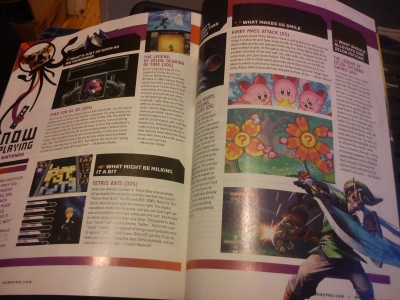
SNK fanboyish aside, it really is a classy issue. The content is generally great, the layouts are classy and distinct (a huge step above Edge's recent awful redesign), and it's solid enough to be worth the $10, even if it does make me wistful for the days of 200+ page issues of Next Generation that cost half the price.
Wednesday, November 2, 2011
Magazine Reviews - Nintendo Fun Club #1
Hello, I'm Alexander Case. I recently did write-ups of the the numbered titles in the Might and Magic series. In the past, in my personal blog, I've been doing write-ups of old issues of various video game magazines. I've decided to continue this here, where I'll be taking a look at old issues of Nintendo Power magazine, starting with the magazine's original form – the Nintendo Fun Club Newsletter. I'll also be doing some write-ups of titles that are covered in the magazine but not on the site.
A little background first. Nintendo started the Fun Club, as with most other fan clubs, as a marketing tool for Nintendo. Around the time of the NES's release, most of the video game magazines that would have provided publicity for NES games had either gone under, or had switched their focus from the more-or less deceased console market to home computers. Thus, if Nintendo wanted to get the word out on upcoming titles for the NES, they would have to do it on their own.
A little background first. Nintendo started the Fun Club, as with most other fan clubs, as a marketing tool for Nintendo. Around the time of the NES's release, most of the video game magazines that would have provided publicity for NES games had either gone under, or had switched their focus from the more-or less deceased console market to home computers. Thus, if Nintendo wanted to get the word out on upcoming titles for the NES, they would have to do it on their own.
Friday, September 9, 2011
Videogames Electronic Games Thought (And Hoped) We'd Never See

Originally published from 1981 to 1985 (and resurrected later), Electronic Games was one of the first periodicals devoted entirely to videogames (as they wrote it as one single word). In their March 1982 issue (#3) they had "A Humorous Look at Some Unlikely Future Videogames." I'm sure what they came up with was terribly funny in 1982. Some of it still is. But you know what'd be even more fun? Digging their "ridiculous" ideas up now and see how many of them have since been made into actual video games!
Now their descriptions are sometimes awfully detailed and represent to a degree the technological status of 1982, as well as the general state of the industry, so we'll be counting games that follow the same general concept, or even just include the proposed main elements (after all, games have grown more complex in general, and many of the ideas on their own would nowadays be dismissed as overly simple). Do comment, of course, if you know any more fine examples.
Freeway Menace

While not following the "exact" same story premise and they don't (predominantly) take place on the freeway, the Crazy Taxi games would be an almost perfect fulfillment of the basic idea for the gameplay.
The screenshot that I think was supposed to go with it (although it gives the game a different title) on the other hand looks much closer to Carmageddon, while it also resembles the top-down view GTA games in their habit to distribute points for killing pedestrians.

Alien Invaders

Holy crap, that's a risque concept! I still don't think we'll ever see that one in a commercial game, unless you count X-Com.

Nuclear Wargames

I vaguely remember nuclear weapon technology being somewhat of a big deal in Civilization as an optional research, then later the nuclear strike in Command & Conquer as a straight wargame? Nowadays nuclear war in video games sounds almost trivial, doesn't it?

Prom Night Massacre

This is kinda a cool concept, like a slasher movie with one player being the mysterious killer and the other one of the potential victims. Could somehow work as an online game where the two (or more) players genuinely have know means of knowing who's the killer, and that card is dished out randomly at the beginning of each round. I'm sure there must be something like that at least as an optional mode in any game, even if lacking the prom night scenario?
Gang Wars

They really could have foreseen this, couldn't they? Double Dragon, River City Ransom, GTA, Mafia, The Warriors, whatever. Next!

Medflies / Deluxe Medflies

Maybe for Harvest Moon 25: Industrial Edition?

Roman Circus

Gladiator games are legion, too. This started very early on with games like the 1986 arcade 1-on-1 fighter Gladiator, more recently we'd gotten Gladiator: Sword of Vengeance and Colosseum: Road to Freedom, some of the Asterix games, too. Shadow of Rome even tied the fights into a huge epic narrative, sporting the complete package of wild animal fights, gladiator rumbles and chariot races. The latter have been explored quite frequently as well (Computer Circus Maximus, Coliseum, Ben Hur 2000, Circus Maximus: Chariot Wars).
I think putting players in control of the wild animals would be new, though (or maybe there's an unlockable in one of the aforementioned games that I don't know about). The whole Christian convert angle promises hilarity, too.

PADI Scuba Scare

Why hasn't this concept been exploited more often, actually? There are a couple of diving-themed games for 8-bit systems, but most are rather simple shmups. The only true simulation is Sea Rogue, released in 1992, where the actual diving is just one part of the whole expedition you have to plan from the ground-up, including hiring divers, scientists and engineers. The rival here is always CPU-controlled, though.
Afterwards many games have dabbled with stages where you're diving for treasure, from Super Mario 64 to Ninja Gaiden (Xbox), but a modern, competetive diving action/simulation? Hell, yeah!

Teacher Terror

This has been done so many times in homebrew games, only from the opposite angle. The commercial consequence would be Bully / Canis Canem Edit. The teacher perspective, however, would be... quite boring, I think. (Though I'm sure there are enough Japanese teacher-student porn games to make up for it.)
Lynch Mob

This is also kinda contained in GTA (although you're hunted by the feds there, they're just as bloodthirsty as soon as you hit a 2-star wanted level).
Brain Transplant

Done in Life and Death (the sequel carries the even more fitting subtitle The Brain), in an even more macabre manner than it is described here. Take Trauma Center for the less tongue-in-cheek approach.

Porkbarrel

Political simulations with a focus on corrupt activities are typically set not as close to home, favourably in fictional third-world or communist countries (Tropico series), or in historical settings (Merchant Prince).
The article also has a list of "coming-soons":
Video Horseshoes (almost certainly done as a mini-game somewhere)
JAA Championship Jacks (ehrm... no.)
Potato Yields in Brecklovik, Russia (most definitely not)
Video Coin Toss (mini game in many Soccer simulations. And in Shenmue II, but there you always lose)
Natural Disasters (Disaster Report says hello)
Video Iconoclasm (WTF? There's an indie metroidvania whith the title Iconoclasts!)

Actual game screenshots borrowed from Abandonia (Life & Death 2), Strategy Informer (Shadow of Rome, The Warriors), Mobygames (Sea Rogue) and Game Breakers (Carmageddon).
Wednesday, September 7, 2011
GameFAN issue #06
 It’s taken a while – in fact page 66 even jokes that it took 6 months to arrive – but GameFAN issue 6 is finally with us. That’s a lot of sixes, isn’t it readers? Clearly the BEAST has willed it to be.
.
.
.
The first thing that strikes you is the stunning, hand-drawn cover art, which is rarity these days. I collect games mags as much if not more than I collect games these days, and very few magazines do anything other than recycle CG assets handed out by PR people. Very few actually commission artists to create the covers. EDGE almost never does it. GamesTM hasn’t done so for... I can’t even recall when last. EGM when I subscribed didn’t even bother with decent CG (their Halo cover looked like an exploded Ribena box). Leaving only France’s IG, Retro Gamer and GameFAN doing anything of merit. And to be fair, most of the time Retro Gamer’s content is so old that they’re forced to produce their own content for covers.
 The man behind GameFAN’s artwork (and a lot of imagery at its predecessor Play) is Rob Duenas. He also does the majority of page layouts, and I think it’s fair to say that his work is the aesthetic soul of the magazine. Having spoken with Rob via email on occasion he proclaims his goals: “The biggest treat for me has been growing the retro coverage and drawing the covers. It’s hard work but worth it to bring back original drawn covers to magazines... Lord knows it’s a rarity, most art is just concept stuff from companies or box art.”
 A commendable attitude, I’m sure everyone will agree. In fact this issue he takes us through the creation process for the cover, in connection with his regular podcast Sketchcraft, which details all manner of artistry. As he explained: “The Sketchcraft spread I put together on how I made the covers is also a free podcast I make complete with follow along PDF showing 50+ more of my steps. The cast is like audio commentary, just another GF special. Recording Bloodrayne cast this weekend, but the 3DS is up now.”
If you have any interest in GameFAN, magazine design, comics, or creative art in general, it’s well worth checking out the podcasts and associated files. There are two sites:
sketchcraft.com
http://sketchrob.podomatic.com/
Also, I should add I’m not affiliated with the website despite my internet name. My using of Sketcz is 70% the nickname Tim Rogers gave me on InsertCredit, 20% East European spelling convention, and 10% Sega’s phenomenal Mega Drive game Comix Zone.
 Highlights this issue include a 3 page interview with NG:DEV.TEAM, creators of Last Hope and the to-be-released GunLord, which is coming out on NeoGeo MVS and Sega’s Dreamcast. Gotta love these teams who keep rockin’ it on old hardware. The group says GunLord will be comparable to Turrican, and as a European and Trenz fan to this I’m going to say: hells yeah!
There’s also a ton of 3DS coverage, though being happy with my current handhelds I only skimmed this.
 There’s also three pages on Dragon’s Crown, which is excellent. The in-game screens are so exquisite it’s difficult to image them as actual games, as opposed to only static artwork. But that’s Vanillaware for you – taking 2D to new levels. The write up itself is also good, done by new man and Managing Editor James Bacon. It starts with a rundown of Vanillaware history, which is essential for newcomers, and reminds me of the fact that Play before it always used to give the developer the time they deserved in the spotlight, granting front covers to not only Odin Sphere but also Muramasa. Outside of Japan I don’t think any other magazine even entertained such an idea. Those were good times.
 Lengthy five page review of the new 2D Bloodrayne by developers WayForward, who are making a name for themselves as one of the few (the only?) Western developer still capable of doing 2D. In fact they’re kinda like a Western version of Vanillaware. And all I can say is thank your deity of choice both companies exist, because gaming would be a lot less interesting without their two-dimensional output.
 Three page review of El Shaddai. Well timed too despite the time it took to produce this issue, since the same morning I got my copy of GameFAN I got my copy of GamesTM, and both featured El Shaddai. Both magazines praise it, in fact everyone online also seems to, but I’m still slightly nervous after playing that demo...
 Interesting approach to the Journey review – very arty.
Having read the reviews, I want to address an issue I noticed on a forum, regarding a lot of the positive coverage the mag gives. Although the lowest review score this issue was 6.5, and it mostly has high scores for its games, the impression I get is that they’re covering the games they like, as opposed to everything possible. A snapshot of staff favourites almost. Which makes sense considering they run less pages, plus I have to be very interested in a game before I read through a review in another mag giving it a low score (like DS shovelware you’ll see being reviewed – I just skip those).
The challenge for GameFAN seems to be growing its audience and recognition, since what I gather from people I know in the US, it’s not always easy to find stores stocking it. Did you know this was out?
 Moving on from modern coverage, this issue also marks the creation of a dedicated retro section, 16 pages long. I haven’t read everything but it’s looking good (I’d also not come across the Macross game before, so reckon I might have to give it a try now). The two-page spread listing top Capcom and Saturn games apparently was going to be some kind of special comic, but it didn’t make it in time. A nice trip down memory lane nonetheless. The Saturn coverage is especially poignant for me because it was a great system, with a selection of truly astounding hardcore titles, and yet it never won the console war. I actually received Keio Flying Squadron 2 in the post recently, and must get around to playing it. Yes, I think if I fell through time I’d like to relive the Saturn era, and use my foreknowledge to guarantee its success.

Subscribe to:
Posts (Atom)