Showing posts with label timeline. Show all posts

Saturday, November 19, 2011

Ouch, that looks like it hurt!


Getting injured in video games is usually inconsequential. The hero loses a chunk of his health bar, maybe bleeds a little on the floor, but as soon as he's dealt with the enemy and marches on, you'd never be able to tell he's just been perforated by a gunload of hollow point bullets. Or take the amazon warrior, who needs no protection aside from her metal bikini, as her skin proves just as impenetrable as the steel her risque fashion choice is made of.

There's various reasons for that. Of course technical and workload limitations are always an issue, but aesthetic choice probably also spared us beaten-up, teethless brawler protagonists and RPG love interests covered in scars and bruises. Less superficial accounting for wounds also brings extraordinary game design challenges: How much fun is it being a platformer hero with a realistically depicted broken leg?

That doesn't mean that no one has ever tried showing us players what's going on with our alter egos on the screen. Here is a look at games that went through the lengths of visibly abusing their characters for our enjoyment. While there are tons of cars, tanks, planes and mechas that have been torn to shreds in the history of video games, we're only looking at characters of pixellated or polygonal flesh and blood. Gratuitous death animations aren't enough to qualify, either—characters have to live with their injuries, at least until the next health pack shows up.


Ghosts 'n Goblins (1985)

In the old days of low resolution and few colors, wounds on a player character simply wouldn't have been recognizable as such. There weren't many pixels left in between Arthur's beard and his helmet to make any scratches identifiable, so to show that he's now more vulnerable after a hit, the clever pixel artist at Capcom just took away his armor, leaving him running around in his underpants. A second hit then will leave nothing but hsi crumbling bones. This mechanic lives on in the game's various sequels, and is even picked up for the series reboot Maximo (2002). Capcom's own Black Tiger (1987) and Natsume's Pocky & Rocky 2 (1994) work similarly, too. (picture right: Super Ghouls 'n Ghosts, GBA; below: Maximo)


Super Mario Bros. (1985)

Released just a little bit later than Ghosts 'n Goblins, Super Mario Bros. shows another workaround for the fact that Mario's face can't take any more red pixels beside his cap and moustache. When he gets hurt, he simply shrinks in size. One could argue about the eligibility of this example, though. In the original, the small size appears to be his natural state. In Super Mario Bros. 2 (1988, pictured), however, Mario starts out big, and in the later 3D games that drop the feature, he's no dwarf, either.


Gladiator (1986)

Fighting games seem to be the predestined genre for this. But fighting game characters also start out with stripping their clothes instead of ripping their flesh. Hits on the different parts of a characters' armor will make them fall off, another hit on the now unprotected part kills. It is interesting to note how at least the Japanese version knew no discrimination of the sexes and shows the female warrior just as bare-chested as her male counterparts.

Developer Allumer refined the concept with their 1992 game Blandia, and it has since been imitated in various other, predominantly Japanese, fanservice-y fighting games like Fighting Vipers (1995) and Soul Calibur IV (2008), not to name all those Doujin strip fighters. Many gamers have been very curious what pieces of armor Ivy was supposed to lose.


Art of Fighting (1992)

NOW we're talking! Art of Fighting is the first game were players really can beat each other's faces to pulp. Towards the end of the fight, both combatants are often hardly recognizable, anymore. The game also became infamous because Yuri and King could get their shirts blown off when finished with a fireball attack, which carried over into the first King of Fighters games. Art of Fighting 2 works in the same way, but unfortunately SNK dropped the feature for the 3rd episode.


Time Killers (1992)
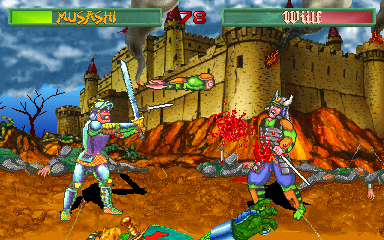
In the wake of Mortal Kombat came this new epitome of bad taste. The game featured fatalities just like its role model, but character's arms could also be severed during combat, forcing them to go on with a limited moveset. Continued with Bloodstorm (1994), where combatants could also go on without their legs, skidding over the floor on their intestines.


Wolfenstein 3D (1992)

Most first person shooters automatically disqualify for this list because... well, because you never get to see your character. Wolfenstein 3D circumvented this issue by placing the head of hero Blascovich into the on-screen display, where you can see it growing bloodier and bloodier the lower your health gets. id used the same feature in Doom (1993), and the animated mugshots were also adopted by the later Might & Magic games.


Robinson's Requiem (1994)

Another first person game, but Silmaril's science fiction retelling of Robinson Crusoe befittingly is a survival adventure. Visible damage comes into play on the player character's profile, which is used to apply bandages, makeshift splints and medication. This game is one of the rare occasions where your health also affects your general performance. As an extreme, your character literally goes blind when birds hack at his eyes! Continued with the sequel Deus (1996), which also adds an infrared view with your skeleton. Both games are available bundled at GOG.com. Call of Cthulhu: Dark Corners of the Earth (2005) features a simplified variant, so does Metal Gear Solid 3: Snake Eater (2004), although the latter without visually showing the damage.


Götzendiener (1994)

As our first example of story-driven damage, Götzendiener falls back to the old hurting=stripping formula. The heroine in this very short game starts out in cpativity of a demon. A knight in shining armor comes to rescue her, but dies together with his foe. No longer under watch, the resolute damsel takes her rescue into her own hands, losing parts of her garments with each chapter.

Many later games have taken the same approach: Die Hard: Arcade (1996), Prince of Persia: The Sands of Time (2003), Heavy Metal: FAKK 2 (2000). The latter has the heroine frequently changing her attire to counteract to the textile decay, which doesn't mean she's gonna show less skin that way, as her outfits just get skimpier and skimpier.


Resident Evil (1996)

Capcom's horror shocker didn't modify Chris' or Jill's models or textures to show how grave their condition is, but the animation. Injured zombie hunters started limping, which also made them significantly slower.

Kinda adopted by Silent Hill (1999), only Harry Mason always runs like he's just been shot in the foot.


Super Mario 64 (1996)

One of the innovators of the category makes his return. Mario doesn't shrink anymore, but when he's at the last quarter of his health, he's visibly out of puff. This becomes a very popular feature in cartoony 3rd person games, even just on the N64: Mystical Ninja Starring Goemon (1997), The Legend of Zelda: Ocarina of Time, Conker's Bad fur Day (2001) ... the list goes on.

This has also been seen in 2D games like Mega Man X4. Do you know any examples that predate Super Mario 64?


Bushido Blade (1997)

Bushido Blade and its sequel do away with the silly health bar convention in weapon based fighters entirely, and instead semi-realistically accounts for damage done to indivudual body parts. It doesn't have any of the instant gratuitous feedback of Time Killers, but characters start to limp when injured, and they'll wear bandages in the following fight.


Deathtrap Dungeon (1998)
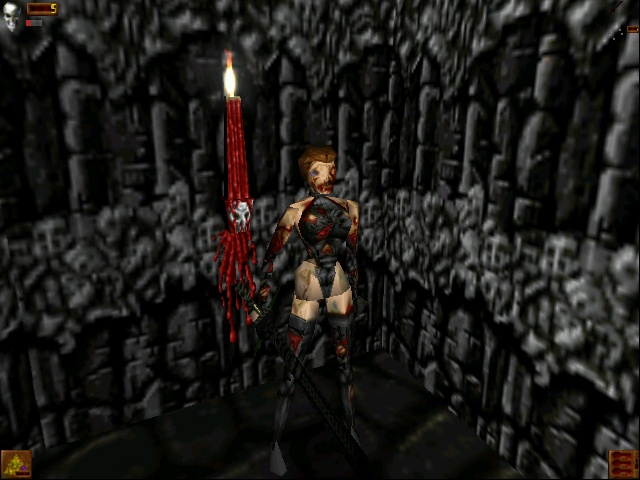
The game that motivated this post. From my article on the title: "There is, however, one really cool feature that got dropped in the conversion [to the PSX]: On the PC, all the damage the adventurers took would show on their body. You see their bruises, cuts — even arrows keep sticking in their flesh until healed." 'nuff said...


Jurassic Park: Trespasser (1998)

Almost doesn't count, because it's not actually the heroine's body that changes appearence, just the tatoo on her chest gets tainted red.


Illbleed (2001)

Another interesting variant on cloth damage, and also a really surprising twist on New Game Plus. Eriko has to rescue her friend from a cursed amusement park, but whenever she fails and one of her friend dies in a second playthrough, her clothes get ripped apart a little more, posing a real moral dillemma for the young male player. If you really screw up, in the end she'll be covered by nothing more than smears of mud and three tiny shreds of cloth at three laughably convenient spots.


Tao Feng: Fist of the Lotus (2003)

Possibly the first fighting game to bring Art of Fighting's approach into the third dimension, the failed comeback of a former Mortal Kombat developer featured quite impressive damage ranging from cuts, dirt and bruises to torn clothes.


Fable (2004)

Fable sure as hell didn't go for short-lived diversions. In Peter Molineux' most persistent obsession yet, you don't get a love interest, you get spouses—lots of them. And you don't get merely injured, you get scars. By the second game those were the least of your worries, though, as skilled characters automatically turned into monstrous beings suffering from gigantism and shiny blue varices all over their body.


Fight Night 2004 (2kduh!)

As a genre were endurance is one of the deciding factors for victory, sports games simulated fatigue in some way or the other since 8-bit times, with slower movement, weaker passes or whatever. With growingly powerful hardware, especially wrestling and boxing games started to go to great lengths to convey how exhausted the combatants got. The most excessive example yet is the Fight Night series, where characters not only get cuts, black eyes and bruises, but also sweat like pigs and start dribbling when they've no energy left in their bodies. (picture below: Fight Night Round 4)


Oneechanbara (2005)

"You're bleeding!"
"Don't worry, that's not my blood."

The girls of the Bikini Samurai Squad turn into a bloody mess when they hurt others. Zombies bleed all over them with their cursed blood, eventually forcing them into a murderous frenzy. They also occasionally have to shake the blood of their swords, lest they become useless. Particularly tasteless: Some of the games offer settings to vary the color of the blood, white being one of the possible choices. It looks naughty.


Retro Game Challenge / Game Center CX: Robot Ninja Haggleman (2007)

Although it is predominantly a hommage to Ninja Jajamaru-kun, the fake-classic action platformer series also contains a nod to Ghosts 'n Goblins—only the little ninja doesn't lose his armor, instead is eyes bulge out. The spin-off Haggleman - Koume Version on Game Center CX: Arino no Chousenjou 2 features the ninja's sister, who has her arm in a sling after a hit.


Batman: Arkham Asylum (2009)

Actually another entry from the Götzendiener school, but nonetheless deserving of its own entry, because Batman also gets scratched here and there, and grows awesome stubble on his chin over the course of this longer-than-planned mission.


Mortal Kombat vs DC Universe (2008) and Mortal Kombat (2011)

You'd think that the one series so famous for its sadistic treatment of its characters would have jumped the train earlier, but up to Mortal Kombat vs DC Universe, characters may have lost gallons of blood, but they could only really be injured—and instantly killed—with Fatalities. The 2011 reboot goes one step further with x-ray vision for special combos.


The 3rd Birthday (2011)

Another stripping game, only here Aya Brea's clothing status is directly tied to her health. She can lose an impressive amount of fiber, but scratch marks also prove the monsters didn't just want to see her naked.


El Shaddai (2011)

It may be the shittiest high-profile game of this console generation, in El Shaddai instead of a health bar you see your armor cracking and shattering, revealing that the protagonist doesn't actually have huge man-boobs.


Tomb Raider (2012)

In Tomb Raider Underworld, the grave robbing brit could already get wet and dirty. (No, not what you're thinking!) Now trailers of the new reboot show a very beaten-up Lara Croft soaked in blood. It remains to be seen how it will all work out in the game, though.


Screenshots taken from Strategy Informer, GameFAQs and GOG.com.


Friday, May 27, 2011

A Brief History of Western Action RPGs


The action RPG is a genre that could thrive first and foremost in Japan, where influences of personal computer games often resulted in new interpretations on game consoles, thus benefiting a healthy melange of genre traditions. Mixtures like that were initially fewer in the West, due to the consoles and arcade games being marked mindless quick entertainment by an elitist home computer crowd for real deal hardcore simulations and RPGs, which were the domain of computers with lots of memory (for the time) to store all those stats. Yet early on there were a few attempts to adapt what was originally inherited from tabletop war games to a more responsive and involving model, and with the slow demise of slow-paced turn-based gameplay eventually ARPGs would catch on as a main stream genre also among Western developers.

The rise in popularity of the genre in modern times may deceive from the fact that it has truly ancient roots, and there is much confusion and oblivion about the actual early innovations. So, following up on our Brief History of 2D Fighting Games, we'll have a look at what was going on with the ARPG genre in the US and Europe over the decades. (I know a lot of you will be yearning for a parallel feature on Japanese games. Such a thing is bound to follow some day, but don't hold your breath just yet.)

Of course I am likely to be eaten by a grue for all the omissions and games I simply didn't know about. Everyone's got their own definition of what belongs in the genre, too, so please be nice when you point out to me all the games I've idiotically left out/falsely included. Please also note that I originally put this post together late in 2010, but ended up not posting it for a number of reasons. I haven't really followed the genre since then, so this is a history for the time until 2010.

Adventure (Atari 2600)


1980-1982:
  • Adventure is released for the Atari VCS in 1980. Yeah, it doesn't have The RPG Elementz(TM), but that doesn't mean it was not an important antecede for the Action-RPG genre. For the first time in an action game, players got to do adventurey stuff, exploring dungeons, finding keys and weapons. Probably exerted more influence on Zelda and the Japanese ARPG tradition than the western one, though, directly or indirectly.
  • Most of the very early computer RPGs have their roots in Dungeons&Dragons applications for big university mainframe computers, so it's hard to work out a timeline for them, but from 1980 to 1982 a lot of them have been ported to home computers, as well as some new, original games. Automated Simulations' (later Epyx) Dunjonquest series and The Sword of Fargoal, as well as Daniel Lawrence's Telengard still played out pretty much like "normal" RPGs with a time limit to your moves.
  • Dungeons of Daggorath did similar for the 1st person crawl (although it had a really interesting feature of a heartbeat sound indicating your level of fatigue and damage and at the same time giving a greater sense of urgency).
  • Also from Automated Simulations, Dragon's Eye combines boardgamey exploration with what can only be described as a fighting game with an ATB battle system, as little sense as that seems to make on paper.
  • The first batch of official Dungeons & Dragons games is released for the Intellivision, but only Treasure of Tarmin vaguely resembles an RPG/Adventure experience.
Dragon's Eye (Apple II)

1983:
  • Gateway to Apshai, an offshoot of the Dunjonquest: Temple of Apshai RPG series, is the first ARPG proper world-wide, predating even the Japanese genre forebears Dragon Slayer and Hydlide. Combat takes place in real-time with reliance on player skill, although there are also stats to be leveled up (which happens mostly automatically without offering any choices for the player), and there is a lot of loot to find in the dungeons. This being a pure dungeon crawler, only NPC interaction is missing from the modern standard formula.
  • Dandy by John Palevich is the progenitor to Gauntlet. It gets later remade as Dark Chambers in 1988.
Gateway to Apshai (C64)

1984:
  • Gemstone Warrior, SSI's first dabbling with the genre, is more of an action adventure by today's standards. The player once again explores dungeons and kills monsters in real-time and searches for treasures which amount to the score. There's item management and a limited supply of ammunition, but no experience system.
  • Icon: Quest for the Ring by the small and unknown developer Macrocom plays like a simplified Gateway to Apshai, but surprises with astonishing CGA techniques that avoid the typical ugly 4-color scheme and make for one of the best looking IBM-PC games of its time. According to a developer interview at MobyGames, the game was popular as a demo for graphic cards in Japan. Could it have been a direct inspiration for Zelda?
  • Also into adventure territory falls Knight Lore, which explores the isometric perspective (and later influences the use of the perspective in Adventures/RPGs in general, as well as Solstice and its successors in particular, which in turn inspires Landstalker and its sequels).

1985:
  • Origin Systems creates Autoduel, the first racing RPG. Eat that, Squaresoft's Racing Lagoon.
  • Also published by Origin Systems is Moebius: The Orb of Celestial Harmony. The game takes place in a vaguely far eastern fantasy setting, with a focus on martial arts training and a fighting game style combat system. The characters awkwardly walk around as profile pictures and the combat controls are horrendous, but the concept is nonetheless unique and interesting.
  • Gauntlet is released the same year. Though also not quite an ARPG in itself, it is save to assume that without Gauntlet, there would be no Diablo (and in consequence neither most other WARPGs we know today).
Auto Duel (C64)

1986:
  • Gemstone Healer, sequel to Gemstone Warrior.

1987:
  • Conceived as an RPG for dummies, David Joyner's Fairy Tale Adventure might be the first western game that fits all modern ARPG definitions without fail, finally causing some steam for the (nowadays) classical top-down ARPG in the west.
  • Dungeon Master brings 1st person real-time RPGs en vogue. With a fighting system based on intervals slightly resembling the later Final Fantasy ATB, it is also no "true" ARPG, though. Aside from a sequel, tons of games follow its formula for combat, among them Bloodwych (1989), Eye of the Beholder (1991), Black Crypt (1992), Lands of Lore (1993).
  • Macrocom delivers a follow-up to Icon with 7 Spirits of Ra. The game takes place in ancient egypt.
Faery Tale Adventure (Amiga)

1988:
  • Times of Lore (Origin Systems). The NPC interaction is as complex as you'd expect from an Origins game at that time, there's no character generation but a selection of three pre-built heroes, and the combat is fully realtime action. Might or might not be the first game with jiggle animation for the female protagonist.

1989:
  • Hero's Quest: So you want to be a Hero (later renamed to Quest for Glory because of legal issues with Milton Bradley's board game) at one hand was a typical Sierra adventure, but also featured different stats and classes for the characters, which have a huge influence on how the game is played, as well as action based combat.
  • Hillsfar is more like an RPG/Mini Game compilation. Arcade style combat takes place only in the Arena.
  • Windwalker is the sequel to Moebius and fares much better thanks to icon-based mouse controls.
  • Also: Gauntlet II.
Quest for Glory (DOS)

1990:
  • Darkspyre by Event Horizon Software could be seen as another antecede for Diablo, albeit with fixed dungeon layouts.
  • Origin's Bad Blood is similar to Times of Lore, but shifts gameplay even more towards action-adventure and is set in a postapocalyptic future where one of three mutant spies is sent out to investigate and avert human war plans.
  • In The Keys to Maramon, a spin-off of the The Magic Candle series, the player gets to chose between four characters and then has to protect the town of Maramon against invading monster hordes. The game features a day/night circle: At night all shops are closed and the fiends start storming in.
  • Quest for Glory continues with its first sequel, the main character can be imported in good, old-school RPG fashion.
Bad Blood (DOS)

1991:
  • Two games based on Norse mythology are released that year. In Dusk of the Gods, Event Horizon builds upon their groundwork laid with Darkspyre, while the Britains at Core Design put themselves on the genre map with Heimdall.
  • Conan the Cimmerian hails as the first licensed ARPG not based on a pen&paper or tabletop game. For combat the game switches to a fighting game-style 1-on-1 sideview.
  • Another licensed title, Robin Hood: Prince of Thieves, was adjusted to tie in with the Costner movie just in time, leaving an unfinished feel about the game. Released for Game Boy and NES, it is the first console exclusive western ARPG.
  • Gauntlet III: The Final Quest (Won't be mentioning any more episodes of Gauntlet beyond this. With the genre as developed and defined as it is by now, the series just doesn't cut it anymore.)
Dusk of the Gods (DOS)

1992:
  • Ultima VII makes first (very slight) concessions towards a more action-oriented combat by introducing realtime.
  • The big attraction of the year is Ultima Underworld, though, with its real-time rendered 3D world, predating even Wolfenstein 3D.
  • Event Horizon bring a direct sequel to their 1990 debut, called The Summoning, so in this year one of the last great 2D dungeon crawl ARPGs (for a while) meets the first great realtime-3D dungeon crawl ARPG.
  • Sierra releases Quest for Glory III.
Ultima Underworld (DOS)

1993:
  • Ultima Underworld II is released, but doesn't stray much from the paths laid out by the first game.
  • Event Horizon in the meantime explore more adventure-esque paths with Veil of Darkness (which in a way anticipates their much later game Sanitarium). This is their last game before closing and reforming as DreamForge Intertainment.
  • In Hired Guns by DMA Design a team of 4 cyber agents infiltrate futuristic complexes in real time over 4-splitscreen, similar to the Dungeon Master formula. Quite a stressful task for a single player, so the game also supports multiple players simultaneously. (For comparison, the first big Japanese multiplayer ARPG, Secret of Mana, was released the same year).
  • Only one year after the third part comes Quest for Glory IV.
Hired Guns

1994:
  • Warren Spector, formerly of Origin System, changes the world with System Shock and its genius mixture of RPG and FPS elements.
  • Probably through influences from Japan, western developers by now also seem to discover the console-style ARPG for themselves. SSI's Al Qadim: The Genie's Curse would have worked just as well on the Genesis or SNES
Al Qadim
  • Interplay for once releases an ARPG that isn't a straight port of a computer game, but adjusted to what they deemed suitable for the platform - J.R.R. Tolkien's Lord of the Rings Volume One for the NES has (other than shared source, art and music) little in common with its PC counterpart, which is a traditional turn-based RPG. With a party of up to five, each of which can be controlled by a human player, it has the highest simultaneous player count in an offline ARPG ever.
  • Blue Sky software delivers a console title as well, Shadowrun for the Genesis (while the SNES game is more like a traditional RPG in that, though realtime, player effort has little influence over the combat vs character stats).
  • King Arthur & the Knights of Justice shares many features with an ARPG, however it lacks a levelup system.
  • Heimdall 2 is also much more console-like than its predecessor and becomes an important title for Commodores Amiga CD32 console.
  • The main Ultima series now makes is full jump to a point&click based action RPG with platforming sequences, much to the dismay of old time series fans.
  • The Elder Scrolls: Arena in turn manages to build a bridge between the concepts of Ultima Underworld and classical fantasy world exploration.
System Shock (DOS)

1995:
  • As great a year 1994 was, the more dreary appears the slump in 1995. The only western PC title that comes to mind is Entomorph, which features an interesting setting but proves quite insignificant, gameplay-wise as well as on the market.
  • Things look a bit better on the console side. Squaresoft America sets up a development team to create Secret of Evermore, inspired by Japanese game mechanics (namely a combat system taken from Secret of Mana; but on the other hand also an ingredient-based magic system that resembles that of more recent Ultima episodes) but with an audiovisual design meant to cater to American gamers specifically.
  • Lucasarts creates Big Sky Trooper. The unique Sci-Fi action RPG falls under most people's radar for combining overly cutesy graphics with complex mechanics.
  • Ocean's Addams Family Values follows closely in the footsteps of The Legend of Zelda.
Big Sky Trooper

1996:
  • The Elder Scrolls: Daggerfall is likely the biggest RPG ever, in terms of sheer world size. YMMV once again whether it is an action- or a "true" RPG. My mileage says I won't mention any more main series entries, as now the demise of the turn based RPG in the west has begun to set in, and real-time combat loses its role as a distinguishing factor between the subgenres.
  • Most of all, 1996 is Diablo year (though some sources claim it was released in January 1997. We Europeans got it a bit later, anyway, so I wouldn't know), marking the end of the big RPG draught. The vast majority of western ARPGs to come will be influenced by Blizzard's megahit in one way or another. Love it or hate it, deny its RPG status, whatever: Diablo is the most influential game for the genre of the whole decade.
Diablo (Windows)

1997:
  • Lands of Lore II is released, other than the first game a pure ARPG with lots of FMV sequences and digitized graphics, filling 4 CDs.
  • Faery Tale Adventure also makes its comeback with part 2: Halls of the Dead.
  • The Elder Scrolls: Battlespire ditches the huge overworld and NPC interaction of its predecessors, so it almost plays like a straight action game.

1998:
  • Now the era of "Diablo clones" begins: Ancient Evil, Dink Smallwood, Hexplore (the latter featuring a voxel-based 3D engine and a party of four exchangeable characters).
  • Tomb Raider's mark on the industry also becomes clear: Bethesda Lara-fies their Elder Scrolls series with Redguard, the French RPG sovereigns at Silmarils bring Asghan: The Dragon Slayer (the Action-Adventure genre should start to return the favor the next year with Drakan: Order of the Flame).
  • After a long pause, the Quest for Glory series is concluded with its fifth and final installment.
  • Interplay releases Descent to Undermountain. Using the successful Descent engine and the even more successful AD&D license, the game is a huge disaster, often quoted as the most bug-infested retail game ever and/or the worst RPG ever.
Hexplore (Windows)

1999:
  • Ultima's main series turns 3D with Ascension, but after endless revisions from the groundup isn't the game fans wanted, they call it pejoratively an "action adventure". It also ships with lots of bugs, and receives many fan mods to fix its several flaws.
  • Lands of Lore III is released and considered the weakest title in the series as well.
  • More Diablo clones: Revenant, Darkstone, Clans.
  • The year is saved by System Shock II, once again the best thing since sliced bread.
  • Another mention deserves Silver, which combines Japanese-style inspired RPG flair with beat 'em up fights and mouse gesture special moves.
Ultima IX: Ascension (Windows)

2000:
  • Diablo II is released, and it would have completely rejuvenated the hype around its predecessor, hadn't it been going strong consistently over all the years, anyway.
  • Warren Spector continues to explore new grounds with his cyberpunk thriller Deus Ex, which gives more meaningful plot decisions into the hands of the player than any game before.
  • Also: Summoner for PC and consoles, Nox.

2001:
  • Piranha Bytes apparently takes any concepts that are salvageable out of the trainwreck that is Ultima IX (figuratively speaking), patch it all up with what they carried over from their pen&paper passion, and somehow make a great game out of that. The new German RPG prodigy is called Gothic.
  • No end to Diablo-inspiration in sight: Vampire The Masquerade: Redemption and Throne of Darkness (in a samurai setting).
  • But 2001 marks also the beginning of console hack&slay shovelware with Baldur's Gate: Dark Alliance, an attempt to cash in with the biggest name in non-action RPGing at the time.
  • Also: The obscure Euro-only title Technomage that dreams of being Japanese; Dragon Riders: Chronicles of Pern, based on the fantasy novels by Anne McCaffrey.
Gothic (Windows)

2002:
  • With Divine Divinity by the Belgian Larian Studios and Dungeon Siege by Gas Powered Games, the Diablo worshippers start to create something more meaningful with their time.
  • Gothic gets a sequel, which manages to excel the expectations set up by the first game.
  • The Lord of the Rings: The Fellowship of the Rings, oddly enough not based on the recent movie, but the book
  • Only one month later EA brings The Lord of the Rings: The Two Towers. This one is based on the movie, and other than the aforementioned one a straightforward hack&slash game.
  • With Arx Fatalis appears a spiritual successor to Ultima Underworld.
  • Also: Summoner 2, now only on consoles.
Lord of the Rings: The Fellowship of the Ring

2003:
  • With the current console generation, "RPG Elements" (meaning: stats that grow over the course of the game) start to crawl in into all genres, distinguishing between "proper" Action RPGs and action games with RPG elements becomes more and more difficult. For example, Deus Ex: Invisible War is more linear than its predecessor and relies even more on player skill rather than stats, causing many to file it as an FPS.
  • More Hach&Slay with Dungeons & Dragons: Heroes, The Lord of the Rings: The Return of the King.

2004:
  • Even more Hack&Slay: Baldur's Gate: Dark Alliance II, Fallout is selling out with Brotherhood of Steel, Everquest gets a console hack&slay spin-off with Champions of Norrath, The core RPG cult classic Bard's Tale gets a remake that in no way pleases old fans, either, but can at least win a new niche audience with sarcasm and snide. And not to forget Forgotten Realms: Demon Stone, Knights of the Temple: Infernal Crusade and X-Men Legends (some of which also got sequels I'm not tracking any further).
  • More stuff to shove down the throats of point&click ARPG fans on the PC comes with Sacred and Beyond Divinity.
  • With Sudeki tries another game to emulate Japanese aesthetics, with mixed results.
  • The most significant entry of this year is Peter Molyneux' latest baby Fable with its good&evil mechanics and a visibly developing main character, despite keeping about 5% of the promises previously made by its creator.
  • The underdog gem Vampire: The Masquerade - Bloodlines, by the troubled Troika Games, is one of the most RPG-ey games (in the classical sense) games to date. Unfortunately the developer shall soon go bankrupt, leaving the game unpatched with loads of bugs. Maybe the most extensively fan-patched game.
Sudeki (Xbox)

2005:
  • Bioware, by now known as the saviour of the WRPG, tries their hand at the slightly pretentious Asia-Fantasy story Jade Empire, fittingly with a martial arts beat 'em up fighting system, most likely their least loved game ever (maybe with the exception of the Sonic handheld RPG), although that of course still isn't too bad in Bioware terms.
  • Sequels to Dungeon Siege and Champions of Norrath (dubbed Champions: Return to Arms). In a similar mold fits Fate by Wild Tangent.
  • Sigma Star Saga (WayForward Technologies) for GBA mixes an RPG with Shmup stages.
  • D.W. Bradley, of Wizardry fame, makes a short and unfortunate comeback with Dungeon Lords.

Jade Empire

2006:
  • Gothic 3 ships as the most bug-ridden game since Ultima IX and completely forfeits the series' reputation. Publisher and developer part ways to set in motion their individual follow-ups.
  • Dark Messiah of Might and Magic revives another of the big ancient PC RPG series in a new subgenre. Console version/remake follows in 2008.
  • Also: Titan Quest.

2007:
  • CD Projekt from Poland land a surprise hit with The Witcher, based on the most popular Polish fantasy novel.
  • Less surprising but even more hit is Bioware's Mass Effect.
  • Hellgate: London tries to combine Diablo's collecting mentality with the FPS genre, but can't even dream to repeat its role model's success.
  • Been awfully long since the last norse setting. Cyanide Studios from France try to rectify this with Loki: Heroes of Mythology. Another French title, Silverfall, is a typical fantasy hack&slay for PC and PSP.
The Witcher (Windows)

2008:
  • Fable II is released and fulfills about half the expectations people had for its predecessor.
  • Fallout 3 brings an old core RPG fan favourite back in form of an FPS/RPG hybrid.
  • Also: Two Worlds by Reality Pump from Poland; Sacred 2.

2009:
  • Borderlands is also borderline FPS/ARPG.
  • Piranha Bytes rises again with Risen, only not quite as high as they stood before Gothic 3.
  • Venetica embraces The Legend of Zelda, though not without a solid shift towards stat-based RPG, and pairs it with the gorgeous views of fantasy Venice.
  • Sidescrolling ARPGs never really caught on with western developers, but now there's Aztaka, which by virtue of being unique(?) in this therefore is the only indie game included in here.
  • Also: Divinity II, Torchlight.
Venetica

2010:
  • Mass Effect 2, though sacrificing many of its predecessor's "RPG elements", becomes the most engaging RPG yet.
  • Arcania: Gothic 4 is likely to doom the series to mediocracy forever.
  • Fable III comes out by the end of the year.
  • The espionage RPG Alpha Protocol and Fallout: New Vegas stand in good old Obsidian (and Troika, as some of that company's former employees are involved) game tradition in that they waste a lot of potential with lackluster QA (more fateful with Alpha Protocol, less with Fallout).
Alpha Protocol