As promised, my interview with Jim Gregory, on Akira for the SNES. Further interview responses expected in the coming months (hopefully). Spread it around! There has never been this level of detail on the unreleased games published before.

 I know where they might be! Well, technically it’s more that I know who might have them, even if I don’t quite know where these people are – but that’s where you, the readership, comes in. By making this information public, perhaps someone will succeed at tracking down those involved and report on it for the world to see. Read on for details!
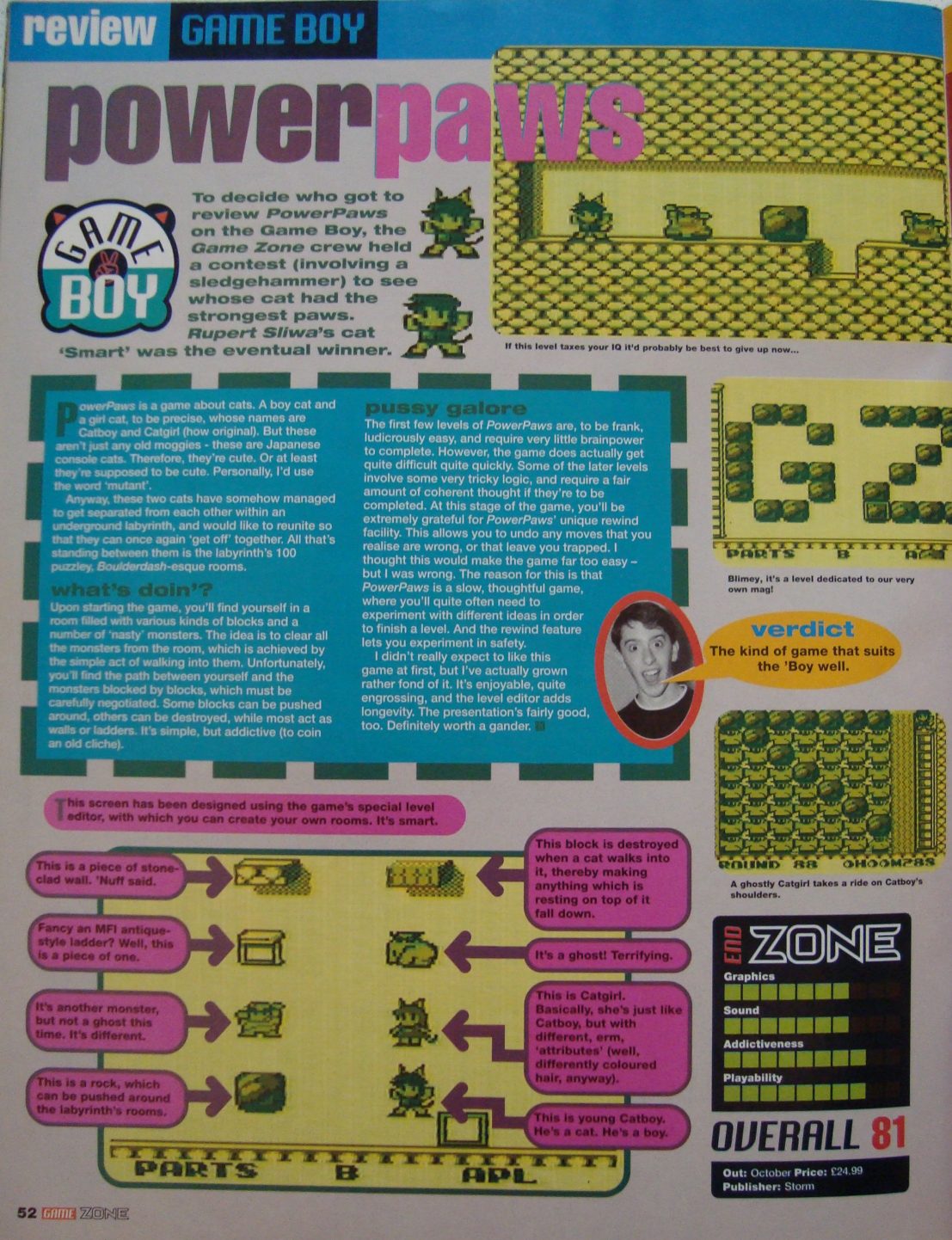
 Eventually I tried contacting everyone listed in the staff page of the issue directly prior to that issue (which I had). I got hold of quite a few, though none still had any issues. Until I tracked down Rupert Sliwa, who you may remember from HG101’s Catrap article (pictured here). He kindly went to a great deal of trouble scanning the feature, which wasn’t easy considering the type of binding they used on the spine. But at last I had it, and if you click on the images below, you’ll see it reveals just enough concrete details to prove extremely valuable.
 The key information is that the man in charge was LARRY SIEGEL. He was head of Black Pearl Software (which most people know was involved with the Akira licence thanks to this interview), which was absorbed into THQ. What I’ve never seen mentioned before is info on the SNES and GB versions specifically.
 The SNES version was handed over to Handmade Software in Swindon, UK. It was formerly known as Mr Micro, and was headed by Jim Gregory, who also worked on Kasumi Ninja and other Atari games.
 The GameBoy version of Akira was handed to Ice Software in Slough, UK, on which I could find no further information. Are they connected to International Computer Entertainment (ICE) which worked on the Amiga Akira game? I have no idea, but all the staff on that specific project said they’d had no involvement with any other version other than the Amiga release. On the other hand, a few spotty records online say that was ICE was based on Slough. It's all very difficult to find solid info on.
 The unreleased Akira games, based on reports of those who played them (see below in green), sound awesome. And unlike a lot of other unreleased console games, which are hidden in Japan and near impossible to find, if any prototypes exist for these they’ll be in England or America. They’re so close I can almost touch them. Larry Siegel even has a LinkedIn profile, stating he resides in New York. If anyone can shed light on all the planned versions (SNES, Genesis, Sega CD, Game Gear, Game Boy), it’ll be Larry. All we need to do is find Larry.
 My hope had been to track these guys down, get concrete info, interviews, photos, maybe screens, maybe working prototypes, and then have all this information dumped onto the internet via Hardcore Gaming 101, because how awesome would that have been? Site traffic would be up, infamy would be assured, and we’d all coast along on a delirious wave of cocaine, strippers and fan adulation. But tracking Larry and Jim down proved pretty tricky. I trawled Mobygames, LinkedIn and Directory Inquiries, sent no fewer than 20 emails, and made over a dozen phone calls. Hell, I even got people I knew to use their Facebook accounts to contact other Facebook users who may have had a connection, and the same for Twitter. I thought I’d come close several times, managing to get hold of many of Larry and Jim’s former colleagues, but in all cases they’d lost contact with the gentleman in question. I even tried asking on our blog, with no luck.
 So, here are the Game Zone scans, plus scans from Unseen 64 (if you write for Unseen 64 feel free to re-use my GZ scans), and the rest I leave up to you – the wider world. If you know Larry or Jim, I advocate kidnapping and truth-inducing drugs.
 And if you’re unconvinced on the quality of the games, read this post by Whimsical Phil on NeoGAF. They sound like the greatest games ever (not) released.
 ---
--- - A motorcycle racing stage that was a lot like Super Hang-On. As you would imagine, you were Kaneda racing against the Clowns.
  - A side scrolling stage where you were Kaneda and Kei piloting that hover vehicle through the sewers. These stages weren't strictly side scrolling, though, as they were quite large and maze-like. You could fly quite a ways up and down as well as left and right. You used the gun on the vehicle to shoot down the guards' crafts.
 - An isometric stage (think Viewpoint) where you were Tetsuo walking across the bridge (the one he would eventually destroy). Pressing the attack button caused him to swing his arm out in front of him, sending a wave of psychic energy out in front on him. The main enemy that I recall in this stage were rows of soldiers armed with the laser cannons from the movie. I remember being really impressed with the look of the Tetsuo sprite on this stage (complete with his tattered red cape).
 - The last stage that I remember was a 2D beat-em-up (or was it a one-on-one fight?). Either way, you were a surprisingly large mutated Tetsuo attacking, well, whoever it was attacking you (Kaneda? Soldiers? I don't remember).
 Seeing as how I was a big fan of the movie at the time, I talked to one of the head PR people at length about the game. She even gave me an animation cel from the movie (of the giant teddy bear and rabbit that attacked Tetsuo), which they were probably giving out to the press. Even though I was just a scrub working at Babbage's at the time (yes, I was one of those retail kids who snuck into the show), she gave me her business card and I kept in contact with her for a while getting updates on the game. Until, of course, she gave me the sad news one day that they had cancelled it.
 It’s taken me about a week in a my spare time, with a 6 month gap in the middle due to loss of interest. But I started it again last week and added one of the Clown gang. It’s little more than a tech demo, and I stole the music track from the Amiga game, but it kinda shows what I’d want it to be if I ever finished it. I want to add another Clown biker or two, and give each distinctive AI. The current one is stupid, and while he will try to evade your line of fire he doesn’t see the barricades and doesn’t actively attack you. If I can I’d also intend to add one of those flying vehicles from the film, since they wouldn’t be affected by the road speed.
 Actually, perhaps the Ed Wood comparison is incorrect. I don’t suffer from Wood’s more perverse traits, I’ve never made porn games, I don’t have someone like Bella working for me, and my games don’t even reach the level of so badly kitsch they’re awesome (that status is reserved for Red Seeds, which I’m hoping receives an English Asian release for the PS3).
 But if a tortured analogy to Welles and Wood allows me to put my own name alongside the astoundingly gifted Derek Yu, then so be it. I recently read an article on him, one of the best articles I’ve seen, in GamesTM magazine issue 93, and it reinforced my admiration for Yu’s creative skill (especially his deft use of randomisation), and it also convinced me that he might be the indie scene’s own Miyamoto. He said how he’s always been designing games since he started playing them, if only on paper, and went on to explain how he created his own studio at the age of 14 (I started when I was about 15). The inventiveness and creativity he showed, even at an early age, is astounding.
 (naked Derek Yu image taken from indiegames.com)
 Something else which I’m proud of is Trampoline Gunmen (not Tramampolining Gunmen as I once called it), which I will dedicate a whole entry to tomorrow. I swear, if I had a proper dev team and some marketing budget, I could probably scrape some profit with a cheap PSP release. That beautiful oblong screen would be perfect for it. Unfortunately I never implemented all the stuff I’d written down, and with newer Operating Systems beyond Windows 98, most people’s computers stopped being able to run these DOS games anyway. Hence why I eventually abandoned my ambitious TG ideas.

 It was a wonderful era, with the PS Net Yaroze community releasing regular demos, Digitiser in full swing on Teletext, and long summers that never seemed to end. I got talking with Luke and he explained the joys of QBasic. I’d used it before to play Nibbles and Gorilla in Middle School, but at the time hadn’t realised I could make my own games using it. He copied the files which were on the school’s computers to floppy, plus he gave me all the stuff he was working on, and so I tried my hand at game creation.


 An artist's impression of me and Luke, during those lazy, innocent summery wonder years, where you could skip class to code some games, before riding your bicycle to the soda shop to play some pinball.
 The first game I ever made, it started off as a three-line text adventure which I coded the night I brought QBasic home from school, housed on a standard floppy disk. The next day I spent my lunch break and, if I recall, my art class working on it (along with classical art, we had weekly art classes to learn how to use Corel Photo Paint proficiently). I tried to incorporate as much from the help files as possible, including randomisation so you were forced to play everything in sequence. I also screwed around with different screen modes (a bad idea). My big problem was that for some tasks, like taking the water, there was an incredible number of things people might type: check water, take water, grab water, read water, read water bottle, take the water, drink the water, and so on. Only much later did I learn how to use an INPUT statement that searched an entire sentence for a specific word. Here you have to type precisely what it needs or it doesn’t work. In the uncompiled version I had about 30 variations for each situation, but this wouldn’t compile, so I trimmed it down to about 5 obvious ones (try to keep what you type simple). Most kids in my class liked this, with one playing it to the point where he timed himself and claimed he could finish it in under 20 seconds.
 Immediately after finishing John’s Fortress I started this, an action game based on the film/manga Akira. It was also the only game whose code I destroyed – a grossly over-ambitious project which, had I had more experience, could have been great.
 With the only two Akira games I could think of at the time being the Famicom text adventure, and the awful Amiga game, I thought that if I could make something slightly more fun, the brand recognition alone would propel it to stardom. The basic premise was Spyhunter with a big boss battle at the end. You drove your red bike up the street and could fire ahead of you in a long line using the laser gun from the film – I think you had like 50 shots or something. Up to two pink Clown bikers would attack you at a time, each being able to fire left or right. It was really cool because if they were on either side of you and one fired, you could slow down and let his bullet hit his friend on the other side of you. There were also yellow road blocks hurtling down the road, and it was possible to lure the Clowns into these to be destroyed. If you hit the roadblocks, or were shot, you’d lose some fuel. You started with a set amount and the goal was to survive 20 miles to the Tokyo Stadium, at which point you’d fight Testsuo. You could alter the speed of your bike, which affected fuel consumption, and if you lost too much fuel through collisions or poor driving, it was GAME OVER.
 Unfortunately my lack of experience killed it – I went partially with ASCII rather than all drawn sprites. This led to a few weird problems where the ASCII conflicted with the drawn images, and the constant need to update the screen made it slow. Also, different computers have different ASCII sets I discovered, meaning it looked totally different on my computer to how it did on the school computers and my friend’s computer. The controls used the Numkeys and so tended to jam a lot (after this I discovered how to code using the arrow keys). I also didn’t have any grasp of computer speed or timing, meaning it tended to run WAAAY too slowly on other people’s lesser-specced computers. This taught me a valuable lesson though, and all subsequent games started with a screen requesting GAME SPEED. Other problems included only much later learning that the CINT statement rounded numbers – until then, your distance travelled was augmented by like a dozen variables, including fuel amount, number of Jokers on screen, proximity to enemies and roadblocks, and so on. Somewhere along the line these miniscule numbers would go awry and the distance travelled in the status bar would shoot up to about half-a-dozen decimal places, borking the screen in the process.
 Dice game inspired by the same dice game in Mystical Ninja on the SNES. As you can tell, it in no way, shape or form evokes any of the good feelings found in Mystical Ninja. In hindsight I wished I’d added a stupid story or something to this. I don’t know why I made it, apart from the desire to have another finished title under my belt. The kids in my class loved it.
 I saw a screenshot of a really old wireframe flight-sim in some magazine (for DOS?), and decided I’d try to create a pseudo-copy. It didn’t need to be accurate I told myself, it just needed to trick people into thinking there was something clever going on in the background. I spent a 6 hour train journey writing the code up by hand, while some guy in the chair opposite mine, with his wife, gave me a deranged psychotic look. On reflection, I think they may have been on drugs, drunk, or possibly just trying to freak me out – fresh-faced teenager that I was. Either way, that’s the most memorable thing about this project. Those two nutjobs on the train. After a couple of weekends I dropped this.
 The fifth game I started after Akira, Dice and the Flight Sim, this was technically only the third game I completed: a Pong clone in colour. Except, because multiple key presses had a tendency to freeze DOS, it’s One Player only. And since I couldn’t be bothered to create AI, the enemy paddle follows the ball continuously, and you score only when you rebound the ball. It’s basically racquetball.
 This tech-demo exists because I wanted to experiment with altering the angle of a DRAW statement using variables which could be changed in real time. Tap the arrow keys and it changes the number in the draw statement, as opposed to having a separate line of code drawing each conceivable angle. The asteroids and stars also move at different rates to simulate foreground and background movement. I think there’s only 4 of each, and when they go off screen they randomly appear on the other side. There’s not much to do except fly around. Like so many other games, it was the development of graphical trickery which led the design of the gameplay. I toyed with the idea of doing some kind of space-trading game, like Elite in 2D, but my mind wandered long before that.
 I think this was done after the Asteroids game, since I think I included the ability to alter the line angle in the DRAW statements in real time. I also recall spending ages painstakingly drawing the aeroplanes – and today their DRAW statements are so long and complicated you can’t compile the game! The title was inspired by the Iron Maiden song, and the gameplay was a less-elegant version of Space War. For a start you can only fire one bullet each (I only worked out how to do arrays, and therefore multiple bullets, MUCH later on in my coding life), and you can only travel in one of eight compass directions. I would later learn how to do 360 degrees of movement with variable speed for each angle, but I never did anything with the knowledge.
 Unfinished tank game, killed by the fact that I didn’t pay attention in maths class and couldn’t use Pi or any other kind of function that would help me draw an accurate projectile arc. As a result the projectiles moved in a kind of cuboid trajectory. I later got a handle on Pi, circular area, and other such essential knowledge, but it was rather late in my coding life and I never really put any of it to use outside of a few tech demos which drew heartbeat lines. The game was probably inspired not by the myriad of other tank games out there, but the film THE BEAST OF WAR, which featured a group of Russian tankers invading Afghanistan. Bloody good film.
 Ever play Metal Gear 2 Solid Snake on the MSX? Well, it featured the Hanoi Hilton tap code, where you had to count people’s tapping to spell out words, or in the case of the game, find new frequencies for the codec. I made a simple program to do this using numbers. It is rubbish.
 This must be played with DOSBox’s cycles set to maximum, otherwise the jumping physics don’t sync properly. I stole the title screen from Luke’s RPG, and the game was basically an excuse to show off a “music playing” section of code I taught myself. I recall that Mathew Smith’s Manic Miner featured the Waltz of the Blue Danube, or some such classical piece of music, so now that I had a piece of music, a crappy single-screen platformer seemed the way to go.
 Derivative Indiana Jones storyline coupled with some diabolically broken jumping was the result. Unfortunately, the way the sound code worked, I couldn’t easily change the speed of the game or the number of loops is did while playing the music – in a bizarre situation which I can’t ever recall understanding, the game synced itself to the music being played and was locked at that speed. Meaning on slower machines it went all weird – if you drop the DB cycles, you suddenly gain a double jump because the timing has gone off. If played on max cycles though it’s similar to how I remember it was supposed to be played. You can double jump by clipping the edge of the platform, and to win you need to jump and double back on yourself at one point (which is technically impossible in the real world once you have momentum, but if Mario can do it!), then jump over a snake hidden on one platform, reach the upper right and jump over the end of the screen to land near the gold mask. There’s some cool scaling effects when you grab it, based on increasing the length of the DRAW command.
 I made this right after the above platformer, because I was still obsessed with having music in my games. I thought it sounded like Jaws, but in hindsight it’s just annoying here. The game plays like Gyruss, with your ship moving in a circle and attacking the red ship.
 If you wait around for long enough the Slipgate becomes unstable you get a really cool warbling effective, the result of the circles moving around as they expand. I still like this, since the gameplay is fairly playable and the effects almost give the impression that I knew what I was doing – as opposed to screwing around with the CIRCLE command.
 Recoil in horror as you read some of my earliest and worst attempts at fiction. The name on the title screen doesn’t even match the name IN THE GAME. In my defence, your honour, I was a young teen – I knew not what I did! Anyway, if you can ignore the terrible plot to this, you’ll be astounded to find the game is actually quite unplayable. I’d been playing Mercenary all weekend and had momentarily become obsessed with wireframes and flat green landscapes.
 In an afternoon I cooked this up but, not being bothered to even try to create wireframe models, populated the planet only with an invisible enemy and a black sphere you needed to collect – unfortunately it had the worrying tendency to not display properly, and with the enemy constantly closing in on you, actually winning was a nightmare. I thought if Kenji Eno can have invisible enemies in Enemy Zero, then so can I!
 Ahh yes, these were the experimental days of the Sega Saturn, and I have fond memories of bidding on weird Saturn imports online before eBay became crappy. There was a distinctive smell during the era, one of warm summers and drying lawns. In hindsight I wish I’d made it more like Everblue, with no enemies and instead a sonar which pinged the closer you got. It might have actually had some semblance of fun. As it is, it’s delightfully impossible.
 I made a deal with an student archaeologist friend: if he discovered a new dinosaur, he’d name it after me, and in return I’d make a game featuring him. He never did discover the dinosaur (actually, he became a farmer in the end), but this Metal Gear inspired game features him. It’s also very loosely based on a hedonistic night out, which featured some mind-altering “food” and events (Fear and Loathing in Las Vegas style).
 Stealth Dude is almost perfect, let down only by my laziness to implement proper collision detection, and the fact that I randomised the number of Dollars you need to steal (this can make playing tedious if the number was randomised at the maximum 16). At the time I had trouble dealing with the problem of: how can the code detect when you’ve entered a solid object, like a wall, and revert you back to your original starting position if you can enter said wall from any side. The outer walls are simply collision based on IF PLAYER > NUMBER THEN PLAYER = -1, because the EAST wall is always in the same place. Much later I solved this by creating an additional variable which, every time the direction key was pressed, became the number travelled (which was either negative or positive depending on which way you went). If you entered an object (IF PLAYER = WALL) then it subtracted this variable from the X, Y co-ordinates before anything was even drawn to the screen. It was hugely effective, and I should have gone back to fix this, but I was too lazy, so instead walking into walls kills you. Also, the randomisation of items to collect can make the game impossible, since you’ve a timer. LESSON LEARNED: randomisation is bad, and so is impossible games. I probably should have also added more colour to stuff. Still, you can escape from rooms if the dollar is in a dangerous place, and it’s still a cool experimental title.
 Based on the Atari 2600 game, Adventure. This was made after Stealth Dude, and took advantage of better collision detection which I learned. It also has an “engine” of sorts, and signifies my attempt to streamline my coding. Every room is built using the same building blocks (6 or so cubes of colour), each governed by the same code, just with different location variables. Some rooms also have items in them, and the enemies are identical, with no AI. I was also experimenting with detection of computer speeds, since inputing numbers is a pain – but unfortunately it doesn’t quite work. I highly recommend you play this, but you’ll need to experiment until you find a speed where the monsters are fast enough to catch you if you try to run past them, but slow enough to allow you to run back in the direction you came. Like Adventure, there’s also an Easter Egg. If you kill all the enemies, then grab an invisible item in a tiny walled off room, and then take it and drop it in a big empty grey room, you’ll be able to grab the glowing circle and discover something totally awesome. And by awesome, I mean pointless.
 The first ever PC game I played was Castle Addventure, by Kevin Bales, during my first year at primary school. Mr Bales was apparently only 14 when he made it, back in 1984, but at the time it captivated me. Only a few years ago did I finish it for the first time, and I’d say that it has probably influenced my view of videogames quite considerably over the years. I love how he was able to create so much detail using only ASCII, and there’s actually quite a lot of depth to the game, especially when it comes to using items. I wanted to create something similar, so after finishing Arcamus I started my own Castle Adventure in ASCII. I’d finished the design and basic engine code, but grew bored before I’d implemented item usage or anything interesting. As it stands, it’s a ghost castle. If it looks interesting, then please find and play Kevin’s original Castle Adventure.
 During Metal Gear Solid fever back in the day, there was a website where you could put your details in and get a MGS-style codename – someone I knew got the codename Panda Commander. Since I was also playing through the original Metal Gear again, I decided to make a game based on the remote control missile segments, since they were especially fun. This is a great title, with its own boss at the end, but like everyone who played it said: you should have designed each stage, instead of having them randomly designed. As it stands, the first stage is fine, then there’s about a dozen or so which are stupidly easy because the blocks end up in ridiculous places, then you finish it. Or, you could end up with a stage impossible to finish. I’m convinced that with a little more thinking, I could have refined the randomisation to create meaningful levels. Or I could have knuckled down and actually been creative. Laziness I tell you, for the love of pies, it was the thing which crippled me!
 Why would I think that creating a Battleship game with the added of complexity of submarine depth would be a good idea? Why would anyone think that’s a good idea? Why would I base it on a film I can remember nothing about? Perhaps I was being post-modern and intentionally wanted to make a terrible film-to-game conversion. Well, if I had, I probably should have turned it into a platformer. Be amazed at the fact that you can actually SHOOT YOURSELF with your OWN TORPEDOS. Enemy AI is pure randomisation. Sonar helps with working out enemy depth. Please do not play it.
 This started off as my attempt to get QBasic to display the colour orange, and it sorta works. Then it mutated into a game based on the Mad Max films (playing like Spyhunter, and reminiscent of my Akira game), but I lost interest before doing anything with it.
 A fairly late project of mine, this was another text adventure – though I never finished it. Inspired by a description I read on Digitiser, of a text adventure they played with the same starting scenario. I never discovered what it was, and I grew bored with this before completion. The code for keeping stock of your inventory also proved bloody troublesome.
 This is why 15-year-olds shouldn’t write text adventures – horrible, horrible, horrible writing. Another attempt at a text adventure, this time purely multiple selection. I reckoned if I could put a few dialogue trees in, some of which reached the same conclusion, I could knock up a text adventure in an afternoon. Well, after a few hours I realised I’d need to write another 30 entries or so and gave up. Again, this was based on a Digitiser entry I had read. I also seemed to have an obsession with dingy hotels and amnesia. Hey, if it worked for Shadowrun on the SNES!
 I attempted this 3rd text adventure directly after the above two. This time I decided to use randomly generated situations based on a pool of words, most with a cyberpunk theme, to avoid having to write anything. Why waste time writing a whole bunch of scenarios when the computer can do it for you? Honestly, I think I may have been inebriated when I coded this, but today it stands as something which, thanks to the absolute lunacy of what it tries to do, is actually funny. I am amazed at how ridiculous some randomly generated situations can be, many of them worse than a lot of internet Engrish, and on at least one occasion I laughed hard to point of projecting coffee out my nose. Derek Yu used randomisation in Spelunky to create something beautiful, whereas I used it to create something frightfully wrong. Yes, I think I’ll head in the direction of some tramps!
 I watched a documentary on the development of sentient AI for computers – and one experiment involved creating an AI that learned to hunt another AI more efficiently. So I wanted to make an experiment like that. The two coloured blobs feature rudimentary AI augmented by 3 parameters: attack, defence and speed, and each has to draw from a limited pool of points. I can’t remember how they work, but the results of changing them are often unexpected and the whole thing is mostly pointless. I had the intention of creating a save function for this, so it could record the best possible set of parameters against other sets and, in effect, have the AI learn to be more efficient. I got bored though and stopped.
 Bloody hell, did I make this? The code is in my personal folder, but I don’t ever remember typing this. The creature gets smarter each time it dies, and more stupid each time it feeds.
 Make bets on how long the creature will survive.
 A really late effort, coded sometime around 2004 I think, in an afternoon. I was attempting to recreate two-dimensional outer space physics in ASCII – this was inspired by that Star Trek film where Shatner has to go back in time, and in order to do so has to gravity whip them around the sun.
 The game works, kinda. You need to speed past the sun and get caught in its gravity force to be slingshotted around and increase your speed beyond the maximum which your thrusters can achieve (which was “ONE”, I think). I recall managing to do this twice and get the number pretty high.
 Long after finishing Trampoline Gunmen 2, I came to the conclusion that multiplayer games were best (what I was really thinking was that they’re easier to make interesting, since even some crap games are enjoyable with another player). Two balls and a timer bar. If the bar is your colour, you’re faster than and can catch the other player. When the bar runs out, the roles are reversed, and the other player can catch you – think of Pacman and the ghosts, in that once his power pill wears off they no longer need to run from him.
 To make it interesting, the grey boxes can kill you. It’s a good idea, and one that would probably be more fun if coded by someone else. I’ve never actually tested it with anyone else, but I would guess that as your bar decreases, there’s a fair amount of tension if you’re close to catching the other guy. Be fast, because if you take too long he’ll get you!
 I was experimenting with having a sprite travel in true 360 degrees of movement – travelling NORTH-EAST for example, should not mean he moves up and right by one pixel, since that results in faster movement than directly east. I created a fraction based bit of code, but never quite got it working right. Apparently you need to use some seriously high level maths to get absolutely, mathematically precise 360 degrees of movement.
 Tomorrow, I will talk about Trampoline Gunmen – which is excellent.