Monday, December 21, 2009

So Mushi Futari Finally Came In...


If you order from Play Asia, Mushihime-sama Futari costs nearly $75! Add in shipping and it's at least $80. That's not inexpensive at all! Cave's reasoning for making this one region free was to gauge overseas interest, although apparently the word on the street is that this one has actually sold less than Death Smiles, which was region locked. I think this might just have to do with interest in the Japanese end - Mushi is a bit older, and doesn't have the goth loli thing going for it. Meanwhile, I'm not too sure there are too many folks on the non-Japanese side who are going to pay $80 for this, outside of the hardcore audience, anyway. Although I do have to wonder - would the audience be necessarily that much wider if they sold it for $20 instead of $80? You'd certainly pick up more curious and impulse buyers, although probably not enough to make up for the lost profit.

Now, the low price of digital downloads has proven a double edged blade for multiple reasons. In this case, you'll find people clamoring that every 2D game should automatically be a cheap downloadable title, which grows annoying and completely devalues it. On the other side, it does pressure the publishers to stick in extra stuff to make a retail purchase more appealing. This is exactly why Mushihime-sama Futari has gotten me hooked, where the previous Cave games never quite gelled.
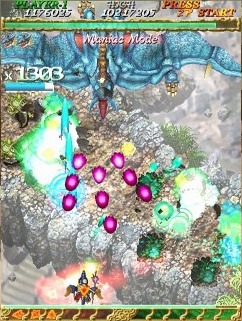

There's a lot of different ways to play the game, with four modes on the outset - the Ver 1.5 (a rebalanced version of the arcade game) which comes in the Arcade flavor (with the original graphics) and Xbox 360 (with enhanced graphics which look quite good.) There are also two console exclusive modes modes, Novice and Arrange. In each of these four modes, there's three sub-modes with different patterns and scoring systems (the third of which, Ultra, is more of a practical joke than anything), plus two playable characters, each with two types of firing shots. Do some math and there's a lot of permutations you can play through, even if it is ultimately variations on the same game. There's also Ver 1.01, which is apparently closer to the original arcade game but can only be accessed via a downloadable voucher if you got the very first print - I ordered from Play Asia and did not get one, which does not seem to be an uncommon occurrence. There's also Black Label, another mode offered as DLC. I haven't played this, because frankly it's quite bitchy to charge $15 for additional content released a few weeks after publication, when it seems clear it could've been added in - the price is already high enough as it is.

I can't get too excited about the Ver 1.5 modes, honestly - it's a Cave shooter, much as they've always been. What I DO totally dig are the two Arrange modes. I've heard people call Novice mode stupidly easy, and that's really only true in the context of Cave shooters - anyone completely unfamiliar with them will still have some practicing to do. Still, I'm not terribly good at them and I was able to 1 cc it on the first shot, and only died at all on the final boss. On this level, playing for survival is a bit boring. Now, the reason I've never liked playing these games for score in the past is because they were so damned difficult that just surviving was hard enough - and these aspects are closely intertwined, because if you run out of lives, your score drops to zero. Novice mode is easy enough so it's possible to focus on scoring without getting killed every few seconds. (Even with all of the practice I've been getting, I still can't get past stage 3 on the Ver 1.5 modes.) I'm still not sold on the Original Mode in here, but Maniac offers a pretty damn fun scoring system.
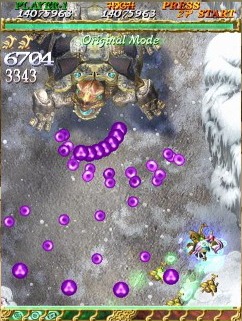

The Arrange mode puts you in control of both characters at once, which you can switch between. The secondary character will mirror the movements of your ship, and is surrounded by a circle. If you're rapid firing (the R trigger on the 360 controller), the circle will slow down enemy bullets, allowing you to weave out and escape from them, sorta like the doujin shooter Trouble Witches If you firing a steady shot (the A button), it will reflect all of the bullets away. There's a counter at the bottom of the screen that determines how often you can reflect, so you can't abuse it, but it can be refilled if you don't use it. (Not ENTIRELY sure what refills it - I think it's the yellow gems that explode out from everywhere.) Each character has their own counter though, so you can exhaust one of them, switch to the other, and continue reflecting. It's pretty hectic, especially considering your own shots get even more super powered up - I think at a given instant the screen might be 75% filled with your own bullets. The only problem I have with it is that the reflecting doesn't feel completely implemented - it's more of a defense measure than an offense, although if you do it right you can replenish some (all, maybe?) of the counter gauge, turning it into a delicate balancing act. If the reflected bullets actually damaged enemies instead of running right through them, this would be a mechanic of Treasure level brilliance - as it stands, it's just merely a lot of fun.

I'm not still not sure that the framework is really my ideal - online leaderboards and Achievements are nice, but I'd still like some more tangible rewards for progress. But the Arrange modes go a long way towards making this one a fair bit friendlier to newbies than any of Cave's past console ports, and I'm certainly enjoying it a whole lot more.

On a closing note - I bought the regular edition, and my CD has a black and white label. Is it supposed to be like that? It feels weird how colorful the rest of the packaging is, and then get such a bland looking CD.

Miku's up to something....


Good thing I have my camera for moments like these.

Read more...

Friday, December 18, 2009

Bomberman Ultra is no Saturn Bomberman


Saturn Bomberman was released over 13 years ago, and despite regular sequels, including the online-capable current-gen Bomberman games, it has never bettered. Why is this?
.
.
.


With the reduction in price of Bomberman Ultra on yesterday’s UK PSN update (from £8 down to £4), I finally bought it. As expected it’s good, but nowhere near as good as Saturn Bomberman. In fact I’ve never found any other Bomberman game to even come close to the greatness of the 10-player Saturn edition.

Saturn Bomberman’s plus points are many: it has a really cool intro and ending, and throughout the game the audio is fantastic. It also has some truly beautiful sprite-based visuals, complete with rotation, scaling and really good animation. Jesus, this game is incredibly gorgeous. Also, for once the single-player campaign is as good as the multiplayer, with large sometimes multi-sectioned levels, a decent variety of enemies and maze-like layouts, and generally some excellent design. A lot of earlier Bomberman games were dull in single-player, but Saturn Bomberman really went all out to make this fun – I’ve completed it a few times. Oh, and let’s not forget that it used the Saturn pad, the best digital d-pad specific controller ever released (the Japanese one anyway – I have no idea what the hell Sega were thinking when they redesigned it to resemble a breeze block, those western pads are an oversized abomination like most western pads are).

The biggest draw though is the simultaneous 10-player action. It even features cameo appearances by other Hudson characters! Truth be told I’ve never experienced with 10 human players – the most I’ve managed is 6 humans, and 4 computer opponents, at the UK’s Game On museum exhibit, where the game was set-up on an enormous screen (it could have even been a projector). Otherwise a few years after it came out I spent a long string of weekends with 3 friends and the CPU set to best, bombing the hell out of each other.

Saturn Bomberman stands alongside MULE, Star Control 2 and Demon’s Souls as one of the greatest multiplayer experiences of my life. Cool retro chap Witchfinder (who brought the PC-FX to the Retro Reunited event) wrote this piece on it.


It’s said the 10-player mode was based on the unreleased Hi-Ten Bomberman for the PC-FX, intended for use on HDTVs, and the only other 10-player example I can think of is Atomic Bomberman on the PC. I've not played it, but allegedly it supported 10 players.


So here’s the pull people: Hi-Ten was meant for HDTVs in an era when not many people owned them. So why is it today I can download the latest Bomberman games, be it Ultra, or Live, or whatever, for use on my current-gen hardware and HDTV, and instead of 10 or more players, it’s been retrograded back to only 8 players? PRs can harp on about 150,000 character combinations in Ultra all they like, the fact remains it only supports a maximum of 8 players. This represents another example of videogame de-evolution – where progress is ignored and we take a step back to something less satisfactory. Considering Ultra and Live were designed for HDTVs and online play, this feels like such a wasted opportunity.


Furthermore, I don’t like the graphics. The polygons and odd overhead camera angle make it difficult to follow things, and I miss the sprites from before – also, how much screen real-estate is wasted on that stupid border? 40% or more? Look at the cut-up I made of one stage, you lose about half the screen due to borders. With a hi-def resolution they could have easily remade the 10-player mode from the Saturn game (which felt cramped on a normal TV). Instead they waste screen space and create an inferior product. Plus I didn’t see any Hudson cameos, and the poly-models are just plain ugly (though not as ugly as the living abortion that was the Act Zero clusterf**k).


Maybe I’m complaining too much. Ultra was a lot of fun online. I played against some Scandinavians (I think they were Scandinavian), and lag was reasonable when I joined instead of hosted a game, and it was fun. People with a PS3 camera even showed up on the victory screen doing naked dances. But it was only fun because the original formula from way back when was fun – it wasn’t fun because Hudson did anything interesting with it. Another thing that disappoints me is, as stated on IGN: “Ultra doesn’t mess around with any story or adventure. It cuts right to the heart of what we all love about this franchise: fast-paced, frantic multiplayer action.”

CAPTION: cameo appearances from obscure Hudson games (Kabuki Dan!) in Saturn Bomberman!

Now, I must be one of the few who like the Bomberman games for their silly stories and adventure mode, and its omission, along with the fact people are rejoicing in its omission, makes me sad. Saturn Bomberman showed that this could be substantial and worth playing. I mean, it was really good – fun, lighthearted, blithe, just really neat! Two people could play co-op to finish it! Obviously it would have increased development times to implement a decent single-player campaign in these recent instalments, so fair enough. But still, the multiplayer mode also feels lacking.

Will we ever see another Bomberman of the quality of Saturn Bomberman, marrying 10-player multiplayer with a rich, lavishly made single-player campaign of genuine merit? I don’t think so...

Wednesday, December 16, 2009

Yakuza Kenzan interviews in English


Videos pertaining to Ryu ga Gotoku Kenzan, which were on a DVD included with the rerelease of Yakuza 2 in Japan, have been translated into English.
.
.


With the recent confirmation that Yakuza 3 is coming to the west, plus continuing release of information regarding Yakuza 4, I thought now a good time to post links to Eastern Mind's translation of the Yakuza Kenzan production videos. I’d actually wanted to talk about the Eastern Mind blog for a while now, since it covers a wide range of fascinating Japanese news which other websites don’t normally carry – it also covers stuff from Japanese news sites like Dengeki, with an English explanation. They’ve covered all manner of things, including Nagoshi-san’s visit to a curry house to research Yakuza 3.


It's well worth bookmarking to see what else they report on, plus check out their archives for some fascinating past features.

Regarding Kenzan the game:
For those who haven’t played it, Kenzan features the cast of the Yakuza games, albeit in a medieval Japanese setting. Imagine almost if the cast from Goodfellas did a Robin Hood film, and you’ve got a rough analogy.
It’s also based on the excellent Musashi novel by Eiji Yoshikawa. Basically you wander around solving problems, getting into swordfights, and generally having the same kind of fun as in the Yakuza games. Steeped in Japanese history, it’s a game we’re likely never to see here. But it’s a lot of fun and relatively easy to complete without knowing the language.


Regarding the Kenzan videos:
"In the world of videogame playing, the Japanese are a fortunate people. For the Japanese re-release of Ryu ga Gotoku 2 (Yakuza 2), SEGA prepared a bonus DVD with exclusive contents that focused on advertising the third game of the series, the Kenzan! spin-off. Within this DVD there are a few presentation trailers to be found, as well as a couple of exclusive interviews that were never released online before - or at least not with proper subtitles. Because the very purpose of this blog is to fill the information gaps between East and West, I now publish two small video features."


One of the videos includes an exclusive pre-release interview with Toshihiro Nagoshi.

Link to the videos.


On a side-related note, the BBCF has rated Yakuza 3 as an 18 certificated game, and it's UNCUT. Yay!


Tuesday, December 15, 2009

HG101 Digital Archive Project - Dragon Slayer


There's a labyrinthine history behind the Dragon Slayer games - you can read up on all of the site's Falcom articles for more information - but the gist goes something like this. Dragon Slayer was originally a very (VERY) early dungeon crawly RPG, but Falcom later turned it into a "brand", releasing several successors that, while technically very different games, sort of drew upon various elements of each other. While most of these games were action-RPG hybrids, this all stopped at the sixth Dragon Slayer game, Legend of Heroes (or Eiyuu Densetsu), which was a pretty standard Dragon Quest clone. (I have an unfinished article for a bit about that.) It was fairly popular and ported every which way, but the only version to make it Stateside was the Turbografx-16 CD version, which was probably the best of them anyway. It later spawned three other sequels known as the Gagharv Trilogy, which were the games released on the PSP a few years back (the PSP ports/English translations are baaaaad) as well as the sixth chapter, Sora no Kiseki, which in turn had three separate games, and there's a seventh Legend of Heroes coming soon.


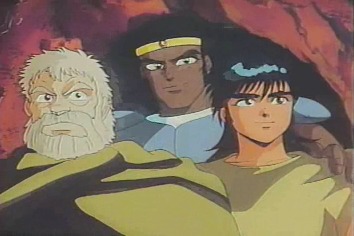
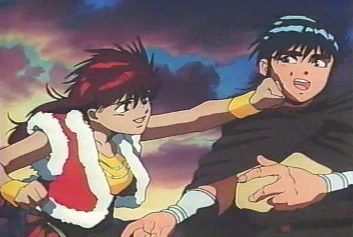
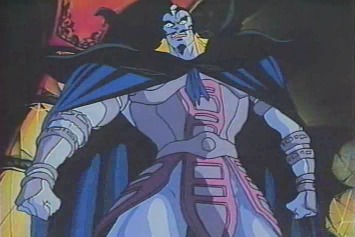
Back to the point! The first Legend of Heroes game was the basis for an anime called (obviously) Dragon Slayer, which was released in Japan in 1992, and localized by Urban Vision in 1997. Other than a few scant mentions of Falcom in credits, this North American release wasn't tied in with the game, because it was based on an obscure something released five years earlier on a system nobody owned anyway. But hey, it was probably cheap to license, and it fulfilled their fantasy anime quota for a bit.


I won't lie - I've only watched a bit of this when it was recording. It's pretty bad. It's an OVA, which means there's not enough time for reasonable character development nor anything resembling an interesting plot. It's wholly generic fantasy fare and it barely has anything in common with the game it's purportedly based on. Sure, some of the characters names are the same, but they look totally different, and it doesn't feel the same, at all, even though it uses some music from it.

That's not really a positive, though, because Legend of Heroes' soundtrack was only interesting when arranged by Ryo Yonemitsu for the TG-16 port (who also did all of the TG-16 Ys games). In its standard form, it attempts to be rousing but is completely held back by the cheap orchestral synth (they called them "electric orchestra" back in the day). It was released separately with the name Symphonic Poem Dragon Slayer ~ The Legend of Heroes Vol. 2. I own this CD, and it is quite dull.


This isn't the first time this happened to a Falcom anime. There was also an OVA based off Xanadu, which originally had the look and feel of an action version of Wizardry and somehow got turned into a show about mecha and tentacle thingies. As much as I love Falcom, they have a tendency to farm out their properties and do as little as possible to make sure they aren't screwed up. (Those Ys DS ports, for instance.) I might post this Xanadu anime later, although it's still in raw Japanese.

The only thing I can't figure out is if this contains both episodes of the OVA or only one. I didn't notice any particular chapter breaks, but it is a bit over 40 mins total, which seems to suggest they combined both onto one tape.

Download here

YAAAAAAARRR


PEACH-PIT wins my internet for having the gonads to even go out with a costume like this for the character.

Well, I guess it's time for me to dual-boot


Thought the gamepad drivers was the last of the problems I was to face with Windows 7. Guess I was wrong.


What you're seeing there is the result of moving things around in one of the GUI menus with Windows 7 in the latest edition of TrueSpace, professional 3D modeling software that Microsoft bought out which you can now download for free but was discontinued earlier this year. And even if you don't move things around, the program itself still behaves erratically. If you're running any version of Windows before 7, however, it works fine.

Apparently Microsoft's too lazy to fix it. Oh well.

Sunday, December 13, 2009

Contra 4 - Rocked 'n Loaded


Did you know some folks are working on a Contra 4 metal remix album? I sure didn't, until like two days ago, even though it's apparently been in the works for something like a year. But it's all good, because it's due out in January, making it a fairly short wait. Check out the info at Rocked n' Loaded, which includes a preorder link and some background info. Contra 4 had some really fantastic music that not only paid homage to the older games (specifically the NES era) but were also quite a bit more intricate than the average NES tune. And since the Japanese video game soundtrack has been so slow lately (how long has it freaking been since the last Konami Battle album?) this definitely sounds like something worth supporting. Check out this sample vid:


And more after the jump...


Win Some Cool Free Metroid Stuff

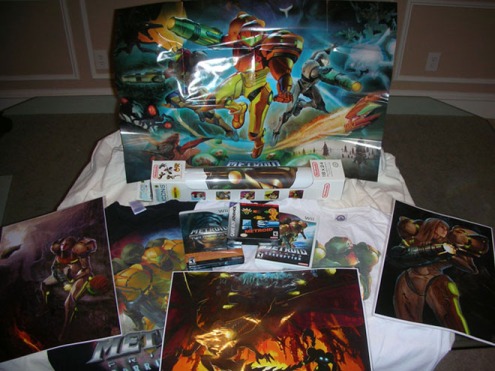
Fellow Classicgaming refugee (and current fellow Kontek hostee) The Metroid Database is hosting a Design Your Own Metroid contest. The rules are below:

1. Create a Metroid using any kind of material or materials. (Be it plastic, clay, junk or trash, food, etc. The more creative the better. Big, small, heavy, light, soft, or squishy, go crazy!)
2. No drawings or 3D CGI accepted. The Metroid must be a real, physical object you can touch.
3. Take a photograph (or even upload a video if you want) of your creation and send it to us!
4. Just so we know it's your work, have a note with "MDb" on it somewhere in the image.
5. Entries are due by December 31, 2009 -- GET CRACKIN!


There's some cool prizes too:


1st place Prize:
* Metroid Prime Trilogy for Wii
* $50 Gift Card to Amazon.com
* Metroid Prime Trilogy official poster
* Signed 11x17 Metroid Artwork Print by Ivan Flores*

2nd place prize:
* Metroid Prime 3: Corruption for Wii
* Metroid Prime 3 T-Shirt (black, Size L)
* Samus Wall Sticker
* Signed 11x17 Metroid Artwork Print by Ivan Flores*

3rd place prize:
* Metroid Classic Series for GBA
* Metroid Prime 3 T-Shirt (white, Size L)
* Signed 11x17 Metroid Artwork Print by Ivan Flores*

That's some good stuff, even if you already have the games. Kinda wish I had some semblance of artistic talent...

Friday, December 11, 2009

French NES – with RGB output


A French NES outputs an RGB signal...

Or rather, it doesn’t. Contrary to what I’ve heard some say, and to what the machine itself declares, the French model of PAL NES does not output a true RGB signal; the quality of output seems absolutely no different to a UK system with AV cables. What is interesting, is the way the French NES actually provides said signal.


But first a little explanation on TV signals. I’m no expert, and you’re better off reading something by visual fecundity expert NFG, but it goes something like this: in the old pre-HD days, for the best image on your TV screen you wanted RGB since it separated each colour and there was no image degradation. Complicating matters was the fact that America and Japan used NTSC for TV signal, England and various colonies used PAL, and some countries like France used SECAM – and they weren’t really compatible with each other (French videos were monochrome on a PAL video player). PAL also sucks.

In the UK to get an RGB signal on a PAL TV you needed to use a SCART cable to connect your games system. Systems in the UK by default always came with an RF lead – even my Dreamcast came with a shitty RF lead! This was likely due to the fact that everything on that depressing island is done to cut costs, cut corners, increase profit and generally screw the consumer over (yay for Rip Off Britain!). From they PS2 we started getting red/yellow/white AV leads, but you still needed to buy a SCART cable for the best image.

Now, for reasons I can’t be bothered to investigate, most (all?) game systems in France come with an RGB SCART lead. At least all that I’ve seen (not sure about the N64), and at one point I had a roaring trade in buying cheap second-hand French Mega Drives, modifying them to be region free and 60Hz, and then selling them for three times the price to UK punters. Normally getting a SCART lead for old systems in the UK can be expensive, or at the very least an eBay-induced chore, since they’re weren’t bundled with systems. So the French saved me a lot of hassle.

Anyway, turns out the French NES also comes with a SCART cable, and the slot you plug into states quite clearly: RGB OUTPUT. Thing is, the NES can’t natively output an RGB signal. Neither can the Famicom. I recall reading a fascinating page a long time ago explaining the situation, with comparison screenshots. Basically the standard video chip can’t do it – to get true RGB output from a Famicom you need a Famicom Titler.

EDIT: It was this page with the fascinating explanation. It's well worth reading.

Standard video VS RGB from a Titler system (click to enlarge):


For ease, I just use a Dreamcast with the older Version 4 of whatever NES emulator was doing the rounds, which produces a crystal clear RGB picture on my TV (later versions of the emulator introduced mandatory and non-removable anti-aliasing, which made the image look worse than what I’d get through RF – those charlatans!).


But back to this French NES. I’d actually acquired it from a British car boot sale for £3, and as I’d expected it didn’t work and needed the pins bending back. I decided to compare it against my Dreamcast, using Mission Impossible. The problem with NES AV signals is that vertical lines, especially those coloured red, appear jagged and swirly. Another good example is to look at Zelda. Link’s A/B item boxes appear like swirly, twisting pillars through AV, whereas emulated they’re lines of solid colour.

The quality of Mission Impossible running through a Dreamcast on a Panasonic CRT TV is much better than through a French NES supposedly outputting RGB. It looks no better than through my UK NES, having jagged vertical edges and some serious colour-bleeding. It is, in short, a terrible picture like all NES/Famicom units produce.
EDIT: This page gives a more technical explanation.

To highlight various facts, I took some photos.

BELOW: DREAMCAST (note the straight vertical edges)


BELOW: NES (click to enlarge, hopefully the jagged edges are clear enough)


On the NES, note the vertical lines of the computer monitor’s edges – I realise the TV's scanlines obscure the image, but on the left side you can clearly see the lines are jagged.


The French NES SCART cable is probably the longest cable I’ve seen for a games console. Several pins are missing from the SCART head, though I’m not sure what the significance of this is. Certain pins pertain specifically to carrying the RGB visual signal, and so redundant ones are often omitted.


I then decided to open the NES up – I have no idea what I’m looking for, but this might be of interest to hardcore technogeeks out there. Or maybe not!


This big metal block is soldered onto the NES motherboard and houses the slot for the SCART cable.


And damn, the thing is built like For Knox. Considering you weren’t supposed to open your NES anyway, I don’t know why they went to the trouble of making it so difficult to get in here.


So, let’s grab some tools and take a peek under mademoiselle's skirt.


Here’s the circuit board inside. Click for a more detailed shot.


On the other side it says Mitsumi Elec Co Ltd on the circuit board. And the board is titled R-22. The outer metal shell also had Mitsumi engraved onto it. Did Nintendo hire Mitsumi to create some kind of signal conversion box for the NES?


There’s a Sony chip deeper inside:
Sony
V7021
ASCII (in katakana)
122A26K


And this curious sticker on the side.


The motherboard from a distance.


Such an item would normally be worth keeping as a curio. Unfortunately there was never any sound with the unit (I’m wondering if I’d damaged something when bending the pins). And without sound it’s useless - dans la poubelle avec vous, harlot gris!


Thanks to NFG for the screen and all the knowledge over the years.