Showing posts with label adgames. Show all posts

Friday, May 23, 2014

Bringing back the ad in adventure (2): Captain Gysi und das Raumschiff Bonn

Captain Gysi und das Raumschiff Bonn - IBM PC (1997)

Oh, my! Has it really almost been a year since I've posted the first episode? Well, circumstances have prevented me from continuing with these for much too long, but I actually played this game back around the time when I wrote about Das Erbe, so my memory might be a bit hazy about specifics this time, sorry about that.

We're getting political this time! This was actually the adventure that brought me to covering advertisement games - last year we had elections in Germany, and leading up to them, Captain Gysi's face could be seen in the streets quite a lot (there, I missed my chance to be topical for once), which reminded me of his game, and in search for it I stumbled upon the fantastic Werbespiel-Archiv site, where I got this and other games.

The game was commissioneed by the German PDS (Party of Democratic Socialists), and Gregor Gysi was their top candidate at the time. In the intro, Commander Kohl (chancellor at the time) has steered the space ship Bonn dangerously close to a black hole. His course of action? Landing the ship on an asteroid, putting everyone in stasis and waiting until the problem solves itself (a criticism often put up by the left against the real Helmut Kohl in his later years as chancellor in the '90s). So it's up to Captain Gysi to set a new course for the spaceship! Yes, subtlety is not this game's strength, but at least it's funny.

In the stasis room, he meets Kinkelstein, a small walking rock with a hat, who blindly follows whoever's in charge (he's based on Klaus Kinkel, whose party, the FDP had served as coalition partner to both left and right governments in the decades prior) and thus becomes Gysi's companion and manages his inventory.

After getting out of the stasis room by fishing a key out of the commander's suit and unlocking the door, Captain Gysi steps into the elevator room. The game now suddenly gets really hard because of a bug: It's necessary to go down the corridoor to the right, but something's wrong with the hotspot - it's almost impossible to find, especially if you don't know that you need to go there.

This leads into the Merkelarium, where he meets the Commander's servant and his main antagonist, a recorder flute. This may seem random and nonsensical, but behind that lies sharp political commentary: Before the unification, Merkel (who as you've probably heard made quite a career a few years later) used to be a member of the East German CDU, whose old members were referred to as Blockflöten (of course a play on the Bloc, but the word actually means recorder flute). Merkel had distanced herself publicly from that old-DDR faction, but the implication here is that she might not have been as far removed from them as she claimed.

After dealing with the flute through some clever rhetoric (the dialogs run automatically), Gysi can get the commander's coat, which is enough to fool his unflexible guard bot Blümel (CDU politician Norbert Blüm).

Most of the puzzles rely on silly puns to (German) political jargon. Here is a tax hole blocking your way, but Captain Gysi can fill it with a tax coin he found earlier.

I'm blanking on who this guy might be, although a bit he reminds me of East Germany's General Secretary of the Socialist Unity Party, Erich Honecker. But who knows...

On the bridge we meet the flute again, and a reserve brain in the back. But we send her away in a bubble and can move freely around the bridge.

But we need the Master Key Card to change the course!

This is the arsenal. It's not possible to take any of the space suits, but Captain Gysi pockets the 1000 ton bomb (of course) and the Napoleon hat.

This is (then) SPD politician Oscar LaFontaine. (Whose name is French for "the fountain". Blunt? Yes.)

Gysi doesn't want to walk past because he doesn't want to get wet, but he can put a napoleon head he just found on him to make him shrink.

With the "Social Hammock" (another political term describing the state's wellfare support of supposedly unproductive individuals) we can get up the broken stairs to the computer room. The animation of the Kinkelstein growing wings and flying along is pretty neat.

If my remember correctly, the frog is actually not a politician, but TV personality/producer Alfred Biolek, who's in this game just because the last part of his name sounds like "lick" in German, so Gysi can give him a lollipop to lick and turn him back into a human, because he's blocking the data highway by sitting on a cable. Makes sense, doesn't it?

The flute is also there again to annoy us, but she can be easily flung off screen using a rubber paragraph (actually a term for a piece of legislation whose vague phrasing is open to very differing interpretation) and a portable fan to cut it.

That gives access to the computer, but I completely forgot what I did there. I do remember, though, that it was full of useless, time-wasting options.

For some reason there is a machine that turns everything that falls through it red. Gysi's uniform goes back to normal after a short while, but he can also throw in this sock, which is needed later.

In the gunnery station, Gysi at first claims he's a pacifist and won't touch it, but once certain criteria are met...

... the view switches to a mini game where the player has to shoot invading ears(!) by clicking on them. WTactualF!?

Somehow all of this gives access to the commander's safe and a key card (don't remember the specifics of this, sorry).

Inside the off-limits area we find two more conservative politicians as statues who keep arguing about nonsense. They have laser eyes, but since they're statues they can't actually turn their heads, so we only have to take out the left one, CDU politician Theo Waigel, famous for his bushy eyebrows, by...

... putting the red sock on his head. This grants us the master keycard, and now we can finally go to the bridge and set a new course.

But not before dealing with the brain and the flute one last time. The brain shouts at the socialist Gysi: "Go to the other side (implied: if you don't like the status quo here)!" The captain's answer: "That's not possible anymore." (Since East Germany was a thing of the past.)

Taking them out is easy: Just open the battery lit on the flute (what does a flute need a battery for?), take out the battery and watch it fall and crush the brain.

Setting course to Galaxis Futura... which is actually the title of the sequel, which boasted high res graphics and speech!

The game once again can be found at the Werbespiel-Archiv. I might yet cover the sequel eventually, but if you don't want to wait another year for me to get to it, you can try it yourself here.

Monday, September 9, 2013

Bringing back the ad in adventure (1): Das Erbe

I still haven't quite mustered the strength to continue my series on ancient RPGs from Japan, so here's something completely different, something that's closer to home for me.

For my country having been the number one consumer of point-and-click adventure games practically since the genre existed, I've always wondered why there were hardly any adventure games made in Germany during the '90s, as the industry only really seemed to pick up on developing them long after the stream of new titles from the US had dried up. I understand there had been a healthy text adventure scene in the C64-days, and a handful of first person adventures, but the only traditional LucasArts/Sierra style games I knew of were Chewy: Esc from F5 and Imperium Romanum (the latter seems to have never been released in English, as far as I know).

But it turns out I was wrong all the time. In actuality, there's a ton of German-developed point-and-click adventures from that era, and I even had played a lot of them back in the day, but I just blanked them out off my radar, because mentioning them almost seems like a dirty word: They're advertisement games! Commisioned by private companies or public institutions, they solely exist to sell goods or ideas. Almost all of them are quite short, but a few are actually not all that bad. So I wanted to take a closer look at some of them.

Das Erbe - Amiga, IBM PC (1991)

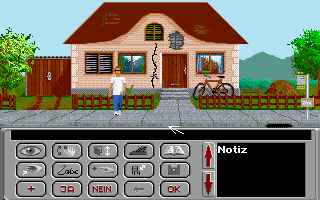
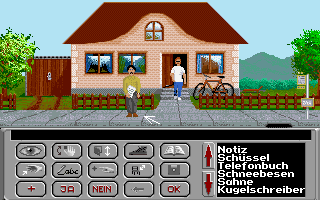
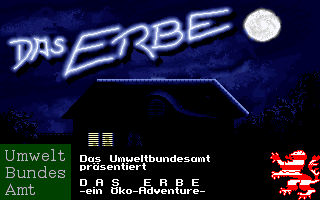
Das Erbe ("The Heritage") was actually the first point & click adventure game I ever played, on a friend's Amiga (all the screenshots here are from the IBM PC version, which has slightly retouched graphics). Commissioned by the German Federal Environmental Agency, it's all about preserving the earth's atmosphere. You play as some dude how inherited a house and three million Deutsche Mark from his late uncle, under the condition that he'd renovate the house without damaging the environment.

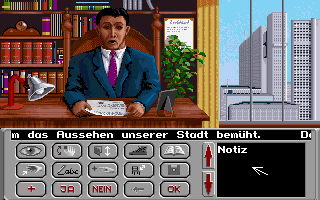
The commands are obviously inspired by the early LucasArts adventures, although the game already uses icons instead of plain text buttons. It's still more inconvenient, though, as hotspot names only appear after clicking on them. The commands are look at, use, open/close, go (has to be selected each time before going somewhere), read (very important and distinguished from look at), take (something out of), write (completely useless cause you only have to write something once, and then it can be done by using the pen with the paper), buy, sit down (useless), and save.

The plus sign in the bottom row actually has to be used to combine items with one another. The syntax is USE [first item] + [second item]. At certain points in the game you will be asked questions that can be answered with Yes or No, which also have two extra buttons, the arrow pointing left is there to delete a command. For example, if you press the "write" button but there's nothing to write on, you cannot go on until you press that arrow. "OK" is used to confirm combining items in the inventory.

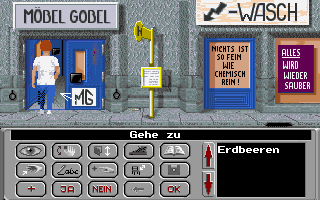
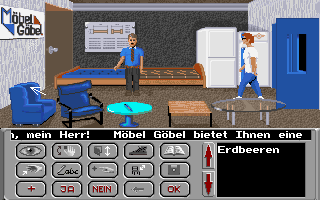
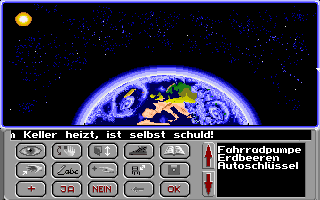
The main task only consists of two major parts. The first one involves getting replacements for all the broken furniture. So you take the bus into the city (apparently you traveled there without a penny in your pocket, so find some money first), and go into the furniture store. It has two models of each type of furniture. The descriptions are always painfully obvious as to which one is better for the environment. If you buy the wrong one, you see an animation of the earth dying, get some error points and have to try again.

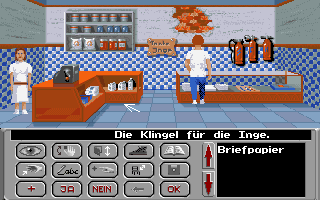
You also need a fire extinguisher from the general store. If you try to "USE" the cashier, she says "Maybe later, boy."

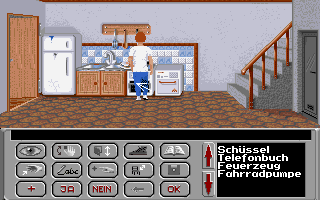
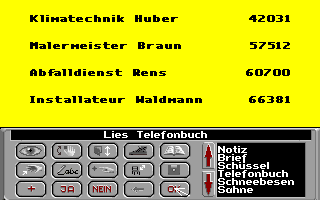
Then comes the actual work on the house, which of course you don't do yourself. You just have to find a phone book in a drawer, then call all the different workers to get the house painted, isolated, the boiler replaced, the broken furniture removed, and the water tap repaired. All the calls just boil down to someone asking you "DO YOU WANT TO DESTROY THE PLANET OR NOT?"

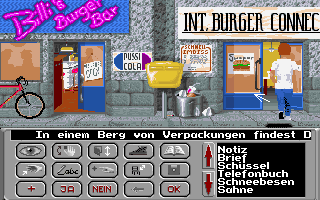
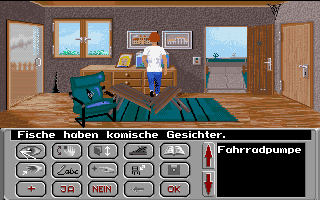
If all this is done, you can write a letter to the Environmental Agency (the paper has to be bought, the stamp can be found under the bell in the general store). But in order to do that, you first have to get your bike in working order by finding the key to its lock and an air pump for the tire. Next to the post box are two fast food restaurants, which are useless, but the international chain is also bad for the environment, so stay out of it.

Sending the letter makes a friendly man arrive in front of the fixed house and hand you the environmental ceertificate. You get 3 million, the end.

But wait! There is actually a side quest that's much more interesting than the main task: In the living room you can find a picture of a girl, on the back it has her phone number and introduces her as your uncles stepdaughter LOLITA, so the guy immediately decides he has to date her (creepy, yes). Up in the sleeping room/home office in the attic is the phone. When calling her, she says she wants to meet you and she wants you to prepare her strawberries with cream.

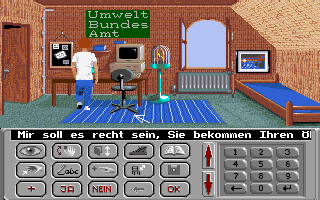
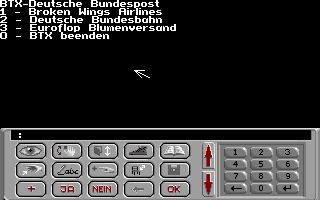
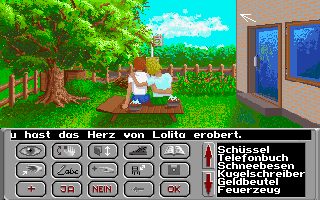
Strawberries you can find in the garden, cream has to be bought in the general store. You cannot buy the canned cream because of the gas, but fortunately there's an eggbeater and a bowl available in the kitchen. Then you have to use the computer upstairs (after connecting the keyboard, puzzle yeah), order flowers and buy your train ticket online(!) to her home. (Oddly, if you succeed in meeting her, you see the two of you sitting arm in arm in YOUR garden.)

Das Erbe has a number of amusing WTF-grade death scenes:

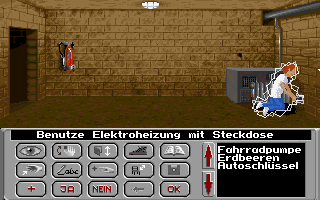
There's an electric heater in the cellar, which you can plug in. To teach you ho wrong it is to heat a cellar, the game kills you with an electric discharge.

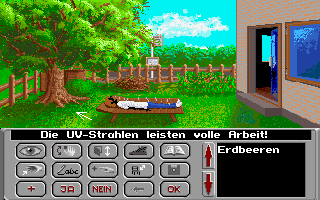
If you lie on the lounger in the garden, the sun roasts and kills you. Ouch!

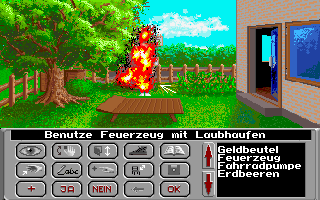
Also in the garden, you can try to burn a pile of leaves with a lighter, with cruel results:

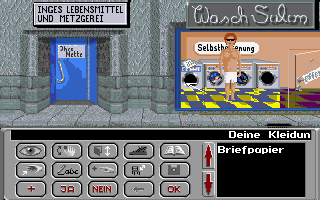
The safe way to get rid of it is a hardly visible box for compost behind the tree. I don't actually know if you have to remove it (might be necessary for the romance side quest), but if you do your clothes get dirty and you have to go a laundry room in town. The guy then just takes off his clothes at the location to wash them.

Overall, Das Erbe is a neat little adventure, although its message can be a bit too blunt and the solutions all too obvious. The only real obstacles in the main quest is finding the stamp. There's also a sequel called Das Schmutzige Erbe ("The Dirty Heritage"), but apparently it wasn't very good, and by the time it came out overshadowed by better advertisement adventures.

Thanks go to the German blog Werbespiel-Archiv, for preserving and cataloging these adgames. It also has the German DOS version for download. And you can take a look at the sequel there.