Tuesday, November 19, 2013

In our forum thread for last update's Mickey Mania article, we spent a bit of time discussing how 8/16-bit European developed platformers had elements which very clearly gave away their origins, and, on a broad level, just weren't as good as many Japanese developed ones. To counter that, Derboo wrote up an article on Lionheart, a forgotten Amiga classic that has the virtue of that gorgeous bright European style while still being an excellent game in its own right.

In general, we have a fascination with American or European games that get ported to Japanese platforms to see how they handle it. Law of the West originated on the Commodore 64 and Apple II, but also ended up on the Famicom and PC88, with some minor changes in the former's case to accomodate the console audience. The game itself is interesting because it might very well be the first instance of dialogue trees, even though it's not explicitly an adventure game or an RPG, but rather, more of a broad "sheriff simulator". I also posted the article for Murder on the Mississippi, which again originated on the Commodore 64 and Apple II platforms, but was ported to the Famicom and MSX2 courtesy of Jaleco, probably to capitalize on the murder mystery crazy due to the success of Yuji Horii's Portopia Renzoku Satsujin Jiken. In both of these cases, the Nintendo versions were not re-released out of Japan, making them weird little exclusives. I'd like to run a feature on more of these, someday!

We're rounding out these with an article on Trog, a single screen action game from Midway that uses claymation, and is generally like a more violent version of Pac-Man. It's probably most remembered for being featured prominently in the arcade scene in Terminator 2. The Secret Files article has also been updated to include a review of the third game in the popular German adventure game series, though unfortunately it seems to be pretty terrible.

The iOS Shooter article has been updated with more arena shooters, most of them taking after Asteroids in some way. The most interesting (or bizarre) of these is Facetroids, which makes enemies out of pictures from your Facebook account. And episode 23 of Game Club 199X discusses Sweet Home, Capcom's ur-survival horror game for the Famicom, which was also based on a movie from around the same time.

Finally, the HG101 Guide to Classic Graphic Adventures is featured as part of the Video Game StoryBundle, which includes eight quality video game related books and zines packed together for a low price. You can pay $3 or more to get our book plus Dreamcast Worlds by Zoya Street, Kill Screen Issues 1 and 7, Blue Wizard Is About To Die by Seth Barkan (a lovably goofy poetry book) and Vaporware by Richard Dansky. Pay $10 or more and get Rise of the Videogame Zinesters by Anna Anthropy, A Slow Year by Ian Bogost, and Replay: The History of Video Games by Tristan Donovan. It's a great selection of stuff for a low price, so please do check it out!


Tuesday, November 5, 2013

Sony Gamer's Day 2013 in Saudi Arabia

So despite the disastrous first try in 2012, Sony decided to take another shot at their Gamer Day convention in Riyadh, Saudi Arabia.

The event once again took place at the Riyadh Exhibition Center (RICEC), and this time all four exhibition halls were used for a grand total of 15,000 square meters of floor space. The event organizers didn't spare any expenses this time. On top of that, they hired a security company and imposed a proper ticketing system at approximately 20$ to attend per day in order to lessen the flow of rabble that plagued last year’s event.


When my friend and I arrived at the event location, we were orderly ushered into a line that led into the exhibition hall. We discovered that half the rented floor space was actually used as an area to properly check in attendees, which worked wonders for keeping things organized.


After receiving our passes and free PSN Plus monthly trials, we finally entered the convention area. The layout wasn’t terribly different from last year, but not having to wade through a sea of people was an improvement.


On display was the usual smattering of demos for upcoming games. The first I tried out was Yaiba: Ninja Gaiden Z. Having completely ignored the DMC-style hack n’slash genre for the better part of this console generation, I didn’t find anything particularly worth noting about the gameplay. There were a few amusing touches though, like clearing obstacles by sticking zombies into vehicles. This leads to grin-inducing bit near the end where you destroy a strip club by having a zombie drive a truck straight through the roof between a pair of giant stocking-clad legs followed by your character standing under a shower of panties. I wasn’t able to finish off the boss because I couldn’t do anything beyond stunning him with a charge attack.


The other group of games that caught my eye was an entire corner of the convention reserved for Namco Bandai releases, including the upcoming Young Justice Legacy game which Namco Bandai will be publishing for Little Orbit outside the US. There was also the upcoming but unaffiliated Ben 10 game which was probably placed there because they couldn’t find a better location for it. The rest of the demos were comprised of Naruto Shippuden: Ultimate Ninja Storm 3 Full Burst, Dragon Ball Z: Battle of Z and Dark Souls 2. Someone decided that the demo character for Dark Souls 2 should be equipped with an incredibly unwieldy zweihander, so that any poor fool not familiar with the unforgiving intricacies of the series will just flail around and die horribly at the first enemy encounter (or maybe that just happened to me and I’m being a bitter sore loser about it).


The real stars of the show of course were the playable PS4 demos of Knack, Drive Club and The Playroom, the latter of which was enclosed in a separate room and had the longest waiting line in the entire convention. I got to try out Knack for a bit, but unfortunately I was tossed right into where the previous player left off so all I ended up doing was some generic platforming with no hint of the game’s Katamari-inspired growth gimmick. On that note, I should mention that apart from games that had very small or non-existent lines like Yaiba, demo times were still much too short.


I also tried out Tearaway for the Vita, which relied almost entirely on the handheld’s touchscreens to get anything done like drawing a paper crown (a segment I regretted not trying to do something more obscene with). I did like the camera gimmick that projected my face as an all-seeing deity upon the game world so I could play out my fantasy of being the Eye of Sauron or that creepy baby-faced sun from Teletubbies.


Since there weren’t any kid-unfriendly games that needed to be enclosed behind walls, the increased space allowed for a dedicated panel area (that doubled as the game tournament venue) and an indie developer booth, which were both missing from last year. What was missing from this year though were big name celebrity guests.


Speaking of tournaments, they actually happened this time but not without a few sloppy management hiccups. The Call of Duty: Black Ops 2 tournament had the in-game spectator audio and commentary blasted over all the convention floor speakers from some unfathomable reason, while the Naruto Shippuden: Ultimate Ninja Storm 3 tournament happened quietly in the Namco Bandai corner and caused it be closed off to the people who wanted to try the other games. The sheer backwardness with which Sony KSA is handling a simple tournament setup that TGXPO got right the first time two whole years ago is bad enough without them indirectly telling non-Call of Duty tournaments how irrelevant they are.


The first two days were generally the same, but once again I couldn't attend the third day due to car troubles.


On the whole, this convention fared much better than the last thanks to some honest-to-God planning this time. While the increased floor space and pricey entrance fee definitely played a role in reducing the amount of chaos, it’s still unknown if they would have been enough had there been an actual celebrity guest or two. This is probably the biggest challenge that conventions here need to overcome before we can brag to the rest of the world about our local flavor of nerd gatherings.

Sunday, October 20, 2013

Update 10/20 - Ordyne, Guerrilla War, Aselia the Eternal, Volgarr the Viking, Blast Wind

Ordyne is game I should love. It's essentially a Gradius clone from Namco, with a cartoony makeover. But it's not QUITE as cartoony as Parodius, so it's not quite as funny, and the power-up system, which is stolen from Fantasy Zone, just doesn't work well enough. It's still okay though, and the music is very good. Guerrilla War is an offshoot of the Ikari Warriors series (kind of), a Commando-type run and gun from SNK. It's mostly infamous for its Japanese release, entitled Guevara, where the player controlled Che Guevara and Fidel Castro. Seeing as how US-Cuba relations have never been the best, this scenario and title was changed for the overseas release, though nothing else was altered. Aselia the Eternal: At the End of This Earth is one of the few non-ero games from JAST USA, a combination of a visual novel and a strategy RPG.

Völgarr the Viking is one of the more recent retro-style indie games for the PC. After a successful Kickstarter campaign last year, this 16-bit arcade-inspired game was released on PCs last month. It's incredibly difficult, in no small part to the sparse checkpoints, but it's very deliberately and fairly designed. And Blast Wind is one of the last shooters from Technosoft, and like Hyper Duel and Shinrei Jusatsushi Taroumaru, this is another Saturn rarity. It also has some unique history - it appears to be a retooled version of an unreleased arcade game called Inazuma Saber.

The latest 500 Word Indies covers Cogs, an interesting puzzle game where you build awesome machines that mostly consist of cogwheels. iOS Shooters: Arena Shooters Pt. 2 & 3 covers ten games: A.C.E.: Air Combat Elite, Asteroid Dust, Retro Dust, AstroZapper, Aerolite, Cataica, roids79, SpaceFight, AstroRaider, and Realms. And the Best of PC Engine / Mega CD Music: Pt. 5 features music from Ys III, Galaxy Fraulein Yuna and Stellar Fire / Stellar 7: Draxon's Revenge.


Sunday, October 13, 2013

Update 12/13 - Scramble Spirits, Primordia, Steel Gunner, Pig Newton, Samurai Shodown, Amnesia: A Machine for Pigs

Sorry for the delay, I was out of the country on vacation, but hopefully we'll be back to weekly(ish) updates after this one! Scramble Spirits is a fairly typical overhead shooter from Sega, mostly designed to show off the high resolution of the Sega System 24 board, which also ran Gain Ground and Bonanza Bros.. Pig Newton is another early Sega title from their cooperation with Gremlin, which has a rather clever name. Most of us know Namco's Time Crisis series as one of the most popular light gun shooter games ever made, but before that they put out Steel Gunner, using entirely 2D sprites, and looking rather impressive for the early 90s. And moving away from arcade games, Primordia is the most recent publication from Wadjet Eye Games, an indie point-and-click with incredible lore and atmosphere.

We've updated two older articles - first off, Samurai Shodown has been revamped. Since we initially published the article six years ago, there's been some progress with Hyper Neo Geo 64 emulation, though it's still not perfect, so at least we could grab some nicer (albeit glitchy) screenshots from those two games, which to this day remain sadly unported. We also included a review of the most recent game, Samurai Shodown Sen, which was ported to the Xbox 360, and sadly, isn't very good. There's also some new screenshots of the Nakoruru Dreamcast game, amongst other improvements. The Amnesia article, covering the creepy underground first person horror games, has also been updated to include a review of the latest entry, A Machine for Pigs.

And finally, in celebration of Columbus Day, please remember to check out our own adventure game work-in-progress Christopher Columbus is an Idiot, to see if you can figure out how to scam Queen Isabella of Spain, round up the three famous ships, and escape to the New World!


Thursday, September 12, 2013

GC9X #23 - Home Sweet Home!


For the month of September, GC9X has a spooktacular game for you in the form of Sweet Home! Released in 1989 by Capcom and based on a film of the same name, Sweet Home has the distinction of being one of the first ever survival horror games (alongside Project Firestart, released the same year). Sweet Home is all about managing your dwindling resources and making the best use of your characters' items, a mechanic that would be featured in Sweet Home's spiritual successor Resident Evil.

That's not all that's in store for you! The runners up of this month's GC9X vote, Chakan the Forever Man and Majyuuou, are this month's Game's Nite featured games. A livecast covering both games and similarly spooky titles will be shown this upcoming Sunday, September 15th, stream time to be announced.

Finally, later this month, xerxes will do live commentary of the Sweet Home movie, so be sure to stay tuned!

As always, you can follow GC9X on twitter for current and future updates.

(screenshot courtesy of MobyGames)

Wednesday, September 11, 2013

Update 9/12 (plus 9/2) - Cowboy Kid, Flashgal, Desert Breaker, Thor's Hammer Trilogy, Pyongyang Racer, Shadowrun, Rolling Thunder, Fatal Fury, Gotcha Force, Hourai Gakuen no Bouken!, Totally Rad, Altered Destiny, Radix

Cowboy Kid is one of those late-generation NES games that barely got any distribution, and as such, is a little pricey to get a hold of on the secondary market. Seriously, I never saw any reviews at the time, and even after years upon years of retro game prowling, never happened upon it once. Anyway, conspiracy theory time - I have no proof of this, but this game almost feels like Konami was trying to make an Americanized version of Ganbare Goemon 2, but was cancelled, and covertly shipped off to another publisher. It just rips it off so closely, and it's such an odd game to make a clone of.

For oddball Sega stuff for this update: In the comic book scene, there's continual growsing that all kinds of superheroes have gotten movies, yet Wonder Woman has been continually neglected. The same thing happened in the realm of video games...with the (kind of) exception of Flashgal. We say "kind of" because it's not an officially licensed Wonder Woman game, but the protagonist is so closely modeled after her that she may as well be. Additionally, a few months back we covered an arcade game called Bullet, a three player run-and-gun that was suspicious similar to Capcom's Mercs, despite predating it by some time. A few years later, they put out a game called Desert Breaker, which patterns itself after Mercs so closely it's almost uncomfortable. Still, if you're going to steal, might as well steal from the best, and it's actually a fairly decent game.

For everyone's that missed the Weekly Kusoge column, we bring you a thrashing of Pyongyang Racer, the browser-based racing "game" that's meant to, somehow, promote tourism to the North Korean capital. And we reach deep back into the realm of the mid-90s shareware scene to dig out Thor's Hammer Trilogy, a very early first person shooter with a fantasy theme. It's...well, it's not Hexen, which is putting it lightly. And the iOS shooter column now covers arena based shooters, including MiniSquadron, Space Miner Blast, Space Junk and XPilot.

As sort of a follow-up to the Leisure Suit Larry update from last week, we've revamped the Shadowrun article to include a new review of the Kickstartered sequel, Shadowrun Returns, which draws heavily from the SNES cult classic rendition of role playing game. It also includes a review of the 2007 first person shooter, which was a fairly decent game, just one that no one in particular wanted.

Gotcha Force is one of the handful of Gamecube exclusive titles by Capcom. It's essentially a kiddie version of Virtual On, a 3D one-on-one robot fighting game, and one that's a lot of fun, in spite of its seemingly juvenile demeanor. Altered Destiny is another Accolade adventure game, essentially the more serious companion game to the Les Manley series posted in last update. It's a huge ripoff of Sierra games, and it's incredibly frustrating in parts, but I've a certain weakness for the sort of low-color, low-resolution artwork that late 80s/early 90s computer games used.

Hourai Gakuen no Bouken! (Adventures of Hourai High School) is a Super Famicom RPG that was fan-translated awhile back. Though an average game in its own right, with glitchy gameplay and a near total lack of balance, it has an incredibly goofy sense of humor that makes it worth checking out. Radix: Beyond the Void hails from the era of Doom clones, though in this first person shooter, you take control of a jet fighter rather than a human. It seems to be mistaken for Descent, but it's a much faster paced, more action-y take on the formula. Totally Rad is a 8-bit NES platformer which capitalized on early 90s jargon, and still manages to be a decent Mega Man-type game.

The latest 500 Word Indies covers Droidscape: Basilica, an innovative iOS action-puzzle game where you trace routes through mazes and control a stop motion animated bipedal robot through a series of traps. Game Club 199X Episode 21 discusses Master of Orion, Microprose's PC outer space strategy sim. And the Best of PC Engine / Mega CD Music column features Annet Futatabi, The Terminator, and Ai Choaniki.


Monday, September 9, 2013

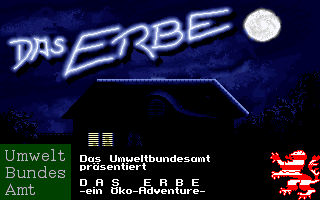
Bringing back the ad in adventure (1): Das Erbe

I still haven't quite mustered the strength to continue my series on ancient RPGs from Japan, so here's something completely different, something that's closer to home for me.

For my country having been the number one consumer of point-and-click adventure games practically since the genre existed, I've always wondered why there were hardly any adventure games made in Germany during the '90s, as the industry only really seemed to pick up on developing them long after the stream of new titles from the US had dried up. I understand there had been a healthy text adventure scene in the C64-days, and a handful of first person adventures, but the only traditional LucasArts/Sierra style games I knew of were Chewy: Esc from F5 and Imperium Romanum (the latter seems to have never been released in English, as far as I know).

But it turns out I was wrong all the time. In actuality, there's a ton of German-developed point-and-click adventures from that era, and I even had played a lot of them back in the day, but I just blanked them out off my radar, because mentioning them almost seems like a dirty word: They're advertisement games! Commisioned by private companies or public institutions, they solely exist to sell goods or ideas. Almost all of them are quite short, but a few are actually not all that bad. So I wanted to take a closer look at some of them.
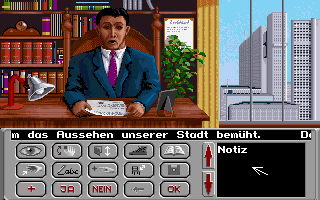
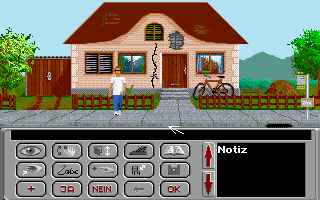
Das Erbe - Amiga, IBM PC (1991)

Das Erbe ("The Heritage") was actually the first point & click adventure game I ever played, on a friend's Amiga (all the screenshots here are from the IBM PC version, which has slightly retouched graphics). Commissioned by the German Federal Environmental Agency, it's all about preserving the earth's atmosphere. You play as some dude how inherited a house and three million Deutsche Mark from his late uncle, under the condition that he'd renovate the house without damaging the environment.

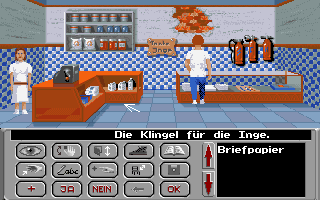
The commands are obviously inspired by the early LucasArts adventures, although the game already uses icons instead of plain text buttons. It's still more inconvenient, though, as hotspot names only appear after clicking on them. The commands are look at, use, open/close, go (has to be selected each time before going somewhere), read (very important and distinguished from look at), take (something out of), write (completely useless cause you only have to write something once, and then it can be done by using the pen with the paper), buy, sit down (useless), and save.
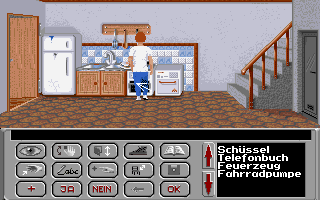
The plus sign in the bottom row actually has to be used to combine items with one another. The syntax is USE [first item] + [second item]. At certain points in the game you will be asked questions that can be answered with Yes or No, which also have two extra buttons, the arrow pointing left is there to delete a command. For example, if you press the "write" button but there's nothing to write on, you cannot go on until you press that arrow. "OK" is used to confirm combining items in the inventory.
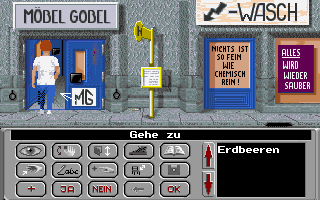
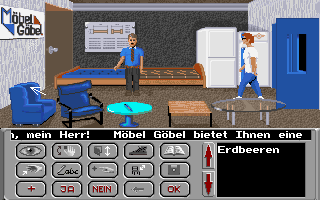
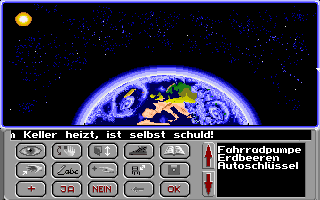
The main task only consists of two major parts. The first one involves getting replacements for all the broken furniture. So you take the bus into the city (apparently you traveled there without a penny in your pocket, so find some money first), and go into the furniture store. It has two models of each type of furniture. The descriptions are always painfully obvious as to which one is better for the environment. If you buy the wrong one, you see an animation of the earth dying, get some error points and have to try again.
You also need a fire extinguisher from the general store. If you try to "USE" the cashier, she says "Maybe later, boy."
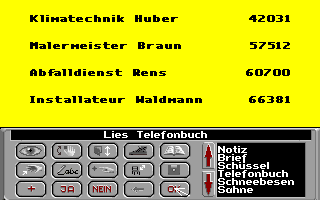
Then comes the actual work on the house, which of course you don't do yourself. You just have to find a phone book in a drawer, then call all the different workers to get the house painted, isolated, the boiler replaced, the broken furniture removed, and the water tap repaired. All the calls just boil down to someone asking you "DO YOU WANT TO DESTROY THE PLANET OR NOT?"
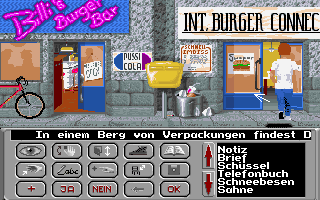
If all this is done, you can write a letter to the Environmental Agency (the paper has to be bought, the stamp can be found under the bell in the general store). But in order to do that, you first have to get your bike in working order by finding the key to its lock and an air pump for the tire. Next to the post box are two fast food restaurants, which are useless, but the international chain is also bad for the environment, so stay out of it.
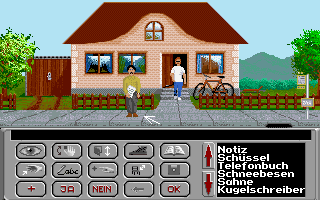
Sending the letter makes a friendly man arrive in front of the fixed house and hand you the environmental ceertificate. You get 3 million, the end.
But wait! There is actually a side quest that's much more interesting than the main task: In the living room you can find a picture of a girl, on the back it has her phone number and introduces her as your uncles stepdaughter LOLITA, so the guy immediately decides he has to date her (creepy, yes). Up in the sleeping room/home office in the attic is the phone. When calling her, she says she wants to meet you and she wants you to prepare her strawberries with cream.
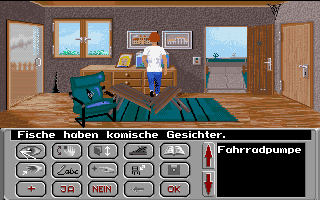
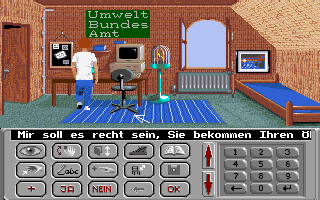
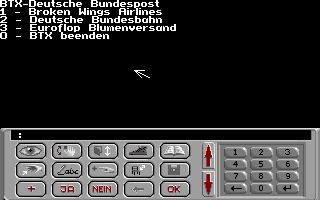
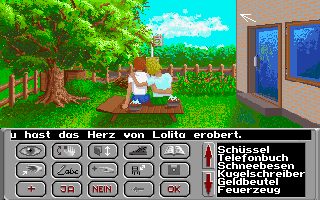
Strawberries you can find in the garden, cream has to be bought in the general store. You cannot buy the canned cream because of the gas, but fortunately there's an eggbeater and a bowl available in the kitchen. Then you have to use the computer upstairs (after connecting the keyboard, puzzle yeah), order flowers and buy your train ticket online(!) to her home. (Oddly, if you succeed in meeting her, you see the two of you sitting arm in arm in YOUR garden.)
Das Erbe has a number of amusing WTF-grade death scenes:
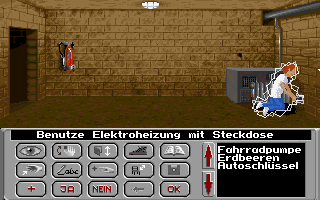
There's an electric heater in the cellar, which you can plug in. To teach you ho wrong it is to heat a cellar, the game kills you with an electric discharge.
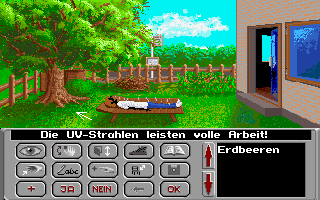
If you lie on the lounger in the garden, the sun roasts and kills you. Ouch!

Also in the garden, you can try to burn a pile of leaves with a lighter, with cruel results:
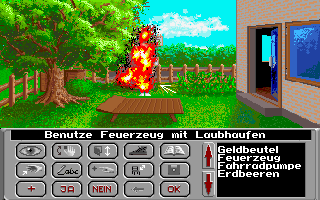
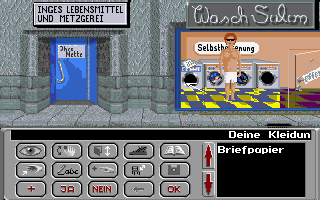
The safe way to get rid of it is a hardly visible box for compost behind the tree. I don't actually know if you have to remove it (might be necessary for the romance side quest), but if you do your clothes get dirty and you have to go a laundry room in town. The guy then just takes off his clothes at the location to wash them.
Overall, Das Erbe is a neat little adventure, although its message can be a bit too blunt and the solutions all too obvious. The only real obstacles in the main quest is finding the stamp. There's also a sequel called Das Schmutzige Erbe ("The Dirty Heritage"), but apparently it wasn't very good, and by the time it came out overshadowed by better advertisement adventures.

Thanks go to the German blog Werbespiel-Archiv, for preserving and cataloging these adgames. It also has the German DOS version for download. And you can take a look at the sequel there.


Monday, August 26, 2013

Update 8/26 - Leisure Suit Larry, Yatagarasu, 7up: Spot, Spinmaster / Dashin' Desperadoes, X-Multiply

We're heading this update with a revamp of the Leisure Suit Larry article. Why? First off, we've added a review of the recent remake, Leisure Suit Larry Reloaded. Second, one of our readers, Starscream, discovered that Softporn Adventure, the text adventure that has inspired the Larry games, was actually ported to Japanese computers, renamed Las Vegas, and given completely new graphics. This article has several comparison shots between these four version: Las Vegas, the EGA Larry 1, the VGA Larry 1, and the HD Larry Reloaded. Additionally, since we dug out Leisure Suit Larry, I decided to post the review for the two Les Manley games, which were fairly shameless Larry ripoffs from Accolade.

Spot, the 7up mascot, was a star of a number of games back in the 90s. While he was first tacked onto a puzzle game, he later game into his own with the fairly decent platformer Cool Spot, which was followed up by the isometric scroller Spot Goes to Hollywood. Yatagarasu is a doujin 3D fighting game developed by some SNK vets, which was recently revealed to be ported to the Vita at some time in the future. X-Multiply is a freaky shooter from Irem, where you fly a miniaturized ship into an infested human body, and has close ties to the R-Type series. Spinmaster and Dashin Desperadoes are a pair of platformers developed by Data East starring two cowboys; the former is a decent action game for the Neo Geo, while the later is a unique split-screen on-foot racing game for the Genesis. And the latest iOS Shooter article covers Astro Bang, Occurro!, geoFighter: Light Wars, Arodius (one of the few such shooters that takes a note out of Otomedius and stacks it with scantily clad women), and Shape Shooter.


Thursday, August 22, 2013

Indie game review: Yatagarasu


So this week we needed a bit more than 500 words for our indie game review. Yatagarasu has recently had a successful crowdfunding campaign for its next major update, which was reason enough for us to take a look at the game in its current state, which is soon also coming to PSVita as Legend of Raven

Monday, August 19, 2013

When was the last time you checked out our Tracing the Influence article?


Those of you who don't follow the forums might not know that thanks to frequent contributions from the community, our collection of stolen images in games is growing bigger and bigger over time. It may well be twice the size than when it was first posted, with a lot of new stuff added even today, so it'll probably be worth another look if you haven't seen it in a while. Just click here: Tracing the Influence: Stolen Images in Games