Showing posts with label Germany. Show all posts

Wednesday, September 29, 2010

Telespiele


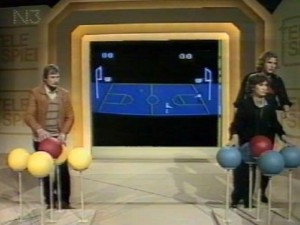
This is Thomas Gottschalk, one of the greatest German entertainers and host of "Wetten Dass..?" (Wanna bet..?). His show where (mostly high profile) celebreties bet on or against ordinary people with crazy propositions (recognize sausage brands by the taste of the can water, put a truck on beer bottles, rip phone books in half, etc.) with entertaining wagers has been extremely successful for decades (among the highest quotes in Europe).

So why is the guy on this blog? If you look closely at the picture, you'll notice in the background the repeating caption "Telespiele". That's what we called video games in the 70s, and that's how Germany's first interactive video game show was called.

Sadly, there is no(?) video footage of this show to be found on the web, and it aired before my time, so all I know is from online sources (listing the more useful ones below). Apparently Telespiele was Gottschalk's first "bigger" success after a young radio career and a number of mostly regional TV music programmes.


Telespiele was broadcasted for the first time on November 11th, 1977. The concept was based on an interesting idea by station technician Erhard Möller - he modified the Pong home video game to be controlled by noise instead of controllers. Loud noise would make the bat go up, a lower voice resulted in the opposite. Under Gottschalk's moderation, Pong was played in two variants: The first pitted calling candidates against each other, who screamed into their phones for victory. There was also a pure studio variant, however, where a single guest in a soundproof booth had to battle the whole audience armed with noisemakers.


Later they added more games, pictures show Pacman controlled with a bumper-car thingie and basketball controlled by moving actual balls. But apparently there were also racing games on fake motorbikes and other stuff we mostly know from 80's arcades.


Celebreties were also often invited to play games against each other, although Gottschalk didn't yet get the big hollywood stars he welcomes nowadays in Wetten dass..?, of course, but there were some fairly big names in Europe, like Roger Whittaker and Bud Spencer. The winner got to chose a music clip (mostly live recordings from the station's archive, that was before music videos became big, after all).

Maybe thanks to those guests and Gottschalk's show talent, Telespiele was incredibly more successful as one would imagine from a show based on video games nowadays. Started on the regional Südwestfunk, it moved to the nationwide public station ARD in 1981, reaching quotes up to 40 percent. Yet the end came already the same year, as the key staff involved with the show switched stations and went on with new programmes.


The concept for the show was sold to the UK, Netherlands and France, but I couldn't find out if it resulted to any actual shows there. I'm also interested if there's any shows in the US that predates it, or if this was indeed the first interactive video game show ever. Please comment if you know anything comparable from that time.


Sources (in German):
http://einestages.spiegel.de/static/topicalbumbackground/2933/pling_plong_gottschalk.html
http://www.gameshowkult.de/telesp.htm

Friday, September 10, 2010

Computer-Spiele


Took me a while to get to the second book...


Sopart's book is much lighter on the gaming strategies part, but of course it has to deal with a much broader market than Video Spiele covered two years before. The book not only introduces a big number of home computers, which had by then taken control of the market, but also consoles, LCD handhelds, "Mini Arcade" tabletops, even chess computers and the like.

While Videospiele gave me the impression that it was aimed at "gamers", Sopart has to spend 7 pages explaining "How he computer plays with humans".

Strictly speaking, computers are not ideal playfellows. From their makeup they bring neither intelligence nor flexibility, which are requirements for a good playfellows. But how could these devices became partners more demanding from the player than a human counterpart?


Picture with the funny caption "game for two", while the screen and the boxes above clearly show office applications.

Sadly, a lot of space is wasted with manual-like descriptions of stuff, but there are a few interesting points that kept being issues for many more years or even decades. So there's the reoccuring complaint about crappy boxes, evaluating plastic clamshells similar to VHS boxes (the winner here) vs instable cardboard boxes. Anyone who thought pro-gaming was a recent phenomenon is put into place by this argument in the joystick buyer guide: "Passionate gamers will be glad to hear that there are even joysticks that ship with interchangeable handles. Slowly, the industry is becoming more active for professionals."


Kinda defeats the purpose of a "wireless" controller, doesn't it?


From the chapter "Pictographs or cinema quality?":

You know them from so many images: The famous computer people. They are pictographs, stylized depictions. Computer games are still identified with pictographs. (...) Why?

Especially with the transition from pictographs to almost realistic figures [don't forget: this is 1984!] it becomes visible, how quickly computer games have developed [yes, perfect tense].

(...) Some of the things we get to see on our screens nowadays really almost look like movies [talking about home computers, so probably not even meaning Dragon's Lair. As it goes on:]

What does that mean for the computer gamer? He should know that these pictographs actually already belong into the realm of history, even if they're sometimes still sold.


And, most interestingly for retro gamers:

Game cassettes with pictograph-esque visualizations could, as scene insiders assume, become bestellers again already in a few years - as computer antiquity. For that one has to recognize, that we're still living in the beginning days of the computer industry, and thus also of computer games. In few years we will experience the same effect as with shellac records. Those classics from the founding years of the music industry are now en vogue. (...)

A similar phenomenon could soon become evident with computer games. Therefore, it is advisable to archive old games that don't satisfy the desired standards and quality today. This not only under an economic aspect (...), but also under consideration do be able to get a "notalgic effect" out of them in a couple of years.


On "war games":

There is no doubt: The bad reputation of computer games in some social strata is mostly due to the games, that contain elements of war. But there are differences world wide. In the USA war games are less strictly rejected by most of the population than in Europe and particularly in the Federal Republic [of Germany]. Yes, one could even say in the USA a greater group developed into downright fans of these kind of games. The special situation in Europe and most of all in Germany resulted from the experiences from two world wars.


In case you wondered how to get the best high scores:

Whoever wants to become a good or great gamer also has to be an adept with the joystick. So it's necessary to make exercises to strenghten the hand's musculature. Thereby, the hands tightly grasp an item [no, not what you're thinking] - a candle, for example.


"In this posture, you'll hardly achieve maximum performance on screen."


The book even has a chapter on game programming, but it doesn't do much more than listing a number of basic Basic commands...

Monday, September 6, 2010

Study the past to learn about the present.


Digging deeper into the history of non-English video game journalism, today we're unearthing two of the oldest German monographs that deal with our favourite hobby.

Peer & Ulrich Blumenschein co-wrote Videospiele in 1982. The team of father and son made sure that the book was written well (Ulrich Blumenschein had worked for rennomated magazines such as Spiegel and Stern) but also knew what it was talking about. I only recently found this book when I decided to write about the other one ...

... Computerspiele, by Christa-Maria Sopart. This is from 1984, but I got it sometime during the early 90's at a bargain bin for 1 Deutsche Mark.

It's astonishing to see the many aspects where we've come an incredibly long way during the last thirty years, and even more astonishing to see how some things never change.


Videospiele was focused on Arcade games and home console, and understood itself mostly as a playing and buying guide. Even the introduction sounds like an economy advisor:

Gratulations ...

... dear reader! The few bucks you've spent for this paperback volume are well invested. For if you use these guide properly, you can save more than the price of the book in a short time. That applies to the young Arcade-Freak as the family dad, who plans to buy a video game console for home use or even a new cassette for his son.


So after ten pages of video game history (interesting how the book already saw the decline of the American industry in favor of the Japanese) it goes on with strategies for the most popular arcade games at the time. Today this section mostly delivers entertaining value for the German paraphrases to the English game titles and a few funny drawings of game scenes. A few examples:

Asteroids: Gefährliche Reise durch den Raum (Dangerous Journey Through Space)

Galaxian: Überleben is alles (Surviving Is Everything)

Defender: Entführungsdrama auf dem Planeten X (Abduchtion Drama On Planet X)

Berzerk: Der üble Otto (The Evil Otto)

Phoenix: Hitchcock im Weltall (Hitchcock in Space)

Donkey Kong: Der Affe und die Jungfrau (The Ape and the Virgin)


Oh, and not to forget the Seven Golden Rules of arcade gaming (These have longer text explaing the rules, I'm only translating the catchphrases):

Rule No. 1: Select a game that appeals to you and that still gives you joy after a few test rounds - and specialize to that game!

Rule No. 2: Assemble your own list of Questions while watching others play, and don't stop watching until it seems you've answered all your particular questions!

Rule No. 3: Examine the machine before you start! [this warns of inferior rip-offs with similar titles and the condition of the conrols]

Rule No. 4: Training brings Score!

Rule No. 5: Let others help you, when you can't cope with a difficult situation in your game.

Rule No. 6: Concentrate while playing!

Rule No. 7: Keep cool while playing!


After that follows a comparison of the four consoles available in Germany at the time and their games - Atari VCS, Intellivision, Phillips Videopac Computer G7000 (that's what the Odyssey II was called here) and the German console, Interton Electronic Video Computer VC 4000. It seems the latter was already out-of-date by the time the book was published, as it is rather neglected. There's no picture of the hardware, and no single screenshot of any game (only one picture of a game box).


For each available game there's a review, if you want to call it that, with a description of the game's mechanics, a sentence about "What caught our attention" and two scores, Spielwert (Game Value) and Gesamturteil (Overall Assessment), of which I don't quite get what's the difference, although the latter is sometimes one point below the former. The unit are once again german school grades.

"What caught our attention" is once again good for chuckles:

"Once again Atari didn't even manage to find an understandable German title for the game." Yars' Revenge (Die Rache der Superfliege)

"The spookhouse can be really frightening, you shouldn't give it to your kids in the evening." Haunted House (Das Spukhaus)


Not so scary: Haunted House

"Simple as Pong. The coloring is very nice." Super Breakout

"You'll need strong nerves." Astrosmash

"It pays to win; the explosion of the enemy battlestar is worth to see and hear." Star Strike

"When playing for a long time, the trigger finger starts to hurt." Weltraum-Armada

"If it wasn't only three field players per team, the illusion would be perfect" Fußball

"Funny how the spectators turn their heads after the ball." Tennis

"Not suited for a small screen. Only with 60-cm color TV are the details on the map overview properly recognizable." Flotteneinsatz (Sea Battle)

"Pong in 2D" Tennis


Interesting in a historical sense is an article on the future of video games, surprisingly cautious with wild speculations, but rather focusing on technologies that were in development at the time or new trends in the US, mentioned are talkie peripherals and Subroc-3D, the first "real" 3D arcade game based on similar technology as we know from the Virtual Boy. On the rise of independent developers (here meaning not what we call indie games today, but 3rd party developers like Activision):

For the video gamer this are of course great perspectives. He can more and more feel like the reader [of books], who is able to read any book with only one pair of glasses. Or with other words: he isn't pressed for a decision between this or that hardware system when buying his basic equipment.


But of course there also had to be:

It seems we are not far from laser light to create spatial images (Holograms) or language controlled computers in Telegames, anymore.


An early announcement for ET the game?
Atari has already teamed up with Steven Spielberg, the man who raised the science fiction film to a new level with his "Star Wars" series (sic!) and [Spielberg] made a contract with Lucasfilm Ltd., the best special effects studio in the world, which created the phantastic scenes for films like "Star Trek II", "Poltergeist" and "ET". Goal of the cooperation is to create novel Video-Games, that appear like a movie at the cinema, with life-like characters in realistic surroundings.


(Almost) at the end of the book stands the eternal question: "Video Games - A danger for young people?"

Question: Are video games addicting?

Answer: (...) Of course there are gamers that overdo it.
One could compare them to buyers of season tickets to the Fußballbundesliga [premiere league of soccer]. No one accuses them of any addiction.

(...)

Question: Shouldn't the young arcade machine fans spend their money for better things?

Answer: (...) There are many temptations in our sparkling, pluralistic world. Cigarettes. Bubble Gum. Pot ... video games seem to be a lesser evil here.

(...)

[after an answer mentioning the learning effects of video games]
Frage: I hope this learning effect doesn't apply to those "War Games"?

Answer: Whether anyone plays "War" is first of all a question of good taste. Parents should definitely make sure not to draw in again that kind of war toys through the back door that has long been banned and disappeared in other places. Program cassettes like "Blowing up dams" are certainly not suited as gifts for a child's birthday or christmas.


Yeah, Germany had/has a rather troubled relationship with the topic "war".

The video game companies are well-advised to follow the example of Mattel Electronics, who didn't even bring a game with the title "B-17 Bomber", that's freely available for home use in the US, to the german market. The task in this game consists of flying bombing attacks on a mass of land that clearly recognizably shows the shape and characteristics of Europe.


By the way the definition for "War Games" by the federal ministry of youth, family and healthcare quoted in the book is: "Entertainment games without profit opportunity [not sure how to translate that, it means no gambling], with which cruelty or acts of war are depicted or where technical appliances are used to simulate bursts [meaning lightguns]."


When watching and questioning real Arcade-Freaks in Hamburg or Munich, it quickly becomes evident that in case they should encounter a green man of Mars on the street after leaving their Arcade, they'd prefer to go have a beer with him instead of putting him down with a laser gun (where to get such a thing, anyway).


Oh, this is getting really long, and it's getting really late. Going to bed now, there'll be a closer look at Sopart's book in a few days ...


Atari Advertisement


Wednesday, August 25, 2010

Old German game mags (2)


The Video Games was Germany's first game magazine dedicated to consoles in the modern sense, with reviews, previews, etc. It started in early 1991 as a special issue of the home computer & PC magazine Power Play, which itself originated in the not games focused Happy Computer, but like it's mother mag, soon evolved into an independent publication, first quarterly, but from 1992 onwards monthly.


Hurray, in fall 1992, we Germans finally officially got the SNES.


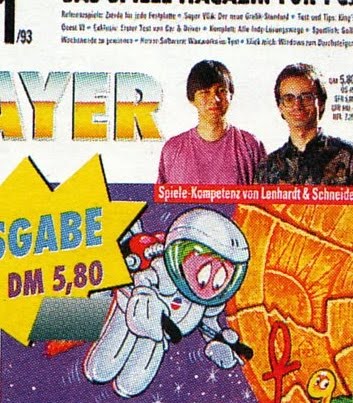
A look at the editorial staff in early 1992. Replace Stephan Englhardt with Heinrich Lenhard and you got all the big names for the early years of German games journalism on one page. Compared to today, there was almost kind of a personal cult around some of those. Imagine a games magazine that advertises its writers with their pictures on the cover, as the first few issues of the magazine PC Player did:


"Games competence by Lenhard & Schneider"

Some of those pioneers are still well known today. Winnie Forster founded Gameplan and publishes encyclopedic books (I think only the Encyclopedia of Game Machines is available in English, but there's also a volume entirely dedicated to game controllers and a company/developer encyclopedia in German). The first book went to its third edition by now.

Boris Schneider (now Boris Schneider-Johne) is also responsible for what might be the first fan translation ever, with his German hack of the C64 adventure Murder on the Mississippi (now there's a bit of trivia to update your translation article with, Sketcz). Afterwards he got hired by Lucasfilm games for their early games (from Maniac Mansion to Fate of Atlantis). Today he's the Xbox product manager for Microsoft Germany.

Julian Eggebrecht of course is (was? I'm not up-do-date what happened after the US "branch" went out of business) one of the leading figures at Factor 5, Heinrich Lenhard founded about half of Germany's computer game magazines in the 80's and early 90's, and later also moved to the US and became correspondent for some of them.


When working with Korean game magazines during the first half of this year, I often chuckled at the many typos for English game titles, but revisiting my early Video Games issues, I was put into perspective quickly. Behold the review of Sol-Deace (EDIT: Oh, turns out the Genesis version of Sol-Feace was actually really titled as such. But the other examples below are still legit and not the only ones).


In another issue I thought for a moment that I had found a mention of a forgotten unreleased game called "Makros", until after a few lines later they wrote the full title "Makros 2036". But worst was "Twinckle Tales", directly below the big, fat logo showing the correct spelling.

Looking back, some of the review verdicts are also hard to comprehend nowadays. Many titles now widely acknowledged as timeless classics got fairly low scores, sometimes with pretty weird reasoning. Interesting was their three-component genre categorization, though. So as you can see below, Quantum Fighter is an Action Platformer with more weight on the platforming (the actual category was "dexterity games", though, so it wasn't necessary for any platforming to be involved).


Sprite of the Month. It might seem now that I'm obscessing with Chun Li, but really, my sources are.


What's that? Didn't remember this ad at all.


Neither did I remember Hudson's 32 bit console prototype. Btw., the mag dedicated a news page to every console manufacturer, titling each of them with an alliteration ("Engine Events", "Sega Special", "Nintendo News", etc.)


Ad for Laguna, a big-ish independent German publisher of Nintendo games. Of the SNES games I own, Breath of Fire II, Soul Blazer, Lord of the Rings and Shadowrun are Laguna published. I remember calling Nintendo's game help hotline and not getting any help with Breath of Fire II. ("That game doesn't exist.")


WTF!? Comic strip in a feature about adult themes in games, originally from Famitsu ('twas Famicom Tsushin back then, right?).


Afterwards I kinda lost sight of the Video Games and only started buying it again regularly at Dreamcast times, when it looked like this:


Video Games was then discontinued in early 2001 (the millenium years 1999-2001 weren't very good to germany's old game mags overall. IIRC, the only early 90's-mag that survived this period was the Man!ac, now renamed just M!)


Before closing this post, I've two questions about games I've rediscovered here:


The caption identifies this game as "Chakan". The Chakan I know is very different, which game is actually shown on the screenshot?


Then there was a preview about Plugsy, Psygnosis' would-be first console only title. I couldn't find any references whatsoever about this game on the web. Is it unreleased, or did it end up with another title?


I should also link to Kultpower.de, a great ressource for many of the old German mags, even with full scans of some issues.

Thursday, August 5, 2010

Old German Game mags (1)

So I'm back in Germany for now and digging through my own old magazines. Here's what was my most favourite game mag during the mid-90's (it was published from 1993 to 2000). UK readers might recognize the name, as it was licensed from a british mag. I'm talking about the Nintendo-only mag Total! It wasn't a translated mag, though, but had its own editorial stuff and content.


The second annyversary issue was the first one I bought myself, the first two years I used to read my cousin's copies.


Early preview of Street Fighter Alpha, then with the working title Street Fighter Legends. Screenshots are of course from the arcade version, back then I couldn't believe how good the background in the lower screenshot looked.


Julian Eggebrecht of Factor 5 used to be a freelancer for the mag. They also were pretty good for reports on import games, as they later got a Japanese freelancer (who was later employed at Squaresoft for localizations, I think). Only their viewpoint was a bit European-centered in hindsight, one time they called Seiken Densetsu Squaresoft's most important series (the only Final Fantasy game being released in Europe by then was Final Fantasy Mystic Quest). I think they were also among the first in Germany to include decent Anime coverage.


Review of Super Turrican 2 (not reviewed by Eggebrecht ;) ). Games were ranked in German school grades (1 being best and 6 being worst).


I think not many people have this issue. The old publishing house went bancrupt by the end of 1995, so issue 12/1995 never came out. The staff didn't give up, though, but founded their own publishing house (Xplain Verlag) after wrangling for the licensing right for a month. So everyone thought the mag was gone, and no one expected it to resurface it with issue 1/1996. I saw it by chance and of course bought it immediately. But only a few days after it came out, someone went out of their way to file a cease and desist order because of the Mortal Kombat logo on the cover. Mortal Kombat 2 was completely banned in Germany (not the regular no-advertisement and only sell to over-18 regulation, but actually criminally punishable prohibited. IIRC, MK 2 was the first game without Nazi symbols or open racism ever to be "graced" by a complete ban). No one bothered to notice that the logo was actually from the movie, which was rated 16-and-up, nor that the magazine had printed the Mortal Kombat 3 logo before without any problems. So as a result, the issue disappeared from shelves quickly, and may be the rarest next to the first issue.


They also offered newsletters via pagers. It's the 90's, baby!


The exclusive comic strip was discontinued with the change of publishing houses, sadly.


In later years with the SNES discontinued and little to report on the disappointing N64, the team found other ways to fill their pages, like with this kind of photo stories. Thanks to stuff like this, Total! is still the game mag many people in Germany have the fondest memories about.


By far the most interesting anecdote in the history of the mag has to be the Nasty Zone "scandal". Another mag had printed a non-existing game in their release schedule list, which reappeared in a Total! list. The problem was: Neither the game, nor the alleged developer "Haip" ever existed. The (already not very popular, later hated by some) editor in chief of that mag immediately blamed the Total! of copying "stealing" information from his publication, he was quoted saying "I thought the xx or the yy would fall for this, but I never imagined the Total! would be so stupid." and that he suspected "for a long time" that someone was stealing from his mag.

The would-be game was called Nasty Zone (after the mag where it first was listed, N-Zone) by the nonexistent company Haip (after the Editor in chief's name, Hans Ippisch).

The Total! made an honest apology for the fauxpas of not double-checking their research and promised to stick to reliable sources in the future, but also made fun of the whole Incident, even showing fake screenshots of the "game":


Research in 'reliable sources' is the nuts and bolts in our job. On the right picture you can see how our technically far advanced video game mag production machine (TOTAL-o-matic) processes hard facts within seconds.

(the mag on the copier is an issue of the N-Zone, below is the Total!)


Nasty Zone - Mega-Hype around stillbirth

Rarely has been made such a turmoil about a game hardly anyone even got to see a single pixel of. As usual, we have researched fiercly to present exclusively the very first images of Nasty Zone, which sadly inspire little hope for a decent title. In the interest of all honest N64-owners we convinced the development team to cease work on the project and do something more meaningful with their time.


Monday, May 17, 2010

Some recent and upcoming Adventure games from Germany


The adventure Genre by now has officially risen from the dead, at least in Europe, and as Hardcore Gaming 101 has become adventure central to some degree during the last year or so, here are a few promising titles from my home country. I don't know if there's much coverage of some of those games in the English speaking world, I hope this post isn't all too redundant.


Black Mirror 2

Germany has always been a rather strong market for adventure games, ever since back in the good old Lucasarts/Sierra days, but the lively development activity nowadays only roots back a few years, mostly. Black Mirror was originally developed by the Czech studio Unknown Identity (adventures are also big in Eastern Europe), but was particularly well received in Germany during the big adventure draught in the early 2000's, although it doesn't quite hold up today. While Unknown Identity delivered many mediocre games after Black Mirror, somehow the rights for the IP ended up with German publisher dtp, who assigned Cranberry Studios with the development of the sequel.


The game takes place 12 years after Black Mirror 1, the player takes the role of a student of physics. The story seems at first unrelated, but there many ties become evident later, as the hero visits locations from the first game.


There are some questionable mini games and death scenes (but the game offers instant restart at a point immediately before the fatal mistake), but the puzzles are said to be executed well, and the main characters quite believably written.

Black Mirror has been released in the United Kingdom earlier this month. An US version isn't in the picture, I think.


Goin' Downtown

This has been actually released in Germany in 2008, but there stil l doesn't seem to be an English version around, correct me if I'm wrong. The game takes place in the Orwellian future of 2072. The writing is kinda meh (although that could maybe be corrected by a good localization...), but the game looks awesome. Characters that hold no importance to the player and the story are displayed as mere gray silhouettes, which is an interesting concept, I'd say, symbolizing the grade of anonymity and de-individualization in the dystopic setting.


A New Beginning

Seen in the first image above. Now we're reaching TBA territory, even for domestic releases. The new game by the studio behind The Whispered World (released in the US recently) and Edna & Harvey: The Breakout (I think scheduled for an US release sometime this year) is the one I'm looking forward to the most.


The Whispered World


Edna & Harvey: The Breakout

It is called and "Ecology-Thriller" by the developers. In the year 2500, earth is pretty much messed up by the breakdown of the climate, but a team is sent back through time traveling to prevent the worst. Like the Whispered World (though in a different style), the game features some breathtakingly gorgeous artwork, and is even supposed to support 3D shutter glasses, going with the current trend. The game is supposed to come out in Germany around christmas 2010.


Lost Horizon


After ripping off Broken Sword with their Secret Files series, Deep Silver go back to the roots, taking their inspiration by Indiana Jones and the early 20th century adventure genre the Spielberg-Lucas movie was based on. The hero looks like a stock 21st century hollywood shitface, but the scenario sounds awesome: Nazis, Triads, Tibetan treasures, is there anything more to wish for?


The biggest weakness of the Secret Files games was their dry, genre-savvy humor, if Deep Silver is able to work that out (the scenario seems a little less inviting for that kind of stuff, so I've got hopes), this can turn out a real hit. As it's done by the Secret Files guys, it can only be a matter of time until this gets translated into English.


There's much more coming up (and recently released), of course, but those are the ones I'd deem most interesting at the moment.